第14章パクス・モンゴリカ――モンゴルの草原帝国Pax Mongolica: The Steppe Empire of the Mongols
Section Summaryこの節のまとめ
Chinggis Khan ruled the Mongol Empire for twenty-one years. In that time, he established a law code, the yassa, that he hoped would allow his seminomadic people to live in harmony. He saw the people living in settled areas, such as the Xi Xia, Jin, and Khwarazmians, as a source of wealth and tribute. The empire changed enormously during Chinggis Khan’s reign, becoming more inwardly peaceful but also much more materialistic in its tastes. The military changed as well, becoming a sophisticated war machine capable of surprise attacks and deadly sieges.
英語のヒント
チンギス・カンは21年間、モンゴル帝国を治めた。その間にヤサという法体系を設け、半遊牧の民が調和して暮らせることを願った。西夏、金、ホラズムのような定住地域の人々を、富と貢納の源とみなした。彼の治世に帝国は大きく変わり、内部はより平和になったが、物質的な豊かさへの欲求は、はるかに強まった。軍も変わり、奇襲や破壊的な包囲戦を行える、洗練された戦争機械となった。
Chinggis Khan’s son Ogedei steered the empire toward his father’s vision of a united people, overseeing a peaceful Eurasia-wide exchange of goods and collection of taxes, and he expanded the empire to make it happen. Equally important, Ogedei undertook the development of the bureaucracy and infrastructure necessary to support trade on a large scale. Due to Ogedei’s lack of foresight in planning for succession, however, the reign of Chinggis Khan’s grandson Mongke marked the end of a united Mongol Empire. When Mongke’s brother Kublai succeeded him as great khan, the empire was beginning to divide into those who preferred the old nomadic ways and those who had adopted a settled lifestyle of wealth and trade.
英語のヒント
チンギス・カンの息子オゴデイは、人々を一つにまとめ、ユーラシア全体で物品を平和に交換し、税を徴収するという父の構想へ、帝国の舵を取った。その実現のため、領土を広げた。同じくらい重要なのは、大規模な交易を支える官僚組織と基盤施設を整備したことだった。しかしオゴデイに後継計画の先見性が欠けていたため、チンギスの孫モンケの治世は、統一帝国の終わりを告げる時期となった。モンケの弟クビライが大カンを継いだとき、帝国は、昔の遊牧生活を好む人々と、富と交易を伴う定住生活を取り入れた人々へ、分かれ始めていた。
Review Questions復習問題
- to reinforce the objectification of women
- to force all Mongols to worship Tengri
- to remove sources of conflict and strife among Mongols
- to make the Mongolian economy self-sufficient
- 女性を物として扱うことを強める。
- すべてのモンゴル人にテングリ崇拝を強いる。
- モンゴル人の間の対立や争いの原因を取り除く。
- モンゴル経済を自給自足にする。
- Chinggis Khan
- Mongke
- Hulagu
- Ogedei
- チンギス・カン
- モンケ
- フレグ
- オゴデイ
- a medallion carried by Mongol government officials to identify them as under the great khan’s protection
- Chinggis Khan’s law code
- rest areas that provided lodging, supplies, and fresh horses for those on official business
- a proto-democratic gathering of a Mongol leader’s followers to reach agreement on major political decisions
- モンゴルの役人が大カンの保護下にあることを示すため携帯した牌符
- チンギス・カンの法体系
- 公務の旅人へ宿泊、物資、新しい馬を提供した休息所
- 重要な政治的決定について合意するため、モンゴルの指導者の支持者が集まる、初歩的な民主性を備えた会議
- because he conquered the Abbassid Caliphate
- because his challenge to Kublai ended the unity of the Mongol Empire
- because he conquered Song China
- because he succeeded Chinggis Khan
- アッバース朝を征服したから。
- クビライへの挑戦が、モンゴル帝国の統一を終わらせたから。
- 宋を征服したから。
- チンギス・カンの後を継いだから。
Check Your Understanding Questions理解を確かめる問題
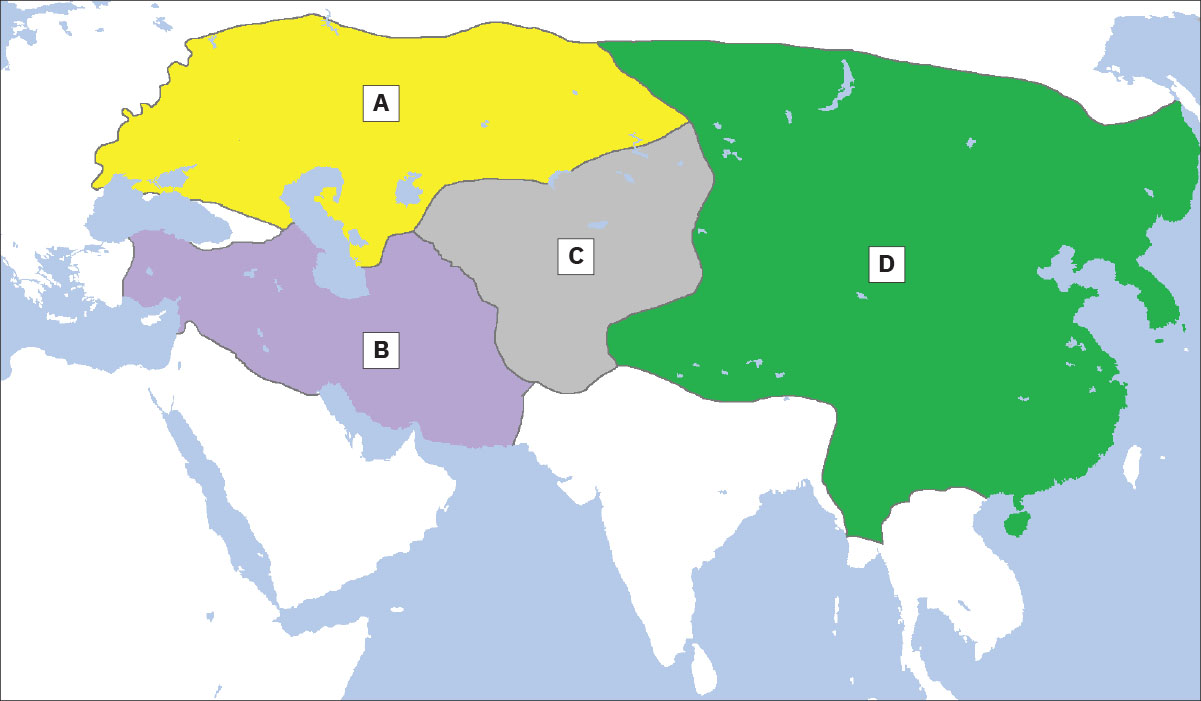
(credit: modification of work "Map of the Mongol Empire c. 1300, after its four subdivisions" by "Gabagool"/Wikimedia Commons, CC BY 3.0) · CC BY 3.0
Application and Reflection Questions応用と考察の問題
Golden Horde
ジョチ・ウルス(黄金のオルド)
the Mongol group that ruled over portions of central Asia, the former lands of the Rus, and northwest Asia
中央アジアの一部、かつてのルーシの土地、アジア北西部を支配したモンゴルの集団。
kurultai
クリルタイ
a proto-democratic gathering of a Mongol leader’s followers, called to reach agreement on major political decisions
重要な政治的決定について合意するために招集される、モンゴルの指導者の支持者たちの、初歩的な民主性を備えた会議。
yam
ジャム(駅伝施設)
horse relay stations established by Chinggis Khan for long-distance communication on military campaigns; they were later expanded into rest areas and supply depots
軍事遠征中の長距離通信のため、チンギス・カンが設けた馬の継ぎ替え施設。のちに休息所と物資の集積所へ拡張された。
yassa
ヤサ
Chinggis Khan’s law code, designed to eliminate the sources of conflict in steppe society and bring harmony to his people
草原社会の対立の原因を取り除き、民に調和をもたらすため、チンギス・カンが定めた法体系。