第14章パクス・モンゴリカ――モンゴルの草原帝国Pax Mongolica: The Steppe Empire of the Mongols
14.2 Chinggis Khan and the Early Mongol Empire14.2 チンギス・カンと初期モンゴル帝国
Learning Objectives学習の目標
By the end of this section, you will be able to:
この節を読み終えると、次のことができるようになる。
Describe the new civilization Chinggis Khan created for the Mongols
チンギス・カンがモンゴルの人々のために築いた新しい文明を説明する。
Analyze the trajectory and motivations of the conquests made under Chinggis, Ogedei, and Mongke Khan
チンギス・カン、オゴデイ・カン、モンケ・カンの下で行われた征服の展開と動機を分析する。
Explain the actions Ogedei Khan took to bring about Chinggis Khan’s vision for a Eurasian trading empire
ユーラシアの交易帝国というチンギス・カンの構想を実現するため、オゴデイ・カンが取った行動を説明する。
Identify the obstacles the Mongols faced in their efforts to unify and expand their empire
モンゴルの人々が帝国を統合し拡大しようとするなかで、直面した障害を明らかにする。
With no remaining rivals to Temujin’s rule over the People of the Felt Walls, nothing stood in the way of his vision of a better world for his followers; Chinggis Khan, or “World Leader,” had truly been born. His vision was twofold. On one hand, Chinggis wanted to end the constant strife and warfare that characterized life on the steppe. Despite being a practitioner of violence and warfare, he also wanted to promote the peaceful acquisition of goods. He spent the rest of his life forcefully promoting those objectives, regardless of whether others desired them, with a bloody ruthlessness that seems at odds with those very same goals.
英語のヒント
テムジンによる「フェルトの壁に住む民」の支配には、もはや対抗者がいなかった。支持者によりよい世界をもたらすという構想を妨げるものは、何もなかった。「世界の指導者」チンギス・カンが、まさに誕生したのである。彼の構想には二つの面があった。一つは、草原の暮らしにつきまとっていた、絶え間ない争いと戦争を終わらせることだった。暴力と戦争を自ら行う者でありながら、物品を平和に手に入れることも促そうとした。残りの生涯をかけて、ほかの人々が望むかどうかにかかわらず、それらの目標を力ずくで推し進めた。その血なまぐさい冷酷さは、目標そのものと矛盾するように見える。
The Yassa and Mongol Lifeヤサとモンゴルの暮らし
To allow bitter feelings to subside after years of struggle, Chinggis waited until 1206 to call a kurultai to consolidate and confirm his rule over all Mongols. A kurultai was a meeting of those loyal to the leader of a seminomadic confederation, convened to confirm acceptance of a major change the leader wanted to make in relations within the group or between the group and others. Attendance signaled acceptance, and not attending meant not just disagreement but possibly withdrawal of loyalty to the leader. Temujin’s kurultai was unprecedented in its scale. The Secret History of the Mongols records that nearly all the million or so People of the Felt Walls attended, setting up encampments that spread for miles. Unlike almost all previous coronations in recorded history, Temujin’s was a highly inclusive event, not just for the elites and population of the capital. A shaman proclaimed him Chinggis Khan and confirmed that Tengri, a god revered by many central Asian peoples, granted him authority and would bless his people with prosperity and good fortune as long as he governed wisely and fairly, an idea similar to the Confucian Mandate of Heaven.
英語のヒント
長年の争いが残した苦い感情を鎮めるため、チンギスは1206年まで待ってクリルタイを招集し、すべてのモンゴル人に対する支配を固め、確認した。クリルタイは、半遊牧の連合の指導者に忠誠を誓う人々の会議である。指導者が集団内や他集団との関係に加えようとする大きな変更について、受け入れる意思を確認するために開かれた。出席は賛同を表し、欠席は単なる反対にとどまらず、指導者への忠誠を撤回することを意味する場合もあった。テムジンのクリルタイは、かつてない規模だった。『モンゴル秘史』によれば、約100万人の「フェルトの壁に住む民」のほぼ全員が出席し、何マイルにもわたる宿営地を設けたという。記録に残るそれ以前の戴冠式のほぼすべてと異なり、テムジンの式は、エリートや首都の住民だけに限られず、広く人々を含む催しだった。シャマンが彼をチンギス・カンと宣言した。そして中央アジアの多くの人々があがめる神テングリが、彼に権威を授け、彼が賢く公正に治めるかぎり、民に繁栄と幸運を与えると確認した。これは儒教の天命に似た考えである。
To prevent conflict over succession and maintain the democratic spirit of the kurultai where members had a say in selection, Chinggis Khan decreed that any future great khan, that is, any leader over the entirety of what he began to refer to as the “great Mongol nation” and the superior of all lesser khans, could be chosen only by a kurultai and not familial succession alone. Chinggis Khan now filled the role of clan and tribe leader. He put forth rules known as the yassa to govern relations between households; later, as the empire grew, he ordered the development of a written script for the Mongol language—based on that used by Uyghur tribes from areas north of China and Mongolia—so the yassa and records pertaining to it could be recorded (Figure 14.8).
英語のヒント
チンギス・カンは、後継者争いを防ぎ、構成員が選出に発言権を持つクリルタイの民主的な精神を保とうとした。そのため、今後の大カン、すなわち、彼が「大モンゴル国」と呼び始めた全体を率い、ほかの小カンすべての上に立つ者は、血縁による継承だけではなく、必ずクリルタイで選ばれなければならないと定めた。チンギス・カンは、今や氏族や部族の指導者の役割をも担った。各家の間の関係を治めるため、ヤサと呼ばれる規則を示した。のちに帝国が大きくなると、ヤサとそれに関する記録を書き留められるよう、中国とモンゴルの北の地域のウイグルの部族が使う文字を基に、モンゴル語の文字を整備するよう命じた(図14.8)。
Chinggis Khan.チンギス・カン。
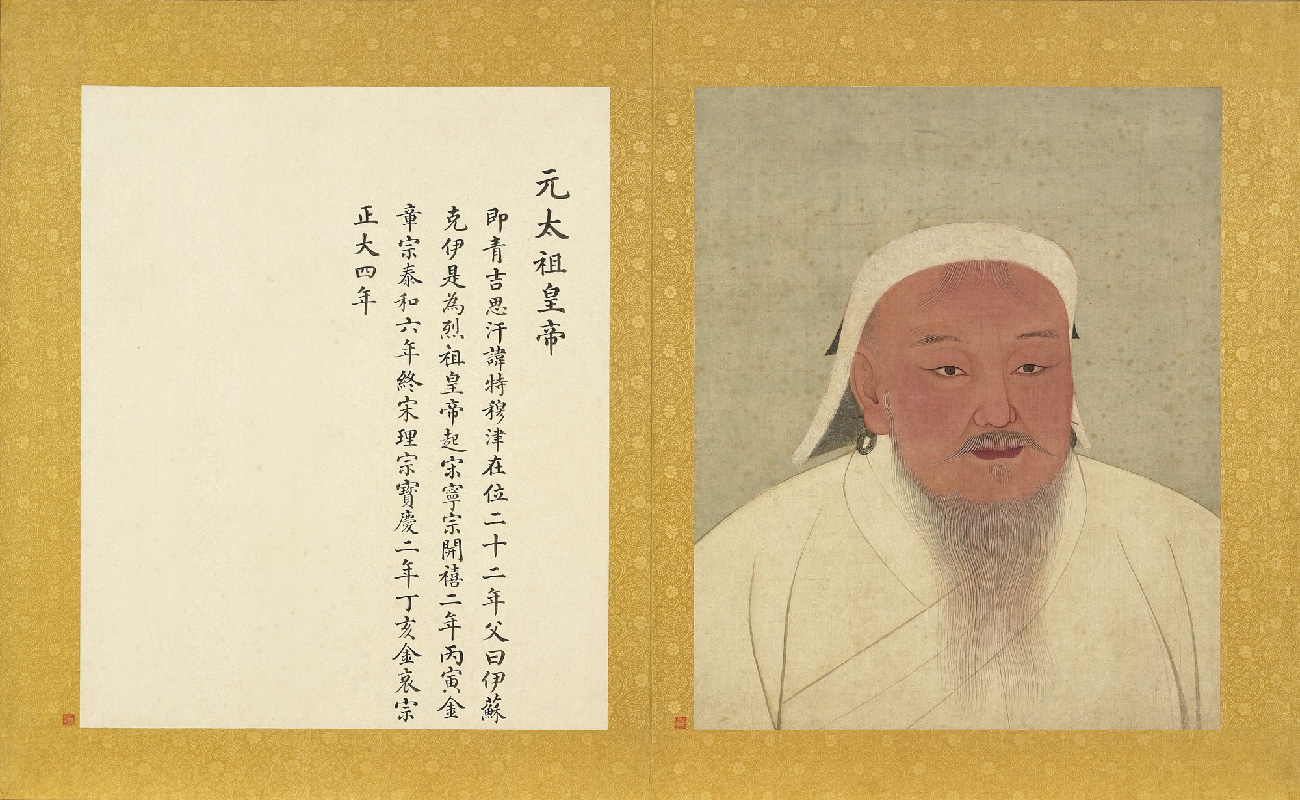
(credit: “Emperor Taizu of Yuan, better known as Genghis Khan” by National Palace Museum/Wikimedia Commons, Public Domain) · Public Domain
Figure 14.8 This oversized portrait of Chinggis Khan was made with paint and ink on silk and comes from a fourteenth-century album of royal portraits that is today held in the National Museum in Taipei, Taiwan. The description on the left page provides brief details about Chinggis, primarily about when he reigned. (credit: “Emperor Taizu of Yuan, better known as Genghis Khan” by National Palace Museum/Wikimedia Commons, Public Domain)
図14.8 絹に絵具と墨で描かれた、この大きなチンギス・カンの肖像は、14世紀の王族肖像画冊に収められていた。現在は台湾・台北の国立博物館に所蔵される。左ページの説明は、主に在位期間など、チンギスについての簡単な情報を示す。(出典:国立故宮博物院/Wikimedia Commons「Emperor Taizu of Yuan, better known as Genghis Khan」、パブリックドメイン)
The yassa made theft and robbery—the objectives of incessant raiding between clans—capital offenses. Enslaving Mongols was outlawed, as were adultery and kidnapping women and selling them for marriage. No one could kill more animals than their household could use, hunting was banned during animals’ mating seasons, and specified butchering methods ensured that maximum use was made of the animal. The yassa favored no religion and prohibited discrimination and favoritism on the basis of religion, perhaps the first law code to do so. Chinggis Khan, who continued to worship Tengri, granted tax and labor service exemptions to all religious leaders and holders of church lands, privileges later extended to those in secular occupations requiring literacy, such as medicine and law.
英語のヒント
ヤサは、氏族同士が絶えず襲い合う目的だった窃盗と強盗を、死刑に当たる犯罪とした。モンゴル人を奴隷にすること、姦通、女性をさらって婚姻のために売ることも禁じた。誰も、自分の家で使える以上の動物を殺してはならず、動物の繁殖期には狩猟が禁じられ、決められた解体方法によって動物を最大限に利用した。ヤサはいかなる宗教も優遇せず、宗教に基づく差別とえこひいきを禁じた。そう定めた最初の法体系だったかもしれない。テングリを信仰し続けたチンギス・カンは、すべての宗教指導者と宗教団体の土地の保有者に、税と労役の免除を認めた。のちにはこの特権を、医学や法学など、読み書きが必要な世俗の職業に就く人々にも広げた。
The family was the center of life for a Mongol woman, yet she had little if any say about how her family was formed. Marriages were arranged, and polygamy was common, although a man was not supposed to have more wives than he could support. Adult males in the household could sleep with any of the women in the household if this did not violate incest taboos, and it is unclear the degree to which a woman’s consent was necessary. Because the yassa defined adultery as occurring only between married people of different households, it codified the potential for sexual assault within households.
英語のヒント
モンゴルの女性の生活の中心は家族だった。しかし、家族がどう作られるかについて、女性には、あったとしてもほとんど発言権がなかった。結婚は取り決めによって行われ、一夫多妻も一般的だった。ただし男性は、養える以上の妻を持つべきではないとされた。近親相姦の禁忌に触れなければ、家の成人男性は、その家のどの女性とも性的関係を持つことができ、女性の同意がどの程度必要だったかははっきりしない。ヤサは、姦通を別々の家の既婚者同士の間でのみ起きるものと定義したため、家の内部で性的暴行が生じうる余地を、法として定めることになった。
Mongol women did have some power, however. They were often left to oversee the household when the men went to herd, hunt, and raid. A widow beyond childbearing years was often considered a household head and took her husband’s place in the clan’s collective decision-making institutions. When Chinggis Khan was away on extended campaigns, his wife Borte was the de facto leader of the civilians of the Mongol Empire, and the wives and mothers of later Mongol rulers could hold significant power over a khanate following this model. Such instances of female leadership were far, far rarer—or entirely unheard of—in most other Afro-Eurasian societies of the same period.
英語のヒント
しかし、モンゴルの女性にも一定の権力はあった。男性が放牧、狩猟、襲撃に出ると、女性が家を監督することが多かった。出産する年齢を過ぎた寡婦は、しばしば家長とみなされ、氏族の共同意思決定機関で夫の席を継いだ。チンギス・カンが長期遠征で不在のとき、妻ボルテは、モンゴル帝国の民間人の事実上の指導者だった。後代のモンゴル君主の妻や母も、この先例に倣ってハン国に大きな権力を振るうことができた。同時期のアフロ・ユーラシアのほかの社会の大半では、こうした女性の指導者は、はるかに、はるかにまれか、まったく知られていなかった。