第13章ローマ後の西欧と十字軍運動The Post-Roman West and the Crusading Movement
13.3 Patriarch and Papacy: The Church and the Call to Crusade13.3 総主教と教皇庁――教会と十字軍への呼びかけ
Learning Objectives学習の目標
By the end of this section, you will be able to:
この節を学び終えると、次のことができるようになる。
Describe the East-West schism within the Christian Church
キリスト教会の東西分裂を説明する。
Explain why Pope Urban II called for the First Crusade
教皇ウルバヌス2世が、第1回十字軍を呼びかけた理由を説明する。
Discuss the concept of religiously motivated warfare in Christianity and Islam
キリスト教とイスラームにおける、宗教を動機とする戦争の考え方を論じる。
Identify the reasons western Christians traveled to the Middle East as crusaders
西方のキリスト教徒が、十字軍として中東へ赴いた理由を挙げる。
The image of holy war has often colored the history of the Middle Ages. We can view it either positively in terms of warriors engaged in an altruistic struggle, or in a more negative light as a conflict rooted in bigotry and ignorance. The factors that justified holy war existed in Christianity well before the Crusades, but the Crusades helped shape specific ideals that sanctioned armed conflict based on religious beliefs. These ideals were both internal to Christian Europe and reactions to developments in the Islamic world.
英語のヒント
聖戦のイメージは、中世史の見方をしばしば色付けしてきた。他者のために戦う戦士の姿として肯定的に捉えることも、偏狭さと無知に根差す争いとして否定的に捉えることもできる。聖戦を正当化する要素は、十字軍よりずっと前からキリスト教にあった。しかし十字軍は、宗教的な信念に基づく武力衝突を認める、特定の理念を形作る助けとなった。それらは、キリスト教ヨーロッパの内部から生まれたものでも、イスラーム世界の動きへの反応でもあった。
The East-West Schism東西教会の分裂
The chaotic aftermath of the collapse of the Carolingian Empire led to a complicated situation between secular rulers and the Christian Church. According to German law, lords had the right to control everything on their land, including churches and monasteries. This control even extended to the appointment of officeholders to church positions such as abbot or bishop. To ensure they had the loyalty of church officials, lords staffed these offices with their family members or even sold them to the highest bidder. The consequence was that those without religious vocations, or even familiarity with Christian doctrine, could be installed into church leadership. Even the position of the pope, the bishop of Rome, could come up for sale.
英語のヒント
カロリング帝国崩壊後の混乱は、世俗の支配者とキリスト教会の間に、複雑な状況を生んだ。ゲルマンの法では、領主は、教会や修道院を含め、自分の土地にあるすべてを支配する権利を持った。その支配は、修道院長や司教など、教会の役職に就く者の任命にまで及んだ。教会の役職者の忠誠を確保するため、領主はその地位に自分の家族を就けたり、最も高い金額を払う者に売ったりさえした。その結果、宗教への召命を持たず、キリスト教の教義をよく知らない者でも、教会の指導者に据えられることがあった。ローマ司教、すなわち教皇の地位さえ、売り物になることがあった。
Revulsion at this treatment of religious office led to a reform movement intended to remove the influence of secular lords from the management of the church. The movement is often associated with the monastery of Cluny in France, which managed to get independence from the local aristocrat. Other monasteries around France flocked to be included in the rights and privileges that Cluny had earned, creating a movement called the Cluniac reform. The Cluniac movement eventually drew in other clergy who wanted the church to control the election of bishops, independent of secular influence. This desire for independence finally reached the top of the Catholic Church and the office of the bishop of Rome (Figure 13.16).
英語のヒント
宗教上の役職をこのように扱うことへの嫌悪は、教会運営から世俗領主の影響を除こうとする改革運動を生んだ。この運動は、フランスのクリュニー修道院と結び付けられることが多い。クリュニーは、地元の貴族から独立することに成功した。フランス各地の修道院が、クリュニーの得た権利や特権を共有しようと集まり、クリュニー改革と呼ばれる運動を作った。やがて、世俗の影響を離れ、教会が司教の選出を管理することを望む、ほかの聖職者も引き込んだ。独立への要求は、ついにカトリック教会の頂点、ローマ司教の地位にまで達した(図13.16)。
The Abbey of Cluny.クリュニー修道院
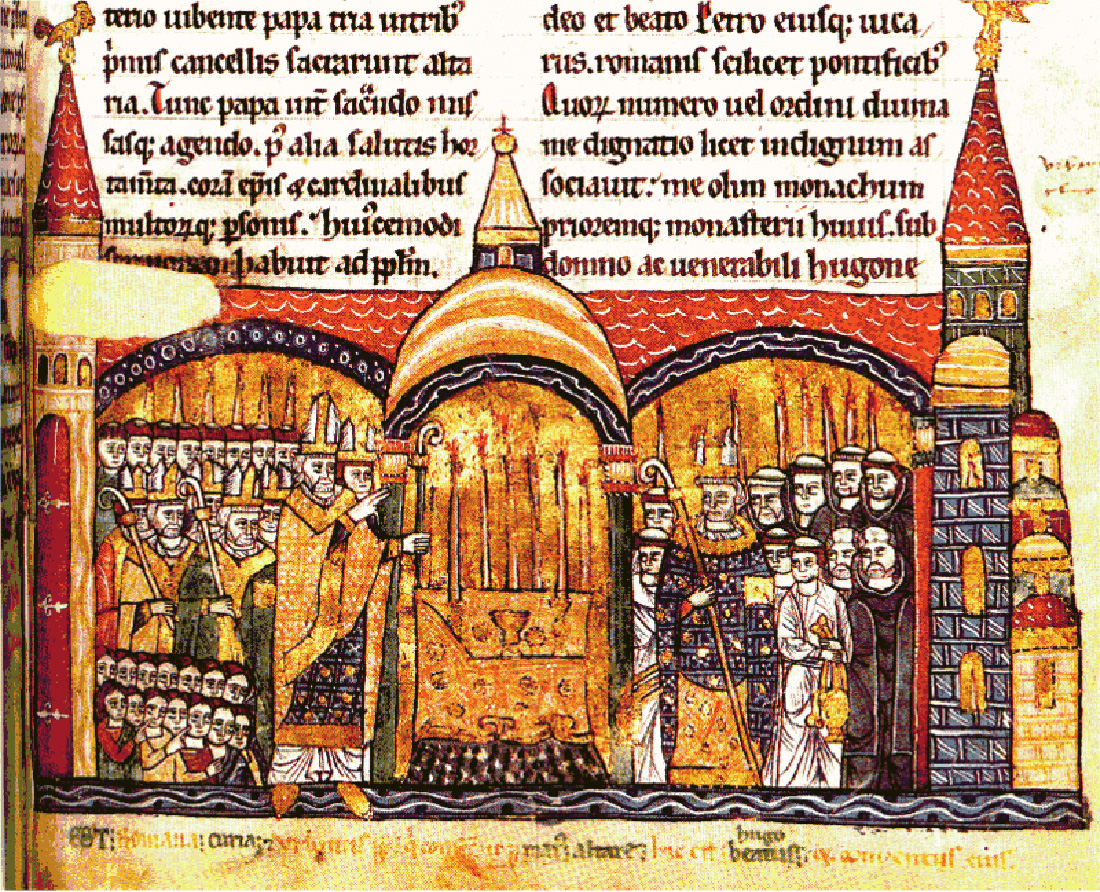
(credit: “Consécration de Cluny III par Urbain II” by Bibliothèque Nationale de France/Wikimedia Commons, Public Domain) · Public Domain
Figure 13.16 This twelfth-century image shows the consecration by Pope Urban II (in gold robes on the left) of the third Abbey of Cluny. Popes developed their reforming platform from Cluny’s program. (credit: “Consécration de Cluny III par Urbain II” by Bibliothèque Nationale de France/Wikimedia Commons, Public Domain)
図13.16 教皇ウルバヌス2世(左の金色の衣)が、第3クリュニー修道院の献堂式を行う姿を描いた12世紀の画像。教皇たちは、クリュニーの方針をもとに、自らの改革構想を発展させた。(出典:Bibliothèque Nationale de France/Wikimedia Commons「Consécration de Cluny III par Urbain II」、パブリックドメイン)
The bishops of Rome were eventually influenced by the Cluniac movement to reform the church. They condemned the sale of offices as a sin called simony and insisted that bishops should be elected by clergy, independent of a lord. Any clergy member who had bought an office or had it bought for them could be removed. To end the practice of treating church positions like a fief to be passed on to the officeholder’s children, priests were told to practice celibacy and were forbidden to marry. While celibacy was not a new concept in the Catholic Church, reforming monks and popes began to enforce it with energy. These changes caused bitter conflict with the rulers of Europe, so the church declared that a king who tried to appoint a bishop or asked for a bribe could be excommunicated (placed outside the church, its communion, and the sacraments, in hopes of reforming the offender). Excommunication could threaten the king’s position and lead to rebellions.
英語のヒント
ローマ司教たちも、やがてクリュニー運動の影響を受けて、教会改革に向かった。役職の売買を聖職売買、すなわちシモニアという罪として非難し、司教は領主から独立して、聖職者が選出するべきだと主張した。自分で役職を買った者や、他人に買ってもらった聖職者は、解任されうることになった。教会の役職を、子どもへ相続する封土のように扱う慣行を終わらせるため、司祭は独身を守るよう命じられ、結婚を禁じられた。独身はカトリック教会にとって新しい考えではなかったが、改革派の修道士や教皇は、熱心に実施を徹底するようになった。これらの変化は、ヨーロッパの支配者との激しい対立を生んだ。そこで教会は、司教を任命しようとしたり、賄賂を求めたりする王は、破門されうると宣言した。破門とは、当人の改心を期待して、教会、その交わり、秘跡から排除することである。王の地位を脅かし、反乱につながることもあった。
The reformers were also interested in creating a thoroughly Christianized society by distinguishing between legitimate and illegitimate warfare. The church argued that Christian soldiers, especially knights, should obey a code of conduct that reflected the church’s values. For example, they should not loot monasteries or hold clergy for ransom. They should protect the church as well as women and the defenseless. They should observe periods of publicly declared truces and not fight on religiously significant days like Easter. These principles contributed to the ideals of chivalry, a code of conduct that was meant to Christianize knightly violence and behavior. Although it was never successful at curbing violence, the idea of Christianized warfare was only one strand of a broader, secular interest in a newly defined chivalric culture of knighthood, and images of Christian knights helped popes justify their directing the military classes of Europe to act against peoples deemed to be enemies of the church, and therefore also of God.
英語のヒント
改革者たちは、正当な戦争と不当な戦争を区別することで、徹底してキリスト教化された社会を作ることにも関心を持った。教会は、キリスト教徒の兵士、特に騎士が、教会の価値観を反映する行動規範に従うべきだと主張した。たとえば修道院を略奪したり、聖職者を捕らえて身代金を求めたりしてはならない。教会、女性、身を守れない人々を保護するべきである。公に宣言された休戦期間を守り、復活祭のような宗教的に重要な日に戦ってはならない。こうした原則は、騎士の暴力と行動をキリスト教に沿うものにしようとする行動規範、騎士道の理念につながった。暴力を抑えることには成功しなかったものの、キリスト教化された戦争という考えは、新たに定義された騎士道文化への、より広い世俗的な関心を構成する一要素だった。キリスト教徒の騎士という姿は、教会、したがって神の敵とみなされた人々に対し、ヨーロッパの軍人層を動かすことを、教皇が正当化する助けとなった。
The reform movement gained the church some moral prestige, but the growing power of the pope also worsened the relationship between the eastern and western halves of the faith. By the time of the Middle Ages, five ancient seats of Christianity were recognized as the most prestigious: Jerusalem, Antioch, Alexandria, Rome, and Constantinople. Each was led by a bishop with the honorary title of “patriarch.” In the tenth century, only Rome and Constantinople were in territory not controlled by Muslims.
英語のヒント
改革運動は、教会に一定の道徳的な威信をもたらしたが、教皇の権力拡大は、東西教会の関係をさらに悪化させた。中世には、キリスト教の五つの古い中心地、エルサレム、アンティオキア、アレクサンドリア、ローマ、コンスタンティノープルが、最も高い威信を持つと認められていた。それぞれを「総主教」という名誉称号を持つ司教が率いた。10世紀には、ムスリム支配下にない領域にあったのは、ローマとコンスタンティノープルだけだった。
While the pope in Rome and the patriarch of Constantinople believed many of the same things, linguistic and cultural differences helped drive a wedge between them. For example, the church in the west operated in Latin, insisted on a celibate clergy, and elevated the pope as the final authority for all matters regarding the church everywhere. The church in the east used Greek, permitted priests to marry (although tradition held that bishops should be unmarried), and believed other patriarchs were just as authoritative as the pope. The reform movement unintentionally made divisions sharper.
英語のヒント
ローマ教皇とコンスタンティノープル総主教は、多くの点で同じ信仰を持ったが、言語と文化の違いは、両者の間にくさびを打ち込んだ。西方教会は、たとえばラテン語で運営され、聖職者の独身を求め、世界中の教会のあらゆる事柄について、教皇を最終的な権威とした。東方教会はギリシア語を使い、司祭の結婚を認めた。ただし司教は独身であるべきだという伝統があった。また、ほかの総主教も教皇と同じ権威を持つと考えた。改革運動は、意図せずして、こうした分裂をいっそう鮮明にした。
In 1054, the pope sent representatives to the patriarch of Constantinople to discuss the differences between the two halves of the church. The pope’s chief representative felt the patriarch was not cooperating with or even recognizing the embassy, so he issued a letter excommunicating the patriarch and his followers. Soon after, the patriarch issued his own letter excommunicating the pope’s representatives. Following this Great Schism of 1054, the eastern church became known as the Eastern Orthodox Church, and the western half the Catholic Church.
英語のヒント
1054年、教皇は、東西教会の相違を話し合うため、コンスタンティノープル総主教へ使節を送った。使節団の代表は、総主教が協力せず、使節団の存在さえ認めないと感じ、総主教とその支持者を破門する書状を出した。まもなく総主教も、教皇の使節たちを破門する書状を出した。この1054年の大シスマ以後、東方教会は東方正教会、西方教会はカトリック教会として知られるようになった。
The Great Schism was not the only cause of their division, given that tensions and disagreements had been growing over time. But it did help to highlight the way Christianity was being shaped by different forces in different parts of Europe. From this time on, the popes hoped to reunite the two halves under their authority and impose their vision of a reformed church on the Orthodox Church. While Orthodox bishops might accept the pope as “first among equals,” the papacy insisted on being the supreme authority in the church.
英語のヒント
大シスマだけが、分裂の原因だったわけではない。それ以前から、緊張や意見の不一致は、時間をかけて強まっていた。しかし大シスマは、ヨーロッパの地域ごとに異なる力によってキリスト教が形作られていたことを、際立たせた。この時から、教皇たちは東西を自分たちの権威のもとに再統合し、自らの改革された教会像を正教会にも押し通そうと望んだ。正教会の司教たちは、教皇を「同等の者の中の第一人者」としてなら認めることがあっても、教皇庁は、教会の最高権威であると主張した。