第13章ローマ後の西欧と十字軍運動The Post-Roman West and the Crusading Movement
The Iberian Peninsula and the World of Al-Andalusイベリア半島とアル=アンダルスの世界
Like the Ostrogoths, Visigoth rulers attempted to emulate Roman institutions in Spain by creating written law codes, but their relationship with their Hispano-Roman subjects was largely uneasy, and unlike Theodoric and Clovis, they tended to remain apart from them. The Visigoths were Arian Christians who tolerated their non-Arian subjects, but the need to better integrate themselves with the population eventually compelled King Recared to convert to Catholicism and gain the support of the church. In 711, however, the armies of the Umayyad Caliphate crossed the Strait of Gibraltar and overran the kingdom.
英語のヒント
東ゴート人と同じく、西ゴートの支配者たちも、成文法典を作ることで、スペインにローマの制度を再現しようとした。しかしヒスパノ・ローマ系の臣民との関係は、総じてぎくしゃくしており、テオドリックやクローヴィスとは違って、住民との距離を保ちがちだった。西ゴート人はアリウス派のキリスト教徒で、アリウス派ではない臣民の信仰も認めていた。だが住民といっそう一体化する必要から、ついにレカレド王はカトリックに改宗し、教会の支持を得た。しかし711年、ウマイヤ朝の軍がジブラルタル海峡を渡り、王国を制圧した。
The Umayyad armies that invaded Spain never succeeded in controlling the entire peninsula, just as the Visigoths had not. Christian kingdoms persisted in the north, though they were weak and often fought with each other. Another reason was that non-Arabic soldiers, like the North African Amazigh (Berbers), always felt shortchanged when Arab leaders divided the spoils of conquest. This ethnic and regional conflict played an important role in the collapse of the Umayyad dynasty, but it also led an offshoot of it to take root in Spain.
英語のヒント
スペインへ侵入したウマイヤ朝の軍は、西ゴート人と同じく、半島全体を支配することには成功しなかった。北部にはキリスト教の王国が残った。力は弱く、互いに戦うことも多かった。もう一つの理由は、アラブ人の指導者が征服の戦利品を分ける際、北アフリカのアマジグ人(ベルベル人)など、アラブ人以外の兵士が、いつも不当に少ない分け前しか得ていないと感じたことだった。この民族的・地域的な対立は、ウマイヤ朝崩壊の重要な要因となったが、同時に、その一支流をスペインに根付かせることにもなった。
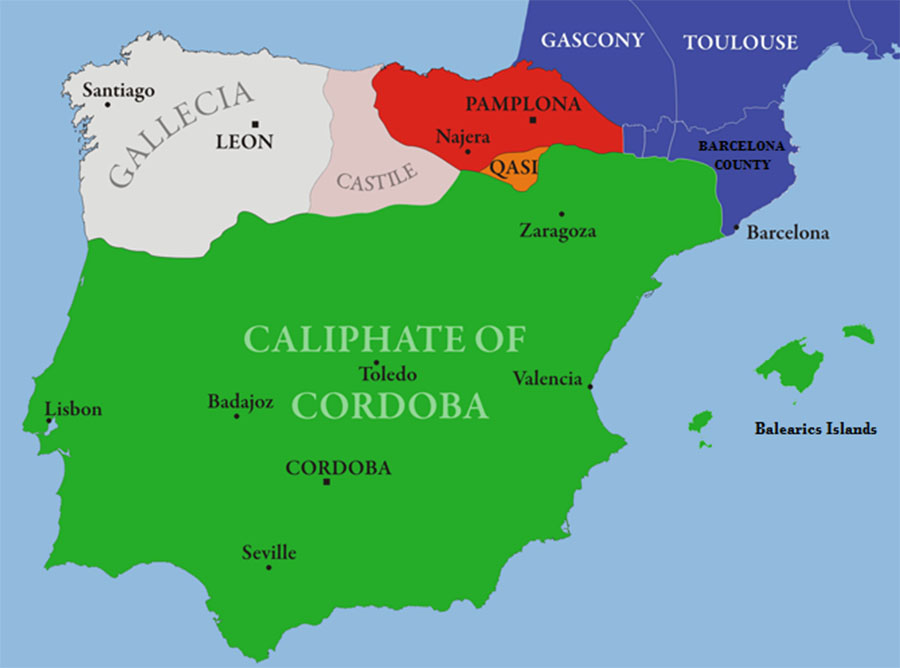
The Muslims called the region Al-Andalus, and it was governed by members of the Umayyad dynasty who had fled the collapse of their power when the Abbasid dynasty overthrew them. Abd al-Rahman I, fleeing the destruction of his family in Syria, capitalized on the discontent felt by non-Arab soldiers following the conquest of Spain. With their help, he was able to build alliances and defeat his enemies to become the ruler of Al-Andalus. He established his capital at the city of Cordoba and began to form a new society, based on Islamic law and dedicated to expanding into Christian territory. Abd al-Rahman and his successors created a remarkable community that was multireligious and multiethnic and that sustained diplomatic and commercial ties throughout the Mediterranean world and beyond, a testament to the global context of the early Middle Ages. Soon Cordoba rivaled Constantinople and Baghdad as a center of trade, learning, and the arts. Connections to North Africa and the Middle East ensured the revival of trade and, consequently, the revival of urban life (Figure 13.10).
英語のヒント
ムスリムは、この地域をアル=アンダルスと呼んだ。そこを統治したのは、アッバース朝に倒され、支配を失って逃れてきたウマイヤ朝の一族だった。シリアでの一族の滅亡を逃れたアブド・アッラフマーン1世は、スペイン征服後にアラブ人以外の兵士たちが抱いた不満を利用した。その助けを得て同盟を結び、敵を破り、アル=アンダルスの支配者となった。コルドバに都を定め、イスラーム法に基づき、キリスト教勢力の領土へ拡大することを目指す、新しい社会を作り始めた。彼とその後継者は、複数の宗教と民族からなる、際立った共同体を築いた。それは地中海世界と、その外にまで外交・商業上のつながりを保ち、中世初期の世界的な広がりを示すものとなった。まもなくコルドバは、交易、学問、芸術の中心として、コンスタンティノープルやバグダードに並び立った。北アフリカや中東との結び付きが交易を復興させ、それに伴って都市生活もよみがえった(図13.10)。
Medieval Cordoba.中世のコルドバ
(credit: “Al Andalus & Christian Kingdoms” by Alexandre Vigo/Wikimedia Commons, CC0 1.0) · CC0 1.0
Figure 13.10 This map shows (in green) the extent of the Caliphate of Cordoba in Iberia at its height in the tenth century, but with Christian kingdoms still controlling the north. (credit: “Al Andalus & Christian Kingdoms” by Alexandre Vigo/Wikimedia Commons, CC0 1.0)
図13.10 10世紀の最盛期に、イベリアでコルドバ・カリフ国が及ぼした支配の範囲を緑色で示す地図。北部には、なおキリスト教の王国が残っていた。(出典:Alexandre Vigo/Wikimedia Commons「Al Andalus & Christian Kingdoms」、CC0 1.0)
Many Christians there, whether they converted or not, adopted Islamic culture by speaking Arabic, dressing as their Amazigh and Arab rulers did, and adopting their practices. For this reason, they are called “Mozarabs.” In some ways, this period, in which Christians, Muslims, and Jewish people lived and worked in proximity, is a good example of medieval toleration, but violence by the dominant group, as we have seen in the conflict between Arians and Catholics, was always possible.
英語のヒント
この地のキリスト教徒の多くは、改宗したかどうかにかかわらず、アラビア語を話し、アマジグ人やアラブ人の支配者のように装い、その習慣を取り入れることで、イスラーム文化を受け入れた。このため「モサラベ」と呼ばれる。キリスト教徒、ムスリム、ユダヤ人が近くで暮らし、働いたこの時代は、ある意味で中世の寛容の好例である。しかし、アリウス派とカトリックの対立で見たように、支配的な集団による暴力は、いつでも起こりえた。
Al-Andalus reached its peak in the tenth century. It was a dynamic society whose population prospered and created its own hybrid culture from the ways of the ethnic and religious peoples who lived in the Iberian Peninsula. Under Abd al-Rahman III, trade expanded into sub-Saharan Africa and across the Mediterranean. This link to the broader Mediterranean world enabled contacts that were often absent from the Germanic kingdoms and brought new agricultural goods like citrus fruit, sugar, and cotton to the peninsula from as far away as India. Cordoba became famed for its orange, lime, and lemon groves.
英語のヒント
アル=アンダルスは、10世紀に最盛期を迎えた。住民は繁栄し、イベリア半島に暮らすさまざまな民族や宗教集団の習慣から、独自の混成文化を生み出した、活力ある社会だった。アブド・アッラフマーン3世のもとで、交易はサハラ以南のアフリカへ、そして地中海の向こうへ広がった。広い地中海世界との結び付きは、ゲルマン諸王国には欠けていることも多かった交流を可能にした。また、はるかインドなどから、柑橘類、砂糖、綿花といった新たな農産物を半島へもたらした。コルドバは、オレンジ、ライム、レモンの果樹園で有名になった。
The growth of trade and commerce also encouraged the revival of cities, another difference from the Germanic kingdoms. By the year 1000, for example, Cordoba had nearly 100,000 inhabitants, making it one of the most populous cities in Europe. Its close connections to the Mediterranean world brought scholars, craftspeople, merchants, and emigrants in greater numbers than to the Germanic north. Even so, Germanic merchants and traders also made connections with Spanish states, those ruled by Christians and by Muslims.
英語のヒント
交易と商業の成長は、都市の復興も促した。これもゲルマン諸王国との違いだった。たとえば1000年までには、コルドバの人口は約10万人となり、ヨーロッパで最も人口の多い都市の一つになっていた。地中海世界との緊密な結び付きによって、ゲルマン人の北方地域よりも、多くの学者、職人、商人、移住者が集まった。それでも、ゲルマン人の商人たちも、キリスト教徒の国とムスリムの国の両方を含む、スペインの諸国と関係を結んだ。
The caliphs established schools of Islamic jurisprudence and hired scholars and linguists to help administer the kingdom. These scholars scoured Spain for older Greek and Latin manuscripts to translate. Jewish and Christian scholars also found the caliphate a place of learning, and a flowering of Jewish religious thought and poetry developed. Under Islamic law, Christians and Jewish people were considered “protected.” This meant that because they also believed in one God, they could not be compelled to convert so long as they did not challenge the beliefs of Muslims. Some historians have viewed this period of toleration, now called convivencia (“living together”), as a particular example of coexistence and nonviolent interaction among people of different faiths. The antagonism of the Christian kingdoms in the north, however, and the growth of zealous Islamic leaders in North Africa show that once again, while toleration was always possible, it depended on the presence of willing leaders for whom peace was desirable. When conflict between Christians and Muslins was exacerbated, religious tensions could make toleration less desirable. Islamic dynasties and Christian rulers who found religious identity a source of inspiration for warriors, for instance, whittled away at convivencia.
英語のヒント
カリフたちはイスラーム法学の学校を設け、学者や言語学者を雇って、統治を助けさせた。学者たちは、翻訳するための古いギリシア語・ラテン語写本を求めて、スペイン中を探し回った。ユダヤ教徒やキリスト教徒の学者も、カリフ国を学問の場として見いだし、ユダヤ教の思想や詩も花開いた。イスラーム法のもとでは、キリスト教徒とユダヤ教徒は「保護される」人々とされた。彼らも唯一神を信じているので、ムスリムの信仰に挑戦しない限り、改宗を強制されないという意味だった。今日「コンビベンシア」、すなわち「共に生きること」と呼ばれるこの寛容の時期を、異なる信仰の人々が共存し、暴力に訴えずに交流した、特徴的な例とみなす歴史家もいる。しかし、北方のキリスト教諸国との敵対や、北アフリカでの熱心なイスラーム指導者の台頭は、ここでも、寛容が常に可能ではあっても、平和を望み、寛容を受け入れる指導者の存在に左右されたことを示す。キリスト教徒とムスリムの争いが激しくなると、宗教的緊張によって、寛容は望ましくないものになりえた。たとえば、宗教的な帰属意識を戦士の奮起の源として用いたイスラーム王朝やキリスト教の支配者は、コンビベンシアを少しずつ損なっていった。
Despite the ongoing toleration that rulers of one faith could show to subjects of another, conflicts between rulers of different faiths persisted. The Islamic rulers of Al-Andalus succeeded in disrupting the Christian kingdoms in the north of the peninsula until the eleventh century. For example, in the 990s, the powerful general al-Mansur sacked Barcelona on the eastern coast and Leon in the northwest, both important centers of Christian political power. Despite its successes in the north, however, the Caliphate of Cordoba collapsed due to infighting after the death of al-Mansur, and regional aristocrats broke up the unity of Al-Andalus, creating smaller successor states that often fought as much against each other (and in alliance with Christian fighters) as against Christianity. The conflicts in the eleventh century were still largely about knights, fast-moving heavily armored soldiers on horseback, winning plunder and fame, but the stage was set for wars of cultural conquest and the struggle for religious supremacy. The destruction of the Christian states in Spain had gained the attention of the popes, and this helped shape the church’s promotion of a religiously sanctioned fight against Islam.
英語のヒント
ある信仰を持つ支配者が、別の信仰を持つ臣民に寛容を示し続ける場合があっても、異なる信仰の支配者どうしの争いは続いた。アル=アンダルスのイスラームの支配者は、11世紀まで、半島北部のキリスト教諸国を混乱させることに成功した。たとえば990年代、強力な将軍アル=マンスールは、東海岸のバルセロナと北西部のレオンを略奪した。どちらもキリスト教勢力の重要な政治拠点だった。しかし北方での成功にもかかわらず、アル=マンスールの死後、内紛によってコルドバ・カリフ国は崩壊した。地方の貴族たちはアル=アンダルスの統一を解体し、小さな後継国家を作った。これらの国は、キリスト教勢力と戦うのと同じほど、互いに争い、キリスト教徒の戦士と同盟することもあった。11世紀の争いは、なお主として、重い鎧を着けて馬で素早く動く騎士が、戦利品と名声を得るためのものだった。しかし、文化を征服する戦争と、宗教的優越をめぐる闘争の土台は整っていた。スペインのキリスト教諸国の破壊は、教皇たちの注意を引き、教会が、宗教によって正当化された対イスラーム戦争を推進することにつながった。