第13章ローマ後の西欧と十字軍運動The Post-Roman West and the Crusading Movement
13.1 The Post-Roman West in the Early Middle Ages13.1 中世初期、ローマ後の西欧
Learning Objectives学習の目標
By the end of this section, you will be able to:
この節を学ぶと、次のことができるようになる。
Analyze the foundations of medieval society that emerged in the post-Roman world
ローマ後の世界に生まれた、中世社会の基盤を分析する。
Define feudalism in western Europe
西ヨーロッパの封建制を定義する。
Describe the role of religion in medieval European culture and society
中世ヨーロッパの文化と社会で、宗教が果たした役割を説明する。
Discuss the establishment of Muslim rule in western Europe and the religiously diverse society in Spain
西ヨーロッパにおけるムスリム支配の成立と、スペインの宗教的に多様な社会について論じる。
Of all the regions in the post-Roman world, western Europe experienced arguably the most dramatic change. Its political order fragmented under Germanic warlords empowered mainly by their ability to provide loot for their followers. In this world of soldiers, the Roman church, directed by the pope, worked to secure military assistance from kings and convert various groups to Christianity. The church’s goal was to ensure that its vision of Christian beliefs and practices eclipsed those of other sects such as the Arians, Christians who questioned the Roman church’s basic tenet that Jesus was divine. The merging of these two antithetical cultures—the religious and the military—helped prepare the ground for a new civilization we call the medieval culture, which emerged between the end of Rome and the rise of the modern world.
英語のヒント
ローマ後の世界の中でも、西ヨーロッパはおそらく最も劇的な変化を経験した。その政治秩序は、ゲルマン系の軍事指導者たちの下で分裂した。彼らの力を主に支えたのは、従う者に略奪品を与える能力だった。この兵士たちの世界で、教皇が率いるローマ教会は、王たちから軍事的な援助を確保し、さまざまな集団をキリスト教へ改宗させようとした。教会の目標は、自らの考えるキリスト教の信仰と実践を、アリウス派など他派のものより優勢にすることだった。アリウス派は、イエスが神的な存在であるというローマ教会の基本的な教義に疑問を呈したキリスト教徒だった。宗教と軍事という、相反する二つの文化の融合は、新たな文明の土台を作った。私たちが中世文化と呼ぶもので、ローマの終わりと近代世界の台頭の間に生まれた。
Europe after the Roman Empireローマ帝国後のヨーロッパ
There was no exact date when the Roman Empire fell, and the eastern half of the empire did not collapse until the fifteenth century. In fact, the Germanic peoples who settled in the former Roman Empire were not hostile to its culture, so in some places, Roman culture lasted longer than Roman political authority. Latin remained the language of the educated, for example, and Germanic peoples gradually adopted the Latin alphabet for their own languages, including English. Traditionally, though, the end of the empire is fixed at 476, when a German general named Odoacer deposed the emperor Romulus Augustulus and established himself not as a Roman emperor but as King of Italy. Even that date may be arbitrary, but by the late fifth century, traditional Roman authority had ceased to be the basis of political power in much of western Europe.
英語のヒント
ローマ帝国が崩壊した、厳密にただ一つの日付があるわけではない。帝国の東半分は15世紀まで崩壊しなかった。実際、旧ローマ帝国の領域に定住したゲルマン系の人々は、その文化に敵対していたわけではない。そのため、場所によっては、ローマの政治権力が失われた後も、ローマ文化が続いた。たとえばラテン語は、教育を受けた人々の言語であり続けた。ゲルマン系の人々も、英語を含む自分たちの言語を書くため、ラテン文字を徐々に取り入れた。それでも伝統的には、帝国の終わりは476年とされる。この年、ゲルマン系の将軍オドアケルが、皇帝ロムルス・アウグストゥルスを退位させ、ローマ皇帝ではなくイタリア王として地位を築いた。その年を区切りとすることさえ恣意的かもしれないが、5世紀末までには、西ヨーロッパの多くで、伝統的なローマの権威は政治権力の基盤ではなくなっていた。
German Successor Statesゲルマン系の後継諸国
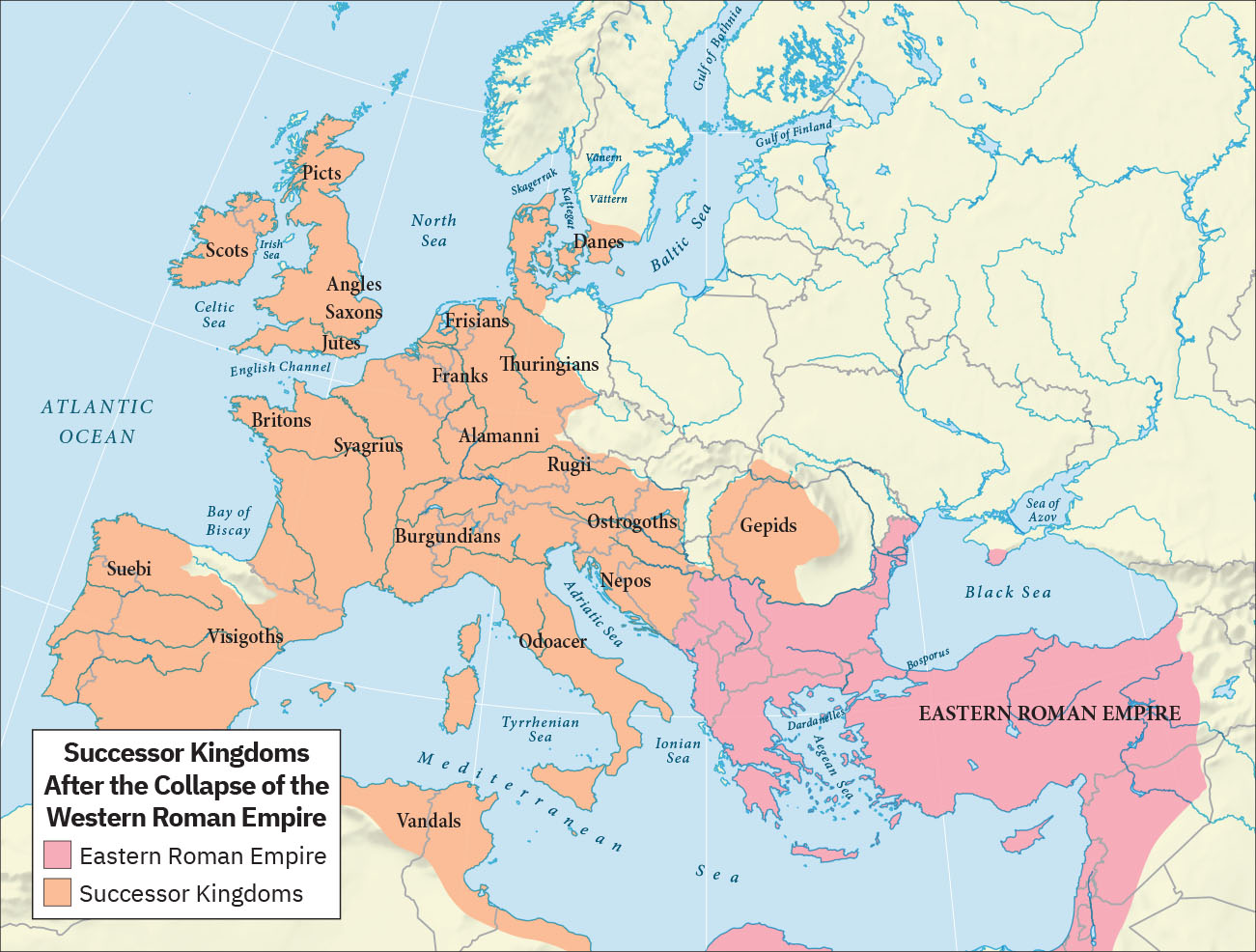
What replaced Roman political authority was the authority of the successor kingdoms (Figure 13.4). The Germanic peoples and the Roman population they conquered were able to create a new society by blending cultural traditions—a process called acculturation—in three ways. First, conversion to Christianity helped reduce differences between the two groups. Second, the Christian Church and the Roman aristocracy offered a useful example of bureaucratic organization and diplomacy that the successor kingdoms adopted. Finally, the erosion of Roman society enabled a new society to emerge in the Middle Ages. Although other Germanic kingdoms existed, those established by the Franks, Ostrogoths, and Visigoths demonstrate these three forms of acculturation most vividly.
英語のヒント
ローマの政治権力に取って代わったのは、後継諸王国の権力だった(図13.4)。ゲルマン系の人々と、彼らに征服されたローマの住民は、文化的伝統を混ぜ合わせることで新しい社会を作ることができた。この過程は文化変容と呼ばれ、三つの形で進んだ。第一に、キリスト教への改宗が、両集団の違いを小さくした。第二に、キリスト教会とローマ貴族は、官僚組織や外交の有用な手本を示し、後継諸王国はそれを採用した。最後に、ローマ社会が崩れていくこと自体が、中世に新しい社会を生み出す余地を与えた。ゲルマン系の王国はほかにも存在したが、フランク人、東ゴート人、西ゴート人が建てた国々は、この三つの文化変容を最も鮮明に示している。
Post-Roman Western Eurasia.ローマ後のユーラシア西部
(attribution: Copyright Rice University, OpenStax, under CC BY 4.0 license) · CC BY 4.0
Figure 13.4 This map shows the Eastern Roman Empire as dominant in the eastern Mediterranean around 500 CE, and the division of western Europe among various successor kingdoms at this time. (attribution: Copyright Rice University, OpenStax, under CC BY 4.0 license)
図13.4 500年ごろの地図。東地中海では東ローマ帝国が優勢である一方、西ヨーロッパはさまざまな後継王国に分かれていた。(著作権表示:Rice University, OpenStax、CC BY 4.0)
“German” was the term Romans used for all the peoples beyond their northern borders, and for them, it was interchangeable with “barbarian,” meaning not Romanized, although there was a great deal of cultural exchange between the two groups. The relationship between the term “German” and the peoples to whom it has been applied is complex. Some of those who invaded the Roman Empire did not speak a Germanic language at all, such as the Huns and Avars. There were few rigid ethnic boundaries between the groups, and the armies of any leader often included warriors from other tribes.
英語のヒント
「ゲルマン人」は、ローマ人が北の国境の外にいる人々全体に使った呼び名だった。ローマ人にとって、それは「ローマ化していない」を意味する「蛮族」と置き換えられる言葉だったが、実際には両者の間に盛んな文化交流があった。「ゲルマン」という語と、その語で呼ばれてきた人々との関係は複雑である。ローマ帝国に侵入した集団には、フン人やアヴァール人など、ゲルマン系言語をまったく話さない人々もいた。集団の間の民族的な境界は厳格なものではなく、どの指導者の軍にも、他の部族の戦士が加わることがよくあった。
The Germanic peoples generally did not read or write and instead transmitted information and traditions orally. Famous tales that eventually found their way into written form, such as the Song of Hildebrand and the Song of the Nibelungs, had their beginnings as spoken epics. Oral culture celebrating warriors facing their fate on the battlefield and scornful queens plotting revenge reflected real possibilities in this society.
英語のヒント
ゲルマン系の人々は、一般に文字を読み書きせず、情報や伝統を口頭で伝えた。後に書き記されるようになった『ヒルデブラントの歌』や『ニーベルンゲンの歌』などの有名な物語も、口承の叙事詩として始まった。戦場で運命に立ち向かう戦士や、怒りと蔑みを抱き、復讐を企てる王妃をたたえる口承文化は、この社会で実際に起こりうる事態を映していた。
Across all Germanic societies, warfare was an important tool for building social prestige. There were no formal hierarchies, so advancement was possible for any willing to serve a powerful chieftain or king. In return, leaders promised loot and the chance to do great deeds. A king who could not ensure material or social resources would lose followers and could not expect to be obeyed. While gold and glory motivated fighters and kings alike, Germanic law and custom tried to limit the destructive cycles of violence by instituting a “blood price” or wergild, under which the injured were compensated according to their social status. These laws tell us much about Germanic society. Chieftains and men of fighting age carried a higher blood price than older men, for example, and women of childbearing age were valued more than older women.
英語のヒント
ゲルマン系の社会では、どこでも戦争が社会的な名声を得る重要な手段だった。正式な序列がなかったため、有力な首長や王に仕える意思があれば、誰でも上へ進むことができた。指導者はその見返りに、略奪品と、偉業を立てる機会を約束した。物質的な利益や社会的な地位を保証できない王は、従う者を失い、服従を期待できなくなった。金と栄光が戦士と王の双方を動かす一方で、ゲルマンの法と慣習は、破壊的な暴力の連鎖を抑えようとした。そのために設けたのが「血の代価」、すなわちヴェルギルドで、被害者は社会的地位に応じて賠償を受けた。これらの法は、ゲルマン社会について多くを語る。たとえば首長や戦える年齢の男性には、高齢男性よりも高い賠償額が設定された。子を産める年齢の女性も、高齢女性より高く評価された。
Women were often responsible for running the household and doing the bulk of the farming work, especially when men were called to fight or travel. Men might hunt, but their contributions were often the spoils of war, including enslaved people captured in battle who then worked in the household. Germanic society was fully patriarchal, and tribes like the Alemanni beat women whose clothes were deemed immodest (showing the leg above the knee). Germans were also often polygynous; men might have multiple wives at once and be able to divorce at will, while women’s options were severely limited.
英語のヒント
女性は家の運営と農作業の大半を担うことが多く、特に男性が戦いや遠征に呼び出されたときにはそうだった。男性も狩猟をすることはあったが、その貢献はしばしば戦利品だった。その中には、戦いで捕らえられ、家内で働かされる奴隷もいた。ゲルマン社会は徹底した家父長制で、アレマン人のような部族は、慎みがないとみなされた服、すなわち膝より上の脚を見せる服を着た女性を殴った。また一夫多妻もしばしば行われた。男性は同時に複数の妻を持ち、思うままに離婚できる場合があった一方、女性の選択肢は厳しく制限されていた。
The Germans were polytheistic, worshipping various deities such as Wodan, a god of war, wisdom, and death, and his consort Frigg, a goddess of motherhood, marriage, and magic. By the third century, individual Germans were already converting to Christianity. Many, like the Goths and Vandals, adopted Arian Christianity, adhering to the teaching that Jesus and the Father were not identical entities. Once within the Roman Empire, they encountered competing forms of the faith that could become a source of further conflict with Christians and non-Christians alike.
英語のヒント
ゲルマン人は多神教徒で、戦争・知恵・死の神ウォーダンや、その配偶神で母性・結婚・魔術の女神フリッグなど、さまざまな神々を崇拝した。3世紀にはすでに、個々のゲルマン人がキリスト教に改宗していた。ゴート人やヴァンダル人など多くの集団は、イエスと父なる神は同一の存在ではないとする教えに従い、アリウス派キリスト教を受け入れた。ローマ帝国の中に入ると、対立する形の信仰に出会い、それがキリスト教徒とも非キリスト教徒とも、さらなる争いを生む原因になりえた。
As an example of acculturation, Theodoric the Great, king of the Ostrogoths, was one of the most dynamic leaders of the post-Roman world. When he became King of Italy in 493, he relied on Roman aristocrats to administer his kingdom, such as the scholar and writer Cassiodorus and the historian and philosopher Boethius. Theodoric also rebuilt Roman infrastructure, including repairing aqueducts and city walls in his kingdom. He used diplomacy to secure alliances with other German kings, often through marriages. To form an alliance with the Franks, for instance, he himself wed Audofleda, the sister of Clovis I, king of the Franks, and he gave his daughters in marriage to other Germanic kings. Envisioning himself as the heir to Roman rule in the west, he maintained ties with the eastern Roman emperors and strove to revive trade with the eastern Mediterranean world. Despite the struggle to maintain order, most rulers attempted to connect with distant civilizations and learned from the peoples around them.
英語のヒント
文化変容の一例を示すのが、東ゴート王テオドリック大王である。ローマ後の世界で最も活動的な指導者の一人だった。493年にイタリア王になると、学者で著述家のカッシオドルスや、歴史家で哲学者のボエティウスなど、ローマの貴族に頼って王国を統治した。テオドリックは、王国内の水道橋や城壁を修理するなど、ローマの社会基盤も再建した。また、しばしば婚姻を通じて、ほかのゲルマン系の王たちと外交上の同盟を結んだ。たとえばフランク人と同盟するため、自らはフランク王クローヴィス1世の姉妹アウドフレダと結婚し、自分の娘たちは、ほかのゲルマン系の王たちに嫁がせた。西方におけるローマ支配の継承者を自任し、東ローマ皇帝との関係を保ち、東地中海世界との交易を復興しようと努めた。秩序の維持に苦闘しながらも、ほとんどの支配者は、遠くの文明とつながろうとし、周囲の人々から学んだ。
To create common bonds between Romans and Germans, Theodoric settled the Ostrogoths among the Roman population, although religious differences kept them from fully integrating. Toleration was possible and even desired in the early Middle Ages, but distrust between religious groups could spark outright violence and persecution. While he was an Arian Christian, Theodoric tolerated the Catholic population of Italy and attempted to mitigate conflict between the two groups until late in his reign, when his distrust of Catholics led him to persecute them. After his death in 526, the Ostrogoths struggled in Italy, and invasion by both the Byzantines and new invaders called the Lombards left the land devastated and divided.
英語のヒント
ローマ人とゲルマン人の間に共通の結び付きを作るため、テオドリックは東ゴート人をローマの住民の中に定住させた。しかし宗教の違いが、十分な融合を妨げた。中世初期には寛容が可能で、それを望む動きさえあったが、宗教集団間の不信は、露骨な暴力や迫害に火をつけることもあった。テオドリックはアリウス派のキリスト教徒だったが、イタリアのカトリック住民を認め、両集団の争いを和らげようとした。しかし治世の晩年には、カトリックへの不信から迫害に向かった。526年に彼が亡くなると、イタリアの東ゴート人は苦境に立たされた。ビザンツ帝国と、新たな侵入者ランゴバルド人の双方による侵攻で、国土は荒廃し、分裂した。
The most successful Germanic kingdom was that of the Franks. Clovis I, a member of the Merovingian dynasty, founded the kingdom in the early sixth century and offers a striking contrast to Theodoric. Ruthless and violent, Clovis was nevertheless a cunning leader who saw the advantages of diplomacy and the support of the Catholic Church and who was tolerant of religious differences until his conversion to Catholicism. He also worked with Gallo-Roman aristocrats and clergy to strengthen the administration of his kingdom and ensure that Roman institutions continued where they could. Shortly before his death, he convened the first council of Catholic bishops at Orleans, whose proclamations were binding on both the Gallo-Roman population and the Franks. In this case, religion helped unite the two groups.
英語のヒント
ゲルマン系の王国で最も成功したのは、フランク人の王国だった。メロヴィング朝のクローヴィス1世は、6世紀初めに王国を建てた人物で、テオドリックと鮮やかな対照をなす。冷酷で暴力的でありながら、クローヴィスは抜け目のない指導者でもあった。外交やカトリック教会の支持がもたらす利点を理解し、自らがカトリックに改宗するまでは、信仰の違いを認めていた。また、ガリア・ローマ系の貴族や聖職者と協力して王国の行政を強化し、可能な場所ではローマの制度が続くようにした。死の少し前、クローヴィスはオルレアンで、カトリック司教の最初の公会議を招集した。その決議は、ガリア・ローマ系の住民にもフランク人にも拘束力を持った。この場合、宗教は二つの集団を一つにまとめる助けとなった。
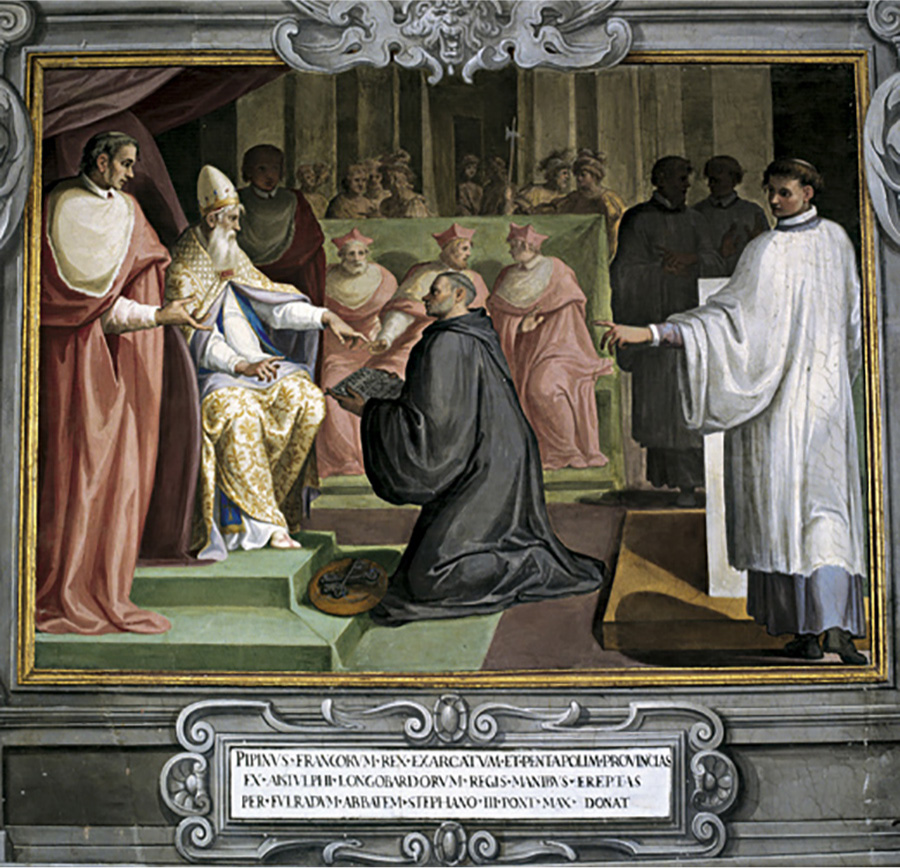
Over time, the Merovingian rulers fell to violent infighting, leaving their sons or nephews as young and often ineffective successors. A chief source of conflict was the practice of partible inheritance, whereby each son received an equal share of his father’s estate. Estates thus became smaller with each successive generation unless new lands were conquered, often by being taken from siblings, in-laws, or cousins. Kings without land and resources to offer as reward lost the ability to attract fighters. Real power lay with the aristocrats, and eventually a new dynasty called the Carolingians took control of the Frankish kingdom. With the support of the pope, Pépin le Bref (Pippin the Short) became the first Carolingian king of the Franks, deposing his Merovingian rival. In return, he confirmed a grant of lands in Italy to the pope. This grant, known as the Donation of Pepin, provided the legal basis for the establishment of the Papal States and helped ensure that the papacy, the set of administrative structures associated with the government of the Catholic Church, was not just a religious institution but also a territorial power (Figure 13.5).
英語のヒント
時がたつにつれ、メロヴィング朝の支配者たちは激しい内紛に陥り、幼く、しばしば力のない息子や甥を後継者に残した。争いの大きな原因は、息子たちが父の財産を等分する分割相続の慣行だった。新しい土地を征服しない限り、財産は世代ごとに小さくなった。その征服も、しばしば兄弟、姻族、いとこから土地を奪うことを意味した。報酬にする土地や資源を持たない王は、戦士を集める力を失った。実権は貴族の手にあり、やがてカロリング朝という新しい王朝が、フランク王国を掌握した。教皇の支持を得たピピン短躯王(ピピン3世)が、メロヴィング朝の対抗者を退位させ、カロリング朝最初のフランク王となった。その見返りに、ピピンはイタリアの土地を教皇へ寄進することを確約した。「ピピンの寄進」として知られるこの譲渡は、教皇領成立の法的な基盤となった。それはまた、カトリック教会の統治に関わる行政組織である教皇庁が、宗教機関であるだけでなく、領土を持つ政治勢力でもあることを確かなものにした(図13.5)。
The Donation of Pepin.ピピンの寄進
(credit: “The donation of Pepin the Short to Pope Stephen II (or Treaty of Quierzy)” by États pontificaux/Wikimedia Commons, Public Domain) · Public Domain
Figure 13.5 An artist's rendering of the Donation of Pepin in 754, in which the pope granted legitimacy to Pépin le Bref as the first Carolingian king of the Franks in exchange for a grant of lands in Italy that would ensure the territorial power of the Papal States in the centuries to come. (credit: “The donation of Pepin the Short to Pope Stephen II (or Treaty of Quierzy)” by États pontificaux/Wikimedia Commons, Public Domain)
図13.5 754年のピピンの寄進を描いた絵。教皇は、イタリアの土地の寄進と引き換えに、ピピン短躯王をカロリング朝初代のフランク王として正統な存在と認めた。この土地は、後の何世紀にもわたる教皇領の領土的権力を支えることになった。(出典:États pontificaux/Wikimedia Commons「The donation of Pepin the Short to Pope Stephen II (or Treaty of Quierzy)」、パブリックドメイン)
Their alliance with the popes allowed the Carolingian rulers to work independently of the Byzantine Empire, which became an important factor in their desire to conquer new territory and revive the idea of empire. It also indicates that even in the chaotic period after the collapse of Roman authority, diplomacy, religious movements, conflict, and opportunity still connected the Mediterranean world and western Europe.
英語のヒント
教皇たちとの同盟によって、カロリング朝の支配者は、ビザンツ帝国から独立して行動できた。このことは、新たな領土を征服し、帝国という理念をよみがえらせたいと考えるうえで、重要な要因となった。またこの同盟は、ローマの権力が崩れた後の混乱期にも、外交、宗教運動、対立、機会が、地中海世界と西ヨーロッパを結び続けていたことを示している。
Pépin's son Charles, known as Charlemagne (“Charles the Great”), was the most influential ruler in the early European Middle Ages and one of its best-known figures. Charlemagne was fortunate, as his father had been, in that he did not need to fight his siblings for control of the kingdom. He was tall and energetic and had a profound belief in his role as a Christian ruler, with a will to conquer others and convert them to Catholic Christianity. He campaigned nearly every year of his reign, conquering land and subjugating peoples across central Europe. He reorganized his government and attempted to revive learning, reform the church, and extend his influence beyond his own realm. His vast empire eventually extended from modern France to Germany, northern Italy, and parts of northern Spain and central Europe, uniting western Europe for the first time since the collapse of Roman authority. On Christmas Day in the year 800, Charlemagne was crowned Emperor of the Romans by Pope Leo III. This coronation angered Byzantine rulers and set the stage for conflict between east and west in their quest for prestige and territory. It also enabled both cooperation and conflict between popes and emperors, because each saw an advantage in working together to fight mutual enemies.
英語のヒント
ピピンの息子シャルルは、カール大帝、すなわち「偉大なるカール」として知られる。ヨーロッパ中世初期で最も影響力があり、最もよく知られた人物の一人だった。父と同じく、王国の支配をめぐって兄弟と戦わずに済んだという点で、幸運だった。背が高く活動的なカール大帝は、キリスト教の支配者としての自分の役割を深く信じ、ほかの人々を征服し、カトリックに改宗させる意思を持っていた。在位中はほぼ毎年出征し、中央ヨーロッパ各地で土地を征服し、人々を服属させた。政府を再編し、学問を復興し、教会を改革し、自分の領域の外へも影響を広げようとした。その広大な帝国は、やがて現在のフランスからドイツ、イタリア北部、スペイン北部と中央ヨーロッパの一部へ広がり、ローマの権力崩壊以来初めて、西ヨーロッパを統一した。800年のクリスマス、カール大帝は教皇レオ3世によって、ローマ人の皇帝として戴冠した。この戴冠はビザンツの支配者たちを怒らせ、威信と領土を追う東西の対立の土台となった。また、教皇と皇帝は、共通の敵と戦うために協力する利点を互いに認めたので、両者の間には協調も対立も生まれることになった。