第13章ローマ後の西欧と十字軍運動The Post-Roman West and the Crusading Movement
13.2 The Seljuk Migration and the Call from the East13.2 セルジューク人の移動と東方からの呼びかけ
Learning Objectives学習の目標
By the end of this section, you will be able to:
この節を学び終えると、次のことができるようになる。
Explain why the Islamic world began to fragment along political and religious lines
イスラーム世界が、政治的・宗教的な境界に沿って分裂し始めた理由を説明する。
Contrast the Fatimids and Seljuks with other Islamic states
ファーティマ朝とセルジューク朝を、ほかのイスラーム諸国と比較する。
Discuss the challenges the Byzantine Empire faced prior to the First Crusade
第1回十字軍以前にビザンツ帝国が直面した困難を論じる。
The Abbasid Caliphate was a remarkable state that increased both the wealth of Islam and Muslims communities’ contacts with peoples across Afro-Eurasia, from China to sub-Saharan Africa. Wealthy, cosmopolitan, and deeply influenced by Persian culture, the Abbasid caliphs invested heavily in reviving science and literature. However, the complications of ruling a large empire ensured that challengers from within the empire and beyond would eventually wear them down. The Abbasids, their Islamic competitors, and a powerful new Turkic empire set the stage for conflict with the Byzantine Empire and the Christian kingdoms of Europe.
英語のヒント
アッバース朝は、イスラーム世界の富を増やすとともに、中国からサハラ以南のアフリカまで、アフロ・ユーラシア各地の人々とムスリム共同体との交流を広げた、傑出した国家だった。豊かで国際色に富み、ペルシア文化の強い影響を受けたカリフたちは、科学と文学の復興に多大な資源を投じた。しかし大帝国の統治は複雑であり、帝国内外から現れる対抗者が、やがてその力をすり減らしていった。アッバース朝、そのイスラームの競争相手、そして新たな強力なテュルク系の帝国は、ビザンツ帝国やヨーロッパのキリスト教諸国との対立の土台を作った。
The Breakdown of Abbasid Authority and the Turkic Migrationアッバース朝の権威の崩壊とテュルク系民族の移動
Having overthrown the Umayyad caliphs, the Abbasid rulers moved east, establishing a capital at Baghdad. There the ruling elite were able to foster a time of immense creativity and intellectual achievement that allowed cultures, languages, and ethnicities to blend in the course of building an empire.
英語のヒント
ウマイヤ朝のカリフたちを倒したアッバース朝の支配者は、東へ移り、バグダードに都を築いた。そこで支配層は、大きな創造性と知的成果が生まれる時代を育んだ。帝国を築く過程で、さまざまな文化、言語、民族が混じり合うことが可能になったのである。
The Abbasid Caliphate kept intact the Persian and Byzantine administrative apparatus, which ensured wealth for the elite and promoted the revival of cities and trade. While Arabic continued as the language of administration and religion, Persian language and literary forms also began to influence Arabic and helped to create a rich tradition of both secular and religious works, housed at the Great Library of Baghdad. The caliphate became cosmopolitan. Syriac Christians translated Greek works into Arabic, Persians served as administrators, and Jewish people and Christians alike were bankers and physicians. Wealth flowed in from the trading routes that connected the Mediterranean with India and China, and Baghdad became the center of the empire, a cosmopolitan city with a reputation as a place of learning, commerce, and trade. (Figure 13.11)
英語のヒント
アッバース朝は、ペルシアとビザンツの行政機構をそのまま維持した。それが支配層の富を確保し、都市と交易の復興を促した。アラビア語は引き続き行政と宗教の言語だったが、ペルシア語やその文学形式もアラビア語へ影響を及ぼし始めた。こうして世俗的・宗教的な著作の豊かな伝統が形作られ、それらはバグダードの大図書館に収められた。カリフ国は国際色豊かになった。シリア語を使うキリスト教徒がギリシア語の著作をアラビア語へ訳し、ペルシア人は行政官として働き、ユダヤ教徒もキリスト教徒も銀行家や医師を務めた。地中海とインド・中国を結ぶ交易路から富が流れ込み、バグダードは帝国の中心地となった。学問、商業、交易の場として名高い、国際都市だった(図13.11)。
The Abbasid Caliphate.アッバース朝
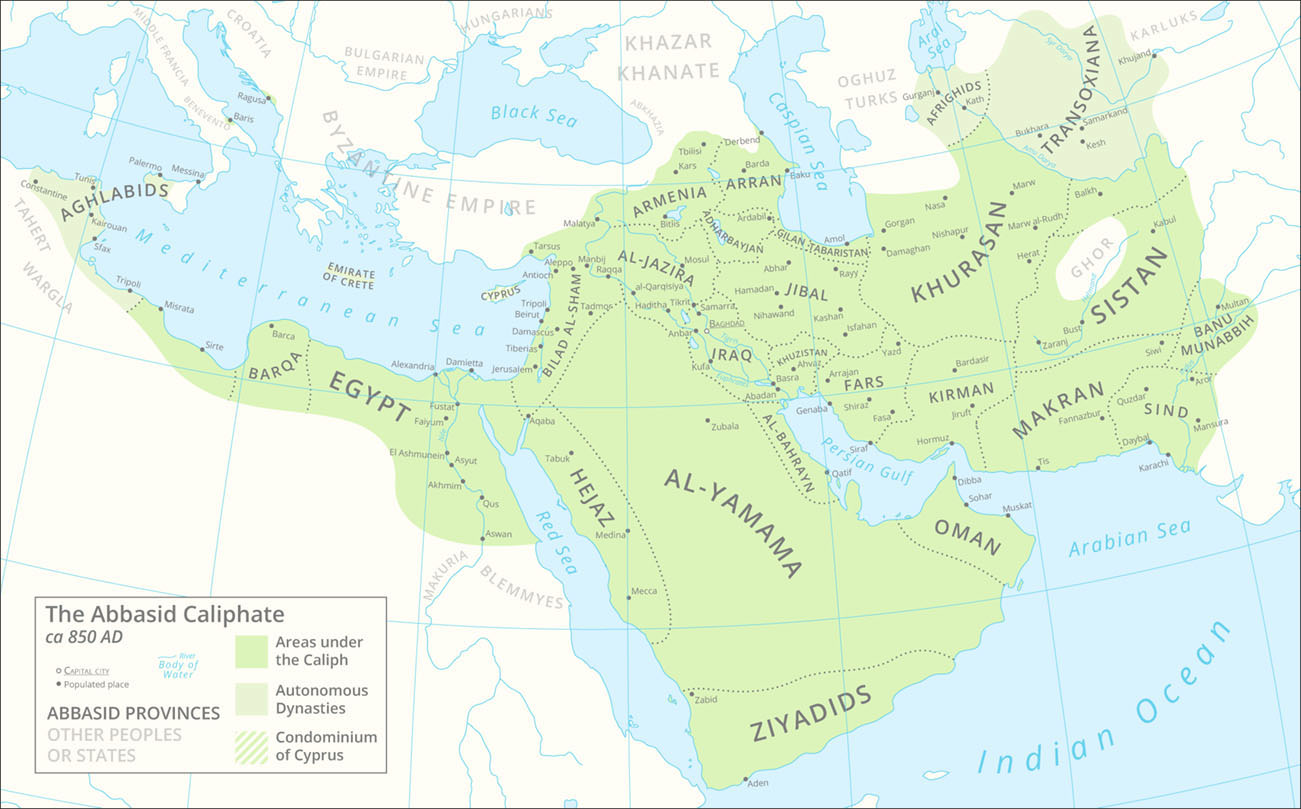
(credit: modification of work “Abbasid Caliphate 850AD” by “Cattette”/Wikimedia Commons, CC BY 4.0) · CC BY 4.0
Figure 13.11 This map shows the Abbasid Caliphate in 850, with areas listed either by their regional name in Arabic or by the ruling dynasty. The caliphate stretched from the territory in North Africa held by the Aghlabids in the west to the region of Transoxiana in the east. The heartland was in Iraq in the center. (credit: modification of work “Abbasid Caliphate 850AD” by “Cattette”/Wikimedia Commons, CC BY 4.0)
図13.11 850年のアッバース朝を示す地図。地域は、アラビア語の地名、または支配王朝の名で表示されている。西は北アフリカのアグラブ朝領から、東はトランスオクシアナまで広がり、中心部のイラクが中核をなした。(出典:「Cattette」/Wikimedia Commons「Abbasid Caliphate 850AD」を改変、CC BY 4.0)
The early Abbasid caliphs were successful in establishing a centralized administration and easing some of the ethnic tension that had undone the Umayyad dynasty. Other problems went unresolved, however, and new ones arose that the Abbasid rulers struggled to manage. To create an army that was loyal solely to the Abbasid ruler, early ninth-century caliphs began to use enslaved men of Turkic origins. These soldiers, called mamluks, were often young boys taken from their homes, converted to Islam, and trained as soldiers. Their education was provided and their social status assured; in return, they were expected to be loyal to the caliph alone.
英語のヒント
初期のアッバース朝カリフは、中央集権的な行政を築き、ウマイヤ朝を崩壊させた民族間の緊張の一部を和らげることに成功した。しかし、解決されない問題もあり、新たに生じる問題への対応にも苦しんだ。9世紀初めのカリフたちは、自分だけに忠実な軍隊を作るため、奴隷となったテュルク系の男性を用い始めた。マムルークと呼ばれたこれらの兵士は、多くの場合、故郷から連れ去られた少年たちだった。イスラームに改宗させられ、兵士として訓練を受けた。教育と社会的地位を保障される代わりに、カリフだけに忠誠を尽くすことを求められた。
The mamluks were initially useful for quelling rebellions, attacking Byzantine rivals, and enabling caliphs such as al-Mutasim to gain some security against hostile aristocrats. Al-Mutasim’s predecessors had tried to strike a balance between Persian and Arab elites, but his own power rested on the militaristic force of the mamluks. The wealth and favor shown the military, however, and especially to these Turkic soldiers, only served to erode the caliph’s position with the traditional elite. To solve this problem, al-Mutasim moved his capital from Baghdad to Samarra in northern Mesopotamia in order to segregate the Turkic soldiers from the rest of the population. After his death, the mamluks supported different successors in a vicious civil war that lasted nearly ten years. Their power and influence had become a permanent fixture in the Abbasid heartland.
英語のヒント
当初マムルークは、反乱を鎮め、ビザンツの敵を攻撃し、ムウタスィムのようなカリフに、敵対する貴族から身を守る力を与えるうえで役立った。ムウタスィムの先代のカリフたちは、ペルシア人とアラブ人の支配層の釣り合いを保とうとしたが、彼自身の権力は、マムルークの軍事力に支えられていた。しかし軍、特にこうしたテュルク系の兵士に富や恩恵を与えることは、従来の支配層との関係では、カリフの立場を弱めるばかりだった。この問題を解決するため、ムウタスィムは都をバグダードからメソポタミア北部のサーマッラーへ移した。テュルク系の兵士を、ほかの住民から隔離するためだった。その死後、マムルークは異なる後継者を支持し、約10年に及ぶ激しい内戦を戦った。彼らの権力と影響力は、アッバース朝の中核地域に恒常的に存在するものとなっていた。
The Abbasid rulers also faced religious divisions and criticism, even as the cosmopolitan nature of the caliphate sparked the growth of speculative philosophy and rationalizing thought. For example, philosophers like al-Farabi and Ibn Sina delved deeply into the philosophy of the ancient Greeks, including their systems of logic and medicine. They promoted new ways of approaching philosophy and made contributions to science, law, and theology that later influenced the thought of Christian philosophers in Europe. These Islamic scholars translated ancient philosophical texts into Arabic that Christian scholars later translated into Latin. However, the fact that these two leading figures were not Arabs, and that they applied human reason to the truths of Islam, antagonized religious conservatives and fostered discontent with the worldly caliphs. The Abbasid cultural renaissance was a remarkable achievement, but the Abbasid leadership was not celebrated by all.
英語のヒント
アッバース朝の支配者たちは、宗教的な分裂や批判にも直面した。その一方で、カリフ国の国際的な性格は、思弁哲学や理性を重視する思考の発展を促していた。たとえばファーラービーやイブン・スィーナーのような哲学者は、論理学や医学の体系も含め、古代ギリシアの哲学を深く探究した。彼らは哲学への新しい接近法を広め、科学、法、神学に貢献した。その成果は、後にヨーロッパのキリスト教哲学者の思想に影響した。これらのイスラームの学者が古代の哲学文献をアラビア語へ訳し、後にキリスト教の学者が、それをラテン語へ訳した。しかし、この二人の重要人物がアラブ人ではなかったこと、イスラームの真理を人間の理性で考えたことは、宗教的保守派の反感を招き、世俗的なカリフへの不満を育てた。アッバース朝の文化的再生は目覚ましい成果だったが、その指導者たちを、すべての人がたたえたわけではなかった。
One of the most important and enduring religious developments in the Abbasid period was the growth of a mystical form of Islam known as Sufism. Sufism was organized into “brotherhoods,” each of which followed the teachings and practices of its founders in the pursuit of heartfelt and personal worship of God. Sufis behaved like monks in other religions, renouncing the artificial performance of religious duties, as well as luxury and worldliness, to embrace a life dedicated to mystical union with God. Some Sufis also rejected the rationalization of religion and criticized the incorporation of Greek philosophy into Islamic theology. Though Sufism was not a political movement, its search for spiritual purity and rejection of classical philosophy weakened the position of the Abbasids.
英語のヒント
アッバース朝時代の、最も重要で長く影響を残した宗教上の発展の一つは、スーフィズムと呼ばれるイスラーム神秘主義の成長だった。スーフィズムは「同胞団」を形成し、それぞれが創始者の教えと実践に従い、神を心から個人的に崇拝することを求めた。スーフィーたちは、ほかの宗教の修道者のように振る舞った。形だけの宗教的義務の遂行、ぜいたく、世俗性を捨て、神との神秘的な合一に捧げる生活を選んだ。宗教を理性で説明しようとすることを拒み、イスラーム神学へのギリシア哲学の導入を批判するスーフィーもいた。スーフィズムは政治運動ではなかったが、精神の純粋さを求め、古典哲学を拒む姿勢は、アッバース朝の立場を弱めた。
As the Abbasid rulers struggled to maintain control over the heartland in Mesopotamia and Persia, the political and cultural unity of the Islamic world began to decline. Dynasties that viewed the Abbasids as too corrupt or too distant began to splinter off. In Spain and North Africa, the Amazigh Idrisid dynasty in Morocco and the Aghlabids in Algeria drifted away from Abbasid control. On the eastern fringes, Persian and Turkic dynasties openly contested the authority of the Abbasid Caliphate without formally dissolving it. This process of growing disunity is called political devolution, in which powers once assumed by a centralized state are taken over by local authorities.
英語のヒント
アッバース朝の支配者が、メソポタミアとペルシアの中核地域の支配を保つのに苦しむにつれ、イスラーム世界の政治的・文化的な統一は衰え始めた。アッバース朝を腐敗しすぎている、あるいは遠すぎる存在とみなした王朝が、分離し始めたのである。スペインと北アフリカでは、モロッコのアマジグ系イドリース朝や、アルジェリアのアグラブ朝が、アッバース朝の支配から離れていった。東の周辺部では、ペルシア系・テュルク系の王朝が、アッバース朝カリフ国を正式には解体しないまま、その権威を公然と争った。こうして統一が失われていく過程は、政治的な権限の地方への移行と呼ばれる。かつて中央集権国家が担っていた権力を、地方の権力者が引き継ぐのである。
The worldliness of the Abbasid culture offended religious conservatives. For example, the scholar al-Ghazali criticized the incorporation of Greek speculative thought when speaking of Islamic beliefs. The caliphs’ support for Persian culture and literature, as well as the power given to Persian families and scholars, alienated the Arab elites. An entrenched and powerful bureaucracy, as well as the use of the mamluks, made the Abbasid government look corrupt and weak. The most significant blow to Abbasid power was the ability of rivals to establish their own states and claim the title of caliph, as well as the arrival of powerful Turkic tribes like the Seljuks in the Abbasid heartland.
英語のヒント
アッバース朝文化の世俗性は、宗教的保守派の反感を買った。たとえば学者ガザーリーは、イスラームの信仰を論じる際に、ギリシアの思弁思想を持ち込むことを批判した。カリフがペルシアの文化や文学を後援し、ペルシア人の家系や学者に権力を与えたことは、アラブ人の支配層を遠ざけた。強く根を張った官僚機構と、マムルークの使用も、アッバース朝政府を腐敗し、弱体化した存在に見せた。権力に最も大きな打撃を与えたのは、対抗者たちが自らの国家を築いてカリフを名乗れるようになったこと、そしてセルジュークのような強力なテュルク系部族が、アッバース朝の中核地域へ入ってきたことだった。