第13章ローマ後の西欧と十字軍運動The Post-Roman West and the Crusading Movement
Pope Urban II and the Council of Clermont教皇ウルバヌス2世とクレルモン公会議
In 1095, facing invasion on all sides, the Byzantine ruler Alexios I sent ambassadors to plead for help from the pope and an opportunity for a reconciliation between the two churches. Pope Urban II was a supporter of church reform, and that put him at odds with German emperors like Henry IV, who insisted on his own right to appoint bishops, even the bishop of Rome. To avoid being in Italy when Henry was, Urban traveled throughout western Europe, preaching repentance from sins and obedience to the church. He answered the Byzantine emperor’s call for aid, but in a way Alexios was probably not expecting.
英語のヒント
1095年、各方面からの侵入に直面していたビザンツの支配者アレクシオス1世は、教皇に援助を求め、東西教会の和解の機会を得るため、使節を派遣した。教皇ウルバヌス2世は教会改革の支持者で、それがハインリヒ4世のようなドイツ皇帝との対立を招いていた。ハインリヒは、ローマ司教を含む司教の任命権は自分にあると主張した。ハインリヒがイタリアにいるとき、自分もそこにいる状況を避けるため、ウルバヌスは西ヨーロッパ各地を巡り、罪の悔い改めと教会への服従を説いた。ビザンツ皇帝の援助要請には応じたが、それはおそらく、アレクシオスの予想とは違う方法だった。
Urban II presented his idea of religious war in response to the Byzantine request for aid at a council in Clermont, France, in 1095. While the council was ostensibly about reform, Urban also issued a call for Christians from all walks of life to undertake an “armed pilgrimage” to liberate the Christian Holy Land (the lands of the eastern Mediterranean associated with the life of Jesus and the biblical prophets, including Jerusalem) from “Turkic” control. Urban’s goal at this point was to free the Holy Land from non-Christian rulers in defense of the Christians living there; it was not a blanket endorsement of violence against Muslims. These limitations were later eased, however, as the popes discovered the power of calling repeated crusades to promote the reforming goals of the church and to compete with political rivals in Europe, like the German emperors.
英語のヒント
ウルバヌス2世は、ビザンツ帝国の援助要請を受け、1095年、フランスのクレルモンで開かれた公会議で、宗教のための戦争という構想を示した。公会議の表向きの議題は改革だったが、ウルバヌスは同時に、あらゆる境遇のキリスト教徒に「武装巡礼」を呼びかけた。キリスト教の聖地、すなわちエルサレムを含む、イエスや聖書の預言者たちの生涯にゆかりのある東地中海の地を、「テュルク人」の支配から解放するというものだった。この時点でのウルバヌスの目標は、現地のキリスト教徒を守るため、聖地を非キリスト教徒の支配から解放することだった。ムスリムに対する暴力を、無条件に認めたわけではない。だが教皇たちは、教会改革を推し進め、ドイツ皇帝などヨーロッパの政敵と争ううえで、繰り返し十字軍を呼びかけることの力を知り、のちには、この制限を緩めた。
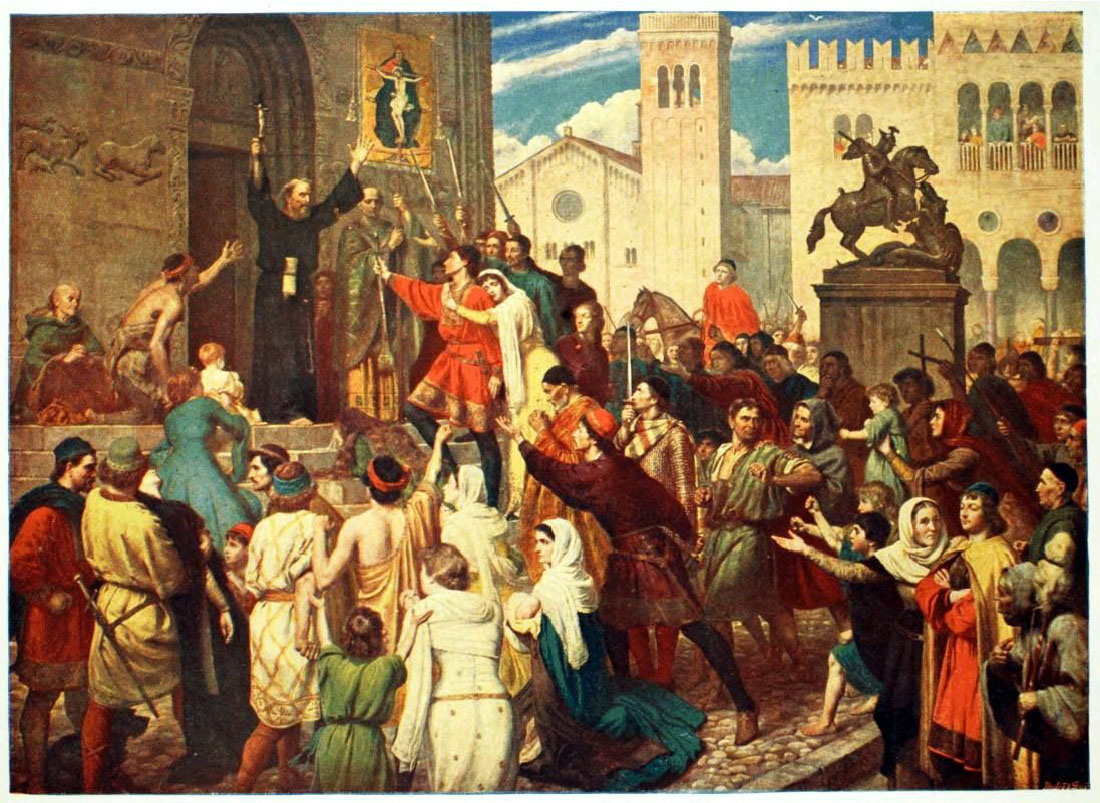
While the Byzantine emperor wanted aid for his realm, Urban instead sent the crusaders to Jerusalem. Urban’s directive to “liberate Jerusalem” and support the Christians in the Middle East was clever. Few Europeans knew or cared about the problems of Constantinople, but the church’s reforming and educational efforts had made the life of Jesus in Jerusalem and the early Christian community there a focal point in people’s imaginations. Catholics prized relics of saints as a means of fostering their devotion and bringing them closer to the divine, and Jerusalem was in effect an enormous relic, a gateway to heaven itself. Preachers like Peter the Hermit whipped up crowds of men and women with the idea of a glorious pilgrimage to the most sacred of cities (Figure 13.17). The call to crusade stirred western Christians into action, soldiers and knights as well as poor peasants and zealots.
英語のヒント
ビザンツ皇帝が自国への援助を望んだのに対し、ウルバヌスは十字軍をエルサレムへ向かわせた。「エルサレムを解放し」、中東のキリスト教徒を支援せよという指示は、巧みだった。コンスタンティノープルの問題を知り、気に掛けるヨーロッパ人は少なかった。しかし教会の改革と教育の取り組みによって、エルサレムでのイエスの生涯と、そこにあった初期キリスト教の共同体は、人々の想像力を引き付ける中心になっていた。カトリックの信徒は、信心を深め、神聖なものに近づく手段として、聖人の遺物を大切にした。エルサレムは、いわば巨大な聖遺物であり、天国そのものへの入り口だった。隠者ピエールのような説教者は、最も神聖な都への栄光ある巡礼という考えで、男女の群衆を熱狂させた(図13.17)。十字軍への呼びかけは、兵士や騎士だけでなく、貧しい農民や熱烈な信仰者を含む西方のキリスト教徒を、行動へと駆り立てた。
Peter the Hermit Preaching the First Crusade.第1回十字軍への参加を説く隠者ピエール
(credit: “Peter the Hermit Preaching the First Crusade” by Cassell’s History of England, Vol. 1 (of 8)/Wikimedia Commons, Public Domain) · Public Domain
Figure 13.17 This painted illustration from a world history published in the early twentieth century imagines Peter the Hermit giving a rousing speech to attract men and women to go on crusade. In many ways, it is representative of a modern perception of the popularity (and virtue) of the crusading movement from the perspective of western Christian society of the period. The reality, however, was much more nuanced. (credit: “Peter the Hermit Preaching the First Crusade” by Cassell’s History of England, Vol. 1 (of 8)/Wikimedia Commons, Public Domain)
図13.17 20世紀初めに刊行された歴史書の挿絵で、男女に十字軍への参加を促す、隠者ピエールの熱烈な演説を想像して描いたもの。当時の西方キリスト教社会の視点から見た十字軍運動の人気と美徳について、近代の人々が抱いた見方を、多くの点で表している。しかし実際の状況は、はるかに複雑だった。(出典:Cassell’s History of England, Vol. 1 (of 8)/Wikimedia Commons「Peter the Hermit Preaching the First Crusade」、パブリックドメイン)
Urban also hoped to restore unity to the church by offering help to the Byzantine Empire. What we know of his speeches shows how he tied this effort together with his reform program. Freeing Jerusalem from “the wicked” would mirror the rallying cries to free the church from aristocratic control. After all, the reason Urban called for the crusade while in France was that he had to contend with a rival pope, supported by the German emperor, who had occupied Rome since before Urban became pope. Urban was also likely concerned about guarding the frontiers of Christianity, which compelled him to insist that Spanish Christians should not go on this pilgrimage because they were needed at home in the persistent struggle against Islam in the Iberian Peninsula.
英語のヒント
ウルバヌスは、ビザンツ帝国を助けることで、教会の統一を回復することも望んだ。残されている演説の情報からは、この取り組みを自身の改革計画にどう結び付けたかが分かる。「邪悪な者」からエルサレムを解放することは、貴族の支配から教会を解放せよという呼びかけと、重なり合っていた。そもそもウルバヌスがフランスで十字軍を呼びかけたのは、ドイツ皇帝が支持する対立教皇と争わなければならなかったからだった。この対立教皇は、ウルバヌスの教皇就任以前からローマを占拠していた。ウルバヌスは、キリスト教世界の境界を守ることも気に掛けていたと思われる。そのため、スペインのキリスト教徒には、この巡礼へ行かないよう求めた。イベリア半島では、イスラームとの争いが続いており、彼らは故国で必要とされていたのである。
Finally, Urban’s ability to inspire the people of Europe signaled the influence he wielded over Christians at large. The popes had no armies, and they often had to depend on the unreliable aristocracy for protection when disagreements over church policy resulted in armed conflict with the princes of Europe. If they were to maintain their control over the church in contests with kings and emperors, it would be useful to see what happened when a pope rallied common Christians to a religious cause as a test of faith. Thousands were willing to stitch a cross onto their clothes, a sign that they were on this special pilgrimage and the source of the word “crusade.”
英語のヒント
最後に、ヨーロッパの人々を奮い立たせる力は、キリスト教徒全体に及ぶウルバヌスの影響力を示した。教皇は軍隊を持たず、教会の方針をめぐる不一致がヨーロッパの君主との武力衝突になると、身を守るため、頼りにならない貴族たちに依存しなければならないことが多かった。王や皇帝との争いで、教会に対する支配を保とうとするなら、教皇が一般のキリスト教徒に、信仰を試す宗教上の大義への参加を呼びかけたとき、何が起こるかを見ることは、有益だった。何千人もの人々が、進んで服に十字架を縫い付けた。それは、この特別な巡礼に参加している印であり、「十字軍」を意味する英語の crusade の語源にもなった。
The Rhetoric of Holy War聖戦を説く言葉
The use of religion to justify war was not new in Christianity, or in human history. For Christian theologians, however, acts of violence put believers in the difficult position of committing a grave sin and endangering their soul. Most Christian thinkers, like Augustine of Hippo (354–430), had argued that some forms of violence had to be tolerated for the good of the community, such as punishing criminals and defending against invasion. Above all, a recognized public authority like a king was needed to publicly call for war. From this point of view, Christians had tried to identify what would be an acceptable or “just war,” but the idea of a “holy war” did not exist until the crusading period. A crusade, then, was a “just war” called by the pope, who offered spiritual rewards.
英語のヒント
戦争を正当化するために宗教を使うことは、キリスト教においても、人類の歴史においても、新しいことではなかった。しかしキリスト教の神学者から見れば、暴力行為は、信徒を重い罪と魂の危機に陥れる、難しい問題だった。ヒッポのアウグスティヌス(354〜430年)のように、キリスト教の思想家の多くは、犯罪者を罰したり、侵略を防いだりするなど、共同体の利益のためには、ある種の暴力を認めざるをえないと論じてきた。何より、王のように公認された公的権威が、戦争を公に呼びかける必要があった。この観点から、キリスト教徒は、何が許される戦争、すなわち「正戦」になるかを見極めようとした。しかし「聖戦」という考えは、十字軍の時代まで存在しなかった。したがって十字軍とは、教皇が呼びかけ、霊的な報いを約束する「正戦」だった。
This technical definition of crusade does not mean that Christian rulers had always sought the pope’s blessing before attacking their non-Christian enemies. Very little prevented earlier rulers from claiming God supported their military efforts, especially against non-Christians, or from believing God condoned specific acts of violence. Charlemagne claimed as much in his wars against non-Christian peoples, forcing Saxons to convert to Christianity when he was victorious. But the idea of fighting a war against other religions was outside the boundaries of classical Christian thinking. The Christian view of violence was that it should be as limited as possible and justified as defensive. The Crusades made that technical definition problematic, and the earlier notion of crusade expanded to include Muslim kingdoms in Spain or elsewhere, non-Christian settlements in Europe, and even the domains of the pope’s political enemies in Europe. The result of the Crusades was a belief that warfare on behalf of God, even if it was neither defensive nor approved by the people, was a “just war.”
英語のヒント
この厳密な意味での十字軍の定義は、キリスト教の支配者が、非キリスト教徒の敵を攻撃する前に、いつも教皇の祝福を求めていた、という意味ではない。それ以前の支配者が、特に非キリスト教徒との戦いにおいて、神が自分の軍事行動を支持していると主張したり、個々の暴力を神が容認していると信じたりするのを、妨げるものはほとんどなかった。シャルルマーニュも、非キリスト教徒との戦争でそのように主張し、勝利するとサクソン人をキリスト教に改宗させた。だが、他の宗教を相手に戦争をするという考えは、伝統的なキリスト教思想の枠外にあった。キリスト教では、暴力をできる限り限定し、防衛として正当化するべきだとされた。十字軍は、この厳密な定義に問題を突き付けた。十字軍の初期の考え方は拡張され、スペインなどのムスリム王国、ヨーロッパの非キリスト教徒の居住地、さらにはヨーロッパにある教皇の政敵の領地まで、対象に含むようになった。その結果、防衛のためでもなく、民衆の承認を得たものでもなくても、神のための戦争であれば「正戦」だという信念が生まれた。
The images conjured by Urban, Peter the Hermit, and others implied that the Muslim occupation of the Holy Land was unjust and oppressed the Christian community. This idea of Christian suffering was linked to the earliest days of the church when, as members of an underground religion, Christians were persecuted by Rome.
英語のヒント
ウルバヌス、隠者ピエール、その他の人々が呼び起こしたイメージは、ムスリムによる聖地の占領は不正であり、キリスト教徒の共同体を抑圧している、というものだった。このキリスト教徒の苦難という考えは、キリスト教が地下で信仰されていた時代に、信徒がローマから迫害された、教会最初期の歴史に結び付けられた。
Although some historians have speculated that it was only the younger sons of aristocrats, those who could not hope to inherit anything from their fathers, who fervently joined the crusade, the reality was more complicated. Commoners (even poor ones), women, the sick, and the elderly all joined alongside knights, and powerful nobles also answered the call. Many sacrificed their own land and property to gain the resources needed to join the crusading movement. The trek to Constantinople alone was arduous, with few amenities or roads to guide the way. Some may have hoped to gain land if they remained in the Holy Land, and others were motivated simply to see the earthly Jerusalem as a way of experiencing the heavenly Jerusalem that awaited them when they died, and then returned home.
英語のヒント
歴史家の中には、熱心に十字軍へ参加したのは、父から何も相続できそうにない、貴族の次男以下の息子たちだけだった、と推測した人もいる。しかし実態はもっと複雑だった。騎士と並んで、庶民、貧しい人々、女性、病人、老人までが参加し、有力な貴族も呼びかけに応じた。参加に必要な資金や物資を得るため、自分の土地や財産を犠牲にした者も多かった。コンスタンティノープルまでの道のりだけでも困難で、利用できる設備や、道しるべとなる道路は乏しかった。聖地にとどまれば土地を得られると期待した人もいただろう。ほかには、死後に待つ天上のエルサレムを体験する手段として、ただ地上のエルサレムを見たいと願い、その後、故郷へ帰った人もいた。
Others had less altruistic motives. The rhetoric preached about non-Christians made Jewish communities, like those in the Rhineland, vulnerable to attack by crusaders seeking plunder, who extorted bribes from Jewish communities to leave them in peace. Even those whose motivations were clearly religious, like Peter the Hermit, compelled German Jewish people to render supplies for their crusading bands. Although the church condemned violence, the Crusades mark the beginning of precarious times for Jewish communities in Christian Europe, when they were subject to abuse, expulsion, and sudden violence.
英語のヒント
他者のためとはいえない動機を持つ者もいた。非キリスト教徒について説かれた言葉は、ラインラントなどのユダヤ人共同体を、略奪を求める十字軍の攻撃にさらした。十字軍は、危害を加えない代わりに金を出せと、ユダヤ人共同体から金品を強奪した。隠者ピエールのように、動機が明らかに宗教的だった者さえ、ドイツのユダヤ人に、十字軍の一隊へ物資を供給するよう強いた。教会は暴力を非難したが、十字軍は、キリスト教ヨーロッパのユダヤ人共同体にとって、不安定な時代の始まりを画した。彼らは虐待、追放、突然の暴力にさらされるようになった。
Unlike classical Christianity, Islam from its earliest days had a concept of holy war called jihad. Jihad, meaning “struggle” in Arabic, can have different meanings or uses. For the Sufi mystics, the struggle against internal doubt and weakness could be a form of jihad. In other circumstances, the struggle was against evil, in which Christians, Muslims, and Jewish people could participate as allies. Defining jihad is similar to the problem of defining crusade and distinguishing it from other conflicts. In the Quran, Muslims were enjoined to avoid conflict with Christians and Jewish people unless they provoked Muslims in some way. Like the notion of “crusade,” jihad had to be called by a proper authority, such as the caliph or a high-ranking Muslim cleric. In some ways, then, jihad is similar to the idea of a “just war” for Christianity. In practice, however, Muslim rulers, like Christian rulers, could certainly wage war against their nonbelieving neighbors without a formal declaration of jihad, while still claiming their actions were for the benefit of Islam and supported by Allah.
英語のヒント
伝統的なキリスト教とは異なり、イスラームには、その最初期からジハードと呼ばれる聖戦の考え方があった。アラビア語で「努力・奮闘」を意味するジハードには、さまざまな意味や用法がある。スーフィーの神秘主義者にとっては、内面の疑いや弱さとの闘いも、ジハードの一形態となりえた。別の場合には、悪との闘いを意味し、キリスト教徒、ムスリム、ユダヤ人が、味方同士として参加できた。ジハードを定義する問題は、十字軍を定義し、ほかの争いと区別する問題に似ている。クルアーンでは、キリスト教徒やユダヤ人が、何らかの形でムスリムを挑発しない限り、彼らとの争いを避けるよう命じられていた。「十字軍」と同じく、ジハードも、カリフや高位のムスリム聖職者のような、適切な権威を持つ者が呼びかける必要があった。この点で、ジハードは、キリスト教の「正戦」の考え方に似ている。しかし実際には、ムスリムの支配者も、キリスト教徒の支配者と同様に、ジハードの正式な宣言なしに、近隣の異教徒に戦争を仕掛けることができた。そして、自分の行動はイスラームの利益となり、アッラーに支持されていると、なおも主張できた。
According to Islam, Jewish people and Christians should be tolerated because they are monotheistic. In most instances, though, the idea of endeavoring to realize the will of God meant that armed conflict and conquest were also options. A ruler who was not concerned with striving against non-Muslims was viewed as failing in his duties. Similar ideas began to color Christian views of their own conflicts with Islam, especially in places like Spain. One such thought was that territories that had once been Christian should always belong to Christians, and this was considered particularly true of the Holy Land, even though the area was significant to Muslims and Jewish people as well. It was difficult to find nuance when attempting to carry out the will of God.
英語のヒント
イスラームの考え方では、ユダヤ人とキリスト教徒は、一神教徒であるため、受け入れるべきだった。しかし多くの場合、神の意志を実現しようと努力するという考えは、武力紛争と征服も選択肢となることを意味した。非ムスリムとの闘いに関心を示さない支配者は、義務を果たしていないとみなされた。スペインなどでは、イスラームとの戦いをめぐるキリスト教徒の見方にも、似た考え方が影響し始めた。その一つが、かつてキリスト教徒のものだった領土は、いつまでもキリスト教徒に属するべきだ、という考えだった。特に聖地には、これが当てはまるとされた。その地が、ムスリムやユダヤ人にとっても重要であることは、考慮されなかった。神の意志を実行しようとする場面では、物事の微妙な違いを見極めることは難しかった。