第15章現代世界と続く課題The Contemporary World and Ongoing Challenges
15.4 Ongoing Problems and Solutions15.4 続く問題と解決策
Learning Objectives学習の目標
By the end of this section, you will be able to:
この節を学び終えると、次のことができるようになる。
Describe threats to global peace and security since the end of the Cold War
冷戦終結以降の、世界の平和と安全への脅威を説明する。
Identify some consequences of migration and refugee resettlement in Europe and the United States
移民と難民の再定住がヨーロッパとアメリカにもたらした結果を挙げる。
Identify recent and current threats to human rights around the world
近年と現在、世界各地で人権を脅かしているものを挙げる。
Analyze the effects on poorer nations of the increasing division between the Global North and the Global South
グローバル・ノースとグローバル・サウスの分断の拡大が、貧しい国々に与える影響を分析する。
On February 24, 2022, the world watched in horror and frustration as Russian tanks rolled across the Ukrainian border and began bombing cities around the former Soviet republic. This was the second time in fewer than ten years that Russian troops had invaded the nation. In 2014, Russian forces had annexed the Ukrainian region of Crimea. While both invasions were decades in the making, to many they seemed like a rerun of a bygone era. Those who had watched Soviet tanks roll into Budapest and Prague to quell uprisings in the 1950s and 1960s saw the invasion of 2014 and the violence of 2022 as a reminder that some problems, no matter how far in the past, remain unresolved.
英語のヒント
2022年2月24日、ロシアの戦車がウクライナの国境を越え、かつてのソビエト連邦の共和国の各都市を砲撃し始めるのを、世界は恐怖とやりきれなさの中で見守った。ロシア軍がこの国に侵攻するのは、10年足らずで二度目だった。2014年、ロシア軍はウクライナのクリミア地域を併合していた。両侵攻に至る事情は何十年もかけて形成されていたが、多くの人には過ぎ去った時代の再演のように見えた。1950年代と1960年代、蜂起を鎮めるためソビエトの戦車がブダペストとプラハに進入するのを見た人々は、2014年の侵攻と2022年の暴力を、どれほど昔のことになっても未解決のまま残る問題があるという警告として受け止めた。
Instability in the Post–Cold War World冷戦後の世界の不安定さ
When the Soviet Union dissolved on December 31, 1991, most in the West celebrated the end of the Cold War, believing that a new world that would uniformly embrace liberal democracy and capitalism was in the process of being born. Political scientist Francis Fukuyama even published a book on the idea in 1992 called The End of History and the Last Man. The argument presented in the book was that the world had been marching toward a Western liberal democratic future for centuries, and with the Soviet Union gone, it had reached the inevitable end of its “ideological evolution.” With the United States as the only remaining superpower, many also assumed the Cold War’s bipolar world would soon evolve into a mostly unipolar one based on U.S. military, cultural, and economic dominance.
英語のヒント
1991年12月31日にソビエト連邦が解体すると、西側の大多数は冷戦の終結を祝い、自由民主主義と資本主義を一様に受け入れる新世界が生まれつつあると考えた。政治学者フランシス・フクヤマは1992年、その考えを扱った『歴史の終わりと最後の人間』という本まで出版した。同書の主張は、世界は何世紀にもわたり西側の自由民主主義の未来へ進んできたのであり、ソビエト連邦の消滅とともに「イデオロギー的進化」の必然的な終着点へ到達した、というものだった。残る超大国がアメリカだけとなったため、多くの人はまた、冷戦の二極世界が、アメリカの軍事・文化・経済上の支配を基礎とする、ほぼ一極の世界へと間もなく変わると考えた。
With this idea in mind, U.S. president Bill Clinton drafted a foreign policy platform geared to revising and expanding the North Atlantic Treaty Organization (NATO), the alliance for mutual defense forged by the United States and other Western democracies during the Cold War. Clinton aimed to strengthen relationships in Asia, bring post–Soviet Russia into the international community, and address ethnic and political strife in the Middle East, the Balkans, Northern Ireland, Latin America, and East Africa. These goals occasionally required using the country’s military, such as in 1995 when Clinton sent a force of twenty thousand to the Balkans as part of a NATO operation to enforce a cease-fire and protect upcoming elections.
英語のヒント
この考えを念頭に、アメリカのビル・クリントン大統領は、北大西洋条約機構(NATO)の再編と拡大を目指す外交方針を立案した。NATOは冷戦中、アメリカと他の西側民主主義国が結成した相互防衛同盟だった。クリントンは、アジアでの関係強化、ソ連崩壊後のロシアの国際社会への統合、中東、バルカン、北アイルランド、ラテンアメリカ、東アフリカの民族的・政治的紛争への対処を目指した。これらの目標には、時に軍隊を使う必要があった。たとえば1995年には、停戦を実施させ、来る選挙を守るNATOの作戦の一環として、クリントンは2万人の部隊をバルカンへ派遣した。
One of the most pressing concerns for the United States and the world, however, was the need to secure the thirty-five thousand nuclear weapons then installed in thousands of sites around Eurasia. Many were in states that had separated from the former Soviet Union such as Ukraine, Kazakhstan, and Belarus. Because these countries were going through a difficult period of transition and instability, many feared that non-state actors, meaning terrorist groups not tied to a specific country, might gain access to the armaments or the material necessary to make them and cause catastrophic damage. Some of the work had begun even before the Soviet Union collapsed. In the summer of 1991, the United States and the Soviet Union had signed the Strategic Arms Reduction Treaty (START), agreeing to each reduce their arms stockpiles by more than 80 percent.
英語のヒント
しかしアメリカと世界にとって、最も差し迫った懸念の一つは、ユーラシア全域の数千か所に配備された3万5千発の核兵器の安全を確保することだった。その多くは、ウクライナ、カザフスタン、ベラルーシなど、旧ソビエト連邦から分離した国々にあった。これらの国が移行と不安定さの困難な時期を通っていたため、特定の国に属さないテロ集団を意味する非国家主体が、兵器やその製造に必要な物質を入手し、壊滅的な被害を引き起こしかねないと多くの人が恐れた。一部の作業はソビエト連邦崩壊前から始まっていた。1991年夏、アメリカとソビエト連邦は戦略兵器削減条約(START)に調印し、それぞれの兵器備蓄を80パーセント以上減らすことに合意していた。
After the disintegration of the USSR, however, the need to secure these stockpiles became more pressing. The solution proposed by the United States and supported by Russia was to denuclearize those states that had split from the former Soviet Union but still possessed nuclear weapons. While successful, the effort did run into some difficulties, particularly in Ukraine, which felt that preserving its nuclear weapons would be the best way to deter Russian belligerence in the future. Only after it had secured assurances from the international community that its borders would be respected did Ukraine allow its nuclear weapons to be removed and disassembled in Russia.
英語のヒント
しかしソ連の解体後、こうした備蓄の安全を確保する必要は一段と切迫した。アメリカが提案しロシアが支持した解決策は、旧ソビエト連邦から分離したものの核兵器を保有し続けていた国々を非核化することだった。取り組みは成功したが、確かに困難にも直面した。特にウクライナは、将来のロシアの好戦的行動を抑止するには核兵器の保持が最良の方法だと考えた。国境が尊重されるという確約を国際社会から得て初めて、ウクライナは自国の核兵器を搬出し、ロシアで解体することを認めた。
Nuclear proliferation elsewhere around the world was also a problem. India, for example, had become a nuclear power in 1974. At the time, it claimed it was not pursuing nuclear weapons capability, but since then, it has embraced these weapons as an important part of its security platform. Given the history of hostility between India and Pakistan, international observers in the 1970s worried about the implications of a nuclear-armed India. Some of these fears were realized in 1998 when Pakistan tested its first nuclear weapons, a goal toward which it had been building since before India became a nuclear power. While India maintains a no-first-use doctrine for its nuclear weapons, Pakistan has not reciprocated. Today, the countries have approximately one hundred nuclear weapons each, as well as long-range ballistic missile delivery systems.
英語のヒント
世界の他の地域でも核拡散が問題となった。たとえばインドは1974年に核保有国となった。当時は核兵器能力を追求していないと主張したが、それ以降、安全保障政策の重要な一部として核兵器を受け入れてきた。インドとパキスタンの敵対の歴史を考慮し、1970年代の国際的な観察者はインドの核武装の影響を懸念した。その不安の一部は、1998年にパキスタンが初の核実験を行うことで現実となった。パキスタンは、インドが核保有国になる前から、この目標に向けて準備を進めていた。インドは核兵器の先制不使用の方針を保つが、パキスタンは同様の対応をしていない。今日、両国はそれぞれ約100発の核兵器と、長距離弾道ミサイルによる運搬システムを保有している。
Only a few years after Pakistan tested its first nuclear weapon, the illusion of an enduring post–Cold War peace was further shaken when on September 11, 2001, nineteen militant Islamic hijackers took control of four large passenger airplanes and crashed two of them into New York City’s World Trade Center (Figure 15.24), one into the Pentagon, and the fourth—after its path was deflected by passengers—into a field in Shanksville, Pennsylvania. It was soon determined that the terrorist attack, which killed nearly three thousand people from many nations, had been orchestrated by al-Qaeda, an Islamic terrorist organization then based in Afghanistan that was financed and led by a militant Saudi Arabian national named Osama bin Laden. According to bin Laden, the attack was carried out in response to U.S. support for Israel and its continued military presence in the Middle East.
英語のヒント
パキスタンの初の核実験からわずか数年後、冷戦後の平和が永続するという幻想は、さらに揺さぶられた。2001年9月11日、イスラーム過激派のハイジャック犯19人が大型旅客機4機を乗っ取り、2機をニューヨークの世界貿易センター(図15.24)に、1機を国防総省に激突させた。4機目は乗客によって進路を変えられた後、ペンシルベニア州シャンクスビルの野原に墜落した。多くの国の出身者を含む約3千人を殺したこのテロ攻撃は、当時アフガニスタンを拠点としたイスラーム系テロ組織アルカーイダが組織したと、間もなく判明した。同組織は、ウサマ・ビンラディンというサウジアラビア国籍の過激派活動家が資金を提供し、率いていた。ビンラディンによれば、攻撃はアメリカのイスラエル支援と、中東での継続的な軍事的駐留に応じて行われた。
September 11, 2001.2001年9月11日。
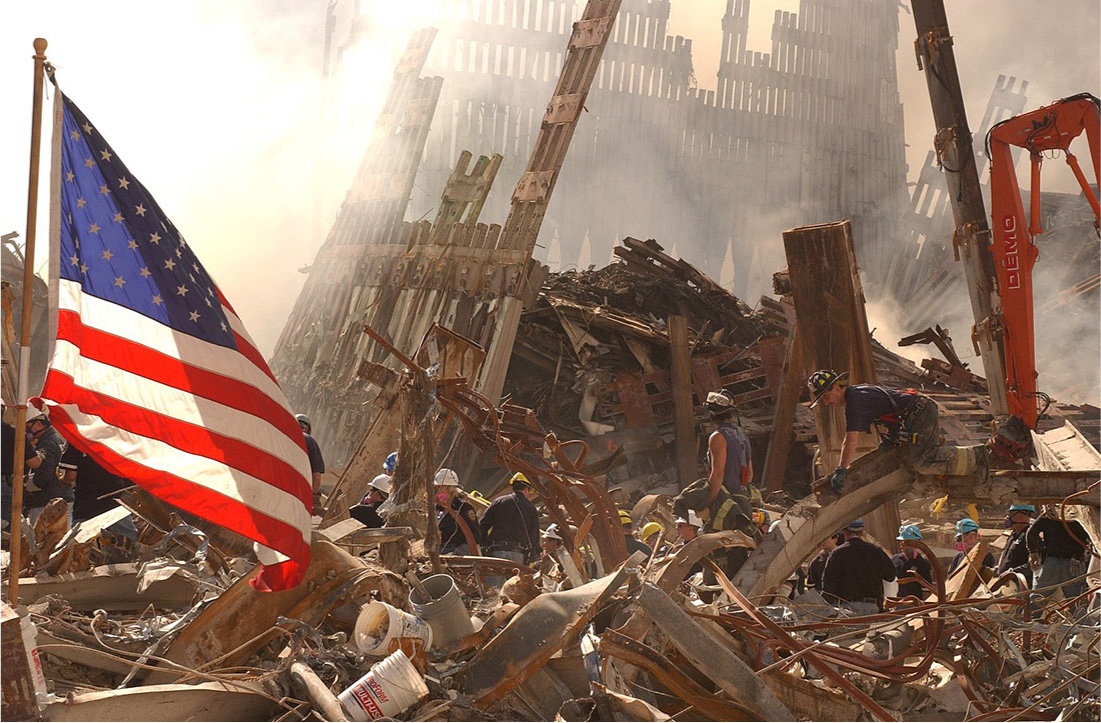
(credit: “New York, NY, September 19, 2001 -- Rescue workers climb over and dig through piles of rubble from the destroyed World Trade Center as the American flag billows over the debris” by Andrea Booher/Wikimedia Commons, Public Domain) · Public Domain
Figure 15.24 Less than two hours after hijackers flew two jetliners into the World Trade Center in New York, both its towers crumbled to the ground in a pile of rubble. Those still inside were all killed. (credit: “New York, NY, September 19, 2001 -- Rescue workers climb over and dig through piles of rubble from the destroyed World Trade Center as the American flag billows over the debris” by Andrea Booher/Wikimedia Commons, Public Domain)
図15.24 ハイジャック犯が2機の旅客機をニューヨークの世界貿易センターに激突させてから2時間もたたないうちに、両棟は崩落し、瓦礫の山となった。まだ内部にいた人々は全員死亡した。(クレジット:Andrea Booher/Wikimedia Commons「New York, NY, September 19, 2001 -- Rescue workers climb over and dig through piles of rubble from the destroyed World Trade Center as the American flag billows over the debris」、パブリックドメイン)
After assessing the damage and collecting global support, the United States launched an attack on Afghanistan with the stated purpose of finding those responsible. This offensive represented the beginning of the U.S. war on terror and resulted in the collapse of Afghanistan’s Islamic fundamentalist Taliban government, many of whose officials fled to the southern parts of the country or into neighboring Pakistan. Most of al-Qaeda’s leadership also escaped, however, including Osama bin Laden. Over the next several years, the U.S. military pursued a policy of eliminating al-Qaeda, rebuilding civil society and infrastructure in Afghanistan, and propping up a democratically elected regime in the country. These efforts were made more difficult, however, by the decision of President George W. Bush to launch a war against Iraq in 2003.
英語のヒント
被害を評価し世界の支持を集めた後、アメリカは実行の責任者を見つけるという目的を掲げてアフガニスタンを攻撃した。この攻勢はアメリカの「テロとの戦い」の始まりとなり、アフガニスタンのイスラーム原理主義的なタリバン政権は崩壊した。政権の幹部の多くは南部や隣国パキスタンへ逃亡した。しかしウサマ・ビンラディンを含むアルカーイダ指導部の大半も逃れた。その後の数年間、アメリカ軍はアルカーイダの排除、アフガニスタンの市民社会と基盤設備の再建、民主的選挙で選ばれた同国の政権の支援を目指した。しかしジョージ・W・ブッシュ大統領が2003年にイラクとの戦争を始めると決めたことにより、これらの取り組みは一層困難になった。
The United States supported Iraq during the Iran-Iraq War (1980–1988) but came into conflict with it during the Gulf War in 1990, when Iraq invaded its neighbor Kuwait. The United States, Great Britain, and thirty-three other nations came to Kuwait’s defense by bombing Iraqi targets and then launching a ground invasion. A mere one hundred hours after the coalition’s ground invasion began, Iraqi forces had retreated from Kuwait, and a cease-fire was in place. Immediately following, uprisings took place in Kurdish and Shi‛ite regions of Iraq that sought to topple President Saddam Hussein’s government. Hussein brutally crushed the attempted revolts, but the coalition forces withdrew from Iraq, leaving him in power.
英語のヒント
アメリカはイラン・イラク戦争(1980〜1988年)ではイラクを支援したが、イラクが隣国クウェートへ侵攻した1990年の湾岸戦争では、イラクと対立した。アメリカ、イギリス、その他33か国はクウェートの防衛に加わり、イラクの目標を爆撃した後、地上侵攻を開始した。多国籍軍の地上侵攻開始からわずか100時間で、イラク軍はクウェートから撤退し、停戦が成立した。直後、イラクのクルド人地域とシーア派地域で、サッダーム・フセイン大統領の政権打倒を目指す蜂起が起きた。フセインは反乱の試みを残虐に鎮圧したが、多国籍軍はイラクから引き揚げ、彼を権力の座に残した。
In 2001, in the aftermath of the September 11 terrorist attacks, U.S. foreign policy leaders began to worry that Hussein might acquire weapons of mass destruction (WMDs), possibly including biological weapons. The Bush administration wanted to prevent this and to channel the international goodwill showered on the country after the 2001 attacks toward the goal of removing the Iraqi leader. To this end, the United States built a new coalition of Asian, European, and Latin American countries. It sent Secretary of State Colin Powell to the United Nations to present the argument that Iraq had connections to al-Qaeda and possessed WMDs that made it a threat to international security (Figure 15.25). Even though at the time some in the U.S. intelligence community felt the evidence on which Powell relied was weak or flawed, to secure support for a U.S. invasion, members of the Bush administration such as Vice President Dick Cheney claimed the WMDs existed.
英語のヒント
2001年、9月11日のテロ攻撃後、アメリカの外交政策指導者は、フセインが生物兵器を含むかもしれない大量破壊兵器(WMD)を入手することを懸念し始めた。ブッシュ政権はそれを防ぎ、2001年の攻撃後にアメリカへ寄せられた国際的な好意を、イラクの指導者を排除するという目標へ向けようとした。そのため、アメリカはアジア、ヨーロッパ、ラテンアメリカ諸国の新たな連合を作った。コリン・パウエル国務長官を国連へ送り、イラクはアルカーイダとつながりがあり、国際的安全への脅威となる大量破壊兵器を保有する、と主張させた(図15.25)。当時、アメリカの情報機関の一部はパウエルの証拠が弱いか欠陥があると考えていたが、ディック・チェイニー副大統領などブッシュ政権の要人は、アメリカの侵攻への支持を確保するため、大量破壊兵器が存在すると主張した。
Colin Powell.コリン・パウエル。
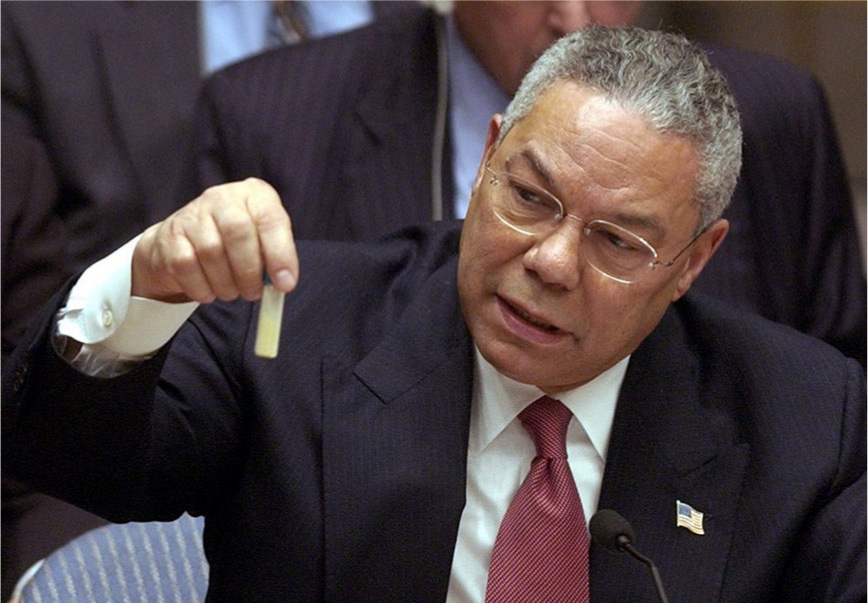
(credit: “Colin Powell anthrax vial. 5 Feb 2003 at the UN” by United States Government/Wikimedia Commons, Public Domain) · Public Domain
Figure 15.25 Secretary of State Colin Powell gave a powerful presentation about Iraq’s suspected weapons of mass destruction at the United Nations in 2003. At one point, he held up a model vial of anthrax (a bacterium that causes a serious infectious disease) to highlight the danger of biological weapons that Saddam Hussein was supposed to have. (credit: “Colin Powell anthrax vial. 5 Feb 2003 at the UN” by United States Government/Wikimedia Commons, Public Domain)
図15.25 コリン・パウエル国務長官は2003年、国連でイラクの大量破壊兵器保有疑惑について、強い印象を与える説明をした。その際、サッダーム・フセインが持つとされた生物兵器の危険を強調するため、炭疽菌(深刻な感染症を起こす細菌)の模型の小瓶を掲げた。(クレジット:United States Government/Wikimedia Commons「Colin Powell anthrax vial. 5 Feb 2003 at the UN」、パブリックドメイン)
The invasion began on March 19, 2003, just a few weeks after Powell’s presentation. By 2005, it had become obvious to the world that Iraq did not possess WMDs, and the hypothetical al-Qaeda connection had not been demonstrated. The invasion contributed to the violent unraveling of Iraqi society, however, which the coalition forces then struggled for years to bring under control. There were countless civilian casualties; Brown University’s Watson Institute for International and Public Affairs estimates that between 184,382 and 207,156 civilians were killed. While the United States could point to some successes, such as the 2005 Iraq elections and the 2006 conviction of Saddam Hussein for crimes against humanity, the nation’s reputation as a global force capable of projecting power to bring about positive change in the world had suffered greatly.
英語のヒント
侵攻は、パウエルの説明からわずか数週間後の2003年3月19日に始まった。2005年までには、イラクが大量破壊兵器を持たず、推測されたアルカーイダとの関係も立証されていないことが、世界に明らかになった。しかし侵攻はイラク社会の暴力的な崩壊を促し、多国籍軍はその後何年も、制御を取り戻すのに苦しんだ。無数の民間人が犠牲となり、ブラウン大学ワトソン国際・公共問題研究所は、民間人18万4,382人から20万7,156人が殺害されたと推計している。アメリカは2005年のイラクの選挙や2006年のフセインに対する人道に対する罪での有罪判決など、いくつかの成功を挙げることはできたが、力を及ぼして世界に良い変化をもたらせる世界的勢力という同国の評判は、大きく損なわれた。
The consequences for the United States became more obvious in October 2006 when communist North Korea launched its first nuclear weapons test, an event the U.S. government had worked for years to prevent. The test was the culmination of decades of work inside the isolated country. North Korean leaders believed nuclear weapons would guarantee its survival in the post–Cold War world. But the United States and neighboring countries like South Korea and Japan worried that the unstable North Korean regime might use the weapons against them. Given the problems in Iraq and diminished global standing of the United States, it was unclear whether North Korea could be deterred from attempting additional tests, or whether the United States could discourage Iran from pursuing a nuclear weapons program.
英語のヒント
アメリカにとっての影響は、2006年10月、共産主義国家の北朝鮮が初の核実験を実施すると、一層明らかになった。アメリカ政府は何年もその阻止に取り組んできた。実験は、孤立した同国の数十年に及ぶ取り組みの到達点だった。北朝鮮の指導者は、核兵器が冷戦後の世界で自国の存続を保証すると考えた。しかしアメリカと韓国、日本などの近隣国は、不安定な北朝鮮政権が自分たちに核兵器を使用することを恐れた。イラクでの問題とアメリカの国際的地位の低下を考えると、北朝鮮の追加実験を抑止できるか、あるいはアメリカがイランに核兵器開発計画を断念させられるかは、不透明だった。