第15章現代世界と続く課題The Contemporary World and Ongoing Challenges
The creation of Canada-US FTA and later NAFTA represented an important policy shift for the United States. Until the early 1980s, the country had largely avoided limited regional trading deals, preferring instead to seek comprehensive global agreements. Such efforts had begun relatively soon after World War II in the form of the General Agreement on Tariffs and Trade (GATT), signed in 1947 by twenty-three countries. Initially conceived as a way to reinforce other postwar economic recovery efforts, GATT was designed to prevent the reemergence of prewar-style trade barriers, to lower trade barriers overall, and to create a system for arbitrating international trade disputes. Since its initial acceptance in 1947, GATT has undergone a number of revisions, completed in sessions referred to as rounds, to promote free trade and international investments.
英語のヒント
加米自由貿易協定と後のNAFTAの成立は、アメリカの重要な政策転換を示した。1980年代初めまでは、限定的な地域貿易協定を概して避け、包括的な世界規模の協定を求めていた。その取り組みは第二次世界大戦後まもなく始まり、1947年に23か国が署名した関税と貿易に関する一般協定(GATT)という形をとった。戦後復興の他の取り組みを補強するものとして構想され、戦前型の貿易障壁の復活を防ぎ、障壁全体を低くし、国際貿易紛争を仲裁する制度を作るよう設計された。1947年の当初の合意以来、GATTは自由貿易と国際投資を促進するため、「ラウンド」と呼ぶ会合で何度も改定された。
In 1995, at the Uruguay Round, GATT transformed itself into the World Trade Organization (WTO) and cleared the path for free trade among 123 countries. Like GATT, the intent of the WTO was to support international trade, reduce trade barriers, and resolve trade disputes between countries. Unlike GATT, however, the WTO is not a free trade agreement. Rather, it is an organization that ensures nondiscriminatory trade between WTO countries. This means that trade barriers are allowed, but they must apply equally to all members. Many observers saw the creation of the WTO as a triumph of globalization, or the emergence of a single integrated global economy. China joined in 2001, a clear sign of its integration into global market systems.
英語のヒント
1995年、ウルグアイ・ラウンドでGATTは世界貿易機関(WTO)へ転換し、123か国間の自由貿易への道を開いた。GATTと同じく、WTOの目的は国際貿易を支え、貿易障壁を減らし、国家間の貿易紛争を解決することだった。しかしGATTと異なり、WTOは自由貿易協定ではなく、加盟国間の無差別貿易を確保する組織である。つまり貿易障壁は認められるが、すべての加盟国へ平等に適用しなければならない。多くの観察者は、WTOの創設をグローバル化、すなわち統合された単一の世界経済の出現の勝利とみなした。中国は2001年に加盟し、世界市場システムへの統合を明確に示した。
Because the WTO is regarded as a major force for globalization, its meetings often attract protestors who oppose corporate power and the economic, political, and cultural influence of wealthy nations in the developed world on less-developed nations. In 1999, in Seattle, Washington, a diverse group of students, labor union representatives, environmentalists, and activists of many kinds protested the abuses associated with globalization. Police confronted activists staging marches and sit-ins with rubber bullets and tear gas, and trade talks ground to a halt. Meetings of the WTO continue to attract protestors.
英語のヒント
WTOはグローバル化を進める大きな力とみなされるため、その会議には、企業の力や、先進国の富裕国が途上国へ及ぼす経済的・政治的・文化的影響に反対する抗議者が集まることが多い。1999年、ワシントン州シアトルでは、学生、労働組合の代表、環境保護主義者、さまざまな活動家が、グローバル化に伴う弊害に抗議した。警察は行進や座り込みをする活動家にゴム弾と催涙ガスで対抗し、貿易交渉は停止した。WTOの会議には今も抗議者が集まる。
As the creation of the EU and NAFTA demonstrate, the signing of international trade agreements like GATT, which was ratified by countries on six continents, did not prevent regions from establishing their own free trade blocs like MERCOSUR, the South American trading bloc created in 1991. Nor have such blocs been confined to the West. The most notable to emerge in Asia are the Association of Southeast Asian Nations (ASEAN) and the Asia-Pacific Economic Cooperation (APEC) (Figure 15.5).
英語のヒント
EUやNAFTAの成立が示すように、6大陸の国々が批准したGATTのような国際貿易協定は、地域が独自の自由貿易ブロックを作ることを妨げなかった。1991年に成立した南米の貿易ブロックMERCOSUR(メルコスール)がその例である。こうしたブロックは西側に限られもしなかった。アジアで現れた最も重要なものは、東南アジア諸国連合(ASEAN)とアジア太平洋経済協力(APEC)である(図15.5)。
Association of Southeast Asian Nations.東南アジア諸国連合。
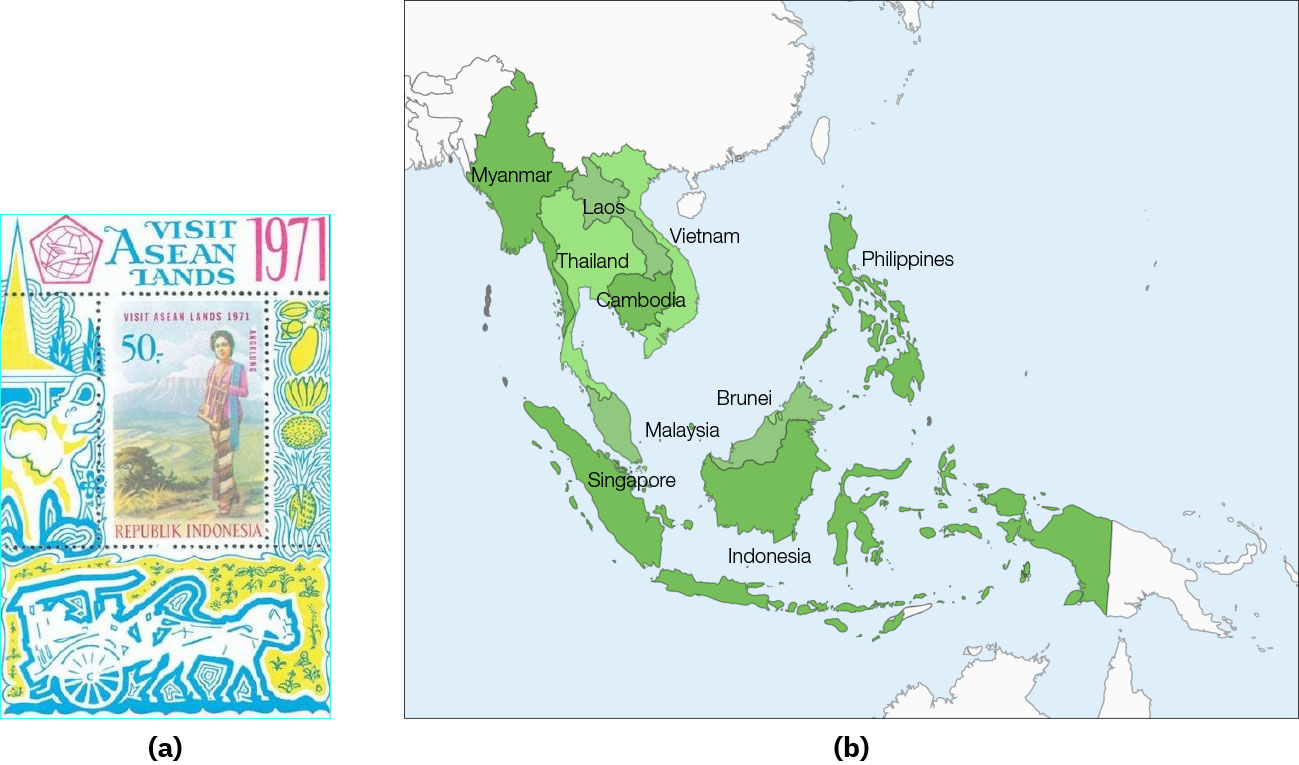
(credit a: modification of work “Stamp of Indonesia - 1971 - Colnect 257406 - Visit ASEAN South East Asian Nations Association Year” by Colnect/Wikimedia Commons, Public Domain; credit b: modification of work “Map of ASEAN member states” by “Hariboneagle927”/Wikimedia Commons, Public Domain) · Public Domain
Figure 15.5 This 1971 postage stamp (a) from Indonesia celebrates the country’s membership in ASEAN, whose member countries are highlighted in the map (b). (credit a: modification of work “Stamp of Indonesia - 1971 - Colnect 257406 - Visit ASEAN South East Asian Nations Association Year” by Colnect/Wikimedia Commons, Public Domain; credit b: modification of work “Map of ASEAN member states” by “Hariboneagle927”/Wikimedia Commons, Public Domain)
図15.5 インドネシアの1971年の郵便切手(a)は同国のASEAN加盟を祝う。加盟国は地図(b)で強調されている。(aの出典:Colnect/ウィキメディア・コモンズの「Stamp of Indonesia - 1971 - Colnect 257406 - Visit ASEAN South East Asian Nations Association Year」を改変、パブリックドメイン。bの出典:「Hariboneagle927」/ウィキメディア・コモンズの「Map of ASEAN member states」を改変、パブリックドメイン)
ASEAN had its beginnings in the 1960s when Indonesia, Malaysia, the Philippines, Singapore, and Thailand agreed to cooperate economically to foster regional development and resist the expansion of communism in Asia. Largely successful, the organization expanded in the 1980s and 1990s to include more countries. By the early 2000s, it was openly advocating the creation of EU-style integration in the area.
英語のヒント
ASEANは1960年代、インドネシア、マレーシア、フィリピン、シンガポール、タイが地域発展を促し、アジアでの共産主義拡大に抵抗するため、経済協力に合意したことに始まる。概して成功し、1980年代と1990年代には加盟国を増やした。2000年代初めまでには、EU型の地域統合の創設を公然と唱えるようになった。
APEC, launched in 1989, was in many ways a response to the growth of regional trading blocs like ASEAN and the EEC. Initially composed of twelve Asia-Pacific countries including Australia, the United States, South Korea, and Singapore, it has since grown to include Mexico, China, Chile, Russia, and more. It promotes free trade and international economic cooperation among its members.
英語のヒント
1989年に発足したAPECは、多くの点でASEANやEECのような地域貿易ブロックの成長への対応だった。当初はオーストラリア、アメリカ、韓国、シンガポールなどアジア太平洋の12か国で構成され、その後メキシコ、中国、チリ、ロシアなどへ拡大した。加盟メンバー間の自由貿易と国際的な経済協力を推進している。
Multinationals and the Push to Privatize多国籍企業と民営化への動き
The growing global economic integration represented by the rise of the WTO and regional trading blocs opened new opportunities for multinational corporations to extend their reach and influence around the world. A multinational corporation, or MNC, is a corporate business entity that controls the production of goods and services in multiple countries. MNCs are not new. Some, like the British East India Company and the Hudson’s Bay Company, exerted great influence during Europe’s imperial expansion in the early modern and modern periods. But with globalization and improvements in transportation and communication technology, MNCs have thrived, especially since the 1950s. They have used their growing wealth to lobby governments to create conditions favorable to their operation, enabling them to become even more powerful.
英語のヒント
WTOと地域貿易ブロックの台頭が示す世界経済の統合拡大は、多国籍企業が世界で活動範囲と影響力を広げる新しい機会を開いた。多国籍企業(MNC)とは、複数の国で商品とサービスの生産を統制する企業体である。新しい存在ではなく、イギリス東インド会社やハドソン湾会社などは、近世・近代のヨーロッパの帝国拡張期に大きな影響力を行使した。しかしグローバル化と輸送・通信技術の改善により、多国籍企業は特に1950年代以降に繁栄した。増大する富を使って政府に働きかけ、自社の事業に有利な条件を作らせ、それによってさらに強力になった。
Multinationals have also benefited greatly from the lowering of trading barriers around the world. These developments have encouraged major automobile manufacturers like Volkswagen, Toyota, Chevrolet, Kia, and Nissan to build and operate assembly plants in Mexico, for example, where workers are paid lower wages than they are in countries like Germany, Japan, South Korea, or the United States. This translates to significant cost savings and thus higher profits for them. And because Mexico is part of a free trade bloc with the United States and Canada, cars made there can be exported for sale in the United States or Canada without the need to pay tariffs.
英語のヒント
多国籍企業は世界の貿易障壁の低下からも大きな利益を得た。たとえばフォルクスワーゲン、トヨタ、シボレー、起亜、日産などの大手自動車メーカーは、それを受けて、ドイツ、日本、韓国、アメリカより賃金の低いメキシコに組立工場を建設・運営するようになった。これは大幅な費用削減、ひいては高い利益につながる。またメキシコはアメリカ、カナダと自由貿易圏を構成するため、そこで作った車を関税なしで両国へ輸出・販売できる。
Supporters of MNCs claim that the benefits for workers in this arrangement are also substantial. They get access to well-paying and reliable industrial jobs not available before, and their paychecks flow into the local community and contribute to a general rise in the standard of living. The companies themselves invest in local infrastructure like roads, powerlines, and factories, and their presence often helps expand support industries like restaurants that cater to workers and shipping companies that employ them to move their goods. Technology spillovers also occur when MNCs either help to develop necessary job skills in local workers or introduce new technologies that ultimately become available to domestic industries in the host country. Finally, MNCs that focus on retail and establish branches in other countries, such as Walmart, Aldi, Costco, Carrefour, Ikea, and many more, provide access to high-quality consumer goods like clothing, appliances, and electronics at competitive prices, raising the standard of living in the countries where they operate (Figure 15.6).
英語のヒント
多国籍企業の支持者は、この仕組みは労働者にも大きな利益をもたらすと主張する。以前にはなかった高賃金で安定した工業の仕事を得られ、給与が地域社会へ流れ込み、生活水準全体の上昇に寄与する。企業自身も道路、送電線、工場など地元の基盤へ投資し、その存在は、労働者を顧客とする飲食店や、彼らを雇って商品を運ぶ運送会社などの関連産業を拡大することが多い。多国籍企業が地元労働者の技能習得を助け、あるいは後に受け入れ国の国内産業でも使える新技術を導入すると、技術の波及効果も起こる。さらにウォルマート、アルディ、コストコ、カルフール、イケアなどの小売業の多国籍企業が他国へ出店すると、高品質の衣料、家電、電子機器などを競争力のある価格で利用でき、進出国の生活水準が高まる(図15.6)。
Multinational Corporations.多国籍企業。

(credit: “Aldi in Bethlehem, PA taken at sunset” by Michael Katz/Wikimedia Commons, Public Domain) · Public Domain
Figure 15.6 Aldi is a multinational chain of grocery stores based in Germany with branches in twenty different countries. This Aldi store is in Bethlehem, Pennsylvania. (credit: “Aldi in Bethlehem, PA taken at sunset” by Michael Katz/Wikimedia Commons, Public Domain)
図15.6 アルディはドイツに本拠を置く多国籍の食料品店チェーンで、20か国に店舗を持つ。この店舗はペンシルヴェニア州ベスレヘムにある。(出典:マイケル・カッツ/ウィキメディア・コモンズの「Aldi in Bethlehem, PA taken at sunset」、パブリックドメイン)
There are drawbacks, however. Critics of MNCs note that while workers may be paid more than they could earn working for local businesses, they are still paid far less than the multinational can afford. Workers are often prevented from forming unions and forced to work long hours in unsafe environments. Furthermore, many multinationals are based in developed countries, mostly in the West, and they tend to express the interests and cultural norms of those countries. This bias has sometimes led to accusations of neocolonialism (the use of economic, political, or cultural power by developed countries to influence or control less-developed countries), particularly for the way MNCs have helped accelerate the homogenization of cultures around the world by exporting not only goods from the West but also ideas and behaviors.
英語のヒント
しかし欠点もある。多国籍企業の批判者は、労働者が地元企業より多く稼げるとしても、多国籍企業が支払える額よりはるかに少ないと指摘する。労働者は組合結成を妨げられ、危険な環境で長時間働かされることが多い。さらに、多くの多国籍企業は主に西側の先進国に本拠を置き、その国々の利益や文化規範を表す傾向がある。この偏りは時に、新植民地主義、すなわち先進国が経済的・政治的・文化的権力を使って途上国に影響を与え、支配することだという非難を招いた。特に、企業が西側の商品だけでなく思想や行動も輸出し、世界の文化の均質化を加速させてきた点が批判された。
One such idea is that countries should encourage the privatization of public services like utilities, transportation systems, and postal services. Privatization means delegating these services to mostly private companies that operate to earn a profit rather than such services being delivered by arms of the government. Organizations like the World Bank and the International Monetary Fund (IMF) have pushed for privatization as a way to make these public services more efficient. The World Bank is an international organization that offers financing and support to developing countries seeking to improve their economies. Founded in 1944 to rebuild countries after World War II, it later shifted its focus to global development. The IMF, also created in 1944, promotes global monetary stability by helping countries improve their economies with fiscal plans and sometimes loans. In exchange, it requires countries to adopt plans that often include privatizing public services and paying off their debts.
英語のヒント
そうした考えの一つは、公益事業、交通機関、郵便などの公共サービスの民営化を国が奨励すべきだというものだ。民営化とは、政府機関が提供する代わりに、主として利益獲得を目的とする民間企業へサービスを委ねることである。世界銀行や国際通貨基金(IMF)などは、公共サービスの効率を高める手段として民営化を推進してきた。世界銀行は、経済改善を目指す途上国に資金と支援を提供する国際機関である。第二次世界大戦後の復興のため1944年に設立され、後に世界の開発へ重点を移した。同じく1944年設立のIMFは、財政計画や時には融資を通じて各国の経済改善を助け、世界の通貨の安定を促す。見返りに、公共サービスの民営化や債務返済を含むことの多い計画の採用を求める。
In some places, this privatization process has been successful. For decades after independence, for instance, India employed a mixed-economy strategy, with a combination of free-market policies and heavy intervention by the government. The result, however, was that a large part of the public sector operated under cumbersome bureaucratic controls that critics complained slowed economic growth. Beginning in the 1990s, new leadership in India began pursuing economic liberalization by privatizing aspects of its large public sector including airlines, shipbuilding, telecommunications, electric power, and heavy industry. As expected, these efforts increased productivity and efficiency, but the public often was confronted by higher prices and loss of access to services.
英語のヒント
この民営化が成功した場所もある。たとえば独立後数十年間のインドは、自由市場政策と政府の強い介入を組み合わせた混合経済を採用した。しかし公共部門の大部分は煩雑な官僚統制のもとで運営され、批判者はそれが成長を遅らせると不満を述べた。1990年代から新しい指導部は経済自由化を進め、航空、造船、通信、電力、重工業など巨大な公共部門の一部を民営化した。予想どおり生産性と効率は高まったが、国民はしばしば値上げやサービスを受けられなくなる問題に直面した。
The World Bank made similar efforts across Latin America. Some view privatization there as largely successful, noting that as the number of state-owned industries declined, the profitability and efficiency of the privatized companies increased. But sometimes, as in Bolivia, privatization came at considerable cost. In 1999, the Bechtel Corporation, a U.S.-based multinational, was awarded a contract by the Bolivian city of Cochabamba to improve the efficiency of the city’s water delivery system. By January 2000, however, water delivery in Cochabamba had actually become worse. Service rates increased even for people who did not receive any water at all. This result led to large and sometimes violent protests later known as the Cochabamba Water War. The Bolivian government sided with the protestors, expelled Bechtel, and passed the Bolivian Water Law in April 2000. Water in Bolivia was no longer privatized. In the aftermath of the protests, which drew international media attention, the World Bank promised to study and revise its procedures and recommendations.
英語のヒント
世界銀行はラテンアメリカ全域でも同様の取り組みを行った。国有産業が減るにつれ、民営化された企業の収益性と効率が高まったとして、おおむね成功と見る人々もいる。しかしボリビアのように大きな代償を伴う場合もあった。1999年、アメリカの多国籍企業ベクテルは、ボリビアのコチャバンバ市から、水道供給の効率を改善する契約を受けた。しかし2000年1月までに、供給はかえって悪化した。まったく水を受け取らない人にまで料金が上がった。この結果、大規模で時には暴力を伴う抗議が起き、後にコチャバンバ水戦争と呼ばれた。ボリビア政府は抗議者側に立ち、ベクテルを追放し、2000年4月に水法を制定した。ボリビアの水はもはや民営化されていなかった。国際報道の注目を集めた抗議の後、世界銀行は自らの手続きと勧告を調査・改定すると約束した。
Multinationals have been crucial in the emergence of modern China as an economic powerhouse. Starting in the 1970s under Deng Xiaoping, the country began to pursue a market-based growth strategy, adopting some of the tools of capitalist economies without ending its Communist system. These economic changes, sometimes called the “Opening of China,” vastly changed the country’s role in the world’s economy and improved a new generation’s prospects for a higher standard of living. Factories constructed for MNCs in coastal cities like Shanghai, Guangzhou, and Shenzhen were filled with workers from the Chinese countryside. Large ships stacked high with Chinese factory-made products crossed the Pacific and Indian Oceans and passed through the Suez and Panama Canals. With the world’s largest population, China holds its largest group of consumers. In 2001 it joined the WTO, and in 2010 it became the world’s second-largest economy, after the United States. As of 2022, China’s economy was predicted to become the world’s largest in 2030.
英語のヒント
多国籍企業は、現代中国が経済大国として台頭するうえで不可欠だった。1970年代に鄧小平のもとで、共産主義体制を終わらせずに資本主義経済の道具の一部を取り入れ、市場に基づく成長戦略を進め始めた。「中国の開放」とも呼ばれる経済変化は、世界経済での役割を大きく変え、新世代が高い生活水準を得る見通しを改善した。上海、広州、深圳など沿岸都市に多国籍企業のために建てた工場は、農村出身の労働者で満たされた。中国製品を高く積んだ大型船が太平洋とインド洋を横断し、スエズ運河とパナマ運河を通った。世界最大の人口を持つ中国には、最大の消費者集団がいる。2001年にWTOへ加盟し、2010年にはアメリカに次ぐ世界第2位の経済となった。2022年時点では、2030年に世界最大になると予測されていた。