第8章ラテンアメリカの革命Revolutions in Latin America
8.4 Portuguese South America8.4 ポルトガル領南アメリカ
Learning Objectives学習の目標
By the end of this section, you will be able to:
この節を学び終えると、次のことができるようになる。
Discuss the relocation of the Portuguese monarchy to Brazil
ポルトガル王室のブラジルへの移転について論じる。
Describe Brazil’s path to independence
ブラジルの独立への道筋を説明する。
Explain what differentiated the Empire of Brazil from neighboring republics
ブラジル帝国は近隣の共和国とどこが異なっていたかを説明する。
Imagine transporting the U.S. president and all the members of Congress and their families across the ocean in forty vessels on a trip that lasted months. This is what the Portuguese royal House of Braganza did in 1807, and for more than a decade after that, Portugal ruled its empire from the Americas rather than from Europe. This unprecedented move set the tone for the independence of Portuguese America, which was pursued relatively peacefully compared to the liberation movements in Spanish America. Furthermore, whereas Spanish America fragmented into many countries, Portuguese America remained one nation, Brazil. In September 1822, Brazil became independent under a Portuguese-born king and adopted a constitutional monarchical system. The monarchy brought political stability to the region but did not challenge colonial hierarchies.
英語のヒント
合衆国大統領と全議会議員、さらにその家族を、40隻の船で数か月かけて海の向こうへ移すことを想像してみよう。1807年、ポルトガル王室のブラガンサ家が行ったのは、まさにそのような移動だった。その後10年以上、ポルトガルはヨーロッパからではなく、アメリカ大陸から帝国を統治した。この前例のない移転は、ポルトガル領アメリカの独立のあり方を方向づけた。その独立は、スペイン領アメリカの解放運動に比べると、比較的平和に追求された。さらに、スペイン領アメリカが多くの国に分裂したのに対し、ポルトガル領アメリカはブラジルという一つの国として存続した。1822年9月、ブラジルはポルトガル生まれの王のもとで独立し、立憲君主制を採用した。君主制はこの地域に政治的安定をもたらしたが、植民地時代の序列には挑まなかった。
The Establishment of the Kingdom of Brazilブラジル王国の成立
In 1807, when Napoléon instituted his Continental System aimed at isolating Britain and economically destroying it, Portugal, notable for its long-standing alliance with Britain, was not able to comply. To punish Portugal’s breaking of his naval blockade, Napoléon obtained the Spanish Crown’s permission to invade Portugal by land (since the French navy was not capable of facing the British at sea). French troops commanded by General Jean-Andoche Junot swept across the Iberian Peninsula to storm into Lisbon.
英語のヒント
1807年、ナポレオンがイギリスを孤立させて経済的に破壊することを目指す大陸封鎖体制を導入したとき、イギリスと長年同盟を結んでいたことで知られるポルトガルは、それに従うことができなかった。ポルトガルが海上封鎖を破ったことを罰するため、ナポレオンはスペイン王室の許可を得て、陸路からポルトガルに侵攻した。フランス海軍には、海上でイギリスと対抗する力がなかったからである。ジャン=アンドシュ・ジュノー将軍に指揮されたフランス軍は、イベリア半島を横切り、リスボンへと突進した。
In view of these events, Lord Strangford, Great Britain’s diplomatic envoy to Portugal, counseled the Portuguese royal family to move the court to Portuguese America. Queen Maria wore the Portuguese Crown, but because she had been declared mentally incapacitated, her son the Prince Regent João was left with the decision. The imminent arrival of French forces in November 1807 finally convinced João that fleeing to Brazil was the only solution. As the troops approached, the Portuguese royal family and its entourage of about ten thousand people escaped to Brazil in a fleet under British convoy (Figure 8.18). In return for their assistance, the British received generous commercial privileges in Brazil.
英語のヒント
こうした事態を受け、イギリスの駐ポルトガル外交使節ストラングフォード卿は、ポルトガル王室に、宮廷をポルトガル領アメリカへ移すよう勧めた。王位にあったのはマリア女王だったが、精神的に統治不能と認定されていたため、決断は息子の摂政王子ジョアンに委ねられた。1807年11月、フランス軍の到着が差し迫ると、ジョアンはついに、ブラジルへ逃れるほかに解決策はないと確信した。軍が迫るなか、ポルトガル王室と約1万人の随員は、イギリス軍の護送を受けた船団でブラジルへ脱出した(図8.18)。イギリスは援助の見返りに、ブラジルにおける手厚い商業上の特権を得た。
A Royal Family Flees.王室の逃避。
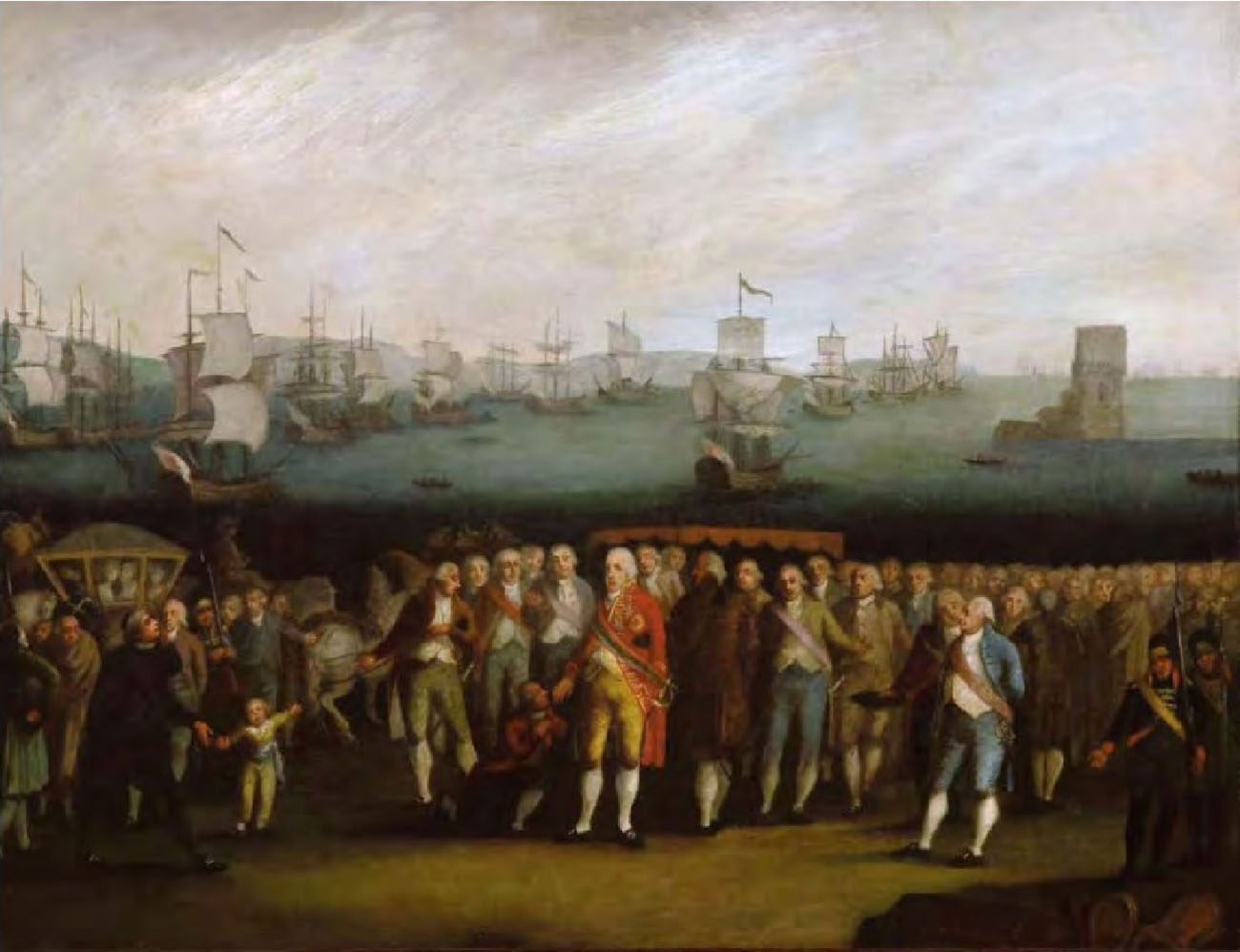
(credit: “Embarkation of the Portuguese Royal Family” by Itamaraty Historical and Diplomatic Museum/Wikimedia Commons, Public Domain) · Public Domain
Figure 8.18 In 1807, the Portuguese House of Braganza and its court fled to Brazil to avoid being captured by French troops. The scene was imagined in this small-scale painting by an unknown nineteenth-century artist. (credit: “Embarkation of the Portuguese Royal Family” by Itamaraty Historical and Diplomatic Museum/Wikimedia Commons, Public Domain)
図8.18 1807年、ポルトガルのブラガンサ王家とその宮廷は、フランス軍に捕らえられるのを避けるためブラジルへ逃れた。この場面は、作者不詳の19世紀の画家による小さな絵の中で想像して描かれている。(出典:Itamaraty Historical and Diplomatic Museum/Wikimedia Commons「Embarkation of the Portuguese Royal Family」。パブリックドメイン)
In 1808, after a short stop in Salvador, Bahia, the royal family and their courtiers were welcomed by Brazilian colonists and departed to settle in Rio de Janeiro on the southeastern coast. For the first time in modern history, a European monarch, heir, and court had set foot in their American domain. On April 1, 1808, Brazilian ports were opened to all friendly nations, which really meant Great Britain; all previous manufacturing prohibitions intended to protect Portuguese industry were revoked; and the Bank of Brazil was established. As a result, Brazil’s total population jumped from almost three million in 1798 to almost four million in 1818.
英語のヒント
1808年、バイーアのサルヴァドールに短期間寄港した後、王室と廷臣たちはブラジルの植民地住民に歓迎され、南東部の海岸にあるリオデジャネイロへ移住するために出発した。近代史上初めて、ヨーロッパの君主、後継者、宮廷が、アメリカ大陸の自らの領土に足を踏み入れた。1808年4月1日、ブラジルの港はすべての友好国に開かれたが、これは実質的にはイギリスを意味した。ポルトガルの産業を保護するための従来の製造業禁止措置はすべて撤廃され、ブラジル銀行が設立された。その結果、ブラジルの総人口は1798年の約300万人から、1818年には約400万人へと急増した。
The Portuguese Crown’s willingness to share power with the local planter aristocracy led to the expansion of institutions such as hospitals, libraries, and schools and universities. Vital reforms in administration, agriculture, and manufacturing were instituted. Though the cultural initiatives were welcome, the new tax burden imposed to pay for the needs of the royal court, the expanded bureaucracy, and the war against France, as well as Brazil’s great dependence on Great Britain, were not. The presence of the Portuguese Crown centralized control of Brazil in Rio de Janeiro to a great degree, however, and this centralization became a powerful force for the unification of Brazil as one nation.
英語のヒント
ポルトガル王室が現地の大農園主貴族と権力を分かち合う姿勢を示したことで、病院、図書館、学校、大学などの施設が拡充された。行政、農業、製造業では重要な改革が実施された。文化面の取り組みは歓迎されたものの、宮廷、拡大した官僚組織、対フランス戦争の費用をまかなうために課された新たな税負担や、ブラジルのイギリスへの強い依存は歓迎されなかった。しかし、ポルトガル王室が存在することで、ブラジルの統治権はリオデジャネイロに大きく集中した。この中央集権化は、ブラジルを一つの国家として統一する強い力となった。
Even after the fall of Napoléon in 1814 and the restoration of Bourbon kings in both France and Spain, the Portuguese Crown resolutely stayed on in Brazil. On December 16, 1815, Brazil was officially given the status of a kingdom. When Queen Maria I died there in 1816, her son became João VI, king of the United Kingdoms of Portugal, Brazil, and Algarve (the southern edge of Portugal).
英語のヒント
1814年にナポレオンが失脚し、フランスとスペインの双方でブルボン家の王が復位した後も、ポルトガル王室は断固としてブラジルにとどまった。1815年12月16日、ブラジルは正式に王国の地位を与えられた。1816年にマリア1世女王がブラジルで死去すると、その息子がジョアン6世となり、ポルトガル・ブラジル・アルガルヴェ連合王国の王となった。アルガルヴェはポルトガルの南端地域である。
Brazil also opened its ports to Bonapartist immigrants, including republican-minded scientists, architects, artisans, freemasons, engineers, painters, and officers who crossed the Atlantic with their liberal books and ideas intending to settle permanently in the new land. Under the sponsorship of King Joao VI, a group of Bonapartist artists and artisans, knowns as the French Artistic Mission, were invited to Brazil in March 1816 to establish an Arts and Crafts lyceum in Rio de Janeiro. The Lyceum later became the Academia Imperial de Belas-Artes under Emperor Pedro I. French painter Jean-Baptiste Debret, who had studied at France’s prestigious Academie des beaux-arts, was part of the group. Debret developed in interest in the enslaved and Indigenous peoples and produced many lithographs and paintings depicting people and everyday life in Brazil. He also painted many portraits of the imperial court (Figure 8.19). After returning to France in 1831, Debret joined the Académie des beaux-arts. By the end of the decade, he had published three volumes of engravings: A Picturesque and Historic Voyage to Brazil, or the Sojourn of a French Artist in Brazil (Voyage pittoresque et historique au Brésil ou Séjour d’un artiste français au Brésil).
英語のヒント
ブラジルはボナパルト派の移民にも港を開いた。その中には共和主義的な考えを持つ科学者、建築家、職人、フリーメーソン会員、技師、画家、将校がいた。彼らは自由主義的な書物と思想を携え、新たな土地に永住しようとして大西洋を渡った。ジョアン6世の後援のもと、フランス芸術使節団と呼ばれる、ボナパルト派の芸術家と職人の一団が1816年3月にブラジルへ招かれ、リオデジャネイロに美術工芸学校を設立した。この学校は、のちにペドロ1世のもとで帝国美術アカデミーとなった。フランスの名高い美術アカデミーで学んだ画家ジャン=バティスト・ドブレも、この一団の一員であった。ドブレは奴隷にされた人々や先住民に関心を持ち、ブラジルの人々と日常生活を描いた石版画や絵画を数多く制作した。帝室の肖像画も多く描いた(図8.19)。1831年にフランスへ帰国した後、ドブレは美術アカデミーに加わった。1830年代末までに、彼は3巻からなる版画集『ブラジルの絵画的・歴史的紀行、あるいはブラジルにおけるフランス人画家の滞在記』(Voyage pittoresque et historique au Brésil ou Séjour d’un artiste français au Brésil)を刊行していた。
King João VI.ジョアン6世。
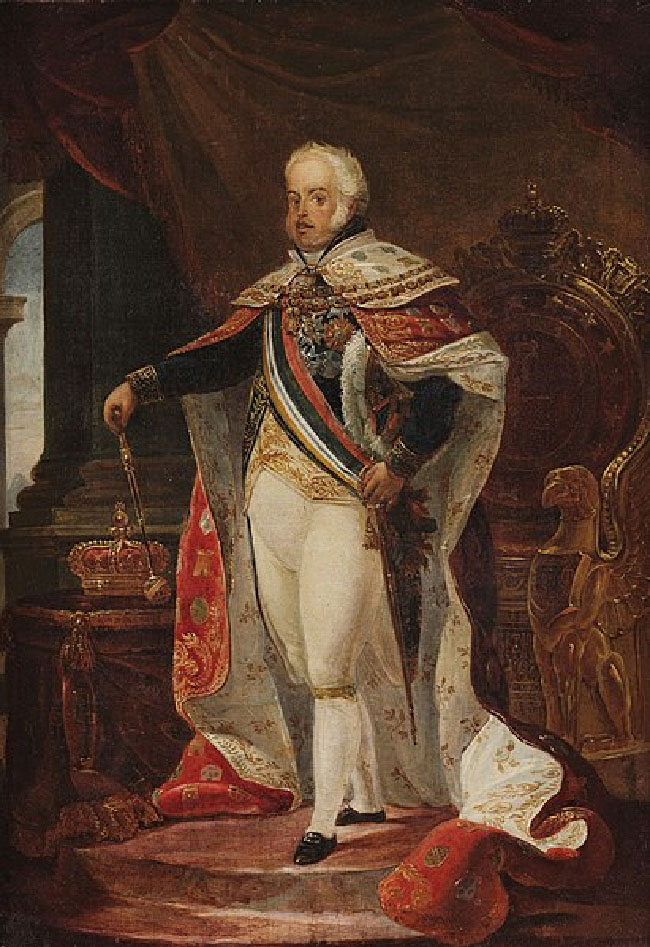
(credit: “Portrait of John VI of Portugal” by Museu Nacional de Belas Artes/Wikimedia Commons, Public Domain) · Public Domain
Figure 8.19 This small-scale 1817 portrait of King João VI of Portugal was painted by Jean-Baptiste Debret, who immigrated to Brazil as a member of the French Artistic Mission. (credit: “Portrait of John VI of Portugal” by Museu Nacional de Belas Artes/Wikimedia Commons, Public Domain)
図8.19 1817年制作の、ポルトガル王ジョアン6世の小さな肖像画。フランス芸術使節団の一員としてブラジルに移住したジャン=バティスト・ドブレが描いた。(出典:Museu Nacional de Belas Artes/Wikimedia Commons「Portrait of John VI of Portugal」。パブリックドメイン)
King João VI was more sympathetic to his Brazilian subjects than King Fernando VII was to his own in Spanish America. Nevertheless, rebellions within Brazil were suppressed with force. For instance, in 1817, Brazilians from Pernambuco—a sugar-planting province on the northeastern coast—reacted to the arrest of a liberal military officer by declaring the province an autonomous republic. King João VI quickly put a brutal end to their experiment. He finally returned to Portugal in 1821, six years after Napoléon’s fall, when the Cortes, the Portuguese parliament, demanded his return.
英語のヒント
ジョアン6世は、フェルナンド7世がスペイン領アメリカの臣民に向けた態度よりも、ブラジルの臣民に対して同情的であった。それでも、ブラジル国内の反乱は武力で抑え込まれた。たとえば1817年、北東海岸のサトウキビ栽培州ペルナンブーコでは、自由主義的な軍人の逮捕に反発したブラジル人が、その州を自治共和国と宣言した。ジョアン6世はただちに、その試みに残虐な形で終止符を打った。ナポレオンの失脚から6年後の1821年、ポルトガル議会であるコルテスが帰国を要求すると、彼はついにポルトガルへ戻った。