第8章ラテンアメリカの革命Revolutions in Latin America
Iturbide and the Plan de Igualaイトゥルビデとイグアラ綱領
In 1820, Spanish liberals succeeded in forcing Fernando VII to reinstate the liberal Cádiz Constitution of 1812. In New Spain, liberal creoles welcomed the implementation of this constitution because it reopened possibilities for their participation in government. However, the conservative creole elite could not accept the measures attacking the privileges of the Catholic Church and the military, in which many of them held positions. The Spanish king again proved his inefficiency in controlling the Spanish colonies, laying the ground for a second independence movement. This one was led by creoles with the goal of improving their status and power. Rather than making colonial society egalitarian, which had been the goal of Hidalgo and Morelos, the creole elite simply wanted to rule Mexico for themselves.
英語のヒント
1820年、スペインの自由主義者は、フェルナンド7世に1812年の自由主義的なカディス憲法を復活させることに成功した。ヌエバ・エスパーニャの自由主義的なクリオーリョは、自分たちが政治に参加する可能性が再び開かれるため、この憲法の施行を歓迎した。しかし保守的なクリオーリョ上層者は、多くの者が職を持つカトリック教会や軍の特権を攻撃する措置を受け入れられなかった。スペイン王は再び植民地を統制する力の不足を示し、第2の独立運動への土台を作った。今度の運動は、自分たちの地位と権力の向上を目指すクリオーリョが率いた。イダルゴとモレロスが求めたように植民地社会を平等にするのではなく、クリオーリョ上層者は単に、自分たちでメキシコを支配したかったのである。
The creole elite—major landowners, military officers, and church officials—decided to declare independence from Spain and forged a very pragmatic partnership with the mestizo and Indigenous followers of Vicente Guerrero. The winning strategy was to be nationalism in the form of an intense pride in Mexican (as opposed to Spanish) identity, an identity defined by birthplace that creoles shared with Indigenous and mixed-blood people as well as the children of enslaved Africans. This mostly anti-Spanish nationalism allowed creoles to fight for independence but keep the social hierarchy more or less intact.
英語のヒント
大地主、軍人、教会の役職者からなるクリオーリョ上層者は、スペインからの独立を宣言することを決め、ビセンテ・ゲレロに従うメスティーソや先住民と、きわめて現実的な協力関係を結んだ。勝利の戦略となるのは、スペイン人ではなくメキシコ人であることへの強い誇りという形の、ナショナリズムだった。この帰属意識は出生地によって定まり、クリオーリョはそれを、先住民や混合出自の人々、奴隷にされたアフリカ人の子どもたちとも共有できた。主に反スペイン的なこのナショナリズムによって、クリオーリョは社会序列をほぼそのまま保ちながら、独立を戦うことができた。
Agustín de Iturbide, a royalist creole officer who had distinguished himself in the campaigns against Hidalgo and Morelos, offered such a strategy. He formed an agreement with Guerrero, the man whose revolutionary movement it had been his duty to crush. Iturbide had the military force needed to win independence, while Guerrero had the support of Indigenous and mixed-race Mexicans, the majority of the population. Both shared the goal of independence from Spain.
英語のヒント
このような戦略を示したのは、イダルゴとモレロスへの軍事行動で功績を挙げた、王党派のクリオーリョ将校アグスティン・デ・イトゥルビデだった。彼は、それまで自分の任務として粉砕すべきだった革命運動の指導者ゲレロと、協定を結んだ。イトゥルビデには独立を勝ち取る軍事力があり、ゲレロには人口の大多数を占める先住民と混合出自のメキシコ人の支持があった。両者はスペインからの独立という目標を共有していた。
On February 24, 1821, Iturbide announced the Plan de Iguala. This plan combined both conservative and radical views and was based on principles known as the Three Guarantees: independence, religion, and equality. Mexico was to be independent of Spain. Roman Catholicism was the official religion. Social equality and protection were to be provided for all residents of Mexico—whether born in the Americas or in Spain. The plan also called for a new imperial Mexican Crown, to be offered to a willing European royal, and the establishment of a regency during the waiting period before the new royal leader was named. To uphold the movement’s grounding principles, a new Army of the Three Guarantees (Ejército de las tres garantías) was formed under Iturbide’s command.
英語のヒント
1821年2月24日、イトゥルビデはイグアラ綱領を発表した。この計画は保守的な見解と急進的な見解を組み合わせ、独立・宗教・平等という「3つの保証」に基づいていた。メキシコはスペインから独立し、カトリックを国教とし、アメリカ生まれかスペイン生まれかを問わず、すべての住民に社会的平等と保護を与えることになった。綱領はまた、就任を望むヨーロッパの王族に差し出す新しいメキシコの帝位を設け、その人物が決まるまでの間は摂政を置くことも求めた。運動の基本原理を守るため、イトゥルビデの指揮下に新たな「3つの保証の軍」が組織された。
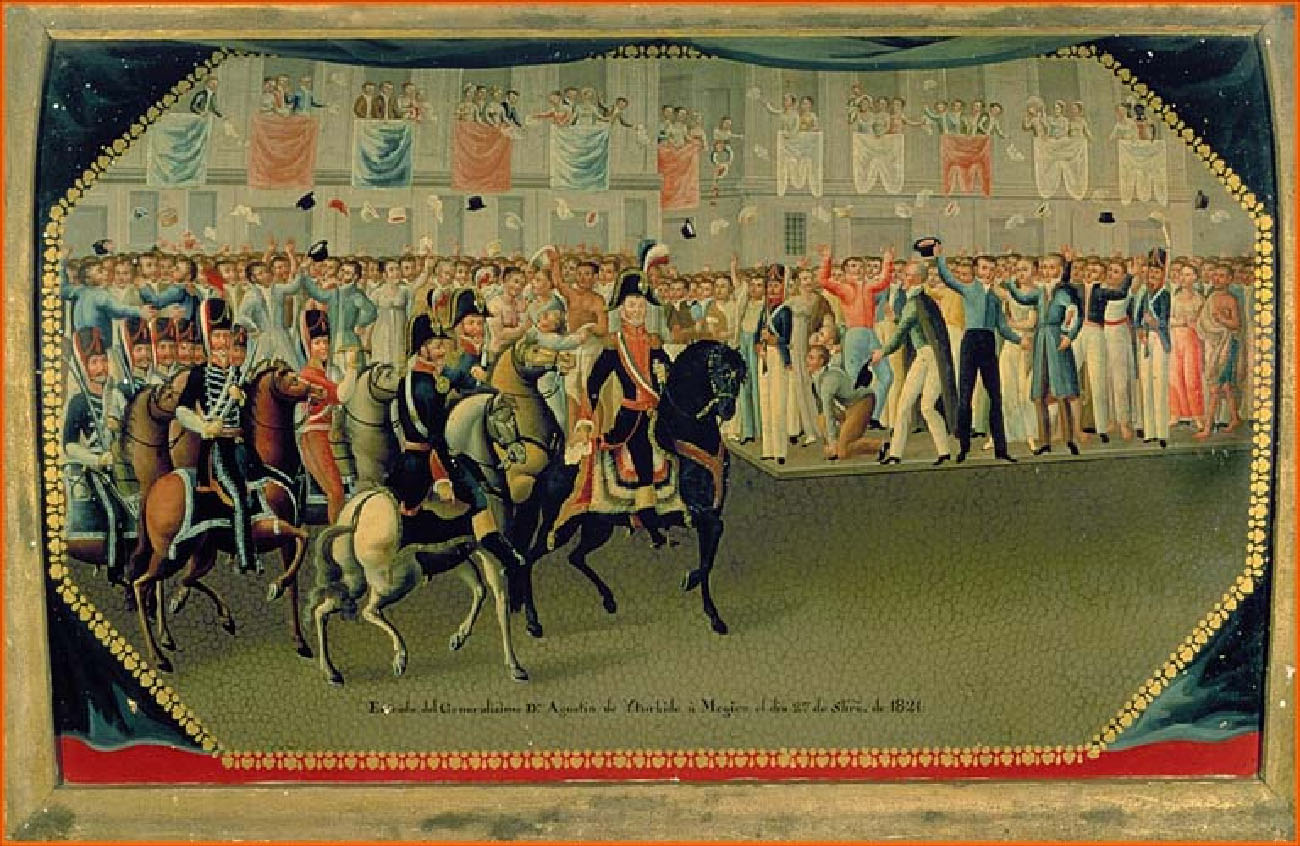
On September 27, 1821, a date marking the three-hundredth anniversary of the fall of the Aztec Empire and the end of an eleven-year rebellious period, Iturbide made a triumphant entrance into Mexico City (Figure 8.14). With the support of the conservative creole elite and two powerful liberal insurgent leaders, Vicente Guerrero and Guadalupe Victoria, he proclaimed Mexican independence. Mexico became a constitutional monarchy, which, according to the Plan de Iguala, protected the interests of both Spanish-born peninsulares and the church. At the town of Córdoba, Iturbide and the Spanish representative Viceroy Juan de O’Donojú y O’Ryan signed a treaty accepting the terms of the Plan de Iguala, with one adjustment. According to a new clause, in the absence of a European monarch, a local emperor could be chosen. Under this arrangement, eight months later in 1822, the newly elected congress confirmed Iturbide as Agustín I, constitutional emperor of Mexico.
英語のヒント
アステカ帝国の滅亡から300周年に当たり、11年間の反乱期の終わりを示す1821年9月27日、イトゥルビデはメキシコ市に凱旋入城した(図8.14)。保守的なクリオーリョ上層者と、自由主義的な有力反乱指導者ビセンテ・ゲレロ、グアダルーペ・ビクトリアの支持を得て、メキシコの独立を宣言した。メキシコは立憲君主国となり、イグアラ綱領に従って、本国生まれのペニンスラーレスと教会の両方の利益を保護した。コルドバの町で、イトゥルビデとスペイン代表の副王フアン・デ・オドノフ・イ・オライアンは、一つの修正を加えて綱領の条件を受け入れる条約に署名した。新しい条項により、ヨーロッパの君主がいなければ、地元の皇帝を選べることになった。この取り決めのもと、8か月後の1822年、新たに選出された議会は、イトゥルビデをメキシコの立憲皇帝アグスティン1世と承認した。
Agustín de Iturbide.アグスティン・デ・イトゥルビデ。
(credit: “Agustin de Iturbide entrance to Mexico City on 27 September 1821” by Instituto Nacional de Estudios Históricos de las Revoluciones de México/Wikimedia Commons, Public Domain) · Public Domain
Figure 8.14 In 1821, Agustín de Iturbide entered Mexico City as the victorious leader of the Army of the Three Guarantees. This unknown artist’s imagining of the event shows him being greeted by a largely creole crowd. (credit: “Agustin de Iturbide entrance to Mexico City on 27 September 1821” by Instituto Nacional de Estudios Históricos de las Revoluciones de México/Wikimedia Commons, Public Domain)
図8.14 1821年、アグスティン・デ・イトゥルビデは「3つの保証の軍」の勝利した指導者としてメキシコ市へ入城した。この出来事を想像して描いた作者不詳の絵は、主にクリオーリョからなる群衆に迎えられる彼を示している。(画像:Instituto Nacional de Estudios Históricos de las Revoluciones de México/Wikimedia Commons「Agustin de Iturbide entrance to Mexico City on 27 September 1821」、パブリックドメイン。)
However, Iturbide’s reign was brief. His monarchy did not have popular support, and the royal requirements clashed with the fiscal realities of the new nation. In 1822, Iturbide dissolved the congress, a move that sparked uprisings on many fronts. In 1823, he abdicated in response to growing opposition and left for exile in England. Mexico became a republic, and a new constitution was drafted.
英語のヒント
しかしイトゥルビデの治世は短かった。その君主制は民衆の支持を得られず、王室が必要とする費用は、新国家の財政の現実と衝突した。1822年、彼が議会を解散すると、各地で蜂起が起きた。1823年には反対の高まりを受けて退位し、イングランドへ亡命した。メキシコは共和国となり、新しい憲法が起草された。
The Constitution of 1824 marked a compromise between liberal and conservative interests, with liberals favoring social reforms such as those championed by Hidalgo and Morelos, and conservatives concerned with protecting the status of elites and the church. Social equality was written into the constitution, with the exception of special judicial privileges given to the military and the clergy. The power to pass laws and to tax was given to the government of the Mexican states. Following the adoption of the new constitution, the liberal general Guadalupe Victoria became Mexico’s first president. When Iturbide changed his mind and decided to return from exile, he was captured as soon as he arrived at the port and was shot by the new republican troops. The sharp division between liberals and conservatives dominated Mexican political life for the rest of the nineteenth century.
英語のヒント
1824年憲法は、自由主義派と保守派の利害の妥協だった。自由主義者はイダルゴやモレロスが唱えたような社会改革を支持し、保守派は上層者と教会の地位の保護を重視した。憲法は社会的平等を明記したが、軍と聖職者には特別な司法上の特権を認めた。立法権と課税権は、メキシコの各州の政府に与えられた。新憲法の採用後、自由主義的な将軍グアダルーペ・ビクトリアがメキシコ初代大統領となった。イトゥルビデが考えを変えて亡命先から戻ることを決めると、港へ到着するやいなや捕らえられ、新しい共和国の軍によって銃殺された。自由主義派と保守派の鋭い分裂は、19世紀の残りの期間ずっと、メキシコの政治を支配した。