第8章ラテンアメリカの革命Revolutions in Latin America
8.1 Revolution for Whom?8.1 誰のための革命か
Learning Objectives学習の目標
By the end of this section, you will be able to:
この節を学び終えると、次のことができるようになる。
Analyze the social hierarchy of Spanish America
スペイン領アメリカの社会的序列を分析する。
Discuss the Bourbon reforms imposed by the Spanish Crown on its American colonies
スペイン王室がアメリカ植民地に課したブルボン改革を論じる。
Explain how European political developments affected Haiti and the Spanish American colonies
ヨーロッパの政治的展開がハイチとスペイン領アメリカ植民地にどう影響したかを説明する。
The hundred years after 1750 marked a profound restructuring of world power and a host of political and economic changes in the Atlantic world. The French American, Spanish American, and Portuguese American colonists encountered different historical circumstances than those met by their neighbors, the former British colonists who declared their independence in 1776. Nevertheless, they too launched successful bids for independence. The Revolutionary War (1776–1783), the French Revolution (1789–1799), and the Peninsular War (1808–1814) were watershed events that reverberated across South America on inspiring waves of revolutionary upheavals. The diversity of the European American colonial societies meant, however, that revolution promised different things to different people in this vast region.
英語のヒント
1750年以後の100年間には、世界の力関係が大きく組み替えられ、大西洋世界に数多くの政治的・経済的変化が起こった。フランス・スペイン・ポルトガル領アメリカの植民地人が直面した歴史的状況は、1776年に独立を宣言した旧イギリス植民地の近隣住民とは異なっていた。それでも彼らも独立への取り組みを始め、成功させた。独立戦争(1776〜1783年)、フランス革命(1789〜1799年)、半島戦争(1808〜1814年)は、革命の激動を励ます波となって南アメリカ全体に響き渡った、転機となる出来事だった。しかし、ヨーロッパ諸国のアメリカ植民地社会は多様だったため、この広大な地域で革命が人々に約束したものは、人によって異なった。
Social Hierarchy and Bourbon Reforms in Spanish Americaスペイン領アメリカの社会的序列とブルボン改革
By the end of the eighteenth century, Latin American societies had become rigidly stratified. Status was dependent on a number of social markers including education, family and professional ties, race, religion, and wealth. Color was the most obvious and most complicated noneconomic factor that affected social position. Whiteness was more than a mark of economic superiority. It indicated European ancestry, which in turn denoted status as a Christian and thus a degree of presumed social and moral superiority. Furthermore, European males born in the Iberian Peninsula (the peninsula on which Spain and Portugal are located), called peninsulares in Spanish America and reinóis in Portuguese America, considered themselves superior to males of European descent born in the Americas, who were called creoles in Spanish America. In the first centuries of colonization, those born in Europe tended to monopolize the highest positions in church and state as well as the means of production, whereas most of the landed elite (miners, plantation owners) were creoles.
英語のヒント
18世紀末までに、ラテンアメリカの社会は厳格に階層化されていた。地位は、教育、家族や職業上のつながり、人種、宗教、富など、多くの社会的指標によって決まった。肌の色は、社会的位置に影響する非経済的要因のうち、最も目につき、同時に最も複雑なものだった。白い肌は単に経済的優位のしるしではなく、ヨーロッパ系の出自を示した。それはまた、キリスト教徒としての地位、ひいては社会的・道徳的に一定の優越があるという想定を示していた。さらに、スペインとポルトガルのあるイベリア半島で生まれたヨーロッパ人男性は、アメリカ大陸で生まれたヨーロッパ系男性より自分たちが上だと考えた。前者はスペイン領ではペニンスラーレス、ポルトガル領ではレイノイスと呼ばれ、後者はスペイン領ではクリオーリョと呼ばれた。植民地化の最初の数世紀には、ヨーロッパ生まれの人々が、教会と国家の最上位の地位や生産手段を独占する傾向があった。一方、鉱山主や農園主などの地主層の大半はクリオーリョだった。
In the decades leading to the movement toward independence, however, Europeans and their descendants in the Americas were struggling to maintain their position at the top of the social pyramid. They had to face the reality that they had imposed an unequal system in which a small group of Europeans and their descendants held power over a much larger group of American Indians and enslaved Africans, as well as a vast contingent of mixed-race people or castas consisting of mestizos (literally “mixed” in Spanish and used mainly for people of White European and Indian descent) and pardos (“brown” in Spanish for someone of part-African descent). This ethnically mixed population dominated urban areas, often working as shoemakers, tailors, and other types of artisans; some mestizo and pardo men served in the lower ranks of the colonial militias.
英語のヒント
しかし独立運動へ向かう数十年間、ヨーロッパ人とアメリカ生まれのその子孫は、社会の頂点の地位を保つため苦闘していた。彼らは、少数のヨーロッパ人とその子孫が、はるかに多数のアメリカ先住民、奴隷にされたアフリカ人、そしてカスタと呼ばれる膨大な混合出自の人々を支配する、不平等な制度を自分たちが押しつけたという現実に直面しなければならなかった。カスタには、スペイン語で文字どおり「混ざった」を意味し、主に白人ヨーロッパ人と先住民の血を引く人を指すメスティーソや、スペイン語で「褐色」を意味し、一部にアフリカ系の出自を持つ人を指すパルドが含まれた。民族的に混じり合ったこの人々は都市部の人口の主力で、靴職人、仕立屋、その他の職人として働くことが多かった。メスティーソやパルドの男性の一部は、植民地民兵隊の下級兵士として勤めた。
At the end of the eighteenth century, the Kingdom of Spain, which had been led by the House of Bourbon since 1700, reorganized its American colonies into four large parts. These were New Spain (in existence since 1521), Peru (in existence since 1542), New Granada (created in 1717 and roughly equivalent to the countries of Colombia, Ecuador, Panama, and Venezuela today), and Río de la Plata (created in 1776 with territory corresponding to modern-day Argentina, Bolivia, Paraguay, and Uruguay) (Figure 8.6). As before, the ruler of each of these viceroyalty units represented the Spanish king. Now, however, local governments within each of the viceroyalties were in the hands of governors, or intendants.
英語のヒント
18世紀末、1700年以来ブルボン家が率いていたスペイン王国は、アメリカ植民地を4つの大きな地域に再編した。それらは、1521年から存在するヌエバ・エスパーニャ、1542年から存在するペルー、1717年に作られ、およそ現在のコロンビア、エクアドル、パナマ、ベネズエラに相当するヌエバ・グラナダ、そして1776年に作られ、現在のアルゼンチン、ボリビア、パラグアイ、ウルグアイに相当するリオ・デ・ラ・プラタだった(図8.6)。以前と同様、これら各副王領の統治者はスペイン王を代表した。ただし今度は、各副王領内の地方政府は、知事、すなわちインテンデンテの手に置かれた。
Spanish Possessions in the Americas.アメリカ大陸のスペイン領。
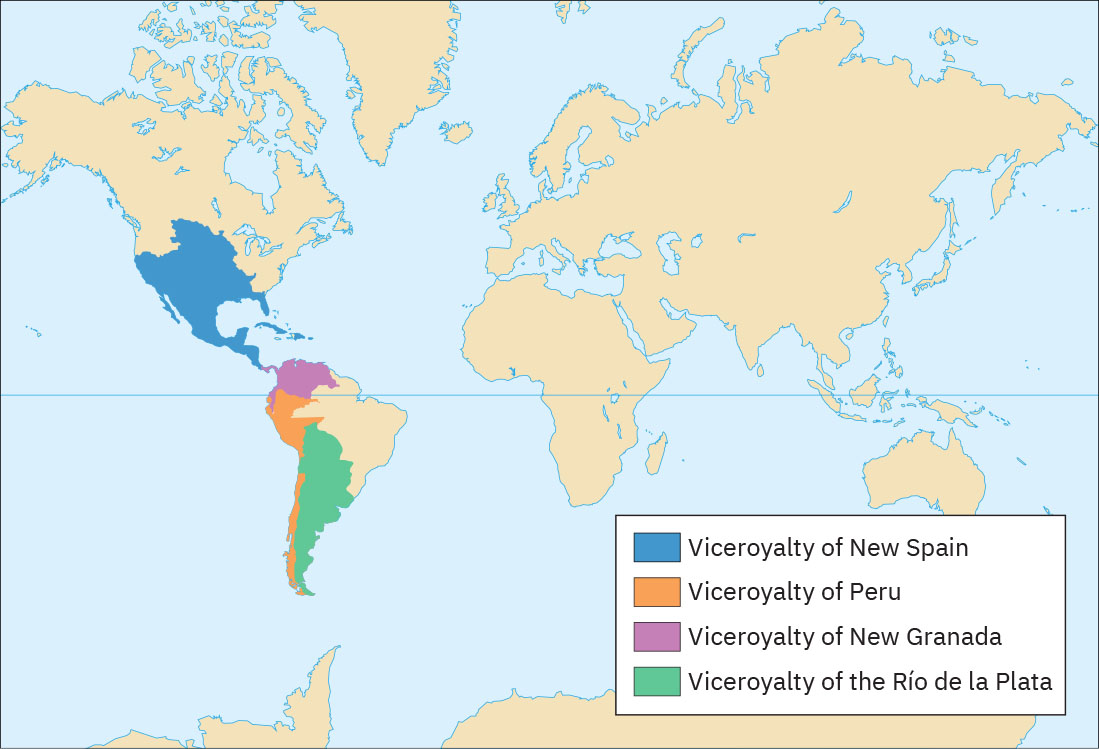
(attribution: Copyright Rice University, OpenStax, under CC BY 4.0 license) · CC BY 4.0
These governors were peninsulares who were appointed by and reported directly to the king, in an attempt to reduce corruption and enforce centralization. They were assisted by other peninsulares, many recently arrived from Spain and far below the creole elite they governed in terms of education, wealth, and culture. This centralization of administration under the intendancy system brought with it industrial and economic development, and new material prosperity for peninsulares and creole landowners and merchants. However, only those born in Spain, the peninsulares, could hold the most important offices in the government. Although creoles could become wealthy under the system, wealth did not translate to social status. The sharp division between them and the peninsular Spaniards fueled creoles’ desire for self-government.
英語のヒント
腐敗を減らし中央集権を強めるため、これらの知事には、国王が任命し、王に直接報告するペニンスラーレスが就いた。彼らを補佐したのもペニンスラーレスで、その多くはスペインから来たばかりで、教育、富、文化の点では、統治対象のクリオーリョ上層者に大きく劣っていた。このインテンデンテ制度のもとでの行政の集権化は、産業・経済の発展と、ペニンスラーレスやクリオーリョの地主・商人に新たな物質的繁栄をもたらした。しかし、政府で最も重要な官職に就けるのは、スペイン生まれのペニンスラーレスだけだった。クリオーリョは制度のもとで裕福になれても、富が社会的地位へと結びつくわけではなかった。本国生まれのスペイン人との鋭い区別は、クリオーリョの自治への願いを強めた。
It was during this Bourbon Era that Enlightenment ideas spread across the Atlantic world, including to the Spanish colonies in North and South America. These ideas were rooted in the principle that all people were entitled to take part in their government, and they influenced creoles in Latin America to demand the right to participate more fully in politics and the economy, which was largely controlled by Spain. The aims were revolutionary, but they stopped short of radically changing the social order. The colonial creole elite originally petitioned only that authority be extended to White males of Spanish descent. Native populations and African and mixed-race populations were excluded. The White male creole elites pointed to the hypocrisy of the egalitarian rhetoric of Europeans and questioned the universal ideals linked to the new rights of citizens, but they did so with only themselves in mind.
英語のヒント
啓蒙思想が、南北アメリカのスペイン植民地を含む大西洋世界に広がったのは、このブルボン時代だった。すべての人には統治に参加する権利があるという原理に根ざす思想は、ラテンアメリカのクリオーリョに影響を与え、主にスペインが支配する政治と経済に、より十分に参加する権利を要求させた。目標は革命的だったが、社会秩序を根本から変えるところまでは踏み込まなかった。植民地のクリオーリョ上層者が当初求めたのは、スペイン系の白人男性に権限を広げることだけだった。先住民、アフリカ系、混合出自の人々は除かれた。白人男性のクリオーリョ上層者は、ヨーロッパ人が唱える平等主義の偽善を指摘し、市民の新しい権利と結びつく普遍的理想に疑問を投げかけたが、念頭にあったのは自分たちだけだった。
An important contributing factor in the desire of creoles and other groups for more participation in politics and the economy was the increased availability of books and other printed material. Traditionally, the Spanish American White elite had been literate and educated, unlike the lower social groups of color, which largely relied on oral tradition for transmitting knowledge. By the end of the eighteenth century, however, the circulation of books and manuscripts had greatly increased among the huge mixed-race population, even if these groups did not share in the other benefits accorded to White people. Still, the “dangerous” notions of the Enlightenment were able to spread not only among educated creoles in the colonies but among mixed-race people as well. Those ideas, combined with resentment of the peninsulares, were fuel for late eighteenth-century rebellions.
英語のヒント
クリオーリョなどの集団が政治・経済への参加拡大を望んだ重要な要因の一つは、本などの印刷物を利用しやすくなったことだった。伝統的に、スペイン領アメリカの白人上層者は読み書きができ、教育を受けていた。これに対して、主に口承で知識を伝えていた有色人種の下層集団は、そうではなかった。しかし18世紀末までに、混合出自の膨大な人口の間でも、白人に与えられる他の恩恵は共有できなくても、本や写本の流通は大きく増えた。こうして啓蒙の「危険な」思想は、教育を受けた植民地のクリオーリョだけでなく、混合出自の人々にも広まることができた。それらの思想は、ペニンスラーレスへの憤りと結びつき、18世紀末の反乱をあおる燃料となった。
Their desire for participation added to the creoles’ anger over the creation of the intendancy system. The Bourbon monarchy had also instituted other reforms to strengthen its American empire and its control over it. The colonial militia was expanded, and newly created army units were staffed by men born in Spanish America. This reduced the cost of defending the empire because Spanish troops no longer had to be transported across the ocean. However, like political offices, the highest military positions were reserved for peninsulares, another cause of creole discontent.
英語のヒント
参加へのこうした願いは、インテンデンテ制度の創設に対するクリオーリョの怒りに重なった。ブルボン王家は、アメリカ帝国とその支配を強めるため、他の改革も行っていた。植民地の民兵隊を拡大し、新設の部隊にはスペイン領アメリカ生まれの男性を配置した。これによってスペインの兵士を大西洋の向こうから運ぶ必要がなくなり、帝国防衛の費用は減った。しかし、政治の官職と同じく、軍の最高位もペニンスラーレスだけのものであり、これもクリオーリョの不満の原因となった。
Along with changing the political and military life in its colonies, in 1767 Spain followed the example of Portugal and expelled the Jesuit missionaries from its American empire, angering people at both ends of the social ladder. Not only did the Jesuits have a reputation as the most humane managers of American Indian forced laborers, but they had also educated many of the creole elite, and many young creole men had joined the Jesuit order.
英語のヒント
植民地の政治と軍事を変えるとともに、1767年、スペインはポルトガルにならい、アメリカ帝国からイエズス会の宣教師を追放した。これは社会の上層と下層の両方の人々を怒らせた。イエズス会は、強制労働に従事させられる先住民を最も人道的に管理するという評判があっただけでなく、多くのクリオーリョ上層者を教育し、若いクリオーリョ男性の多くを修道会に迎えていたからである。
Finally, the Bourbons imposed economic reforms, and these were often unpopular as well. The purpose of colonies was to enrich and strengthen the parent country, so the Spanish monarchs wished to make their American possessions as profitable as possible by, for example, more efficiently collecting taxes from the residents and improving “free” trade. Essentially, this meant Spanish manufacturers were free to sell their goods in the colonies, where they competed with local producers and merchants and often drove them out of business. At the same time, colonial producers were still not free to sell their goods to either French or British buyers. A number of monopolies remained in force. For example, the Crown controlled all tobacco production and sale.
英語のヒント
最後に、ブルボン家は経済改革も課し、これも不人気な場合が多かった。植民地の目的は本国を豊かにし強めることだったため、スペインの君主は、住民からの徴税を効率化し、「自由」貿易を改善するなどして、アメリカ領からできるだけ大きな利益を得ようとした。実際の意味は、スペインの製造業者が植民地で自由に商品を売れるということだった。彼らは地元の生産者や商人と競争し、しばしば廃業に追い込んだ。同時に、植民地の生産者には、フランスやイギリスの買い手に自由に商品を売ることは、なお認められなかった。多くの独占も維持された。たとえば王室は、タバコの生産と販売をすべて統制した。
Unlike the political reforms that affected primarily the creoles, the economic changes affected people at all levels of Spanish American society, who sometimes reacted violently. Two such insurrections, sparked by an increase in the colonial sales tax, were the massive 1780–1781 Inca rebellion near Cuzco in the Viceroyalty of Peru, and the 1781 Comunero (“commoner”) Revolt in New Granada (Colombia). In both these viceroyalties, the basis of Spanish economic activity had evolved from the payment of tribute to the enforcement of systematic forms of labor such as debt servitude. The Great Inca Rebellion was led by José Gabriel Condorcanqui Noguera, a respected local mixed-race leader. Noguera opposed the forced labor the Spanish demanded from American Indians, and to move Indigenous people to rebel, he claimed descent from the last Inca ruler, Túpac Amaru, and called himself Túpac Amaru II (Figure 8.7). Threatened by his mobilization of some forty thousand people from among the Viceroyalty of Peru’s Indian majority, outnumbered creoles joined the Spanish and brutally crushed the revolt, which had threatened to become a rebellion against White, not simply Spanish, rule. Túpac Amaru II and tens of thousands of others were killed.
英語のヒント
主にクリオーリョに影響した政治改革とは異なり、経済の変化はスペイン領アメリカ社会のあらゆる階層に影響し、人々は時に暴力的に反応した。植民地の売上税の引き上げをきっかけとする蜂起が2つ起きた。ペルー副王領のクスコ近郊での1780〜1781年の大規模なインカ反乱と、ヌエバ・グラナダ(コロンビア)での1781年のコムネロ(「平民」)反乱である。両副王領では、スペインの経済活動の基盤が、貢納の支払いから、債務隷属のような組織的な労働強制へと変化していた。インカ大反乱を率いたのは、複数の出自を持ち、地元で尊敬されていた指導者ホセ・ガブリエル・コンドルカンキ・ノゲラだった。彼はスペイン人が先住民に要求する強制労働に反対し、先住民に反乱を促すため、最後のインカ支配者トゥパク・アマルの子孫だと主張して、トゥパク・アマル2世と名乗った(図8.7)。彼がペルー副王領の多数派の先住民から約4万人を動員したことに脅威を感じ、数で劣るクリオーリョはスペイン側につき、反乱を残酷に鎮圧した。それは単なるスペイン支配への反乱にとどまらず、白人支配そのものへの反乱になりかねなかったのである。トゥパク・アマル2世と、他にも数万人が殺された。
Túpac Amaru II.トゥパク・アマル2世。
Figure 8.7 This portrait of Túpac Amaru II by an unknown artist depicts the Indigenous leader who invoked the legacy of the Inca Empire to inspire people in Peru to rise up against the Spanish. (credit: “Portrait of Túpac Amaru II” by Unknown/Wikimedia Commons, Public Domain)
英語のヒント
図8.7 作者不詳のこの肖像は、インカ帝国の遺産を持ち出して、ペルーの人々にスペインへの蜂起を促した先住民指導者、トゥパク・アマル2世を描いている。(画像:作者不詳/Wikimedia Commons「Portrait of Túpac Amaru II」、パブリックドメイン。)
In addition to resisting colonial taxes, the Comunero Rebellion of 1781 rose up against laws that granted the Spanish Crown a monopoly over the production of tobacco and liquor. Calling for the restoration of traditional forms of governance, this revolt spread throughout the mountains, and armed protesters descended on Bogotá. First, the Spanish authorities there decided to negotiate. They agreed to repeal the taxes and end the monopolies as well as give creoles preference over peninsulares in government positions. However, once the comuneros dispersed and the viceroy learned of Bogotá’s concessions, he ordered the rebellion’s leaders to be arrested and executed. These two revolts were warning signs of an ever-growing discontented mixed-race population, and they were followed by immediate legal responses.
英語のヒント
1781年のコムネロ反乱は、植民地の税に抵抗するだけでなく、スペイン王室にタバコと酒の生産独占権を与える法律にも反対した。従来の統治の形を復活させるよう求める反乱は、山岳地帯全域へ広がり、武装した抗議者たちはボゴタへ押し寄せた。当初、現地のスペイン当局は交渉を選び、税を撤廃して独占を終わらせ、さらに政府の職ではペニンスラーレスよりクリオーリョを優先することに同意した。しかし、コムネロたちが解散し、副王がボゴタでの譲歩を知ると、彼は反乱指導者の逮捕と処刑を命じた。これら2つの反乱は、不満を抱く混合出自の人口が増え続けていることの警告であり、その後ただちに法的な対応が取られた。
In 1795, tensions flared between the creole city council of Caracas in the Viceroyalty of New Granada and the king of Spain, Carlos IV. The Crown had passed a new ordinance that allowed people of mixed Spanish and African ancestry to purchase, at some expense, a royal identification card called a cédula real. This card classified the holder as legally “White,” giving mixed-race people citizenship and the legal status of creoles and allowing them greater participation in public life and increased social mobility, such as pursuing political office or formal education.
英語のヒント
1795年、ヌエバ・グラナダ副王領のカラカスのクリオーリョ市参事会と、スペイン王カルロス4世の間で緊張が高まった。王室は、スペイン系とアフリカ系の出自を持つ人々が、相当の費用を払って「セドゥラ・レアル」と呼ばれる王の身分証を購入できる、新しい法令を出していた。この証書は所有者を法的に「白人」と分類し、混合出自の人々に市民権とクリオーリョの法的地位を与え、公職や正式な教育を目指すなど、公的生活への参加と社会的な上昇の機会を広げた。
Both groups of elites, the Spanish-born peninsulares and the American-born Spanish creoles, reacted negatively to the possibility of upward social mobility for those of mixed race. White people saw themselves as educated, productive members of society devoted to mining, ranching, and plantation activities. They regarded mixed-race people as inferior and ignorant, lost in idleness, unable to prosper, and dishonorable in every way. The city council of Caracas argued that granting upward mobility to mixed-race people would lead to the destruction of society as they knew it.
英語のヒント
スペイン生まれのペニンスラーレスも、アメリカ生まれのスペイン系クリオーリョも、上層者の両集団は、混合出自の人々が社会的に上昇しうることに反発した。白人は自分たちを、教育を受け、鉱業、牧畜、農園経営に専念する、生産的な社会の成員だと考えた。彼らは混合出自の人々を、劣っていて無知であり、怠惰にふけり、繁栄する能力がなく、あらゆる点で不名誉だとみなした。カラカスの市参事会は、その人々に上昇の道を認めると、自分たちの知る社会の破壊につながると主張した。