第8章ラテンアメリカの革命Revolutions in Latin America
8.3 Spanish South America8.3 スペイン領南アメリカ
Learning Objectives学習の目標
By the end of this section, you will be able to:
この節を学び終えると、次のことができるようになる。
Discuss the role of Simón Bolívar in the South American revolutions
南アメリカの革命でシモン・ボリバルが果たした役割を論じる。
Discuss the role of José de San Martín in the South American revolutions
南アメリカの革命でホセ・デ・サン・マルティンが果たした役割を論じる。
Describe the consequences of South American liberation
南アメリカの解放がもたらした結果を説明する。
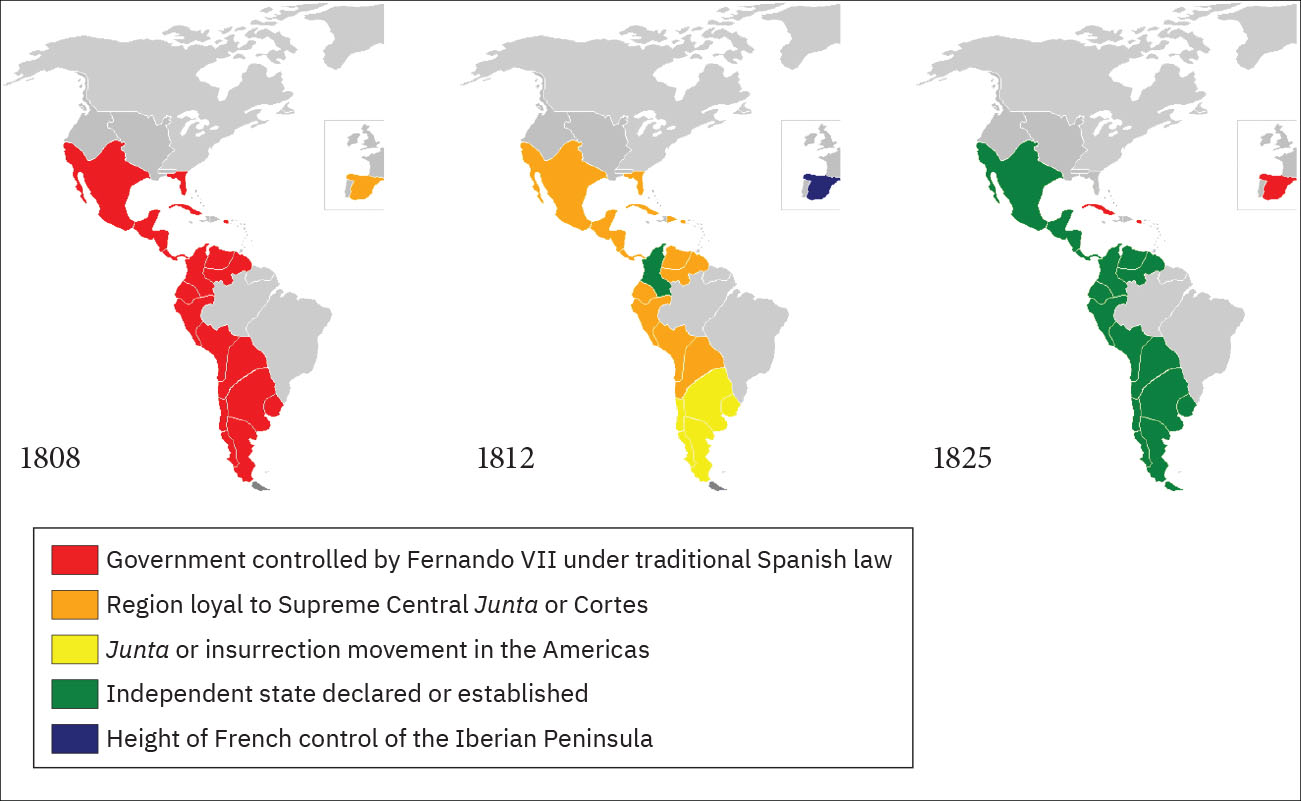
From revolutionary Mexico in the northern hemisphere, rebellion rippled south. Spanish American nationalists in Mexico had gained momentum for their cause when they united against the peninsulares. The southern parts of the Spanish American empire underwent a similar experience because the patriot creole group also coveted the potential benefits of independence: free trade, control over tax revenue, and local governance. There were two initial focuses: one in northern South America led by Simón Bolívar from Caracas, and another in the far south of the continent led by José de San Martín from Buenos Aires. Under the leadership of Bolívar and San Martín—the libertadores (liberators)—military operations began that aimed at controlling the royalist stronghold in Peru to achieve and spread independence throughout South America (Figure 8.15).
英語のヒント
北半球の革命下のメキシコから、反乱は南へと波及した。メキシコのスペイン系アメリカ人の民族主義者は、ペニンスラールに対して結束したことで、その運動に勢いをつけていた。スペインのアメリカ帝国の南部でも、これと似た過程が進んだ。愛国派のクリオーリョも、自由貿易、税収の管理、地域の自治といった、独立によって得られる可能性のある利益を強く求めていたからである。運動は当初、二つの地域を中心に展開した。一つはカラカス出身のシモン・ボリバルが率いる南アメリカ北部、もう一つはブエノスアイレスを拠点とするホセ・デ・サン・マルティンが率いる大陸の南端部であった。「リベルタドーレス」、すなわち解放者と呼ばれるボリバルとサン・マルティンの指導のもと、王党派の拠点であるペルーを制圧し、南アメリカ全域で独立を実現して広げることを目指す軍事作戦が始まった(図8.15)。
Transition to Independence.独立への移行。
(credit: modification of work “Spanish Americas revolutions” by Resvoluci/Wikimedia Commons, Public Domain) · Public Domain
Figure 8.15 Between 1808 and 1825, the countries of what are now Central and South America transformed from colonies governed by the king of Spain to countries governed by juntas and finally to independent nations. (credit: modification of work “Spanish Americas revolutions” by Resvoluci/Wikimedia Commons, Public Domain)
図8.15 1808年から1825年にかけて、現在の中央アメリカと南アメリカにあたる国々は、スペイン王が統治する植民地から、フンタが統治する国へ、そして最終的には独立国家へと変化した。(出典:Resvoluci/Wikimedia Commons「Spanish Americas revolutions」を改変。パブリックドメイン)
The Northern Liberation Movement北部の解放運動
Between 1807 and 1810 in the judicial district of Caracas, Venezuela (in the Viceroyalty of New Granada), royalists and patriot creoles from the upper-class elite struggled to create a self-governing body. Then, on April 19, 1810, the creoles of Caracas deposed the Spanish administrative officers and created a junta to govern in the name of Fernando VII. The junta, whose authority was recognized by other cities in the Viceroyalty of New Granada, then called for the creation of a congress, which met for the first time in March 1811.
英語のヒント
1807年から1810年にかけて、ヌエバ・グラナダ副王領内にあったベネズエラのカラカスの司法管区では、王党派と上層エリートに属する愛国派クリオーリョが、自治機関の設立をめぐって争った。やがて1810年4月19日、カラカスのクリオーリョはスペインの行政官たちを罷免し、フェルナンド7世の名において統治するフンタを設立した。ヌエバ・グラナダ副王領の他都市もこのフンタの権威を認めた。フンタはその後、議会の設置を呼びかけ、議会は1811年3月に初めて会合を開いた。
Not all in the congress favored governing in the name of the still-imprisoned king of Spain. On July 5, 1811, patriot members who believed the body should instead govern on behalf of the people of New Granada officially declared the independence of Venezuela, making it the first South American republic. Royalists struck back. They received support among Venezuela’s large African and pardo population, whose interests had been advanced when the Spanish government gave them the opportunity to purchase White status with the cédula real. White creoles, like the patriots in the Venezuelan congress, had opposed greater rights for people who were not of European ancestry. Cities in the western part of New Granada had not recognized the authority of the Caracas junta or sent representatives to the Venezuelan congress, and they also proclaimed their loyalty to the king.
英語のヒント
議会の全員が、なお幽閉されていたスペイン王の名における統治を支持したわけではなかった。1811年7月5日、議会は王に代わってヌエバ・グラナダの人民のために統治すべきだと考える愛国派の議員たちが、ベネズエラの独立を正式に宣言した。こうしてベネズエラは南アメリカ初の共和国となった。王党派は反撃した。彼らは、ベネズエラで大きな人口を占めるアフリカ系住民とパルドの支持を得た。スペイン政府が王の勅令で白人身分を購入する機会を与えた際、これらの人々の利益は増進されていた。ベネズエラ議会の愛国派のような白人クリオーリョは、ヨーロッパ系の祖先を持たない人々の権利拡大に反対していた。ヌエバ・グラナダ西部の都市は、カラカスのフンタの権威を認めず、ベネズエラ議会に代表も送っていなかったが、これらの都市も王への忠誠を表明した。
The royalists received unexpected additional support for their cause when, on the Thursday before Easter in 1812, a massive earthquake hit Caracas, killing thousands. The Catholic clergy, who supported the royalist cause, convinced the lower social classes that God had punished Caracas because of its disregard for the king’s authority, which had been granted by God. The royalist members of the government reinstituted the district’s previous political links to Spain, and a bitter civil war between royalists and patriots ensued.
英語のヒント
1812年の復活祭直前の木曜日、巨大地震がカラカスを襲って数千人が死亡すると、王党派の大義は予期しない新たな後押しを得た。王党派を支持するカトリック聖職者たちは、神から与えられた王の権威を軽視したために、神がカラカスを罰したのだと下層の人々を説得した。政府内の王党派は、この管区とスペインとの従来の政治的結びつきを復活させ、王党派と愛国派の間で激しい内戦が続いた。
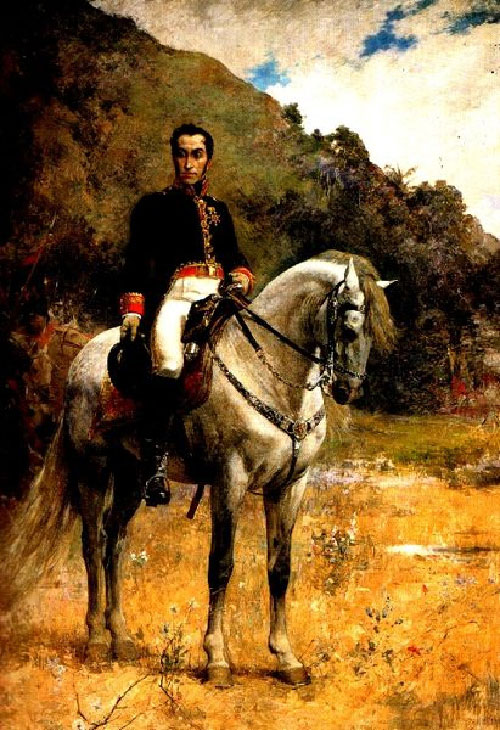
Simón José Antonio de la Santísima Trinidad Bolívar y Palácios, part of the creole elite and impassioned about the new ideas of the Enlightenment and the French Revolution, entered the fight in 1811 as an appointed colonel of the rebel patriot army. After his first defeat, he took refuge on the island of Curaçao and then fled to the city of Cartagena (in modern-day Colombia). From this new base, he was able to launch a successful campaign to invade Caracas in 1813 and reestablish the republic (Figure 8.16).
英語のヒント
シモン・ホセ・アントニオ・デ・ラ・サンティシマ・トリニダー・ボリバル・イ・パラシオスは、クリオーリョのエリート層に属し、啓蒙思想とフランス革命の新たな理念に情熱を抱いていた。1811年、彼は反乱側の愛国派軍の大佐に任命され、戦いに加わった。最初の敗北後、キュラソー島に避難し、さらに現在のコロンビアにあるカルタヘナの町へ逃れた。この新たな拠点から、彼は1813年にカラカスへ進攻する作戦を成功させ、共和国を再建することができた(図8.16)。
Simón Bolívar.シモン・ボリバル。
(credit: “Retrato ecuestre de Bolivar” by Galería de Arte Nacional/Wikimedia Commons, Public Domain) · Public Domain
Figure 8.16 The Venezuelan libertador Simón Bolívar in Arturo Michelena’s 1898 painting, made almost seventy years after Bolívar’s death. (credit: “Retrato ecuestre de Bolivar” by Galería de Arte Nacional/Wikimedia Commons, Public Domain)
図8.16 アルトゥーロ・ミチェレーナが1898年に描いたベネズエラの解放者シモン・ボリバル。制作はボリバルの死から約70年後である。(出典:Galería de Arte Nacional/Wikimedia Commons「Retrato ecuestre de Bolivar」。パブリックドメイン)
Bolívar’s success in battle was based on his commitment to fighting to the last soldier, in what became known as “war to the death” (guerra a muerte). This strategy aimed at radicalizing the conflict and reducing support for the royalist cause. For example, all Spaniards who did not actively support the movement for independence were sentenced to death. Bolívar’s dramatic military plan left entire provinces depopulated and kept his army almost constantly in battle. His success was short-lived, however. In 1814, defeated in Venezuela, Bolívar returned to Cartagena.
英語のヒント
ボリバルの戦場での成功は、最後の一兵まで戦い抜くという決意に支えられていた。これは「死に至る戦争」、スペイン語でゲーラ・ア・ムエルテと呼ばれるようになった。この戦略は、戦いを徹底させ、王党派への支持を弱めることを狙っていた。たとえば、独立運動を積極的に支持しないスペイン人は全員、死刑を宣告された。ボリバルの苛烈な軍事計画によって、州全体から人がいなくなることもあり、彼の軍はほぼ絶えず戦闘を続けた。しかし、その成功は長続きしなかった。1814年、ベネズエラで敗れたボリバルはカルタヘナに戻った。
In 1815 after Napoléon Bonaparte’s fall, the newly restored Spanish king Fernando VII sent military forces to South America to shore up his absolute authority. These Spanish forces were able to restore colonial power and defeat Bolívar and his patriot troops. Once again ousted, Bolívar sought shelter in the British colony of Jamaica, where he penned his “Letter from Jamaica” to a newspaper. In this candid document, he outlined his vision of a unified Spanish America and reiterated his defense of independence and conviction that it would triumph.
英語のヒント
1815年、ナポレオン・ボナパルトの失脚後、復位したばかりのスペイン王フェルナンド7世は、自らの絶対的権威を強化するため、南アメリカに軍を派遣した。スペイン軍は植民地権力を復活させ、ボリバルとその愛国派部隊を破ることができた。再び追われたボリバルは、イギリス植民地のジャマイカに避難し、そこで新聞に宛てた「ジャマイカ書簡」を執筆した。この率直な文書で、彼はスペイン領アメリカを統一する構想を示し、独立を擁護する立場と、独立が実現するという確信を改めて述べた。
The most prescient part of the document was Bolívar’s extended analysis of the past, present, and future of Spanish America. The letter reveals his creole bias in its argument that the lower social classes were not equal to the task of gaining independence. Bolívar stressed that the mixed-race people of the Americas were condemned to civic ignorance, oppression, and vice because the Spanish colonial system had acted as a tyrannical father and deprived them of liberty, equality, property, and security. They were forced onto the lowest social rungs, where they were unable to participate in the sociopolitical and economic affairs of their country.
英語のヒント
この文書で最も先見の明があったのは、スペイン領アメリカの過去・現在・未来についてのボリバルの詳細な分析だった。この書簡は、下層階級には独立を勝ち取る務めを果たす力がないと主張する点で、彼のクリオーリョとしての偏見を示している。ボリバルは、スペインの植民地制度が暴君のような父親としてふるまい、自由、平等、財産、安全を奪ったために、アメリカ大陸の混血の人々は、市民としての無知、抑圧、悪徳の状態を強いられてきたと強調した。彼らは社会階層の最下部に押し込まれ、その国の社会政治的・経済的な活動に参加できなかったのである。
Bolívar’s emphasis on his country’s lack of preparation for self-government was used to reinforce his claim that Spanish Americans in general needed firm guidance and a powerful executive in their newly independent nations. Unlike many others who simply advocated for independence from Spain, Bolívar focused on the need for a strong central government rather than the federal system adopted by Mexico in its Constitution of 1824, in which power rested primarily with local authorities. Bolívar was also a promoter of Spanish American unity, and he expressed hope for a league of American nations whose representatives would regularly meet and assist each other.
英語のヒント
ボリバルは、自国には自治への備えが欠けていると強調し、それを根拠として、スペイン系アメリカ人は概して、新たな独立国家において確固たる指導と強力な行政府を必要としているという主張を補強した。単にスペインからの独立を唱える多くの人とは異なり、ボリバルは強力な中央政府の必要性に重点を置いた。メキシコが1824年憲法で採用し、権力を主として地方の当局に置いた連邦制度とは異なる考え方であった。ボリバルはスペイン系アメリカ人の統一も推進し、各国の代表が定期的に会合を開き、互いに助け合うアメリカ諸国の連盟に期待を示した。
From Jamaica, Bolívar went to Haiti, where he received asylum and economic assistance from President Alexandre Pétion. Though there was a clear bond of sympathy between them, their relationship had its problems. Pétion’s regime was genuinely liberal, but there were schisms within its ranks, and the international situation was shaky—neither France nor the United States had yet recognized Haiti as a nation. Pétion’s assistance was therefore discreet. Bolívar received hard cash, armaments, and a recruited Black military force under one condition: Put an end to slavery in the newly independent nations.
英語のヒント
ジャマイカからボリバルはハイチへ渡り、アレクサンドル・ペション大統領から庇護と経済的援助を受けた。二人の間には明らかに共感の絆があったものの、その関係には問題もあった。ペションの政権は実際に自由主義的だったが、その内部には分裂があり、国際情勢も不安定だった。フランスもアメリカ合衆国も、まだハイチを国家として承認していなかったのである。そのため、ペションは慎重に援助を行った。ボリバルは現金、武器、そして募られた黒人部隊を提供された。ただし一つの条件があった。新たに独立する国々で奴隷制を廃止することである。
With the help of those forces, Bolívar sailed back to the Orinoco River delta in Venezuela and turned the tide in favor of the patriot army. He was able to do so, however, only after gaining the support of the mixed-race cowboys, the llaneros, who dominated much of the region, and of their chieftain José Antonio Páez. Thousands of llaneros joined Bolívar’s army at this critical juncture. A key reason for his success was likely his ability to enlist both the marginalized mixed-race and Black populations and the creole elites in his cause. It was only after he allowed the common people to join his army that he was able to consistently win the wars of independence, whose decisive victory came at Boyacá, Colombia, in August 1819. After liberating Venezuela, Bolívar took the rest of New Granada. Bogotá fell only after he had led an army of twenty-five hundred men up to the Orinoco River, climbed over the Andes Mountains, crossed flooded rivers and plains in the midst of the rainy season, with Bolívar carrying soldiers who had become too weak to stand, and descended on the enemy.
英語のヒント
これらの部隊の支援を受け、ボリバルは船でベネズエラのオリノコ川の三角州へ戻り、戦局を愛国派軍に有利な方向へ転じた。しかし、それを可能にしたのは、この地域の大部分を支配していた混血の牧畜民リャネーロと、その首領ホセ・アントニオ・パエスの支持を得てからだった。この重大な局面で、数千人のリャネーロがボリバル軍に加わった。彼の成功の重要な理由は、周縁に追いやられた混血や黒人の人々と、クリオーリョのエリート層の双方を、自分の運動に参加させる能力にあったと考えられる。一般民衆の軍への参加を認めて初めて、彼は独立戦争で継続的に勝利できるようになった。その決定的な勝利は、1819年8月、コロンビアのボヤカで得られた。ベネズエラを解放した後、ボリバルはヌエバ・グラナダの残りの地域を制圧した。ボゴタの陥落は、彼が2,500人の軍を率いてオリノコ川まで進み、アンデス山脈を越え、雨季の最中に増水した河川や平原を渡り、敵に襲いかかった末に実現した。行軍中には、弱って立てなくなった兵士をボリバル自身が背負うこともあった。
In 1819, Bolívar established the Congress of Angostura (in modern-day Ciudad Bolívar in Venezuela), which approved the creation of the nation of Colombia (encompassing modern Venezuela, Colombia, and Ecuador). The congress vested Bolívar with dictatorial powers. He rejected monarchy, with its potential to lead to dictatorship, but he also warned against federalism and popular democracy, for which he felt Spanish Americans were unprepared. He advocated a republican form of government anchored in a powerful hereditary senate. The senate—formed by educated and suitable individuals—was to be a sound intermediary between the people and the government. In his Angostura Address, Bolívar outlined his ideas about how to balance freedom and order as well as how to navigate sensitive race relations. Military brilliance does not necessarily signal political skill, however, and neither Bolívar’s fledgling dream of a representative republican system nor his ideal of pan-American unity were shared by others in the region. With time, it became clear those ideas were not to succeed.
英語のヒント
1819年、ボリバルはアンゴストゥーラ議会を設置した。場所は現在のベネズエラのシウダ・ボリバルである。この議会は、現在のベネズエラ、コロンビア、エクアドルを含むコロンビアという国家の建国を承認した。議会はボリバルに独裁的権限を与えた。彼は、独裁につながるおそれがあるとして君主制を拒否したが、同時に連邦制や民衆の民主主義にも警告を発した。スペイン系アメリカ人には、その準備ができていないと感じていたからである。彼が提唱したのは、強力な世襲制の上院を軸とする共和政であった。教養と適性を備えた人物によって構成される上院は、人民と政府との間に立つ、しっかりした仲介者となるはずだった。ボリバルは「アンゴストゥーラ演説」で、自由と秩序をどう両立させるか、また繊細な人種関係にどう対処するかという構想を示した。しかし、軍事的な卓越が政治的な手腕を必ず意味するわけではない。生まれたばかりの代議制共和政というボリバルの夢も、汎アメリカ的統一という理想も、この地域の他の人々には共有されていなかった。やがて、それらの構想が成功しないことが明らかになった。
In an 1821 gathering in the city of Cúcuta (in present-day Colombia), patriot representatives from Venezuela and New Granada (also present-day Colombia) decided on the unification of the former territories of the Viceroyalty of New Granada (Venezuela, Colombia, Ecuador, and Panama) into one federative nation called Gran Colombia. Bolívar put Francisco de Paula Santander in charge of New Granada’s regional administration. The revolutionary Cúcuta Congress outlined a liberal program of reforms and adopted a centralized constitution and the gradual granting of citizenship rights to all.
英語のヒント
1821年、現在のコロンビアにあるククタで開かれた会議で、ベネズエラとヌエバ・グラナダ(これも現在のコロンビア)の愛国派代表たちは、旧ヌエバ・グラナダ副王領の領土、すなわちベネズエラ、コロンビア、エクアドル、パナマを、大コロンビアと呼ぶ一つの連邦国家に統一することを決めた。ボリバルは、フランシスコ・デ・パウラ・サンタンデールにヌエバ・グラナダの地域行政を任せた。革命的なククタ議会は、自由主義的な改革計画を示し、中央集権的な憲法と、すべての人に市民権を段階的に付与する方針を採用した。
The most pressing Issue was slavery. Enslaved and mixed-race people demanded emancipation, which had been promised in the rhetoric of national liberation and which Bolívar had assured Pétion he would accomplish. In 1820, he ordered Santander to promise emancipation and recruit an army of five thousand willing enslaved people. Afraid of alienating the region’s mine and landowners, who depended on slave labor, Santander limited the recruitment to three thousand and instructed the rest to return to their masters.
英語のヒント
最も差し迫った問題は奴隷制であった。奴隷にされた人々と混血の人々は解放を要求した。それは民族解放の言説の中で約束され、ボリバルもペションに実現を保証していたものであった。1820年、彼はサンタンデールに、解放を約束して、参加を望む奴隷5,000人の軍隊を募集するよう命じた。奴隷労働に依存する地域の鉱山所有者や地主が離反することを恐れたサンタンデールは、募集人数を3,000人に制限し、それ以外の人々には主人のもとへ戻るよう指示した。
Bolívar’s position—already presented in his Jamaica letter’s critique of Spanish colonial control—was clearly reflected in the constitution. Accordingly, the republic of New Granada, the first to grant its citizens the responsibilities of self-government, limited voting rights to male property owners. Minorities (women, poor White people, and people of African descent) still yearned for freedom and equality. The Abolition of Slavery Law, enacted by the Cúcuta Congress, delegated a gradual and complicated process to committees of local notables, which simply prolonged the institution of slavery.
英語のヒント
ボリバルの立場は、すでにジャマイカ書簡のスペイン植民地支配批判に示されていたが、それが憲法にも明確に反映された。したがって、市民に自治の責任を初めて与えたヌエバ・グラナダ共和国は、投票権を財産を所有する男性に制限した。女性、貧しい白人、アフリカ系の人々といった少数者は、なお自由と平等を切望していた。ククタ議会が制定した奴隷制廃止法は、段階的で複雑な手続きを地方の有力者からなる委員会に委ねたため、奴隷制を単に長引かせるだけになった。