João left his son and heir Pedro I as prince regent in Rio de Janeiro, with instructions to preserve the family’s lineage and power. The talented twenty-three-year-old prince enthusiastically took to his duties. The Cortes wanted to reduce Brazil to its former colonial status and ordered the dismantling of Rio’s central government structure. In January 1822, it commanded the prince to return, but Pedro sided with the Brazilians when they asked him to stay. (This event became known as O Fico, from the Portuguese ficar, to remain.)
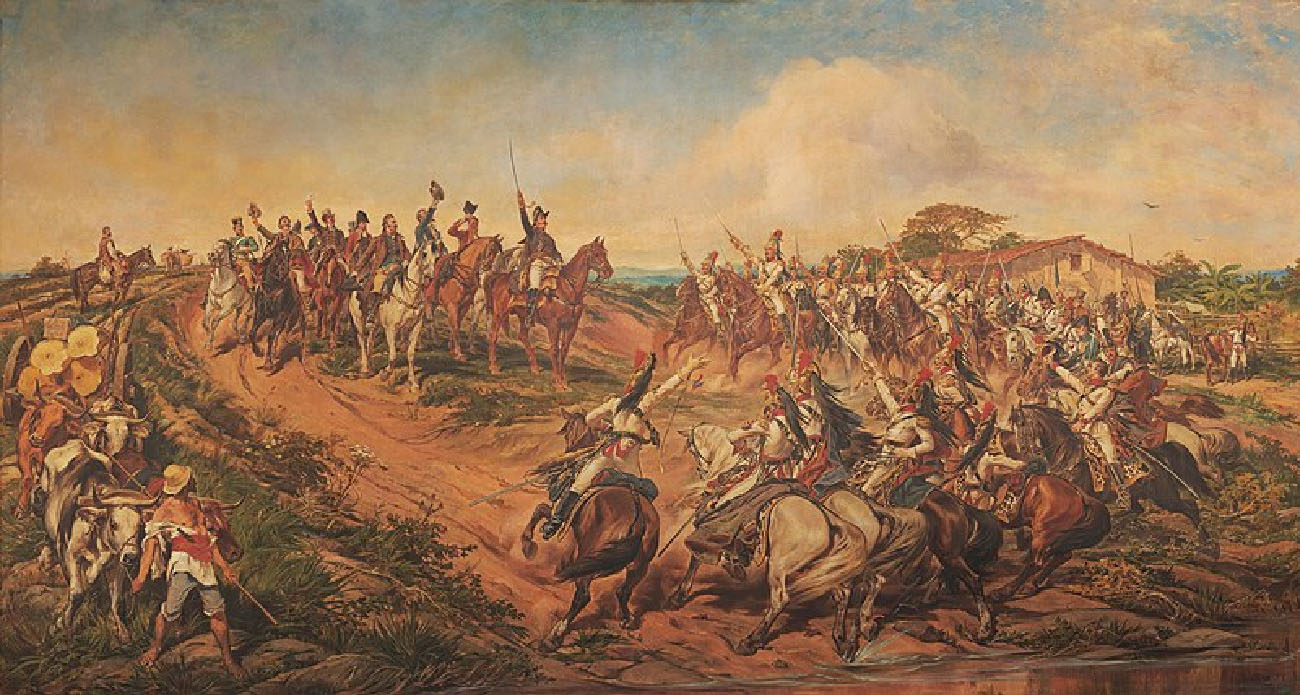
The intentions of the Cortes could now no longer be ignored, however, because they generated conflicts among conservative and liberal factions in the Brazilian provinces. When the Brazilian elites rejected rule by Portugal, Pedro took the final step. He broke with Portugal and on September 7, 1822, declared Brazilian independence on the banks of the Ipiranga River in the province of São Paulo (Figure 8.20). This event became known as the Grito do Ipiranga (Ipiranga Cry). Pedro I was acclaimed Constitutional Emperor and Perpetual Defender of Brazil, and he was crowned in Rio de Janeiro with much pomp and ceremony.
(credit: “Independence or Death” by Museu Paulista collection /Wikimedia Commons, Public Domain) · Public Domain
Figure 8.20 Pedro Américo’s massive 1888 painting shows Pedro I declaring Brazil’s independence with the Grito do Ipiranga on September 7, 1822. (credit: “Independence or Death” by Museu Paulista collection /Wikimedia Commons, Public Domain)
図8.20 ペドロ・アメリコによる1888年の巨大な絵画。1822年9月7日、ペドロ1世が「イピランガの叫び」によってブラジルの独立を宣言する場面を描いている。(出典:Museu Paulista collection/Wikimedia Commons「Independence or Death」。パブリックドメイン)
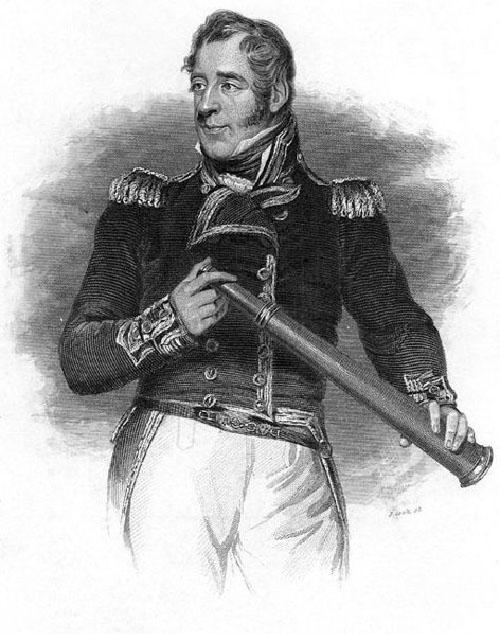
At first, the Portuguese Cortes refused to recognize Brazil’s independence, though away from the cities of Rio de Janeiro and São Paulo and their adjoining provinces, few local juntas declared themselves in favor of Portuguese rule. Determined to beat the Portuguese, Pedro I invited Thomas Cochrane, a former British naval officer, to serve Brazil as first admiral and commander in chief (Figure 8.21).
(credit “Thomas Cochrane, 10th Earl of Dundonald” by Dibner Library of the History of Science and Technology/Wikimedia Commons, Public Domain) · Public Domain
Figure 8.21 Thomas Cochrane, Earl of Dundonald, is shown in a nineteenth-century engraving based on a painting by James Ramsay. Lord Cochrane played a major role in winning independence for Brazil. (credit “Thomas Cochrane, 10th Earl of Dundonald” by Dibner Library of the History of Science and Technology/Wikimedia Commons, Public Domain)
図8.21 ジェームズ・ラムゼイの絵をもとにした19世紀の版画に描かれた、ダンドナルド伯爵トマス・コクラン。コクラン卿は、ブラジルの独立獲得で大きな役割を果たした。(出典:Dibner Library of the History of Science and Technology/Wikimedia Commons「Thomas Cochrane, 10th Earl of Dundonald」。パブリックドメイン)
Cochrane was one of the most daring and successful naval captains of his day; the French called him “the Sea Wolf.” After being struck off Britain’s Navy List because of a financial scandal in 1814, he began a new career as a mercenary. In 1818, he organized the Chilean navy, and with José de San Martín he played a crucial role in securing Chile’s independence and liberating coastal areas in Peru. He was living in semiretirement on his estate in Chile when Pedro I asked him to serve Brazil. Cochrane organized a small Brazilian naval squadron to block Portugal’s access to Brazil’s ports. His first success came with his blockade of Salvador, the main port of the province of Bahia. By preventing resupply of coastal cities and garrisons, Cochrane forced Portuguese fighting forces to abandon the northern provinces of Brazil by 1823. In 1825, the Treaty of Rio de Janeiro recognized Brazil’s independence from Portugal.
The presence of the Braganzas in Rio for thirteen years before independence had unified the nation, and Brazilians still looked to the royal court as a source of power and authority. Most educated citizens accepted the monarchy, with which they identified themselves, and nothing served better to end regional divisions than the external threat from Portugal. In May 1823, Pedro I summoned elected representatives from all provinces to come to Rio and draft the new empire’s constitution. Most were Brazilian sons of the old landed aristocracy, and some had represented Brazil in the Portuguese Cortes, including the liberal José Bonifácio de Andrade e Silva, educated at Portugal’s Coimbra University. The assembly drafted a document that sought balance among the executive, judiciary, and legislative branches of government but disagreed over slavery, the scope of citizenship, and civil rights. Although Pedro I favored the gradual abolition of slavery, Brazilians whose wealth came from sugar plantations were especially concerned that the institution not be interfered with.
Pedro I’s talents did not include the ability to deal with the legislature. When it attempted to limit the power of the emperor in the first constitution, he dissolved the assembly and finished writing the constitution himself, with the help of a small and select council. Acting as an autocrat, Pedro I issued a liberal constitution in 1824 that ignored slavery and added a fourth branch of government, the moderator (moderador), to the executive, legislative, and judiciary. The moderator branch, which consisted of the emperor, empowered Brazil’s ruler to oversee the three other branches and to “balance” them by resolving disagreements among them.
Resentment of Pedro’s autocratic tendencies persisted as he took no notice of slavery and made unpopular foreign-trade and financial decisions. When news of the July Revolution of 1830 in France, which toppled an autocratic king, reached Brazil, popular demonstrations broke out calling for the expulsion of the emperor. In April 1831, Pedro I abdicated in favor of his only son, the six-year-old Brazilian-born Pedro II, and sailed for Portugal to secure the throne for his daughter Maria. He never returned. His departure eliminated the dominant influence of Portuguese-born courtiers and traders in Brazilian society, completing the transition to full Brazilian independence.