第7章ローマ帝国での暮らしExperiencing the Roman Empire
The People of the Empire帝国の人々
The diversity of those living in the Roman Empire meant that Romans felt compelled to define the status of different groups. Not everyone was considered a proper Roman. As the definitions of foreigner and citizen shifted during Rome’s long history, the empire accommodated new peoples in different ways.
英語のヒント
ローマ帝国に暮らす人々が多様だったため、ローマ人はさまざまな集団の地位を定めなければならないと感じた。誰もが正当なローマ人と認められたわけではなかった。ローマの長い歴史の中で、外国人や市民の定義が変わるにつれ、帝国は異なる方法で新たな人々を受け入れた。
Citizens and Foreigners市民と外国人
The Roman Empire policed both its cultural and physical borders. In addition to maintaining their frontier with an army, Romans carried on a perpetual debate about citizenship, or civitas, and whether to extend its benefits to different groups. To gain civitas at birth, a person needed to be the child of two citizens. Citizenship conferred voting rights, the right to perform military service, the right to run for public office, and certain marriage and property rights, among others. The extent to which non-Romans were barred from enjoying these rights was not always clear. Foreigners themselves were categorized into different groups, including free provincials, or peregrini, who were not Roman citizens; army recruits; and those living beyond the Roman border. Foreignness was not a stable category, however; a person could move from one group to another, and the definitions were always changing.
英語のヒント
ローマ帝国は、文化的な境界と物理的な境界の両方を取り締まった。ローマ人は軍隊で国境を維持するだけでなく、キウィタス、すなわち市民権についても、またその恩恵をさまざまな集団に広げるべきかどうかについても、絶えず議論を続けた。生まれた時からキウィタスを得るには、両親とも市民でなければならなかった。市民権によって、投票権、兵役に就く権利、公職に立候補する権利、結婚や財産に関する一定の権利などが与えられた。非ローマ人がこれらの権利を享受することを、どの程度まで禁じられたのかは、必ずしも明確ではない。外国人自身も、いくつかの異なる集団に分類された。例えば、ローマ市民ではない自由な属州住民、すなわちペレグリーニ、軍隊への新規入隊者、ローマの国境の外に暮らす人々である。しかし、「外国人であること」は固定した分類ではなかった。ある集団から別の集団へ移ることもでき、定義は常に変化していた。
People could gain citizenship through other means than being born to Roman citizens. Enslaved people who had been manumitted and allied fighters in times of conflict were likely to be granted citizenship. “Latin Rights,” a limited form of citizenship, were often extended to existing communities when they were brought under Roman control. Finally, in 212 CE, the emperor Caracalla issued an edict that extended citizenship to all free people of the Roman Empire. Its effects are not clear; the emperor was accused of having an ulterior motive, and the surviving text of the edict appears to exclude a group of stigmatized foreigners or freed people. In any case, differences in status and ethnicity persisted among Romans despite the edict.
英語のヒント
ローマ市民の子として生まれる以外の方法でも、市民権を得ることはできた。奴隷身分から解放された人々や、戦争の際に同盟軍として戦った人々には、市民権が与えられることが多かった。限られた形の市民権である「ラテン権」は、既存の共同体がローマの支配下に入る際に、しばしばその共同体に与えられた。最後に212年、皇帝カラカラは、ローマ帝国のすべての自由人に市民権を広げる勅令を発した。その効果は明らかではない。皇帝には隠れた動機があるとの非難があり、現存する勅令の本文は、汚名を着せられた外国人または解放された人々のある集団を除外しているように見える。いずれにせよ、勅令の後も、ローマ人の間には地位や民族の違いが残った。
A person could also lose the privileges of citizenship. Exile and expulsion were a common punishment for criminals. In a series of works, Ovid, a poet during the reign of Augustus, lamented his own exile to a city on the Black Sea. The reasons for his banishment are unclear, but he seems to have angered the emperor, alluding to “a poem and an error” (carmen et error) as the cause of his exile. People could also exile themselves voluntarily to avoid further punishment from Rome, especially the death penalty. There were eventually degrees of exile in which a person might lose their property or in fact be able to return to Rome. Finally, whole groups of people could be expelled from the city of Rome, including Jewish people and followers of Isis in 19 CE, as well as astrologers, philosophers, and actors during the reigns of the emperors Nero and Domitian.
英語のヒント
市民権の特権を失うこともあった。流刑や追放は、犯罪者に対する一般的な刑罰だった。アウグストゥスの治世に生きた詩人オウィディウスは、一連の作品で、黒海沿岸の都市へ流された自身の境遇を嘆いた。追放の理由は不明だが、皇帝の怒りを買ったようであり、自身の追放の原因として「詩と過ち」(carmen et error)をほのめかしている。ローマからさらに処罰を受けること、特に死刑を避けるため、自発的に国外へ去ることもできた。やがて追放にはいくつかの程度が生まれ、財産を失う場合も、実際にローマへ戻ることができる場合もあった。また、集団全体がローマ市から追放されることもあった。19年のユダヤ人やイシス信仰の信者、そしてネロ帝とドミティアヌス帝の治世における占星術師、哲学者、俳優がその例である。
A Special Case: The Jewish People in the Roman Empire特別な事例――ローマ帝国のユダヤ人
The Jewish people had a deep history in the Mediterranean by the time of the Roman Empire. For a considerable length of time, they had occupied the region of the Levant, which was founded as the Roman province of Judaea in 6 CE. Roman writers expressed varied attitudes toward Jewish people; some were sympathetic, while others were overtly hostile. There was often respect for the long tradition of Judaism, but it was offset by slander and violence.
英語のヒント
ローマ帝国の時代までに、ユダヤ人は地中海世界で長い歴史を重ねていた。長期間にわたり、彼らはレヴァントの地域に暮らしていた。この地域には6年、ローマの属州ユダヤが設置された。ローマの著述家がユダヤ人に示す態度はさまざまで、共感的な者もいれば、公然と敵意を向ける者もいた。ユダヤ教の長い伝統への敬意が見られることは多かったが、それを打ち消すように中傷や暴力もあった。
After the creation of the province of Judaea and the incorporation of the local ruling dynasty into the empire, various Jewish uprisings occurred. Inspired by the region’s reorganization, riots occasionally broke out in the cities of the eastern empire. For instance, when images of the emperor were placed in synagogues in Alexandria, riots occurred in 38 CE. There must have been dissatisfaction with the general treatment of Jewish people by the Roman state, but the worship of the emperor was clearly an issue. Further riots occurred in 40; only the death of the emperor Caligula in the next year prevented real war from breaking out.
英語のヒント
属州ユダヤの設置と、地域の支配王朝の帝国への組み入れに続いて、ユダヤ人によるさまざまな蜂起が起こった。この地域の再編に触発され、帝国東部の都市では時折暴動が発生した。例えば38年には、アレクサンドリアのシナゴーグに皇帝の像が置かれた際に暴動が起きた。ローマ国家によるユダヤ人の扱い全般への不満もあったに違いないが、皇帝崇拝が明らかな問題だった。40年にも暴動が起こった。本格的な戦争の勃発を防いだのは、翌年に皇帝カリグラが死んだことだけだった。
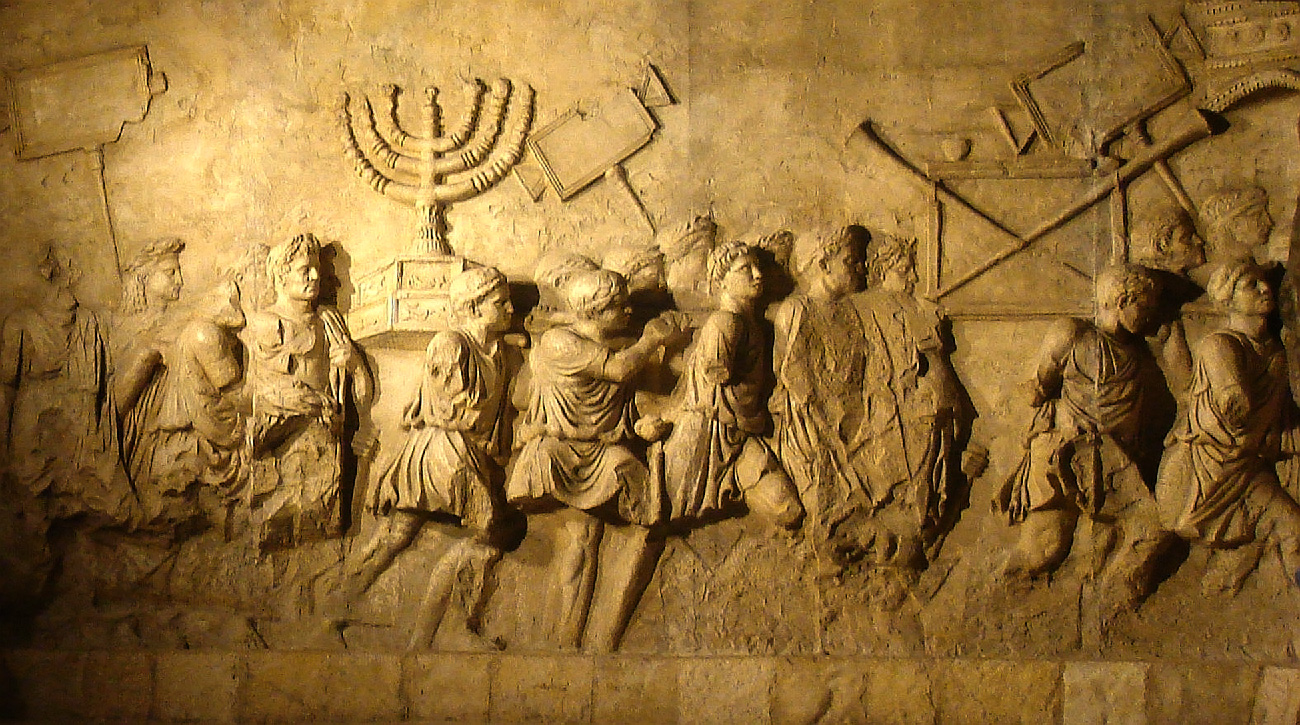
Several wars did occur between Rome and the Jewish people in the first two centuries CE. Revolts against taxation and the Roman looting of the Second Temple in Jerusalem led to war in 66 CE. Roman forces besieged Jerusalem, and in 70 the Temple was destroyed during the conflict. Following the war, the Arch of Titus was erected in Rome in 81 to honor the emperor Vespasian and his son Titus for leading the Roman forces (Figure 7.21). The Arch of Titus and the Colosseum (the latter was built in 79) were paid for with wealth looted from Jerusalem and the Temple. The destruction of the Temple led to a profound change in Judaism; the Temple had functioned as a symbolic center for the Jewish people, and its destruction led to their splintering into different communities based in synagogues around the Mediterranean.
英語のヒント
1〜2世紀には、ローマとユダヤ人の間で、実際にいくつかの戦争が起こった。課税への反乱と、ローマによるエルサレムの第二神殿の略奪が、66年の戦争につながった。ローマ軍はエルサレムを包囲し、70年、戦闘の中で神殿が破壊された。戦後の81年には、皇帝ウェスパシアヌスとその息子ティトゥスがローマ軍を率いたことをたたえ、ローマにティトゥスの凱旋門が建てられた(図7.21)。ティトゥスの凱旋門とコロッセウムの建設費は、エルサレムと神殿から略奪した富で賄われた。コロッセウムは79年に建てられた。神殿の破壊は、ユダヤ教に大きな変化をもたらした。神殿はユダヤ人の象徴的な中心として機能していたが、その破壊により、人々は地中海各地のシナゴーグを拠点とする別々の共同体へと分かれていった。
The Arch of Titus.ティトゥスの凱旋門
(credit: “Arch of Titus Menorah” by “Steerpike”/Wikimedia Commons, CC BY 3.0) · CC BY 3.0
Figure 7.21 This recreation of a relief panel from the Arch of Titus, constructed in Rome in 81 CE, shows the Roman looting of the Jewish temple. (credit: “Arch of Titus Menorah” by “Steerpike”/Wikimedia Commons, CC BY 3.0)
図7.21 81年にローマに建てられたティトゥスの凱旋門の浮彫パネルを再現したもの。ローマ人によるユダヤ教神殿の略奪を表している。(出典:「Steerpike」「Arch of Titus Menorah」、Wikimedia Commons、CC BY 3.0)
Roman views of the Jewish people were complex and contradictory. The historian Tacitus, for example, narrates the events of Titus’s capture of Jerusalem and the suppression of the Jewish revolt in his Histories. He begins by giving an overview of Jewish custom and history: “[Quotation omitted for rights reasons.]” Tacitus goes on to discuss Jewish fasting, observance of the Sabbath, and abstention from pork, all in hostile terms his Roman readers would identify with. He also reports that the Jewish people were from either Mt. Ida on Crete or Egypt, a common view among Romans.
英語のヒント
ユダヤ人に対するローマ人の見方は、複雑で矛盾を含んでいた。例えば歴史家タキトゥスは、『同時代史』でティトゥスによるエルサレム占領とユダヤ人の反乱の鎮圧を語っている。冒頭ではユダヤ人の習慣と歴史を概観する。〔権利の関係で割愛〕続いてタキトゥスは、ユダヤ人の断食、安息日の遵守、豚肉を食べない習慣について、ローマ人読者が共感するような敵意に満ちた言葉で論じる。さらに、ユダヤ人はクレタ島のイダ山かエジプトの出身だという、ローマ人に広く見られた説も伝えている。
Official Roman attitudes to the Jewish people were not consistently hostile, and the Jewish view of Roman treatment also varied depending on the political and cultural climate. Philo, an Alexandrian Jewish ambassador sent to Rome following the riots of 38 CE, recounts in his Embassy to Gaius that he explained to the emperor Caligula how past emperors and officials granted his people particular privileges: “[Quotation omitted for rights reasons.]”
英語のヒント
ローマの公的なユダヤ人への態度は、常に敵対的だったわけではなかった。また、ローマによる扱いをユダヤ人がどう見るかも、政治的・文化的な状況によって異なった。38年の暴動後、アレクサンドリアからローマへ使節として派遣されたユダヤ人フィロンは、『ガイウスへの使節』で、過去の皇帝や役人がユダヤ人にどのような特権を認めていたかを、皇帝カリグラに説明したと記している。〔権利の関係で割愛〕
Philo contrasts Caligula’s hostility toward Jewish people with Augustus’s apparent approval of Judaism. But we also learn about the Jewish population in the city of Rome. Philo explains that there was a particular district of the city in which Jewish people lived, and that there were synagogues within the city. He also suggests that many Jewish people in Rome were formerly enslaved people who had been captured in conflict. It seems therefore that a substantial portion of the Jewish population was made up of freed people. Confirming some of these claims, archaeological evidence of the existence of synagogues and Jewish catacombs in Rome suggests that there was a substantial Jewish population during the imperial period.
英語のヒント
フィロンは、カリグラのユダヤ人への敵意を、アウグストゥスがユダヤ教を認めていたように見えることと対比している。しかし、この記述からは、ローマ市のユダヤ人住民についても知ることができる。フィロンによれば、市内にはユダヤ人が暮らす特定の地区があり、シナゴーグもあった。また、ローマにいた多くのユダヤ人が、かつて戦争で捕虜となった奴隷身分の人々だったことも示唆している。したがって、ユダヤ人住民のかなりの部分は、解放された人々で構成されていたと考えられる。ローマにシナゴーグやユダヤ人の地下墓地があったことを示す考古学的証拠は、これらの主張の一部を裏づけ、帝政期に相当数のユダヤ人住民がいたことを示唆している。