第7章ローマ帝国での暮らしExperiencing the Roman Empire
Life under Slavery奴隷としての生活
Enslaved people led lives that varied across the empire, depending on their age and gender and whether they lived in rural or urban areas. They worked as unskilled laborers, artisans, and assistants to merchants and shopkeepers. Many were trained as teachers, doctors, musicians, and actors. Others helped build public works such as bridges and roads and even served as imperial administrators. In the city, and in the household especially, they had more advantages and avoided the brutal physical labor demanded in mines, quarries, and latifundia across the empire. There, more than one hundred enslaved persons might labor, their harsh life evidenced by their poor clothing, cruel treatment, and inability to raise funds to buy their freedom.
英語のヒント
奴隷にされた人々の生活は、年齢や性別、農村に住むか都市に住むかによって、帝国各地で異なっていた。単純労働者、職人、商人や店主の助手として働く者もいれば、教師、医師、音楽家、俳優として訓練された者も多かった。橋や道路などの公共施設の建設を手伝う者や、帝国の行政官として働く者さえいた。都市、とりわけ家の中で働く奴隷は、より有利な条件を持ち、帝国各地の鉱山、採石場、ラティフンディアで要求された、過酷な肉体労働を免れた。そうした場所では100人を超える奴隷が働くこともあり、粗末な衣服、残酷な扱い、自由を買う資金を蓄えられないことが、その厳しい生活を物語っていた。
Still, enslaved people in any context were a moment away from punishment by slaveholders, who were perpetually concerned with avoiding conspiracy and rebellion. A culture of uncertainty, coercion, and submission was the result of the constant threat of potential violence. Enslaved people could be whipped, beaten, or tortured and were often sexually abused. In Petronius’s Satyricon, a novel written in the first century CE, the freed Trimalchio discusses the services he offered while enslaved: “Still, I was my master’s favorite for fourteen years. No disgrace in obeying your master’s orders. Well, I used to amuse my mistress too. You know what I mean; I say no more, I am not a conceited man.” Enslaved people who ran away and were caught could be branded or forced to wear a collar with their owner’s name on it.
英語のヒント
それでも、どのような環境にいても、奴隷にされた人々は、所有者からの処罰にいつさらされてもおかしくなかった。所有者は陰謀や反乱を防ぐことを絶えず気にしていた。暴力を加えられるかもしれないという脅威が常にあることで、不安、強制、服従の文化が生まれた。奴隷は鞭打たれ、殴られ、拷問されることがあり、性的な虐待も頻繁に受けた。紀元後1世紀に書かれたペトロニウスの小説『サテュリコン』では、解放奴隷のトリマルキオが、奴隷だったころに果たした奉仕について語る。「それでも、私は14年間、主人のお気に入りだった。主人の命令に従うのは恥ではない。まあ、女主人の慰み者にもなっていたがね。どういう意味かわかるだろう。これ以上は言わない。私はうぬぼれ屋ではないからね。」逃げ出して捕まった奴隷は、焼き印を押されたり、所有者の名前が記された首輪を着けさせられたりすることがあった。
Though the enslaved were denied the official rights of marriage, they could form families and have children, which often occurred in urban settings. The slaveholder could always manipulate the relationships between enslaved people for personal ends. Enslaved children were put to work, perhaps with simple duties in the house, and over time enslaved people might be promoted to different roles within a household.
英語のヒント
奴隷には正式に結婚する権利が認められなかったものの、家族を形成し、子供を持つことはでき、都市ではそうしたことがよくあった。奴隷所有者は、奴隷同士の関係を、自分の目的のためにいつでも操作できた。奴隷の子供も働かされ、おそらく家の中の簡単な仕事などを任された。時がたつにつれて、奴隷がその家で別の役割へ昇格することもあった。
Gladiators剣闘士
Gladiatorial combat was an important element of Roman culture and a prominent part of public entertainments. Matches originated in central Italy in the third century BCE and were originally part of funeral games, spectacles that honored the deceased. The first games in the city of Rome occurred in 264 BCE, with three pairs of gladiators fighting. In the centuries that followed, the number of games increased until, under the emperors, they included hundreds of gladiators.
英語のヒント
剣闘士の戦いはローマ文化の重要な要素であり、公の娯楽の中でも目立つ位置を占めた。試合は紀元前3世紀のイタリア中部に始まり、もともとは死者をたたえる見世物である、葬儀の競技の一部だった。ローマ市で最初の競技が行われたのは紀元前264年で、三組の剣闘士が戦った。その後、何世紀にもわたって競技の数は増え続け、皇帝の時代には、数百人の剣闘士が参加するようになった。
Gladiators came from a variety of backgrounds, and though some were volunteers, enslaved people forced into the role formed a substantial number. A team of gladiators was called a familia and was trained in a gladiatorial school by a lanista, the manager of the group. The lanista and other trainers assessed new recruits and picked the weapons they would use in combat. Daily training was strenuous, but gladiators were expected to fight only a handful of times over a year.
英語のヒント
剣闘士の出自はさまざまで、志願者もいたが、その役割を強いられた奴隷が相当数を占めていた。剣闘士の集団はファミリアと呼ばれ、剣闘士養成所で、集団の管理者であるラニスタから訓練を受けた。ラニスタとほかの教官は新入りを評価し、戦いで使う武器を選んだ。日々の訓練は厳しかったが、剣闘士が実際に戦うのは、一年にわずか数回と想定されていた。
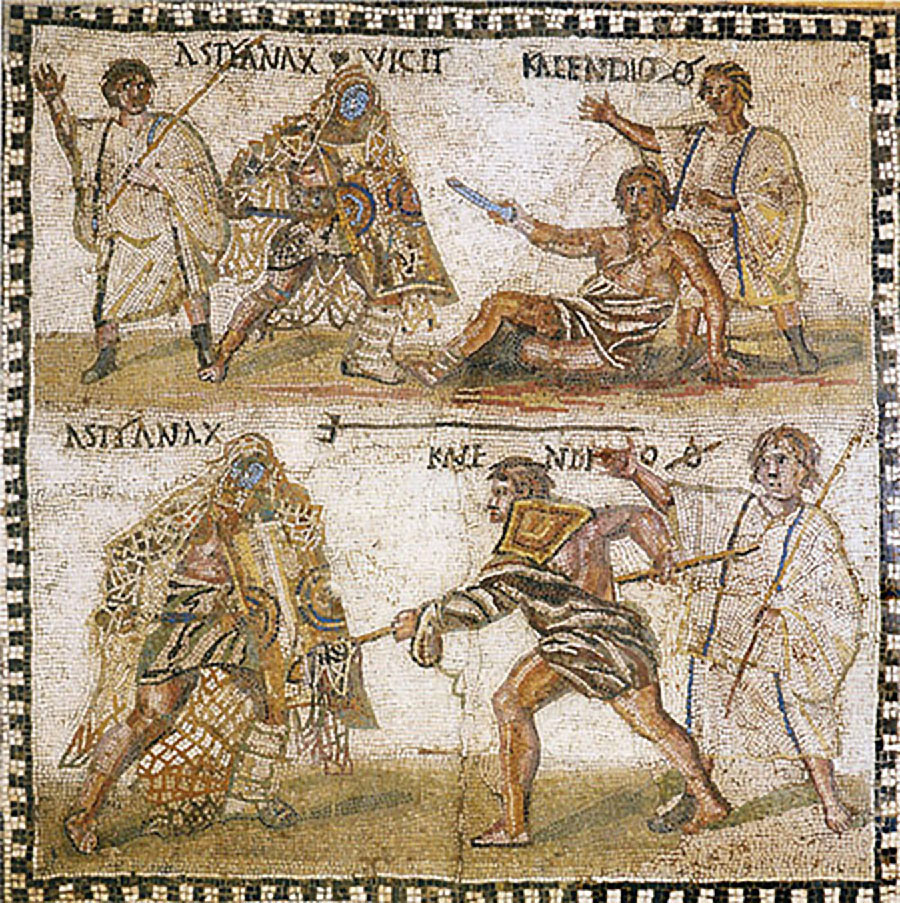
Matches usually consisted of differently armed gladiators fighting one another. In one common type of match, gladiators armed with swords fought a retiarius, who was armed with a net and a trident (Figure 7.8). Gladiators did not usually fight to the death, but the crowd played a major role in the fights, often encouraging gladiators to kill their wounded opponents. The emperor, if in attendance, could also influence the outcome by giving a “thumb up” or “thumb down,” meaning allow the opponent to live or die, respectively. The most talented and successful gladiators could acquire a devoted following of fans as well as earn money for fighting.
英語のヒント
試合では通常、異なる武装をした剣闘士同士が戦った。よく見られた形式の一つでは、剣を持つ剣闘士が、網と三叉槍を持つレティアリウスと戦った(図7.8)。剣闘士は普通、死ぬまで戦ったわけではない。しかし観衆は戦いに大きな役割を果たし、しばしば、傷ついた相手を殺すよう剣闘士をあおった。皇帝が臨席している場合も、親指を上げるか下げるかによって勝負の結末に影響を与えることができた。それぞれ相手を生かすこと、死なせることを意味する。最も才能があり、成功した剣闘士は、戦いによる報酬を得るだけでなく、熱心なファンの一団を獲得することもできた。
Gladiators in the Arena.闘技場の剣闘士。
(credit: “Astyanax vs Kalendio mosaic” by James Grout/Encyclopaedia Romana/Wikimedia Commons, Public Domain) · Public Domain
Figure 7.8 This third-century CE mosaic tells the story of a gladiatorial match in ancient Rome. The fight begins in the bottom panel with the retiarius Kaliendio throwing his net over Astyanax and thrusting his trident at him, but in the upper panel Kaliendio has been wounded, his trident has missed, and he is surrendering by raising his knife. The caption “Astyanax vicit” at the top indicates that Astyanax has won, while “Kaliendio Ø” tells us that Kaliendio was killed. The two toga-clad figures are lanistae (plural of lanista). (credit: “Astyanax vs Kalendio mosaic” by James Grout/Encyclopaedia Romana/Wikimedia Commons, Public Domain)
図7.8 紀元後3世紀のこのモザイクは、古代ローマの剣闘士の試合の経過を描く。戦いは下段から始まり、網闘士のカリエンディオがアスティアナクスに網を投げかけ、三叉槍を突き出している。しかし上段では、カリエンディオは傷つき、三叉槍は外れ、短剣を上げて降伏している。上部の「Astyanax vicit」はアスティアナクスの勝利を示し、「Kaliendio Ø」はカリエンディオが殺されたことを伝える。トガ姿の二人はラニスタエ、すなわちラニスタの複数形である。(出典:James Grout/Encyclopaedia Romana/Wikimedia Commons「Astyanax vs Kalendio mosaic」、パブリックドメイン)
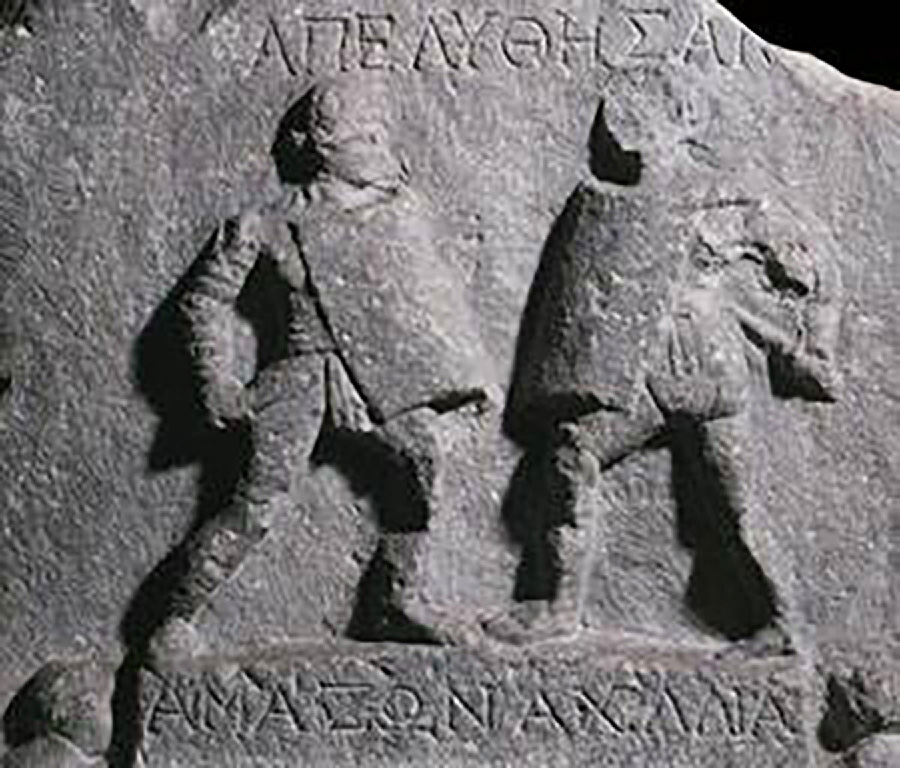
There is also evidence that both senators and women participated in gladiatorial combat, possibly to ceremonially reenact scenes from myth. A law enacted by the emperor Tiberius in 19 CE declared that no senator or person of equestrian rank could take part in the fighting, suggesting that their participation had been an ongoing issue. That women took part is clear in a stone relief from the first or second century CE, showing two female gladiators fighting (Figure 7.9).
英語のヒント
元老院議員や女性も剣闘士の戦いに参加していたことを示す証拠がある。おそらく、神話の場面を儀礼的に再現するためだった。紀元後19年にティベリウス帝が制定した法律は、元老院議員や騎士身分の者が戦いに参加することを禁じた。このことは、彼らの参加が継続的な問題になっていたことを示唆している。女性が参加したことは、紀元後1世紀または2世紀の石の浮彫から明らかである。そこには、二人の女性剣闘士が戦う姿が描かれている(図7.9)。
Female Gladiators.女性剣闘士。
(credit: “Two female gladiators, named as Amazonia and Achillea” by “Xastic”/Wikimedia Commons, Public Domain) · Public Domain
Figure 7.9 The two women gladiators facing off in this stone relief from the first or second century CE are identified below as “Amazon” on the left and “Achillea” (a version of the name Achilles) on the right. Stage names like these were often adopted for the reenactment of mythological scenes in the arena. (credit: “Two female gladiators, named as Amazonia and Achillea” by “Xastic”/Wikimedia Commons, Public Domain)
図7.9 紀元後1世紀または2世紀のこの石の浮彫で向かい合う女性剣闘士二人には、下部に名前が記されている。左が「アマゾン」、右が「アキレア」(アキレウスの名の一形)である。このような芸名は、闘技場で神話の場面を再現するときによく用いられた。(出典:「Xastic」/Wikimedia Commons「Two female gladiators, named as Amazonia and Achillea」、パブリックドメイン)
The Colosseum was a massive structure in the middle of the city of Rome that was the site of many public entertainments, including gladiatorial matches. Built between 69 and 79 CE, it was named the Flavian Amphitheater, after the ruling dynasty at that time. It was also known as the Colosseum because a colossal statue of the emperor Nero stood nearby. (Well over one hundred feet tall, the statue was later rededicated to the Roman sun god Sol.) The amphitheater was officially dedicated in 80 CE by the emperor Titus in a ceremony that included one hundred days of games. Its design featured a rising arrangement of columns in different styles and a complicated network of barrel vaults. Up to fifty thousand spectators could be seated within the structure, and spectacles included gladiator matches, mock naval battles, and animal hunts. The impressive displays of showmanship were intended to be entertainment, but they also served an important political function. As part of a policy mockingly called “bread and circuses,” these epic games (and the distribution of free wheat) were meant to distract the people from potential weaknesses in Roman governance. The idea was that those whose immediate needs were being met with food and entertainment were less likely to notice social inequality, become discontented, or foment rebellion. The games were also a way to bolster popular enthusiasm for the sitting emperor, who usually attended regularly.
英語のヒント
コロッセウムはローマ市の中心部にある巨大建造物で、剣闘士の試合をはじめ、多くの公の娯楽の舞台となった。紀元後69〜79年に建設され、当時の王朝にちなみ、フラウィウス円形闘技場と名付けられた。近くにネロ帝の巨像が立っていたため、コロッセウムとも呼ばれた。この像は高さ100フィートを大きく超え、後にローマの太陽神ソルにささげ直された。闘技場は紀元後80年、ティトゥス帝によって正式に奉献された。その式典では100日間の競技が行われた。建築には、階が上がるごとに異なる様式の柱を配する構成と、複雑に組み合わされた筒型ヴォールトが用いられた。内部には最大5万人の観客を収容でき、剣闘士の試合、模擬海戦、動物狩りなどが催された。目を見張るこれらの演出は娯楽を目的としていたが、重要な政治的役割も果たした。「パンとサーカス」と皮肉られた政策の一環として、大がかりな競技と小麦の無料配給は、ローマの統治に潜む弱点から人々の目をそらすことを意図していた。食料と娯楽で差し迫った欲求が満たされている人々は、社会の不平等に気づいたり、不満を抱いたり、反乱をあおったりする可能性が低い、という考えだった。競技はまた、通常は定期的に観覧に訪れる、在位中の皇帝に対する民衆の熱意を高める手段でもあった。