第7章ローマ帝国での暮らしExperiencing the Roman Empire
Religions of the Empire帝国の宗教
In addition to performing public service and ritual, Romans participated in the private practice of religion. In the home they maintained a lararium, a shrine in which the spirits of ancestors were honored. Tiny statues, or lares, within the shrine represented these ancestors, and Romans made daily offerings to them. In addition, the penates, figurines of household gods, were put on the dining table during meals and worshipped as protectors of the home. Finally, the genius signified the household itself, represented as a snake in religious imagery.
英語のヒント
ローマ人は、公的な奉仕や儀礼に加えて、私的にも宗教を実践した。家にはララリウムという、祖先の霊を敬う祠があった。その中の小さな像、ラレスは祖先を表し、ローマ人は毎日供え物をした。また、家の神々の小像であるペナテスは、食事の際に食卓へ置かれ、家庭の守護者として崇拝された。最後に、ゲニウスは家そのものを象徴し、宗教的な図像では蛇として表された。
More esoteric religious practices included the use of curse tablets and spells. With these, individuals hoped to mobilize supernatural powers to influence the living by writing an invocation. Many curse tablets, aimed at ensuring the writer’s way in love, justice, and competitions, have survived. The tablets were placed in graves, in water sources such as rivers and springs, and in the homes of targeted individuals. An example found in Egypt with a pierced female figurine ordered a spirit to “[Quotation omitted for rights reasons.]”
英語のヒント
より秘教的な宗教実践には、呪詛板や呪文の使用があった。人々は祈願の文を書くことで超自然的な力を動かし、生きている人々に影響を及ぼそうとした。恋愛、裁判、競技で書き手の望みをかなえようとする呪詛板が、多数残っている。板は墓、川や泉などの水源、そして狙われた人の家に置かれた。エジプトでは、針を刺した女性の小像とともに一例が発見されている。そこでは霊に対し、次のように命じていた。〔権利の関係で割愛〕
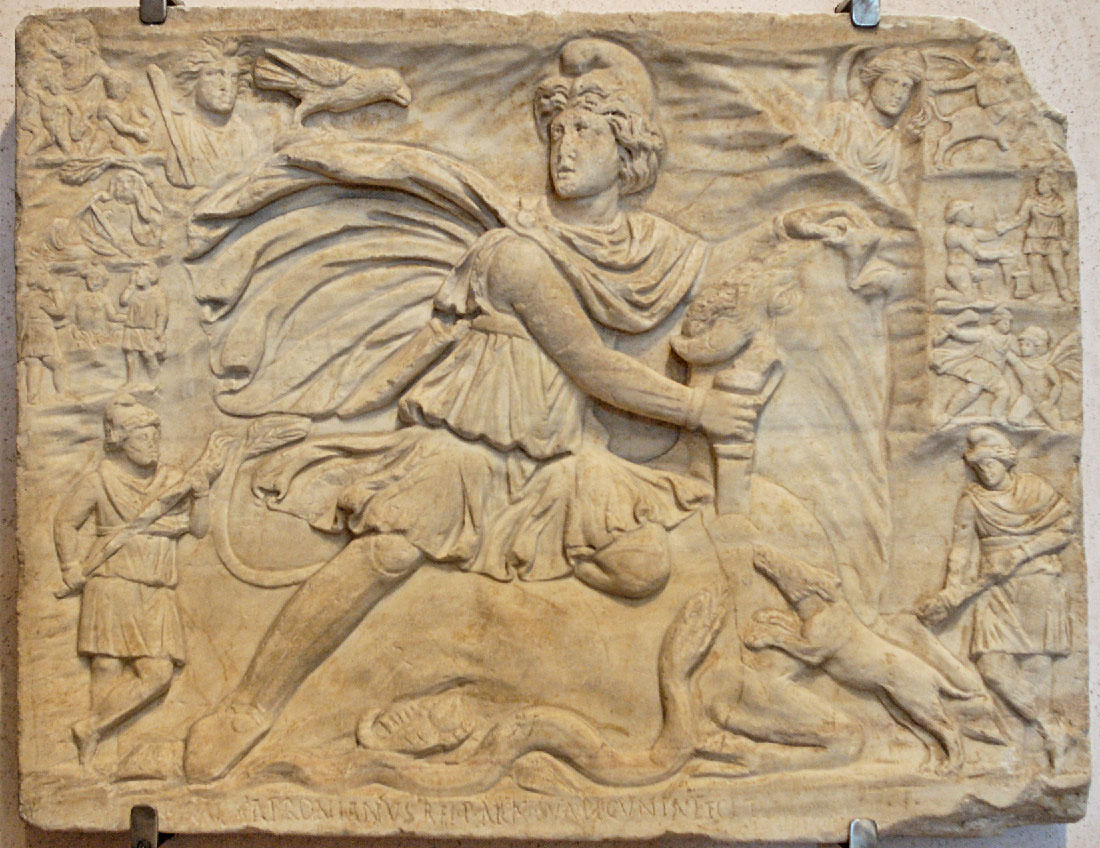
Mystery cults allowed individuals to become initiated in the worship of a specific deity. These groups were devoted to a single god or goddess who was often worshipped to the neglect of traditional Roman gods. Their adherents carried out secret initiation rites and practices, and there were often hierarchical levels of initiation. The cult devoted to the god Mithras originated in ancient Persia (now Iran) and found its way to Rome by the second century CE. Its beliefs centered on the idea that life originated from a sacred bull sacrificed by the god Mithras, often associated with the Sun (Figure 7.15). The practices of the cult are obscure and difficult to reconstruct, but it seems that initiations took place in a cave. The cult was especially popular among Roman soldiers.
英語のヒント
秘儀宗教では、個人が特定の神への崇拝に入信することができた。こうした集団は一柱の男神か女神に献身し、その神を崇拝するあまり、伝統的なローマの神々を顧みないことも多かった。信徒たちは秘密の入信儀礼や実践を行い、入信の段階には階層が設けられることが多かった。ミトラス神をまつる集団は古代ペルシア(現在のイラン)に始まり、紀元後2世紀までにローマへ伝わった。その信仰の中心には、しばしば太陽と結び付けられたミトラスが犠牲にした、聖なる雄牛から生命が生まれたという考えがあった(図7.15)。実践の内容は不明瞭で、再構成することが難しいが、入信儀礼は洞窟で行われたようである。この信仰は、ローマの兵士の間で特に人気があった。
Mithras.ミトラス。
(credit: “Tauroctony: Mithras killing the sacred bull” by Marie-Lan Nguyen/Wikimedia Commons, Public Domain) · Public Domain
Figure 7.15 In this second-century CE relief from a Mithraic sanctuary in Nersae, Italy, the intricate iconography typical of the cult of Mithras shows the god sacrificing the sacred bull, alongside other imagery important to Mithraic belief. (credit: “Tauroctony: Mithras killing the sacred bull” by Marie-Lan Nguyen/Wikimedia Commons, Public Domain)
図7.15 イタリアのネルサエにあるミトラスの聖所から出た、紀元後2世紀のこの浮彫には、ミトラス信仰に典型的な複雑な図像が見られる。神が聖なる雄牛を犠牲にする姿が、信仰上重要なほかの図像とともに描かれている。(出典:Marie-Lan Nguyen/Wikimedia Commons「Tauroctony: Mithras killing the sacred bull」、パブリックドメイン)
Originating in Egypt, the cult devoted to the goddess Isis spread to the western Roman Empire in the first century BCE. The veneration of Isis included hymns of praise and initiation rituals, and priests of the cult usually shaved their heads. The exclusive worship of Isis was reflected in her perceived omnipotence and identification with other gods. She appears in the second-century Roman novel The Golden Ass, rescuing the protagonist Lucius. Her speech begins, “[Quotation omitted for rights reasons.]” The popularity of mystery cults may have been a precursor to monotheism in Rome, as seen in the rise of Christianity.
英語のヒント
エジプトに起源を持つ女神イシスの信仰は、紀元前1世紀にローマ帝国西部へ広がった。イシスへの崇敬には賛歌や入信儀礼があり、この祭祀の神官は通常、頭を剃った。イシスだけを崇拝する姿勢は、彼女を全能と見なし、ほかの神々とも同一視したことに表れていた。紀元後2世紀のローマの小説『黄金のロバ』にも登場し、主人公ルキウスを救う。彼女の語りかけは、次のように始まる。〔権利の関係で割愛〕秘儀宗教の人気は、キリスト教の台頭に見られるような、ローマでの一神教の先駆けだったのかもしれない。