第7章ローマ帝国での暮らしExperiencing the Roman Empire
7.3 The Roman Economy: Trade, Taxes, and Conquest7.3 ローマ経済――交易、租税、征服
Learning Objectives学習の目標
By the end of this section, you will be able to:
この節を学ぶと、次のことができるようになる。
Identify key trade routes in the Roman Empire
ローマ帝国の主要な交易路を特定する
Explain how the Roman Empire used taxes to raise revenue and influence behavior
ローマ帝国が、収入を得て人々の行動に影響を及ぼすために、租税をどう利用したか説明する
Analyze the importance of conquest in the Roman economy
ローマ経済における征服の重要性を分析する
The Roman economy was a massive and intricate system. Goods produced in and exported from the region found their way around the Mediterranean, while luxury goods brought from distant locales were cherished in the empire. The sea and land routes that connected urban hubs were crucial to this exchange. The collection of taxes funded public works and government programs for the people, keeping the economic system functioning. The Roman army was an extension of the economic system; financing the military was an expensive endeavor, but the Romans saw it as a critical tool in dominating the Mediterranean.
英語のヒント
ローマ経済は、巨大で入り組んだ仕組みだった。この地域で生産・輸出された品物は地中海各地へ運ばれ、遠方からもたらされるぜいたく品は帝国内で珍重された。都市の拠点を結ぶ海路と陸路が、この交換に欠かせなかった。徴税は、公共施設や民衆のための政府事業の財源となり、経済の仕組みを機能させ続けた。ローマ軍も経済の仕組みの延長にあった。軍の維持には多額の費用がかかったが、ローマ人はそれを、地中海を支配するための極めて重要な手段と見ていた。
Trade交易
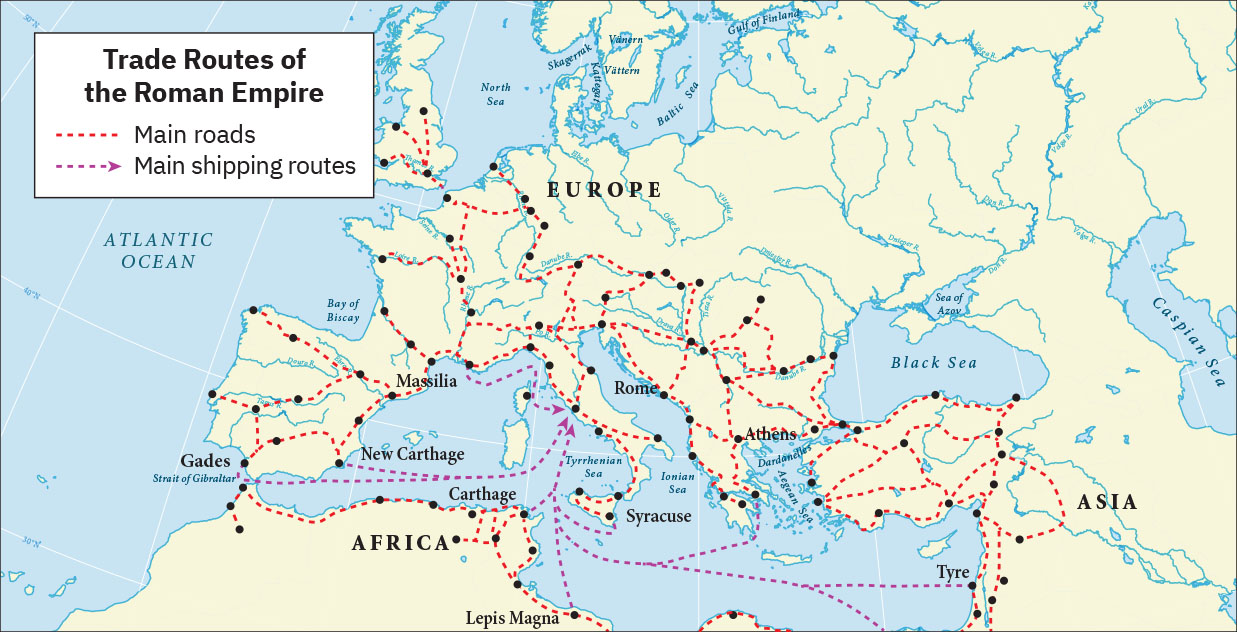
Sea routes facilitated the movement of goods around the empire. Though the Romans built up a strong network of roads, shipping by sea was considerably less expensive. Thus, access to a seaport was crucial to trade. In Italy, there were several fine seaports, with the city of Rome’s port at Ostia being a notable example. Italy itself was the producer of goods that made their way around the Mediterranean. Most manufacturing occurred on a small scale, with shops and workshops often located next to homes. Higher-value goods did find their way to distant regions, and Italy dominated the western trade routes (Figure 7.10).
英語のヒント
海路は、帝国内での品物の移動を容易にした。ローマ人は強固な道路網を築いたが、海上輸送の費用ははるかに安かった。このため、海港を利用できることが交易に欠かせなかった。イタリアには優れた海港がいくつもあり、ローマ市の港であるオスティアは、特に知られた例だった。イタリア自体も、地中海各地に流通する品物の生産地だった。製造業の大半は小規模で、店舗や工房は住宅の隣にあることも多かった。価値の高い品物は遠方にも運ばれ、イタリアは西方の交易路で優位を占めた(図7.10)。
Trade Routes of the Roman Empire.ローマ帝国の交易路。
(attribution: Copyright Rice University, OpenStax, under CC BY 4.0 license) · CC BY 4.0
Figure 7.10 As this map demonstrates, the Romans were able to harness an extensive system of roads and waterways to import and export both practical and luxury goods. (attribution: Copyright Rice University, OpenStax, under CC BY 4.0 license)
図7.10 この地図が示すように、ローマ人は、広範な道路と水路の網を利用し、日用品とぜいたく品の両方を輸出入することができた。(出典:Copyright Rice University, OpenStax、CC BY 4.0)
Italy was known for its ceramic, marble, and metal industries. Bronze goods such as cooking equipment and ceramic tableware known as red pottery were especially popular items. Red Samian pottery made its way to places around the Mediterranean and beyond, including Britain and India. Iron goods produced in Italy were exported to Germany and to the Danube region, while bronze goods, most notably from Capua, circulated in the northern reaches of the empire before workshops also developed there. These industries likewise relied on imports, including copper from mines in Spain and tin from Britain for making bronze.
英語のヒント
イタリアは陶磁器、大理石、金属の産業で知られていた。調理器具などの青銅製品や、赤色土器と呼ばれる陶器の食器は、特に人気が高かった。赤いサモス陶器は地中海各地を越え、ブリテン島やインドにまで運ばれた。イタリアで生産された鉄製品はゲルマニアとドナウ川流域へ輸出され、青銅製品、とりわけカプア産の品は、帝国北部にも工房が発達する以前から、その地域で流通していた。これらの産業もまた輸入に依存し、青銅を作るための銅はスペインの鉱山から、錫はブリテン島から仕入れていた。
Other Roman industries balanced their production with imported goods from foreign markets. Textiles such as wool and cloth were produced in Italy, while luxury items like linen came from Egypt. Several trading routes existed in addition to the famous Silk Roads. The monsoon-driven Indian Ocean network linked Asia and the Mediterranean and provided the Romans with silk from China and India and furs from the Baltic region. The eastern empire was known for its luxury goods, including purple dye, papyrus, and glass from Egypt and Syria. For a time, central Italy did manufacture and export glass products northward, until manufacturing in Gaul (present-day France) and Germany took over the majority of its production in the second century CE. Building supplies such as tiles, marble, and bricks were produced in Italy.
英語のヒント
ローマのほかの産業では、自らの生産と、外国市場からの輸入品が組み合わされていた。羊毛や布などの織物はイタリアで生産され、リンネルのようなぜいたく品はエジプトから来た。有名なシルクロードのほかにも、交易路はいくつもあった。季節風を利用するインド洋の交易網はアジアと地中海を結び、ローマ人に中国やインドの絹、バルト海沿岸の毛皮を供給した。帝国東部は、エジプトやシリアからの紫色の染料、パピルス、ガラスなどのぜいたく品で知られていた。一時期、イタリア中部もガラス製品を製造して北方へ輸出していたが、紀元後2世紀には、ガリア(現在のフランス)とゲルマニアの製造業が、生産の大半を担うようになった。タイル、大理石、れんがなどの建築資材は、イタリアで生産されていた。
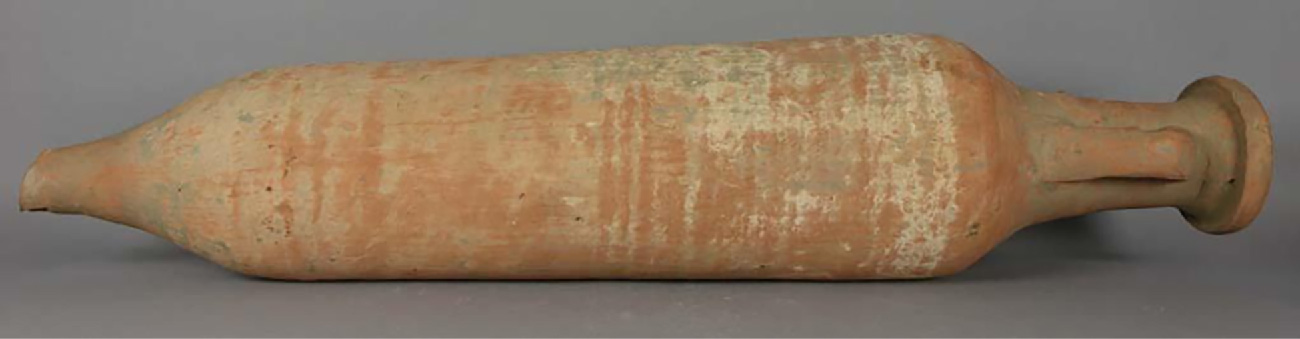
Agricultural goods were an important aspect of the Roman economy and trade networks. Grain-producing Egypt functioned as the empire’s breadbasket, and Italian farmers were therefore able to focus on other, higher-priced agricultural products including wine and olive oil. Wine was exported to markets all over the Mediterranean, including Greece and Gaul. Both wine and olive oil, as well as other goods, were usually shipped in amphorae. These large storage vases had two handles and a pointed end, which made them ideal for storing during shipment. They may have been tied together or placed on a rack when shipped by sea (Figure 7.11).
英語のヒント
農産物は、ローマ経済と交易網の重要な側面をなしていた。穀物を生産するエジプトが帝国の穀倉として機能したため、イタリアの農民はワインやオリーブ油など、より高価なほかの農産物に集中することができた。ワインはギリシャやガリアを含め、地中海全域の市場へ輸出された。ワインとオリーブ油は、ほかの品物と同じく、通常はアンフォラに入れて運ばれた。この大型の貯蔵用の壺には二つの取っ手と、とがった底があり、輸送中の収納に適していた。海路で運ぶ際には、互いに縛り合わせたり、棚に置いたりしたのかもしれない(図7.11)。
A Roman Amphora.ローマのアンフォラ。
(credit: “Roman Amphora” by Mrs. Elvi Adamcak/Smithsonian, National Museum of Natural History, CC0) · CC0
Figure 7.11 Amphorae (the plural of amphora) were large vessels essential for shipping liquid goods in the Mediterranean world. Their slender shape and pointed base made for easy storage whether they were placed upright in a ship’s hold or set in the soft ground. (credit: “Roman Amphora” by Mrs. Elvi Adamcak/Smithsonian, National Museum of Natural History, CC0)
図7.11 アンフォラの複数形であるアンフォラエは、地中海世界で液体の商品を輸送するために欠かせない大型容器だった。細長い形ととがった底によって、船倉に立てる場合でも、柔らかい地面に据える場合でも、収納が容易になった。(出典:Mrs. Elvi Adamcak/Smithsonian, National Museum of Natural History「Roman Amphora」、CC0)
The government’s official distribution of grain to the populace was called the annona and was especially important to Romans. It had begun in the second century BCE but took on new importance by the reign of Augustus. The emperor appointed the praefectus annonae, the prefect who oversaw the distribution process, governed the ports to which grain was shipped, and addressed any fraud in the market. The prefect and his staff also secured the grain supply from Egypt and other regions by signing contracts with various suppliers.
英語のヒント
政府が民衆に行う穀物の公式な配給は、アンノナと呼ばれ、ローマ人にとって特に重要だった。紀元前2世紀に始まっていたが、アウグストゥスの治世までに、新たな重要性を持つようになった。皇帝はプラエフェクトゥス・アンノナエという長官を任命した。この長官は配給の過程を監督し、穀物の輸送先となる港を管理し、市場の不正に対処した。長官とその部下はまた、さまざまな供給業者と契約を結び、エジプトなどの地域から穀物の供給を確保した。
The Roman government was also generally concerned with controlling overseas trade. An elite class of shipowners known as the navicularii were compelled by the government to join groups known as collegia (corporations) so they could be easily supervised. For signing contracts to supply grain, these shipowners received benefits including exemption from other public service. By the third and fourth centuries CE, control of the navicularii had intensified, and signing contracts to supply the annona was compulsory.
英語のヒント
ローマ政府は、海外交易全般を統制することにも関心を持っていた。ナウィクラリイと呼ばれる上層の船主たちは、政府により、コレギア(団体)と呼ばれる集団に加入するよう強制された。容易に監督できるようにするためである。穀物供給の契約を結ぶ見返りに、船主たちは、ほかの公的な奉仕の免除などの特典を受けた。紀元後3〜4世紀までには船主への統制が強まり、アンノナに穀物を供給する契約の締結は義務となった。
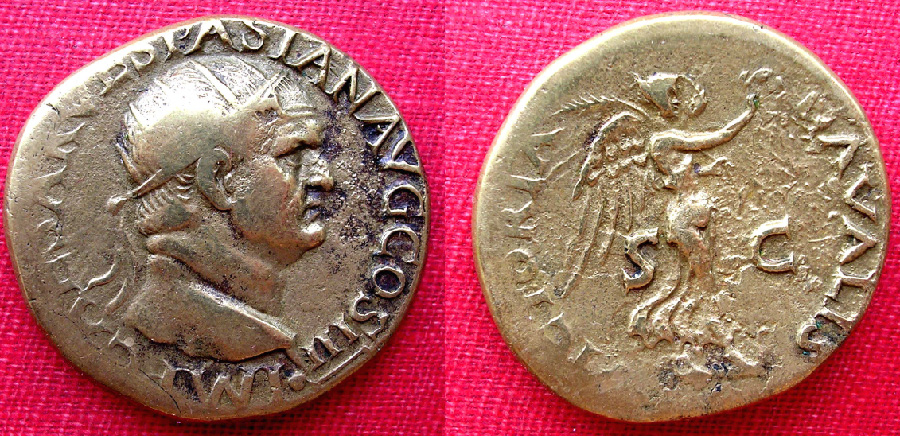
The annona kept the populace fed but was also a political tool; the emperor hoped his generosity would endear him to the people. The distribution of grain was thus heavily tied to the personality of the emperor. For instance, like many emperors, Hadrian, who ruled from 138 to 161 CE, associated himself with the annona to create a positive image before the public (Figure 7.12).
英語のヒント
アンノナは民衆に食料を行き渡らせたが、政治的な手段でもあった。皇帝は、自分の寛大さによって民衆の好意を得ることを期待した。このように穀物の配給は、皇帝個人と強く結び付いていた。たとえば、138〜161年に統治したハドリアヌスは、多くの皇帝と同じように、自分をアンノナと結び付け、民衆の前で好ましい印象を作り出した(図7.12)。
A Coin of Vespasian.ウェスパシアヌスの貨幣
(credit: “Vespasian Dupondius” by Guy de la Bedoyere/Wikimedia Commons, Public Domain) · Public Domain
Figure 7.12 This brass dupondius of the emperor Vespasian was struck at Lyon around 72–73 CE. The obverse (left) bears his portrait and name; the reverse depicts a winged Victory standing on a ship’s prow, with the legend VICTORIA NAVALIS, referring to naval victory. (credit: “Vespasian Dupondius” by Guy de la Bedoyere/Wikimedia Commons, Public Domain)
図7.12 この真鍮製のドゥポンディウス貨は、ウェスパシアヌス帝のもと、72〜73年ごろにリヨンで鋳造された。表面(左)には皇帝の肖像と名前があり、裏面には船首に立つ翼のある勝利の女神と、海戦の勝利を表す銘文VICTORIA NAVALISがある。(出典:Guy de la Bedoyere「Vespasian Dupondius」、Wikimedia Commons、パブリックドメイン)