第4章古代オリエントThe Near East
4.4 The Hebrews4.4 ヘブライ人
Learning Objectives学習の目標
By the end of this section, you will be able to:
この節を学ぶと、次のことができるようになる。
Discuss the history of the Hebrews in the context of the development of the Near East
近東の発展という文脈の中で、ヘブライ人の歴史を論じる。
Explain how the Hebrew faith differed from others in the same region and time period
ヘブライ人の信仰が、同じ地域・時代の他の信仰とどう違ったかを説明する。
The Hebrews, a Semitic-speaking Canaanite people known for their monotheistic religion of Judaism or the Jewish religion, have preserved a history of their people that claims very ancient origins and includes descriptions of early leaders, kings, religious traditions, prophets, and numerous divine interventions. That history, often called the Tanakh or Hebrew Bible in the Jewish tradition and the Old Testament in the Christian tradition, has survived for many centuries and influenced the emergence of the two other major monotheistic faiths, Christianity and Islam. While fundamentalist Christians and Orthodox Jews hold that the Bible is both divinely inspired and inerrant, historians must scrutinize the text and the rich history it records. This study and the careful work of archaeologists in the Near East have revealed a number of problems with accepting as infallible the story as recorded in the Hebrew Bible, but research has also opened our eyes to a history that is perhaps even more interesting than the account traditionally preserved.
英語のヒント
一神教であるユダヤ教で知られるヘブライ人は、セム系言語を話すカナンの人々だった。非常に古い起源を語り、初期の指導者、王、宗教伝統、預言者、数々の神の介入を記す、自民族の歴史を保存してきた。ユダヤ教の伝統ではタナハまたはヘブライ語聖書、キリスト教の伝統では旧約聖書と呼ばれるこの歴史は、何世紀も伝わり、他の二大一神教であるキリスト教とイスラームの成立に影響を与えた。キリスト教原理主義者やユダヤ教正統派は、聖書を神の霊感による、誤りのないものと考える。しかし歴史家は、文章とそこに記された豊かな歴史を精査しなければならない。その研究と近東の考古学者の丹念な仕事は、聖書の物語を絶対に正しいと受け取ることの問題を、いくつも明らかにした。同時に、伝統的に保存された話より、さらに興味深いかもしれない歴史への目も開いた。
The History of the Hebrewsヘブライ人の歴史
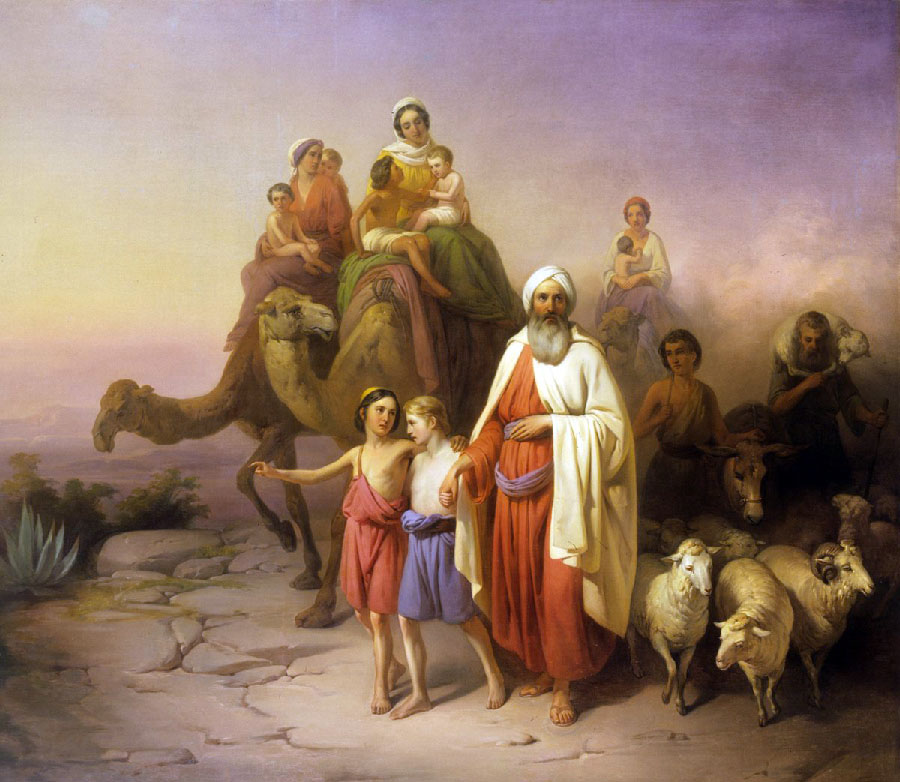
The history of the Hebrews recorded in the Bible starts with the beginning of time and the creation of the first man, Adam. However, it is with the life of the patriarch Abraham that we begin to see the emergence of the Hebrews as a distinct group. Abraham, we are told, descended from Noah a thousand years before, and Noah himself descended from Adam a thousand years before that. Relying on the ages and generations referenced in the Hebrew Bible, we can deduce that Abraham was born around 2150 BCE in the Mesopotamian city of Ur. At the age of seventy-five, he left this city and traveled to the land of Canaan in the eastern Mediterranean. There Abraham and his wife Sarah had their first son together, Isaac. Isaac then had a son, Jacob, and Jacob gave birth to twelve sons. From these twelve sons, the traditional Twelve Tribes of Israel descend (Figure 4.36).
英語のヒント
聖書に記されたヘブライ人の歴史は、時間の始まりと最初の人アダムの創造から始まる。しかし独自の集団としてのヘブライ人が見え始めるのは、族長アブラハムの生涯からである。伝えられるところでは、アブラハムは約千年前のノアの子孫で、ノアはさらに約千年前のアダムの子孫だった。聖書の年齢と世代をたどると、アブラハムは紀元前2150年頃、メソポタミアのウルに生まれたと推算できる。75歳で町を離れ、地中海東部のカナンへ旅した。そこで妻サラとの最初の息子イサクが生まれた。イサクにはヤコブ、ヤコブには12人の息子が生まれ、この12人が、伝統的なイスラエル十二部族の祖となる(図4.36)。
Biblical Abraham.聖書のアブラハム。
(credit: “The Departure of Abraham” by Hungarian National Gallery/Wikimedia Commons, Public Domain) · Public Domain
Figure 4.36 The Bible explains that Abraham migrated from Mesopotamia to Canaan, as represented in this nineteenth-century painting by a Hungarian artist, and there he eventually had children and grandchildren. (credit: “The Departure of Abraham” by Hungarian National Gallery/Wikimedia Commons, Public Domain)
図4.36 聖書によれば、アブラハムはメソポタミアからカナンへ移り、やがて子や孫をもうけた。この19世紀のハンガリーの画家の作品は、その移住を描く。(出典:ハンガリー国立美術館/Wikimedia Commons「The Departure of Abraham」、パブリックドメイン)
While this chronology explains how the Hebrews found themselves in Canaan, there is little to support it. There are no archaeological sites we can reference, and the only evidence we have for Abraham, his trip from Mesopotamia, and his children, grandchildren, and great-grandchildren comes from the Hebrew Bible. This has led some to suspect that the stories of Abraham and his family may have been developed much later than the Bible suggests. And in fact, historians have traced the story of Abraham to sources written down between the tenth and sixth centuries BCE. It is possible that Abraham was a historical person and part of an ancient migration recounted for centuries in oral form, but without additional records or archaeological discoveries that attest to his existence, we cannot know for sure.
英語のヒント
この年代記は、ヘブライ人がカナンにいる理由を説明するが、裏づけは乏しい。関連づけられる考古遺跡はなく、アブラハム、メソポタミアからの旅、子、孫、ひ孫についての唯一の証拠は、ヘブライ語聖書にある。このため、その家族の物語は、聖書の示す時代よりずっと後に作られたのではないかと考える人もいる。実際、歴史家はアブラハムの話を、紀元前10~6世紀に書かれた資料までさかのぼっている。実在の人物で、古代の移住の一員だったことが、何世紀も口承で伝わった可能性はある。しかし、存在を裏づける追加の記録や考古学的発見がなければ、確かなことはわからない。
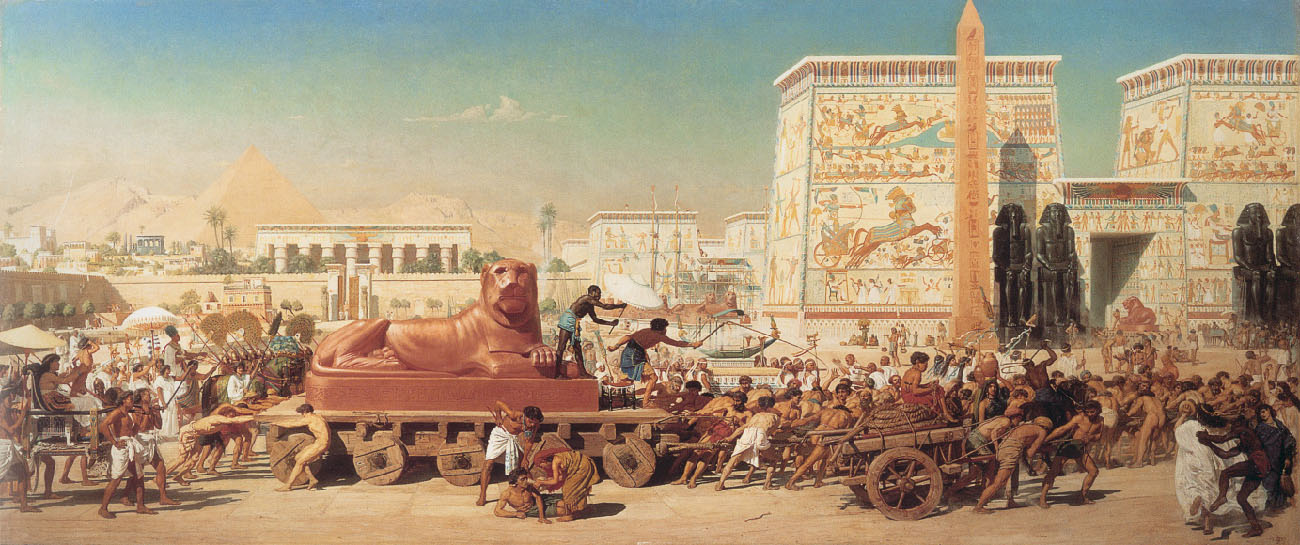
The Hebrew Bible notes that Joseph, one of Abraham’s twelve great-grandsons, ended up in Egypt. Later, around 1800 BCE based on the biblical chronology, Joseph’s family joined him, and his descendants lived there for several generations. During this long time in Egypt, the Bible explains that the descendants of Joseph experienced increasingly poor treatment, including being enslaved by the (unnamed) Egyptian pharaoh and put to work on building projects in the Nile delta (Figure 4.37). Later, the pharaoh decided to kill all the male Hebrew children, but one was saved from the slaughter by being hidden in a basket to float down the Nile. He was discovered by the pharaoh’s daughter, who named him Moses and raised him among the Egyptian royalty as her own.
英語のヒント
ヘブライ語聖書によれば、アブラハムの12人のひ孫の一人ヨセフは、エジプトへ行き着いた。その後、聖書の年代に基づけば紀元前1800年頃、家族も合流し、子孫は数世代そこに暮らした。長い滞在の間、待遇は悪化し、名の記されないファラオに奴隷にされ、デルタの建設事業で働かされたと聖書は説明する(図4.37)。やがてファラオはヘブライ人の男児をすべて殺すと決めたが、一人は籠に隠され、ナイルを流れて虐殺を逃れた。王女に発見され、モーセと名づけられ、自分の子としてエジプト王家の中で育てられた。
The Hebrews in Egypt.エジプトのヘブライ人。
(credit: “Israel in Egypt” by Guildhall Art Gallery/Wikimedia Commons, Public Domain) · Public Domain
Figure 4.37 The Bible explains that, as represented in this monumental nineteenth-century painting by the English artist Edward Poynter, the Hebrews were enslaved and oppressed in Egypt. (credit: “Israel in Egypt” by Guildhall Art Gallery/Wikimedia Commons, Public Domain)
図4.37 聖書は、ヘブライ人がエジプトで奴隷にされ、抑圧されたと説明する。イギリスの画家エドワード・ポインターの19世紀の大作は、それを描いている。(出典:ギルドホール美術館/Wikimedia Commons「Israel in Egypt」、パブリックドメイン)
The Bible continues the story by explaining that the adult Moses discovered who he actually was and demanded that the pharaoh release the Hebrews and allow them to return to Canaan. After experiencing a number of divine punishments issued by the Hebrew god, the pharaoh reluctantly agreed. The Hebrews’ flight from Egypt included a protracted trek across the Sinai desert and into Canaan, during which they agreed to worship only the single god Yahweh and obey his laws. This period of their history is often called the Exodus, because it records their mass migration out of Egypt and eventually to Canaan. Once in Canaan, Moses’s general Joshua led several military campaigns against the inhabitants, which allowed the Hebrews to settle the land.
英語のヒント
聖書は続けて、成人したモーセが本当の出自を知り、ファラオに、ヘブライ人を解放してカナンへ帰らせるよう求めたと語る。ヘブライ人の神による数々の罰を受け、ファラオはしぶしぶ同意した。人々はエジプトを逃れ、シナイ砂漠を長く旅してカナンへ向かった。その間、唯一の神ヤハウェだけを崇拝し、その法に従うと約束した。この時代は、エジプトからカナンへ至る集団移住を記すため、出エジプトと呼ばれる。カナンに着くと、モーセの将軍ヨシュアが住民に対する遠征を率い、ヘブライ人は定住できるようになった。
The details in the biblical account of the Hebrews’ life in Egypt and their exodus from that kingdom have led some scholars to associate these stories with the period of Hyksos rule. It was then, during the Second Intermediate Period, that the Canaanites flooded into the Nile delta and took control, and it may be that the story of Joseph and his family entering Egypt preserves a memory of that process. The exact time of the exodus from Egypt has been difficult for historians to determine for a number of reasons, not least of which is the fact that the Bible does not name the Egyptian pharaohs of the Exodus period.
英語のヒント
聖書が伝えるエジプトでの生活と脱出の細部から、ヒクソス支配期との関係を考える研究者もいる。カナン人がデルタへ流入して支配を握ったのは、第2中間期だった。ヨセフ一家がエジプトへ入る物語は、その過程の記憶を残しているのかもしれない。出エジプトの正確な時期は、さまざまな理由で特定しにくい。とりわけ大きいのは、当時のファラオの名を聖書が記していないことである。
Yet some features of the biblical account indicate there was in fact some type of exodus. For example, Moses’s name is Egyptian and not Hebrew, suggesting he came from Egypt. The Bible also names the two midwives who traveled with the group, leading some scholars to conclude there was some oral tradition about a very small group that may have crossed the Sinai into Canaan, though not the very large group described in the Bible. As for the story of the conquests of Joshua, the archaeological record simply does not support this. Even at the site of Jericho, extensive archaeological work has been unable to prove that the city was destroyed when and in the way the Bible describes. This absence of strong evidence has led most to conclude that there likely was no conquest, and that there was already a population of Hebrews in Canaan who were later joined by a smaller group from Egypt.
英語のヒント
それでも聖書の話の特徴には、何らかの脱出が実際にあったことを示すものもある。たとえばモーセの名はヘブライ語でなくエジプト語で、エジプト出身を示唆する。聖書は同行した2人の助産婦の名も挙げる。このため、聖書のような大集団ではなく、ごく小さな集団がシナイを越えてカナンへ来たという口承があった、と考える研究者もいる。しかしヨシュアの征服については、考古資料は支持しない。エリコでも、広範な発掘は、聖書の述べる時期と方法で都市が破壊されたことを証明できていない。強い証拠がないため、多くの研究者は、征服はおそらくなく、カナンにすでにいたヘブライ人に、エジプトからの小集団が合流したと考える。
The biblical book of Judges describes how the Hebrews moved into the hills of Canaan and lived as members of twelve tribes. In the book of Samuel, we hear how they faced oppression from the Philistines, one of the many Sea Peoples groups. To better defend themselves against the Philistines, the Hebrews organized themselves into a kingdom they called Israel. Their first leader, Saul, became king around 1030 BCE but failed to rule properly. The second king, David, not only ruled effectively but also was able to drive back the Philistines.
英語のヒント
聖書の「士師記」は、ヘブライ人がカナンの丘陵へ入り、十二部族の一員として暮らした様子を語る。「サムエル記」には、海の民の一集団であるペリシテ人による圧迫が記される。防衛を強めるため、人々はイスラエルという王国を組織した。最初の指導者サウルは紀元前1030年頃に王となったが、十分な統治ができなかった。第2代のダビデは、有効に統治するとともに、ペリシテ人を押し返した。
The Hebrews, properly referred to as Israelites in this period because of their formation of the Kingdom of Israel, now entered a golden age in their history. David suppressed the surrounding kingdoms, made Jerusalem his capital, and established a shrine there to the Israelite god Yahweh. This more organized kingdom was then left to David’s son Solomon, who furthered the organization of Israel, made alliances with surrounding kingdoms, and embarked on numerous construction projects, the most important of which was a large temple to Yahweh in Jerusalem.
英語のヒント
この時期のヘブライ人は、イスラエル王国を作ったため、より正確にはイスラエル人と呼ばれる。彼らは歴史の黄金期へ入った。ダビデは周辺の王国を抑え、エルサレムを首都とし、神ヤハウェの聖所を設けた。組織化された王国は息子ソロモンに継がれ、ソロモンはさらに組織を整え、周辺国と同盟し、多くの建設事業を始めた。特に重要だったのは、エルサレムのヤハウェの大神殿である。
Historians call the period of these three kings—Saul, David, and Solomon—the united monarchy period. Archaeological work and extrabiblical sources support many biblical claims about the era. For example, there was a threat to the Hebrews from the Philistines, who were likely one of the many groups of migrants moving, often violently, around the eastern Mediterranean during the period of the Late Bronze Age Collapse. We have Egyptian and other records of these migrants, some specifically mentioning the Philistines by name. It seems likely that the founding of Israel was a response to this threat.
英語のヒント
歴史家はサウル、ダビデ、ソロモンの3王の時代を、統一王国時代と呼ぶ。考古学と聖書以外の資料は、この時代についての聖書の主張の多くを支えている。たとえばペリシテ人の脅威はあった。彼らは、青銅器時代末の崩壊期に、しばしば暴力を伴いながら地中海東部を移動した、多くの集団の一つだったとみられる。エジプトなどの記録があり、ペリシテ人の名を具体的に挙げるものもある。イスラエルの建国は、この脅威への対応だった可能性が高い。
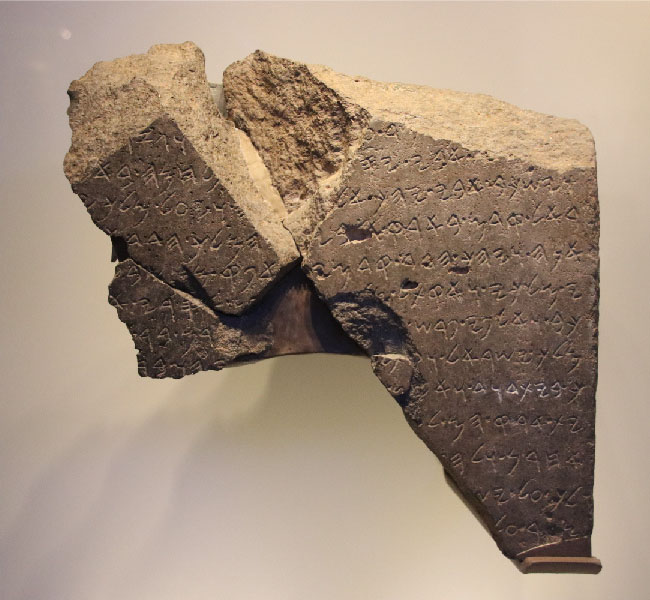
As for the existence of Saul and David, things are less clear. The Bible provides several conflicting accounts of how these two men became king. For example, Saul is made king when he is found hiding among some baggage, but also after leading troops in a dramatic rescue. Similar confusion surrounds David, though it seems clear he became an enemy of Saul at some point and was able to make himself king. Despite these contradictions, there is one piece of archaeological evidence for the existence of King David. The Tel Dan stele discovered in the Golan Heights in the 1990s makes reference to the “house of David,” meaning the kingdom of David (Figure 4.39). However, no similar archaeological evidence has been unearthed for David’s son Solomon. Indeed, evidence of Solomon’s most famous achievement, the building of the first temple in Jerusalem, has yet to be discovered. However, we have strong archaeological evidence for some of his other public works projects, such as the three-thousand-year-old gates discovered at Gezer, Hazor, and Megiddo.
英語のヒント
サウルとダビデの実在となると、事情はあまり明瞭でない。聖書には、王になった経緯について矛盾する話が複数ある。たとえばサウルは、荷物の間に隠れているのを見つけられて王となる一方、兵を率いて救援を成功させた後にも王となる。ダビデにも同様の混乱があるが、ある時点でサウルの敵となり、王位を得たらしい。それでもダビデ王の実在には、考古学的証拠が一つある。1990年代にゴラン高原で見つかったテル・ダン碑文は、「ダビデの家」、つまりダビデの王国に言及する(図4.39)。一方、息子ソロモンには同様の考古証拠がなく、最も有名な事業であるエルサレムの第1神殿の証拠も、まだ発見されていない。ただしゲゼル、ハツォル、メギドで見つかった3千年前の門など、他の公共事業には強い考古学的証拠がある。
Evidence for the Existence of David?ダビデの実在の証拠か。
(credit: modification of work “Aramaic Inscription on Basalt Monument, Dan, 9th Century BC” by Gary Todd/Flickr, CC0 1.0) · CC0 1.0
Figure 4.39 This stone fragment from the Tel Dan stele dates from the ninth century BCE and was discovered in the 1990s. It includes an inscription that reads “house of David,” making it the only non-biblical source attesting to the existence of King David. (credit: modification of work “Aramaic Inscription on Basalt Monument, Dan, 9th Century BC” by Gary Todd/Flickr, CC0 1.0)
図4.39 紀元前9世紀のテル・ダン碑文の石片。1990年代に発見され、「ダビデの家」と読める記述があり、ダビデ王の実在を裏づける唯一の聖書外資料とされる。(出典:Gary Todd/Flickr「Aramaic Inscription on Basalt Monument, Dan, 9th Century BC」を改変、CC0 1.0)
After the death of Solomon, the period of the united monarchy came to an end, and Israel split into two kingdoms, Israel in the north and Judah in the south. This inaugurated the period of the divided monarchy (Figure 4.40). Jerusalem remained the capital of Judah, while Samaria was the capital of Israel. The northern kingdom was the larger and wealthier of the two and exerted influence over and sometimes warred with Judah. The biblical account often puts the kings of the northern kingdom in a negative light, noting that they abused their subjects and incorporated elements of foreign religious traditions in their worship of Yahweh.
英語のヒント
ソロモンの死後、統一王国時代は終わり、北のイスラエルと南のユダの2王国に分裂した。分裂王国時代の始まりである(図4.40)。ユダの首都は引き続きエルサレム、イスラエルの首都はサマリアだった。北王国のほうが大きく豊かで、ユダへ影響を及ぼし、時には戦った。聖書は北王国の王を否定的に描くことが多く、臣民を虐げ、ヤハウェ崇拝に外国の宗教要素を取り入れたと記す。