第4章古代オリエントThe Near East
Darius I and the Reorganization of the Empireダレイオス1世と帝国の再編
The events surrounding the rebellion of Cambyses II’s brother Bardiya are unclear because a handful of different accounts survive. According to Herodotus, Cambyses ordered one of his trusted advisers to secretly murder Bardiya. Since no one knew Bardiya was dead, an impostor pretending to be him launched a rebellion against Cambyses, though after several months the false Bardiya was killed in a palace coup at the hands of Darius, an army officer who claimed descent from the royal house. Afterward, since neither Cambyses nor Bardiya had sons, Darius made himself king. Other accounts differ in some ways, and some scholars have speculated that Darius invented the story about a false Bardiya in order to legitimize his own coup against the real Bardiya and take the throne.
英語のヒント
カンビュセス2世の弟バルディヤの反乱をめぐる出来事は、異なる複数の記録が残るため、はっきりしない。ヘロドトスによれば、カンビュセスは信頼する助言者の一人に、バルディヤを密かに殺すよう命じた。死を誰も知らなかったため、彼を装う偽者が反乱を起こした。しかし数か月後、この偽バルディヤは、王家の血を引くと主張する将校ダレイオスの宮廷クーデターで殺された。カンビュセスにもバルディヤにも息子がいなかったため、ダレイオスが自ら王となった。他の記録とは、いくつかの点で食い違う。研究者の中には、ダレイオスが本物のバルディヤを倒したクーデターを正当化し、王位を奪うため、偽者の話を作ったのではないかと考える人もいる。
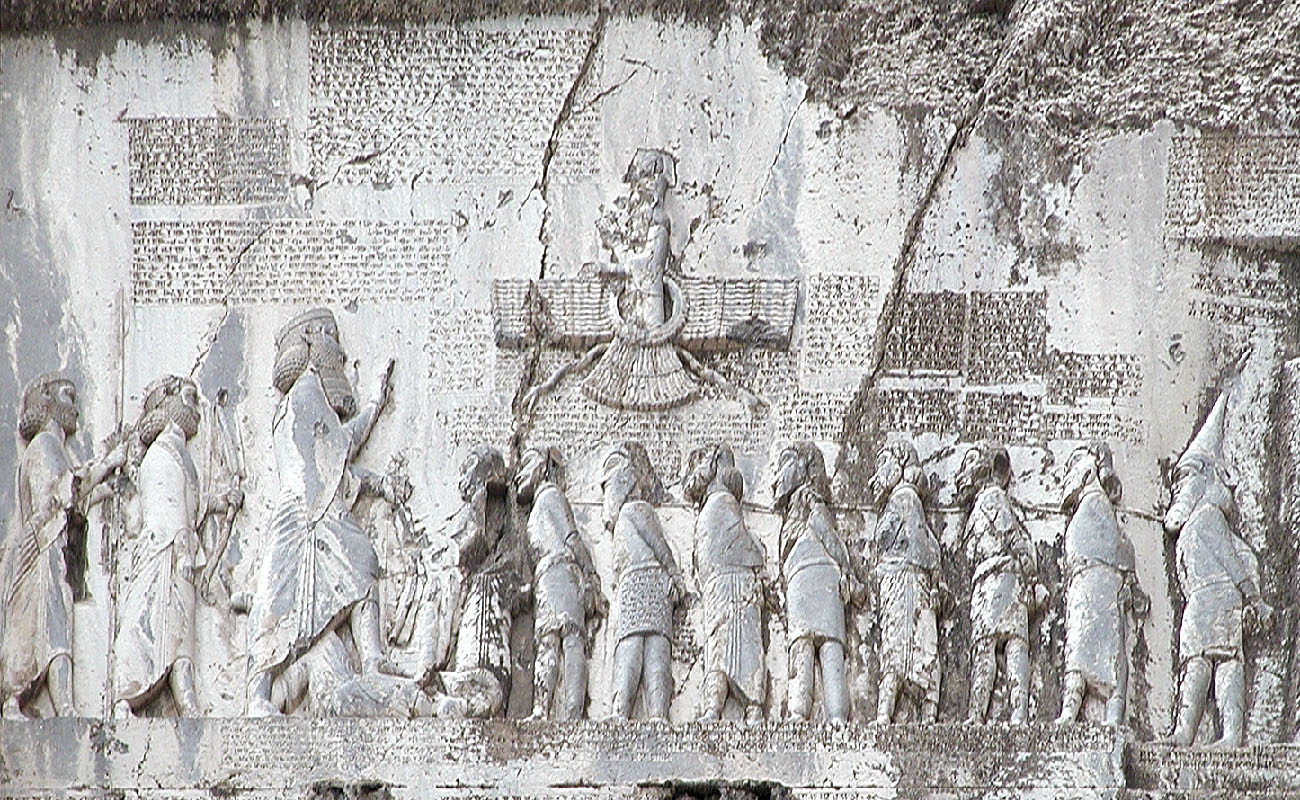
We may never know exactly what happened, but Darius was indeed able to grasp control of the Persian Empire in 522 BCE. However, it took more than a year for him to put down the ensuing rebellions, some possibly instigated by those who refused to recognize the legitimacy of his claim to the throne. Once these had been quelled, Darius commissioned an enormous relief inscription to be made on the cliff face of Mount Behistun. It shows a dominating figure of himself facing a number of bound former rebels, accompanied by lengthy descriptions of the rebellion and, in three different languages, Darius’s version of the events that led to his rise to power (Figure 4.29). To further strengthen his claim on the throne, Darius integrated himself deeply into the royal line through a number of marriages, to the daughters of Cyrus II, the widow of Cambyses II, and two of Cambyses’s sisters.
英語のヒント
実際に何が起きたかは、今後も正確にはわからないかもしれない。それでもダレイオスが紀元前522年、帝国の支配を握ったことは確かである。その後の反乱を鎮めるには1年以上かかった。王位継承の正当性を認めない者が起こした反乱も、あったかもしれない。鎮圧後、ダレイオスはベヒストゥン山の崖面に、巨大な浮彫碑文を造らせた。大きく描かれた王が縛られた反乱者たちと向かい合い、反乱と即位に至る出来事についての、ダレイオス側の長い説明が、3言語で添えられる(図4.29)。王位の主張をさらに強めるため、キュロス2世の娘たち、カンビュセス2世の未亡人、その姉妹2人などとの婚姻を通じ、王家の血統に深く入り込んだ。
The Behistun Relief.ベヒストゥンの浮彫。
(credit: “Behistun Inscription” by “Hara1603”/Wikimedia Commons, Public Domain) · Public Domain
Figure 4.29 The massive Behistun Relief, more than eighty feet long and almost fifty feet high, shows a crowned Darius (on the left) with his foot on the impostor he claimed to have overthrown. Captive rebels and a narrative in three languages of Darius’s version of events complete the carving. (credit: “Behistun Inscription” by “Hara1603”/Wikimedia Commons, Public Domain)
図4.29 長さ80フィート以上、高さ約50フィートの巨大なベヒストゥン浮彫。左の冠をかぶるダレイオスは、自ら倒したと主張する偽者の上に足を置く。捕らえた反乱者たちと、出来事についての王側の説明を3言語で刻んだ碑文が、全体を構成する。(出典:「Hara1603」/Wikimedia Commons「Behistun Inscription」、パブリックドメイン)
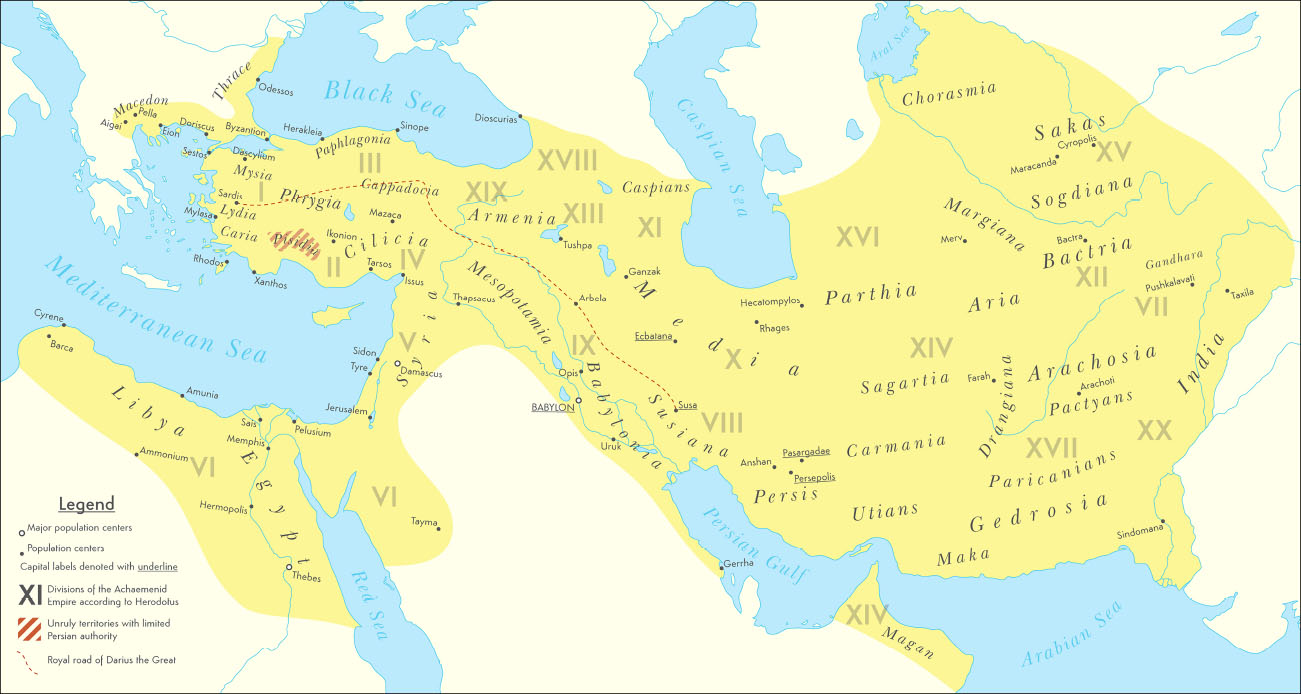
Darius now set about reorganizing the empire, carving it into twenty different governing districts called satrapies (Figure 4.30). Each satrapy was administered by a royal governor called a satrap, usually a trusted Persian or Median noble. Satraps answered directly to the king, had their own courts, wielded great power, and possessed vast lands within the satrapy. They often ruled from the large cities of the regions and were responsible for ensuring that their satrapy remained pacified and submitted its allotted taxes, though there were also local rulers within the region who managed affairs related to specific ethnic or religious groups. The only area not made into a satrapy was the Persian heartland, which was governed directly by the king.
英語のヒント
ダレイオスは帝国の再編を始め、サトラピーと呼ぶ20の行政区へ分けた(図4.30)。各区はサトラップと呼ばれる王の総督が治め、普通は信頼できるペルシア人かメディア人の貴族が任じられた。総督は王に直属し、独自の宮廷、大きな権力、広大な所領を持った。しばしば地域の大都市から統治し、治安を保ち、割り当てられた税を納めさせる責任を負った。ただし、特定の民族・宗教集団の問題を扱う在地支配者もいた。唯一サトラピーにされなかったのはペルシア本土で、王が直接治めた。
The Persian Empire.ペルシア帝国。
(credit: modification of work “Achaemenid Empire 500 BCE” by “Cattette”/Wikimedia Commons, CC BY 4.0) · CC BY 4.0
Figure 4.30 The Persian Empire under Darius I reached from the edge of India in the east to Libya in the west. To manage this large empire, Darius divided it into twenty different satrapies. (credit: modification of work “Achaemenid Empire 500 BCE” by “Cattette”/Wikimedia Commons, CC BY 4.0)
図4.30 ダレイオス1世のもとで、ペルシア帝国は東のインドの端から、西のリビアまで広がった。広大な帝国を治めるため、王は20のサトラピーへ分割した。(出典:「Cattette」/Wikimedia Commons「Achaemenid Empire 500 BCE」を改変、CC BY 4.0)
Darius I and later kings had a number of tools at their disposal to keep the powerful satraps in line. For example, they frequently sent royal officials, known as the “eyes and ears of the great king,” to arrive unannounced and conduct audits, compiling detailed reports about how the satrapies were being governed that were sent directly to the king for review. If the reports were negative, the satraps could expect either removal or even execution at the hands of the region’s military garrison. These garrisons were used by the satraps to enforce the laws and maintain order, but they ultimately answered to the king and could discipline the satraps when necessary.
英語のヒント
ダレイオス1世と後の王たちは、強力な総督を統制する手段をいくつも持った。たとえば「大王の目と耳」と呼ばれる王の役人を、予告なく派遣して監査させた。州の統治状況の詳細な報告は、王へ直接送られた。報告が悪ければ、総督は解任され、地域の駐屯軍によって処刑されることさえあった。駐屯軍は総督のもとで法を執行し、秩序を保ったが、最終的には王に直属し、必要なら総督を罰することもできた。
Communication between the satraps and the king was carried out through letters dictated to scribes and transmitted along royal roads. These roads constituted an impressive communication system that linked the many key cities of the empire with the Persian heartland and its cities, like Susa, Persepolis, and Pasargadae. While it was not new—the Neo-Assyrian Empire had its own network of roads that the Persians adopted and improved—it was a valuable tool for administering the large and complicated empire. Along the many royal roads of the empire were inns, resting places, and waystations with stables for horses. Safety was ensured by the troops stationed along the way, especially at key and vulnerable points. To move letters along the roads, a member of the army of mounted royal messengers would travel the roughly twenty miles to the first station, change horses, and continue to the next station. In this way, communication could move roughly two hundred miles in a single day.
英語のヒント
総督と王の連絡には、書記に口述筆記させ、王道で運ぶ手紙が使われた。道路は帝国の要地を、スサ、ペルセポリス、パサルガダエなどの本土の都市と結ぶ、見事な通信網を形成した。新発明ではなく、新アッシリアの道路網を引き継ぎ、改良したものだったが、広く複雑な帝国を治める貴重な道具だった。王道沿いには宿、休憩所、馬屋を備えた中継所があった。要所や攻撃を受けやすい場所を中心に、駐屯する軍が安全を守った。騎馬の王の伝令は、約20マイル先の最初の駅まで手紙を運び、馬を替え、次の駅へ進んだ。この方法で、情報は1日約200マイルを進めた。
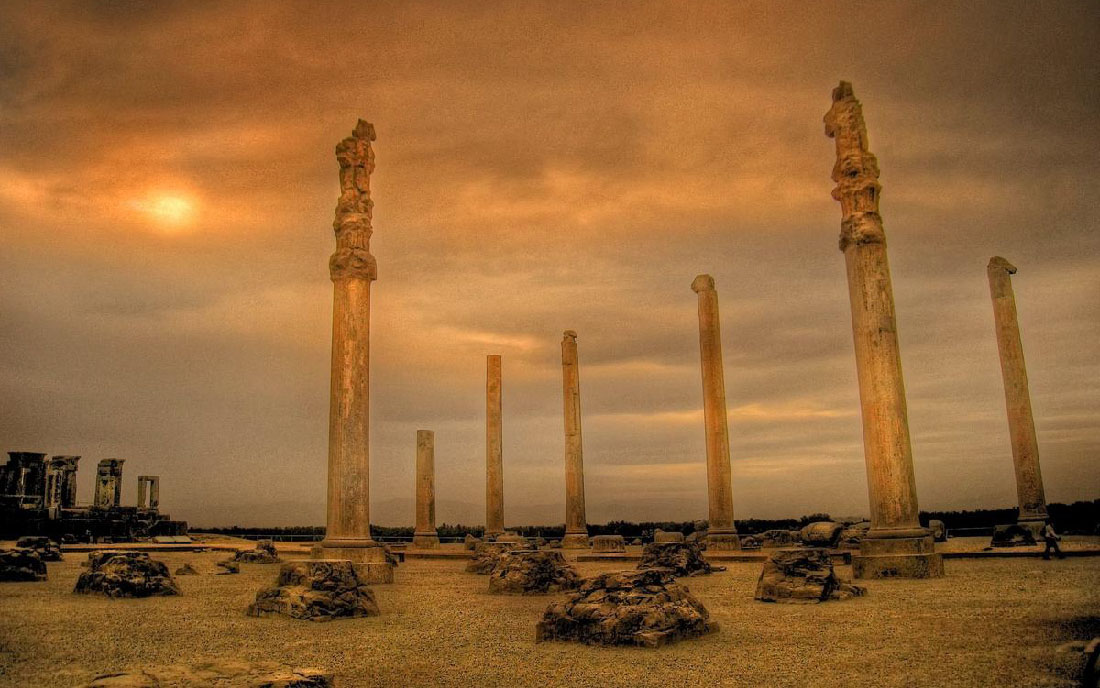
Building projects were another important expression of Darius’s power and authority. During his reign, he undertook the construction of elaborate palaces at Susa, Persepolis, and Pasargadae (Figure 4.32). These were constructed and decorated by skilled workers from many different locations and reflected artistic influences from around the empire, among them fluted columns designed by Greek stonemasons, Assyrian reliefs carved by Mesopotamians, and a variety of other features of Egyptian, Lydian, Babylonian, Elamite, and Median origin. The many workers—men, women, and children—who built these palaces migrated to the construction sites and often lived in nearby villages or encampments.
英語のヒント
建設事業も、ダレイオスの力と権威を表す重要な手段だった。治世中、スサ、ペルセポリス、パサルガダエに精巧な宮殿を建てた(図4.32)。各地の熟練労働者が建設と装飾を担い、帝国各地の美術的影響が表れた。ギリシアの石工が設計した縦溝のある柱、メソポタミア人が彫るアッシリア風の浮彫、エジプト、リュディア、バビロニア、エラム、メディア起源のさまざまな特徴があった。宮殿を造る男女や子どもの労働者は、建設地へ移住し、近くの村や野営地で暮らすことが多かった。
Persepolis.ペルセポリス。
(credit: modification of work “HDR image of Persepolis, Iran“ by “Roodiparse”/Wikimedia Commons, Public Domain) · Public Domain
Figure 4.32 The ruins of the city of Persepolis, situated thirty-seven miles northeast of modern-day Shiraz (in modern Iran), reveal that the site was an impressive imperial center in Darius’s time. (credit: modification of work “HDR image of Persepolis, Iran“ by “Roodiparse”/Wikimedia Commons, Public Domain)
図4.32 現在のイランのシーラーズから北東37マイルにあるペルセポリスの遺跡は、ダレイオス時代の壮大な帝国中心地の姿を伝える。(出典:「Roodiparse」/Wikimedia Commons「HDR image of Persepolis, Iran」を改変、パブリックドメイン)
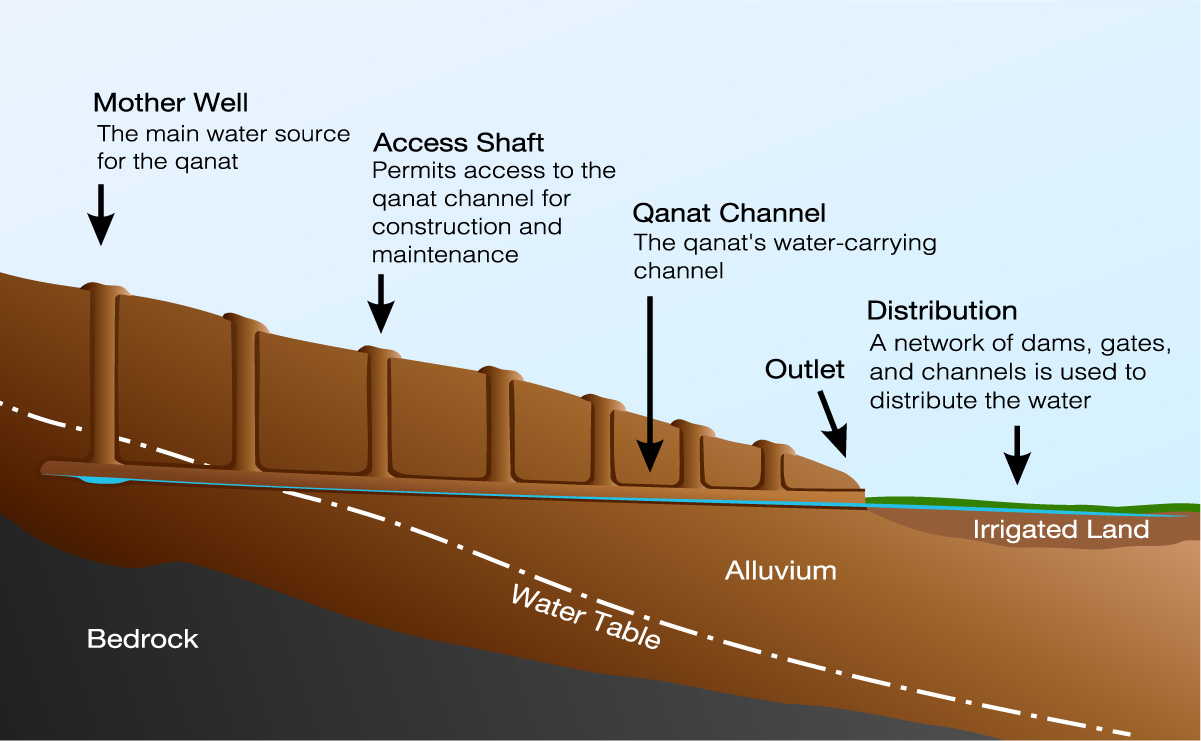
Major infrastructure projects were also a feature of Darius’s reign. For example, he ordered the construction of a long canal that would have allowed ships to pass from the Red Sea into Egypt’s Nile River and thus to the Mediterranean. It is unclear whether he actually completed it. It seems unlikely, though Herodotus insists he did. Whatever the case, that Darius attempted this massive undertaking is a testament to the power and resources the kings of Persia had at their fingertips. Other infrastructure projects included the expansion and rebuilding of the many roads that crisscrossed the empire, as well as the construction of a number of qanats (Figure 4.33). These were long, underground tunnels used for carrying fresh water over many kilometers, usually for irrigation, and represented a major improvement over earlier technologies. They likely had been used before the Achaemenids, but their construction expanded with the rise of Persian power.
英語のヒント
大規模な基盤整備も、ダレイオスの治世の特徴だった。たとえば、紅海からナイル川を経て地中海へ船が通れるよう、長い運河の建設を命じた。実際に完成したかは不明で、完成は考えにくいように見えるが、ヘロドトスは完成したと述べる。いずれにせよ、この巨大事業を試みたこと自体、ペルシア王が自由に使えた力と資源の証しである。他にも、帝国を縦横に走る道路の拡張・再建や、多数のカナートの建設があった(図4.33)。カナートは、淡水を何キロメートルも運ぶ長い地下水路で、主に灌漑に使われ、従来の技術を大きく改善した。アケメネス朝以前からあったとみられるが、ペルシアの勢力拡大とともに建設が広がった。
Qanats for Irrigation.灌漑用のカナート。
(credit: modification of work “Qanat cross section” by Samuel Bailey/Wikimedia Commons, CC BY 3.0) · CC BY 3.0
Figure 4.33 The qanats built by Darius were designed to carry fresh water over long distances into populated areas or to irrigate land for farming. (credit: modification of work “Qanat cross section” by Samuel Bailey/Wikimedia Commons, CC BY 3.0)
図4.33 ダレイオスが築いたカナートは、淡水を遠くの居住地へ運び、または農地を灌漑するよう設計された。(出典:Samuel Bailey/Wikimedia Commons「Qanat cross section」を改変、CC BY 3.0)