第4章古代オリエントThe Near East
The Pharaohs of the New Kingdom新王国のファラオたち
The New Kingdom period (c. 1550–1069 BCE) represents the pinnacle of Egyptian power and influence in the Near East. During this time, Egypt not only reconquered the territory it had lost following the collapse of the Middle Kingdom, but it also extended its reach deep into the Libyan Desert, far south into Nubia, and eventually east as far as northern Syria. This expansion made Egypt the Mediterranean superpower of its day. So it is not surprising that the pharaohs of this period are some of the best known. They include the conqueror Amenhotep I, the indomitable Queen Hatshepsut, “the magnificent” Amenhotep III, the transformative Akhenaten, and the highly celebrated Ramesses II, also known as Ramesses the Great. Many came to power at a young age and ruled for an extended period of time that allowed for many accomplishments. They also commanded massive and highly trained armies and had at their disposal a seemingly endless supply of wealth, with which they constructed some of the most impressive architectural treasures of the entire Near East.
英語のヒント
新王国時代(紀元前1550~1069年頃)は、近東におけるエジプトの力と影響力の頂点だった。エジプトは中王国崩壊後に失った領域を取り戻しただけでなく、リビア砂漠の奥深く、南のヌビア、やがて東はシリア北部まで支配を広げた。こうして当時の地中海の超大国となった。この時代のファラオが、特によく知られているのも不思議ではない。征服者アメンヘテプ1世、不屈の女王ハトシェプスト、「壮麗王」アメンヘテプ3世、変革者アクエンアテン、大王とも呼ばれる有名なラメセス2世などがいる。若くして即位し、長い治世の間に多くを成し遂げた者も多かった。彼らは大規模でよく訓練された軍を率い、尽きないように見える富を自由に使って、近東全体でも屈指の壮大な建築を築いた。
The New Kingdom began with the reign of Ahmose, the pharaoh who recovered not only Lower Egypt but also Nubia and Palestine. When he died in 1525 BCE, his oldest surviving son, Amenhotep I, assumed control. Amenhotep then married one of his sisters, Meritamun, as was common in this period and as the gods of Egyptian myth were believed to have done.
英語のヒント
新王国は、下エジプトだけでなくヌビアとパレスチナも取り戻したファラオ、アハモセの治世に始まった。彼が紀元前1525年に亡くなると、生存する最年長の息子アメンヘテプ1世が継承した。アメンヘテプは、その後、姉妹の一人メリトアメンと結婚した。この時代にはよくあることで、エジプト神話の神々もそうしたと信じられていた。
The rise of the early New Kingdom pharaohs coincided with the elevation of a previously minor deity, the Thebans’ patron god Amun. Respect for him merged with regard for Re, the patron of the monarchy, and he became known as Amun-Re. Amenhotep I and his successors built temples and other major public works in his honor, particularly the great Temple of Amun at Karnak. Thebes also had special importance for the New Kingdom pharaohs as the state’s religious capital and the favored royal burial place, commonly called the Valley of the Kings.
英語のヒント
新王国初期のファラオの台頭は、以前は小さな神だったテーベの守護神アメンの地位上昇と重なった。アメンへの崇敬は、王権の守護神ラーへの崇敬と融合し、アメン・ラーと呼ばれるようになった。アメンヘテプ1世と後継者たちは、その栄誉のために神殿や大規模な公共建築、とりわけカルナクのアメン大神殿を築いた。テーベは新王国のファラオにとって、宗教上の首都であり、王家の谷として知られる王墓の地としても、特別な重要性を持った。
Dying without an heir, Amenhotep I was succeeded by Thutmose I, a general who may have been a distant relative. Thutmose I and his son Thutmose II both campaigned in Nubia and Syria. The father marched his armies all the way to the Euphrates River in Syria, likely as a show of force against emerging powers in the region. The son married his sister Hatshepsut, who gave birth to a daughter but not a son. So when Thutmose II died in 1479 BCE, his two-year-old son conceived by a concubine assumed the throne as Thutmose III.
英語のヒント
アメンヘテプ1世は後継者を残さずに亡くなり、遠縁だった可能性のある将軍トトメス1世が継承した。トトメス1世と息子トトメス2世は、どちらもヌビアとシリアで遠征を行った。父はおそらく地域の新興勢力への示威として、シリアのユーフラテス川まで軍を進めた。息子は姉妹のハトシェプストと結婚し、娘をもうけたが、息子は生まれなかった。そのため紀元前1479年にトトメス2世が亡くなると、側室との間に生まれた2歳の息子が、トトメス3世として即位した。
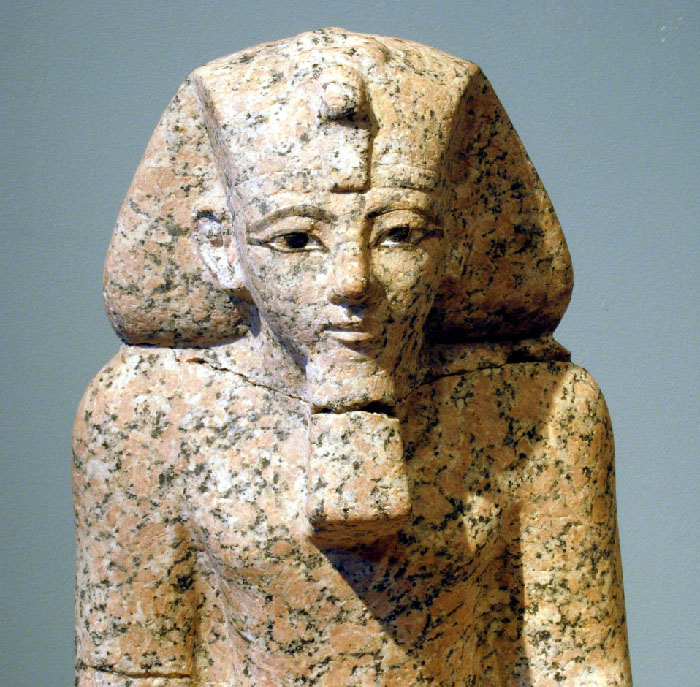
Acting as regent for the infant pharaoh, Hatshepsut inaugurated a very unusual period in Egyptian history. Rather than merely rule in the background as a typical regent would, she proclaimed herself co-regent with her stepson and soon assumed the title of pharaoh. Statues of her from this period depict her wearing the pharaonic headdress and ceremonial beard and give her the broad torso more typical of a male (Figure 4.20). Such masculine features were not an attempt to obscure her femininity but rather a recognition that all the symbolic representations of Egyptian pharaohs were male. Inscriptions clearly indicated that she was a woman. She was called the “Daughter of Re,” and feminine word endings appear in some inscriptions, such as “His Majesty, Herself.”
英語のヒント
幼いファラオの摂政として、ハトシェプストはエジプト史でも珍しい時代を開いた。普通の摂政のように背後から統治するだけでなく、継子と共同で統治すると宣言し、まもなくファラオの称号を取った。この時期の像では、ファラオの頭飾りと儀礼用のつけひげを着け、男性に典型的な幅広い胴を持つ姿で表されている(図4.20)。こうした男性的特徴は、女性であることを隠すためではなく、エジプトのファラオを表す象徴が、すべて男性の姿だったことによる。碑文は、彼女が女性であることを明示していた。「ラーの娘」と呼ばれ、一部の碑文には「彼なる陛下、彼女自身」のように、女性を示す語尾も現れる。
Pharaoh Hatshepsut.ファラオ、ハトシェプスト。
(credit: “Kneeling statue of Hatshepsut” by The Metropolitan Museum of Art, Rogers Fund, 1923/Wikimedia Commons, Public Domain) · Public Domain
Figure 4.20 This granite statue of a kneeling Pharaoh Hatshepsut, carved in the fifteenth century BCE and originally painted, measures just over twenty-seven inches high. As this detail shows, the work depicts her with male features including a flat chest and a beard. (credit: “Kneeling statue of Hatshepsut” by The Metropolitan Museum of Art, Rogers Fund, 1923/Wikimedia Commons, Public Domain)
図4.20 ひざまずくファラオ、ハトシェプストの花崗岩像。紀元前15世紀に彫られ、当初は彩色されていた。高さは27インチ余り。この部分図のように、平らな胸やひげなど、男性的な特徴を持つ。(出典:メトロポリタン美術館、Rogers Fund、1923年/Wikimedia Commons「Kneeling statue of Hatshepsut」、パブリックドメイン)
As Egyptian pharaohs had done for many centuries, Hatshepsut also claimed divinity. While the reasons for this long-standing belief remain unclear and may never be fully understood, this is one of the features of Egyptian culture that made it very different from that of Mesopotamian contemporaries, who usually held kings to be only viceroys of the gods, not gods themselves. Unlike earlier pharaonic claims of divinity, however, Hatshepsut’s included a detailed account of her heavenly origins in the form of a poem she had inscribed on the walls of her mortuary temple for all to see. In the poem, Amun-Re himself assumes the form of Thutmose I and, after conceiving Hatshepsut with her mother, predicts that his child will rule all Egypt and elevate it to unsurpassed glory. The poem then describes how a council of Egyptian gods proclaimed Hatshepsut’s earthly authority, and how Thutmose I recognized her divinity and named her his rightful successor.
英語のヒント
何世紀にもわたって他のファラオがしてきたように、ハトシェプストも自らの神性を主張した。この長年の信仰の理由は明らかでなく、今後も完全にはわからないかもしれない。それでもこれは、王を神自身ではなく神の代理とすることの多かった、同時代のメソポタミアの文化と、エジプト文化を大きく隔てる特徴の一つだった。しかし以前のファラオの主張と違い、ハトシェプストは、自らの神聖な出自を詳しい詩にし、誰もが見られるよう葬祭殿の壁に刻ませた。詩では、アメン・ラー自身がトトメス1世の姿となり、彼女の母との間にハトシェプストをもうけた後、娘が全エジプトを治め、比類のない栄光へ導くと予言する。続いて神々の会議が地上での彼女の権威を宣言し、トトメス1世が神性を認め、正当な後継者に指名したと語られる。
As both a woman and a regent, Hatshepsut was prudent to thus legitimate her rule. And by all accounts, the heavenly prophecies about her reign proved accurate. For twenty-one years she ruled over a prosperous and dominant Egypt, even conducting military campaigns into Nubia and possibly southern Palestine. At one point, she sent a large fleet south into a mysterious land the Egyptians called Punt, likely coastal East Africa near modern Somalia, where her ships collected and brought back a cargo of exotic plants, animals, precious metals, and spices.
英語のヒント
女性であり、摂政でもあったハトシェプストが、このように支配を正当化したのは賢明だった。伝えられる限り、その治世についての天の予言は現実になった。21年間、繁栄し優勢なエジプトを治め、ヌビア、おそらくパレスチナ南部へも遠征を行った。ある時には大船団を南へ送り、エジプト人がプントと呼ぶ、現在も謎の残る地へ向かわせた。おそらく現在のソマリア近くの東アフリカ沿岸で、船団は珍しい植物や動物、貴金属、香料を積んで帰った。
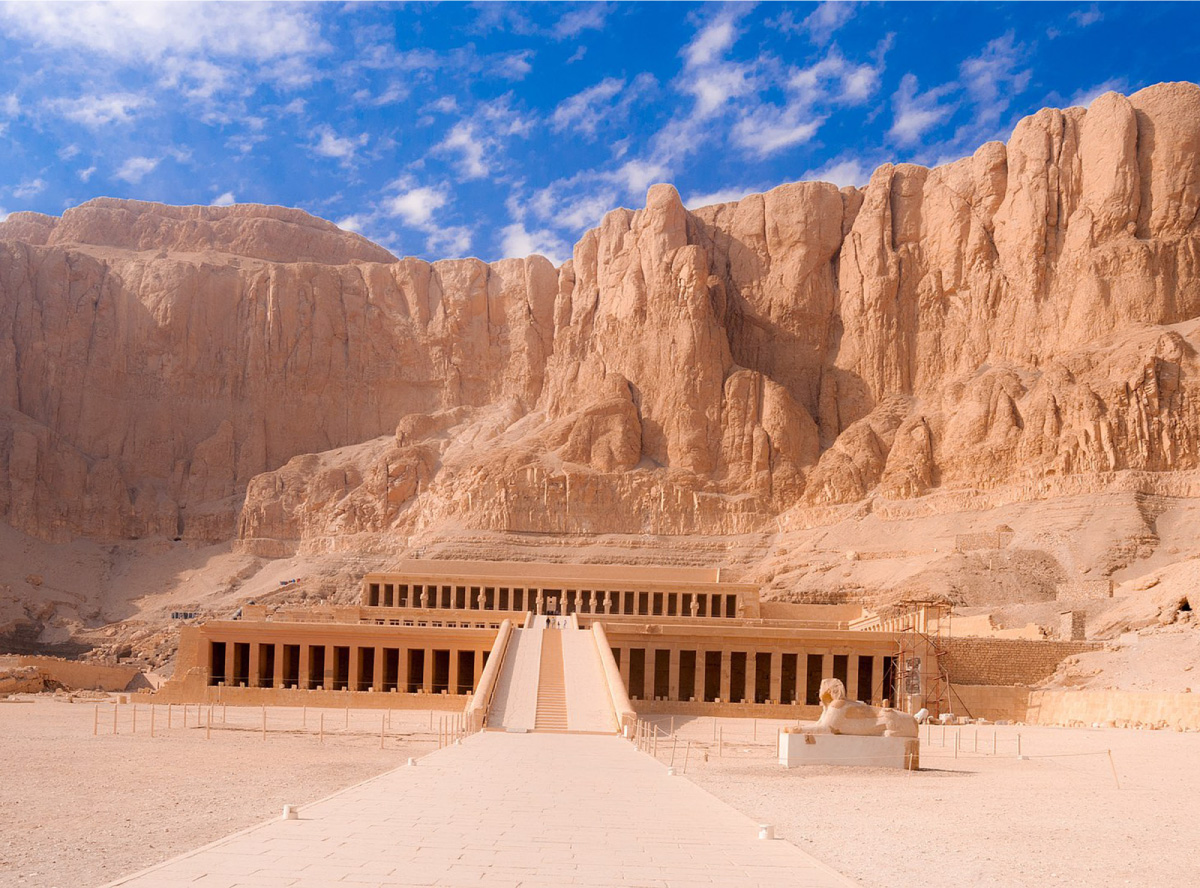
Construction of Hatshepsut’s three-tiered mortuary temple began shortly after she took the throne and likely lasted many years. The temple was built into the side of a cliff and included a series of ramps that took visitors through garden courtyards, past large obelisks and statues, and toward a shrine to Amun at the top (Figure 4.21). In the years after her death, elaborate rituals including libations, food offerings to the gods, purification rituals, recitations, and singing were performed by the priests who managed the enormous complex.
英語のヒント
ハトシェプストの3層の葬祭殿は、即位後まもなく建設が始まり、おそらく何年もかかった。崖の側面に組み込まれ、一連の斜路が、訪問者を庭のある中庭へ、大きなオベリスクや像の脇へ、さらに最上部のアメンの聖所へと導いた(図4.21)。死後も、この巨大な施設を管理する神官が、献酒、神々への食物の奉献、浄め、朗誦、歌などの精緻な儀礼を行った。
The Temple of Hatshepsut.ハトシェプストの神殿。
(credit: modification of work “Temple of Hatshepsut” by Hesham Ebaid/Wikimedia Commons, CC0 1.0) · CC0 1.0
Figure 4.21 Hatshepsut’s mortuary temple is located at Deir el-Bahri, beneath cliffs near the Valley of the Kings. Its large ramps and tiers were designed to blend neatly into the cliff behind it. (credit: modification of work “Temple of Hatshepsut” by Hesham Ebaid/Wikimedia Commons, CC0 1.0)
図4.21 ハトシェプストの葬祭殿は、王家の谷に近い崖の下、デル・エル・バハリにある。大きな斜路と各層は、背後の崖に調和するよう設計された。(出典:Hesham Ebaid/Wikimedia Commons「Temple of Hatshepsut」を改変、CC0 1.0)
When Hatshepsut died in 1458 BCE, her stepson Thutmose III took control as sole ruler in Egypt for the first time. He was about thirty years old by then and had extensive military training. This preparation served him well, for soon he faced a Hittite and northern Mesopotamian threat to Egypt’s control in Syria and Palestine. Leading his armies himself, he was able to neutralize the threats, launch a major raid across the Euphrates River, and take numerous Canaanite princes hostage so as to deter any uprisings from his vassals.
英語のヒント
紀元前1458年にハトシェプストが亡くなると、継子のトトメス3世は、初めてエジプトの単独支配者となった。当時約30歳で、十分な軍事訓練を受けていた。この備えは役立った。まもなく、シリアとパレスチナでのエジプト支配が、ヒッタイトとメソポタミア北部の勢力に脅かされたからである。自ら軍を率い、脅威を抑え、ユーフラテス川を越えて大規模な襲撃を行った。また、属国の反乱を抑止するため、多くのカナンの王子を人質に取った。
It was only late in his reign that Thutmose III began to eliminate his predecessor from history. He had Hatshepsut’s statues toppled and smashed, her name removed from monuments, and references to her scrubbed from the official king lists. The evidence suggests that he harbored no ill will toward his stepmother. Instead, her erasure from the record was probably part of Thutmose’s process of paving the way for his son to rule in his own right in the future, without a dominant female like his stepmother to assert control.
英語のヒント
トトメス3世が先代の存在を歴史から消し始めたのは、治世の後半になってからだった。ハトシェプストの像を倒して壊させ、記念碑から名を削り、公式の王名表から彼女への言及を消させた。証拠は、継母への悪意からではなかったことを示唆する。むしろ、将来、自分の息子が、継母のような強力な女性に支配を主張されず、自らの権利で統治できるよう道を整える過程だったのだろう。
Amenhotep II, son of Thutmose III, continued the successful military campaigns against both Hittite and Mesopotamian threats to Egyptian influence in Palestine and Syria. His rule was followed by the short reign of Thutmose IV, likely a younger son, and the long and especially prosperous rule of Amenhotep III, known as “the Magnificent.”
英語のヒント
トトメス3世の息子アメンヘテプ2世は、パレスチナとシリアでのエジプトの影響力を脅かす、ヒッタイトとメソポタミアの勢力への遠征を、引き続き成功させた。その後、おそらく次男以降の息子だったトトメス4世の短い治世、「壮麗王」として知られるアメンヘテプ3世の長く、とりわけ繁栄した治世が続いた。
Amenhotep III’s nearly forty-year reign in the fourteenth century BCE was a time of extended peace during which numerous monuments to Egyptian greatness were constructed. These included the sumptuous palace at Thebes, the Serapeum—a temple of the god Serapis—at Saqqara, many temples for other gods, Amenhotep’s own large mortuary temple, and a great many statues of himself. His reign was also marked by an increased emphasis on the Egyptian sun god Aton, one of many manifestations of Re. Amenhotep’s palace at Thebes and the large royal barge upon which he and his queen glided along the Nile for important religious events were named for Aton. Toward the end of Amenhotep III’s reign, he officially proclaimed himself the personification of Aton, and his servants greeted him as such.
英語のヒント
紀元前14世紀のアメンヘテプ3世の約40年の治世は、長い平和の時代だった。エジプトの偉大さを示す多くの建築が作られ、テーベの豪華な宮殿、サッカラのセラピス神の神殿セラペウム、他の神々の神殿、王自身の大きな葬祭殿、数多くの王像などが建てられた。この治世には、ラーの数ある現れの一つである太陽神アテンも重視された。テーベの宮殿と、重要な宗教行事で王と王妃がナイルを進む大きな王室の御座船は、アテンにちなんで名づけられた。治世の終わり近く、王は正式に自らをアテンの化身と宣言し、召使いたちはそのような存在として王を迎えた。
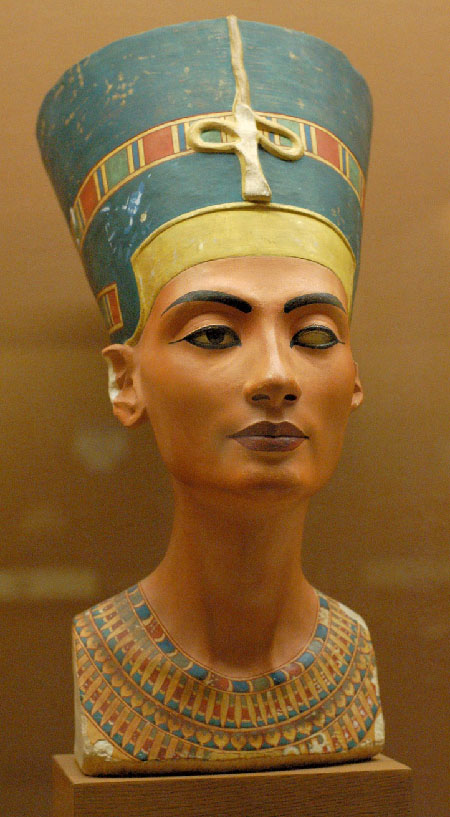
Under Amenhotep III’s heir Amenhotep IV, the emphasis on Aton reached its fullest extent. Amenhotep IV built a new city downriver from Thebes that he called Amarna, “the place where the solar orb is transformed.” It was also known as Akhetaton. The following year, he changed his own name to Akhenaten, meaning “the transfigured spirit of the solar orb,” and moved himself and his entire family to the new city. Akhenaten later closed the temples of the other major Egyptian gods and ordered representations of them destroyed and their names chiseled off monuments. The pharaoh and his wife Queen Nefertiti now became the chief priests of a new cult built around Aton (Figure 4.22).
英語のヒント
後継者アメンヘテプ4世のもとで、アテン重視は頂点に達した。王はテーベの下流に新都市を建設し、「太陽円盤が変容する場所」を意味するアマルナと呼んだ。アケトアテンとも呼ばれた。翌年、自らの名を「太陽円盤の変容した霊」を意味するアクエンアテンに変え、一族全員と新都市へ移った。その後、他の主要な神々の神殿を閉鎖し、神々の像を壊し、記念碑からその名を削るよう命じた。ファラオと王妃ネフェルティティは、アテンを中心とする新しい信仰の最高祭司となった(図4.22)。
Nefertiti.ネフェルティティ。
(credit: “Nefertiti Statue photo from Rosicrucian Museum, replica from the original at the Egyptian Museum in Berlin” by E. Michael Smith “Chiefio”/Wikimedia Commons, Public Domain) · Public Domain
Figure 4.22 One of the most recognizable New Kingdom artifacts is a nineteen-inch limestone bust of Queen Nefertiti that was made in about 1345 BCE and discovered at Amarna, Egypt, in 1912. (credit: “Nefertiti Statue photo from Rosicrucian Museum, replica from the original at the Egyptian Museum in Berlin” by E. Michael Smith “Chiefio”/Wikimedia Commons, Public Domain)
図4.22 新王国の遺物でも特によく知られるものの一つが、高さ19インチの石灰岩製の王妃ネフェルティティ胸像である。紀元前1345年頃に作られ、1912年、エジプトのアマルナで発見された。(出典:E. Michael Smith「Chiefio」/Wikimedia Commons「Nefertiti Statue photo from Rosicrucian Museum, replica from the original at the Egyptian Museum in Berlin」、パブリックドメイン)
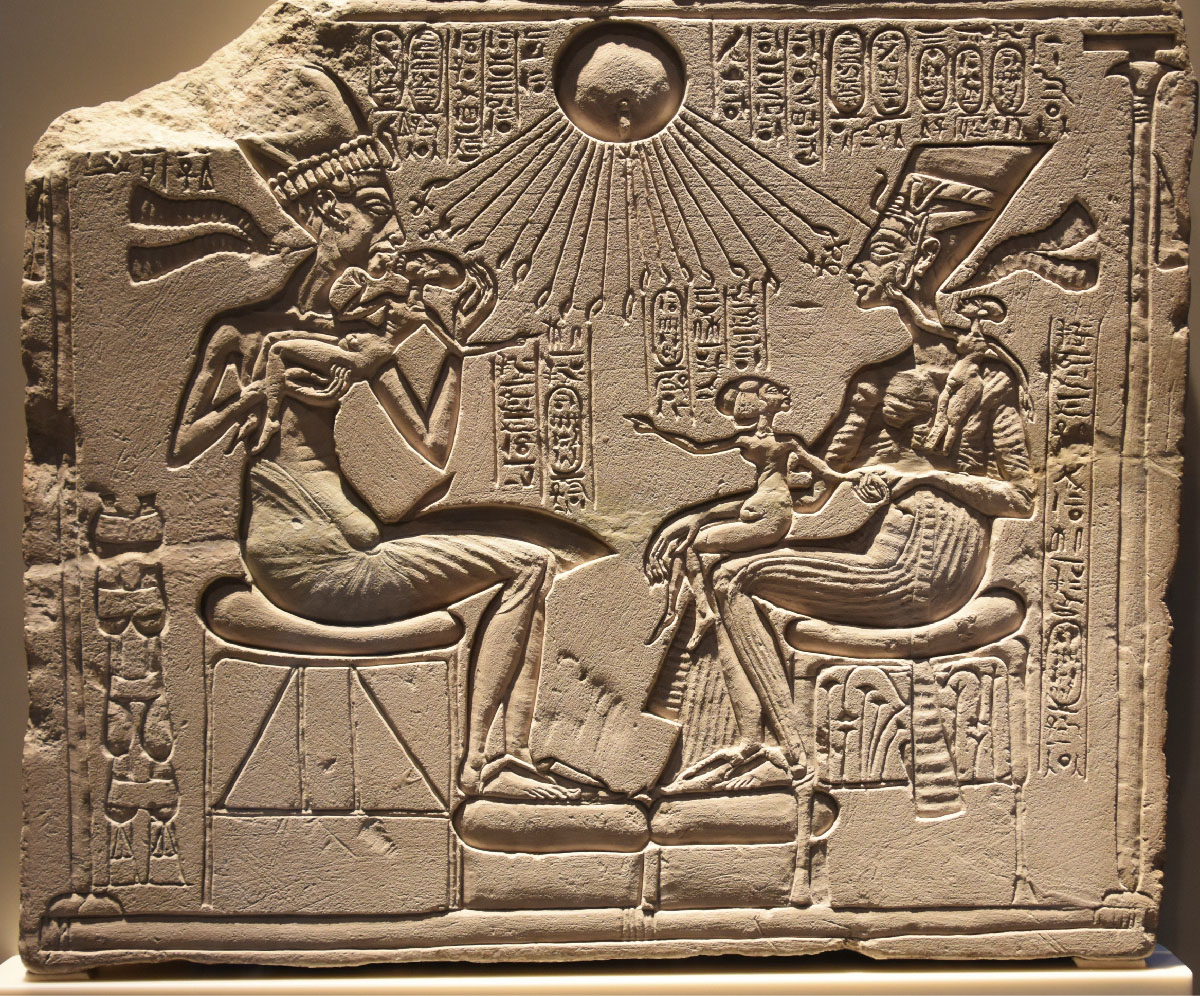
In the emerging new religion, people were instructed to worship the pharaoh. This made Akhenaten and Nefertiti intermediaries between the people and their god, eliminating the need for powerful priests like those of Amun (Figure 4.23). Many theories have been proposed to explain Akhenaten’s motive for founding a new monotheistic religion, including sincere belief, but most have been discarded. It is possible he was merely attempting to revert to an older model of religious practice in which the king was the primary state deity.
英語のヒント
新しい宗教では、人々はファラオを崇拝するよう指示された。これによってアクエンアテンとネフェルティティが、人々と神の仲介者となり、アメンの神官のような強力な祭司層は不要になった(図4.23)。王が新たな一神教を創始した動機には、誠実な信仰からだという説を含め、多くの説が出されたが、大半は退けられた。単に、王が国家の中心的な神だった古い宗教の形へ戻ろうとした可能性もある。
Akhenaten and Nefertiti.アクエンアテンとネフェルティティ。
(credit: “Akhenaten, Nefertiti, and three daughters beneath the Aten” by Richard Mortel/Flickr, CC BY 2.0) · CC BY 2.0
Figure 4.23 This small stone engraving made during his lifetime shows Pharaoh Akhenaten at left, sitting beneath the Aton (the solar orb) with his queen, Nefertiti. Akhenaten cradles one of their three daughters, while Nefertiti holds the other two on her lap and her shoulder. (credit: “Akhenaten, Nefertiti, and three daughters beneath the Aten” by Richard Mortel/Flickr, CC BY 2.0)
図4.23 アクエンアテンの存命中に作られた小さな石の浮彫。左のファラオは、王妃ネフェルティティとともに、アテン(太陽円盤)の下に座る。アクエンアテンは3人の娘の一人を抱き、ネフェルティティは残る2人を膝と肩に抱く。(出典:Richard Mortel/Flickr「Akhenaten, Nefertiti, and three daughters beneath the Aten」、CC BY 2.0)
One reason many questions about him remain is that after Akhenaten died in about 1336 BCE, Egyptians reverted to their older religious traditions and attempted to erase this period from their history. The process was begun by his successor Smenkhkare and accelerated under the pharaoh who followed, Tutankhamun. These two young and short-lived pharaohs ushered Egypt back to the old faith, abandoning the city of Akhetaton, returning to Memphis, and beginning repairs on the temples desecrated under the previous regime. Tutankhamun also sent his armies into Nubia and Canaan to put down revolts and challenge the threat posed by the Hittites. He may have been leading one of these armies when he was killed, at the age of only eighteen or nineteen. The next pharaohs continued restoring the old religions, even scratching out references to the Aton and destroying what remained of Akhetaton.
英語のヒント
アクエンアテンについて疑問が多く残る理由の一つは、紀元前1336年頃の死後、エジプト人が古い信仰へ戻り、この時代を歴史から消そうとしたことにある。後継者スメンクカーラーがこの過程を始め、次のツタンカーメンのもとで加速した。若くして短い治世を終えた2人は、アケトアテンを捨ててメンフィスへ戻り、前政権で損なわれた神殿の修復を始め、エジプトを古い信仰へ戻した。ツタンカーメンはヌビアとカナンにも軍を送り、反乱を鎮圧し、ヒッタイトの脅威に対抗した。わずか18~19歳で命を落とした時、こうした軍の一つを率いていた可能性もある。後のファラオたちは古い宗教の復興を続け、アテンへの言及を削り、アケトアテンの残骸まで壊した。