第4章古代オリエントThe Near East
When Horemheb, the final pharaoh of this first dynasty of the New Kingdom, died childless, a military commander named Ramesses I took control and began a new dynasty. His heirs, sometimes called the Ramesside kings, worked hard to restore Egypt to greatness through impressive military and building campaigns. The greatest pharaoh of this period, and the last great pharaoh of the New Kingdom, was Ramesses II, who ruled Egypt for more than sixty-five years from 1279 to 1213 BCE.
英語のヒント
新王国最初の王朝の最後のファラオ、ホルエムヘブが子を残さずに亡くなると、軍司令官ラメセス1世が権力を継ぎ、新王朝を始めた。ラメセス朝の王たちとも呼ばれる後継者は、大規模な遠征と建設事業でエジプトの栄光を取り戻そうとした。この時代で最も偉大で、新王国最後の大ファラオとされるのはラメセス2世で、紀元前1279~1213年に、65年以上統治した。
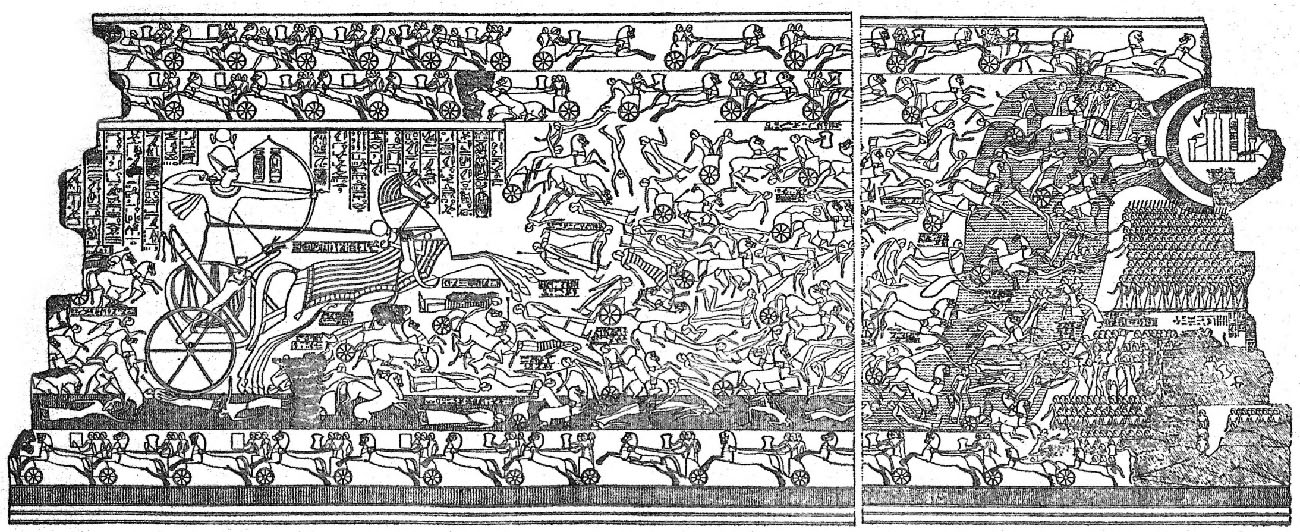
During his long reign, Ramesses II fought several wars with the Hittites in Syria and launched additional wars against the Libyans to the west of Egypt. The threat from the Hittites was especially pronounced in this period. In an attempt to push them back and restore Egyptian influence in Syria, Ramesses II led an army of twenty thousand into Syria to retake the important city of Qadesh. During the fighting, Ramesses himself led several chariots straight into the Hittite lines. It was only by a combination of luck and Hittite negligence that he and his forces survived and were able to ultimately beat back the enemy (Figure 4.24). While the attempt to recapture Qadesh failed, once he was safely home, Ramesses II claimed the campaign was a success.
英語のヒント
長い治世の間、ラメセス2世はシリアでヒッタイトと何度も戦い、西ではリビア人にも戦争を仕掛けた。この時期、とりわけ顕著だったのはヒッタイトの脅威である。彼らを押し戻し、シリアでの影響力を取り戻すため、2万の軍を率い、要地カデシュの奪回へ向かった。戦闘中、ラメセスは自ら戦車数両を率いて敵陣へ突入した。自軍が生き残り、最終的に敵を押し返せたのは、幸運とヒッタイト側の不注意が重なったからにすぎなかった(図4.24)。カデシュの奪回は失敗したが、無事に帰国すると、遠征は成功だったと主張した。
Ramses II.ラメセス2世。
(credit: modification of work “Battle scene from the Great Kadesh reliefs of Ramses II on the Walls of the Ramesseum” by A History Of Egypt From The Earliest Times To The Persian Conquest by James Henry Breasted/Wikimedia Commons, Public Domain) · Public Domain
Figure 4.24 This sketch of an engraving on a wall of the mortuary temple of Pharaoh Ramesses II depicts him (on the left) as a larger-than-life charioteer firing arrows into the Hittite army at the Battle of Qadesh. The Egyptian records of the battle note that the pharaoh demonstrated great bravery as he led a small group of chariots into the fray. (credit: modification of work “Battle scene from the Great Kadesh reliefs of Ramses II on the Walls of the Ramesseum” by A History Of Egypt From The Earliest Times To The Persian Conquest by James Henry Breasted/Wikimedia Commons, Public Domain)
図4.24 ラメセス2世の葬祭殿の壁の刻画を写した図。左の王は、他の人物より大きな戦車兵として描かれ、カデシュの戦いでヒッタイト軍へ矢を射る。エジプト側の記録は、少数の戦車を率いて乱戦へ入った王の勇敢さを伝える。(出典:James Henry Breasted著 A History Of Egypt From The Earliest Times To The Persian Conquest/Wikimedia Commons「Battle scene from the Great Kadesh reliefs of Ramses II on the Walls of the Ramesseum」を改変、パブリックドメイン)
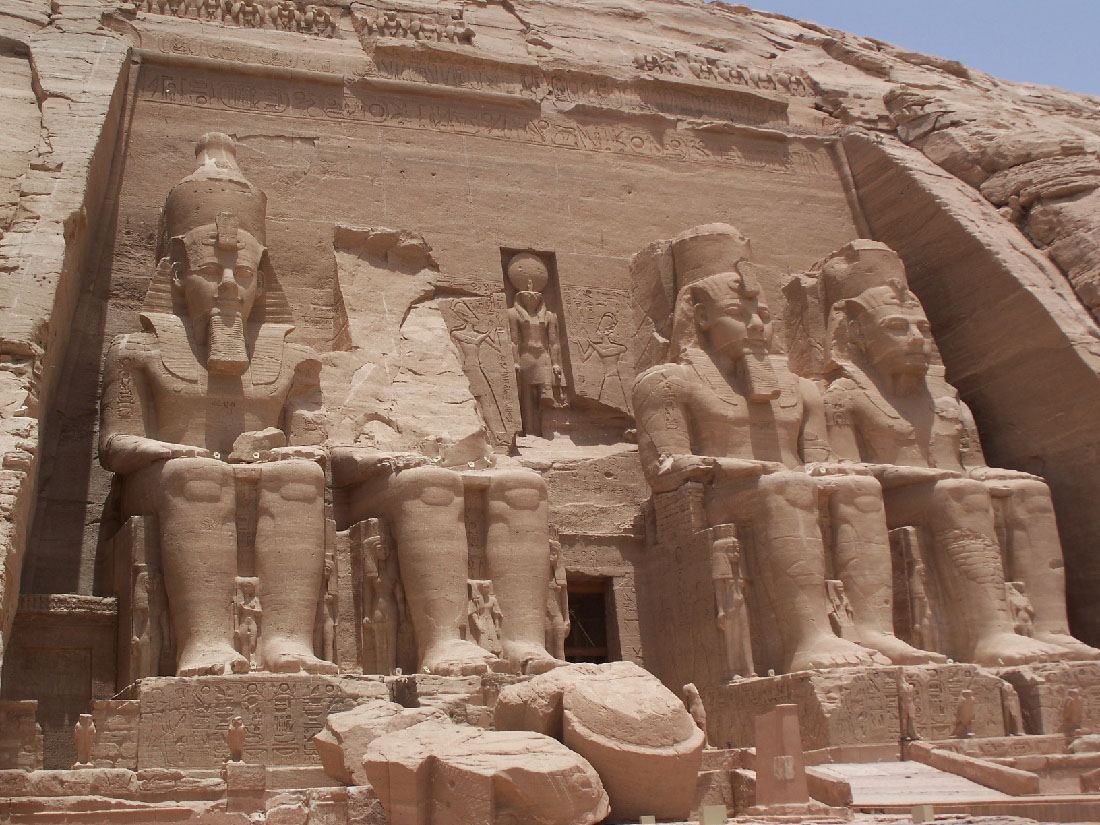
The failed attempt to retake Qadesh helped convince Ramesses to agree to a peace treaty with the Hittites in approximately 1258 BCE. The threat they continued to pose also motivated him to build a new capital in the Nile delta, much closer to Canaan. Called Pi-Ramesse (“House of Ramesses”), it included a great number of impressive monuments, some with reliefs showing the pharaoh defeating the Hittites. Beyond the building campaigns in Pi-Ramesse, Ramesses II also enlarged and beautified several additional temples in Thebes and other locations. However, the greatest monuments to his rule were the two temples he built at Abu Simbel, far to the south in Nubia. The more impressive of the two is called the Great Temple at Abu Simbel. It was carved into the side of a mountain and includes four massive seated statues of Ramesses II himself. A passageway between the two center statues leads to chambers that stretch hundreds of feet into the sandstone (Figure 4.25). The engineers who designed the temple constructed it such that twice a year, the rays of the sun would enter the building at dawn and bathe the gods placed there in light.
英語のヒント
カデシュ奪回の失敗は、ラメセスが紀元前1258年頃、ヒッタイトとの和平条約に同意する一因となった。続く脅威への備えとして、カナンにずっと近いナイル川デルタに、新首都ピラメセ(「ラメセスの家」)を築いた。壮大な記念建造物が多く、王がヒッタイトを破る浮彫を持つものもあった。テーベなどでも神殿を拡張し、美しく整えた。しかしその治世を示す最大の記念建築は、はるか南のヌビア、アブ・シンベルに築いた2つの神殿だった。より壮大な大神殿は山の側面を彫り抜き、ラメセス2世自身の巨大な座像を4体備える。中央の2体の間の通路は、砂岩の奥数百フィートへ続く部屋に通じる(図4.25)。設計した技師たちは、年に2回、夜明けの光が建物に差し込み、内部の神々を照らすように造った。
The Temple at Abu Simbel.アブ・シンベル神殿。
(credit: “Abu Simbel Temple of Ramesses II” by “Than217”/Wikimedia Commons, Public Domain) · Public Domain
Figure 4.25 In 1968, Ramesses II’s thirteenth-century BCE temple at Abu Simbel was relocated because the creation of a large dam on the Nile was going to flood the original site. This photograph shows the structure as it looks today. (credit: “Abu Simbel Temple of Ramesses II” by “Than217”/Wikimedia Commons, Public Domain)
図4.25 紀元前13世紀のラメセス2世のアブ・シンベル神殿は、ナイル川の巨大ダム建設で元の場所が水没するため、1968年に移築された。写真は現在の姿。(出典:「Than217」/Wikimedia Commons「Abu Simbel Temple of Ramesses II」、パブリックドメイン)
Egypt’s Foreign Policyエジプトの外交政策
Powerful pharaohs used war beyond their borders to keep their rivals and other major powers in check. Thutmose III had led armies into both Nubia and Canaan for this purpose. In Canaan, his efforts were directed at blunting the growing influence of Mitanni, a kingdom in northern Mesopotamia. The rise of Mitanni led a number of Canaanite leaders who had previously pledged their allegiance to Egypt to instead seek Mitanni protection. By campaigning in Canaan several times, Thutmose III was able to bring the Canaanite regions back into Egypt’s orbit. He also directly attacked Mitanni itself in order to weaken its control in the region. His numerous successors continued these efforts, thus ensuring Egypt’s influence in Canaan. Amenhotep II brought back thousands of prisoners and a wealth of treasure from his campaigns in the region, for example. Well over a century later, Seti I and Ramesses II were still pursuing these efforts to preserve Egyptian dominance.
英語のヒント
有力なファラオは、国境の外で戦争を行い、競争相手や他の大国を抑えた。トトメス3世がヌビアとカナンへ軍を率いたのも、そのためだった。カナンでは、メソポタミア北部の王国ミタンニの勢力拡大を鈍らせようとした。ミタンニが台頭すると、それまでエジプトに忠誠を誓っていたカナンの指導者の多くが、ミタンニの保護を求めるようになった。トトメス3世は何度も遠征してカナンをエジプトの勢力圏へ戻し、ミタンニ本国も攻撃して地域での支配力を弱めた。歴代の後継者もこれを続け、カナンへの影響力を保った。たとえばアメンヘテプ2世は、遠征から数千人の捕虜と多くの財宝を持ち帰った。1世紀を優に超えた後も、セティ1世とラメセス2世が、エジプトの優位を守ろうと同じ努力を続けた。
Pharaohs also frequently took hostages, usually members of the royal families of subject kingdoms. Thutmose III brought back a number of the sons of Canaanite kings after his campaigns, who were raised and educated in Egypt and learned Egyptian customs. Apart from serving as cultural bridges, hostages also helped strengthen Egypt’s relationships with its subject realms by reducing the likelihood their fathers would rebel in the future. Another means of improving relations with other kingdoms was marriage. Thutmose IV married one of the daughters of the Mitanni king as part of an agreement intended to check the power of the Hittites.
英語のヒント
ファラオは、通常は従属王国の王族を、人質として取ることも多かった。トトメス3世は遠征後、カナンの王子を何人も連れ帰った。王子たちはエジプトで育ち、教育を受け、エジプトの習慣を学んだ。人質は文化の橋渡しをするだけでなく、父王たちが将来反乱を起こす可能性を減らし、エジプトと従属国との関係を強めた。他国との関係改善のもう一つの手段は婚姻だった。トトメス4世は、ヒッタイトの力を抑える協定の一環として、ミタンニ王の娘と結婚した。
While wars in foreign lands could pacify enemies and preserve Egypt’s international influence, military campaigns also had a strong economic component. Conquering new territory meant conquering new wealth that could be used to benefit the state. Records of just one of Thutmose III’s campaigns in Canaan note that the booty included more than two thousand horses and twenty thousand sheep, almost two thousand goats, wheat, weapons, equipment, captives, and items made of precious metals, such as copper from mines in the Sinai. Descriptions of campaigns in Nubia recount similar acquisitions. Conquered peoples were also expected to provide annual tribute to the Egyptian state.
英語のヒント
外国での戦争は、敵を鎮め、エジプトの国際的影響力を保つ手段であるとともに、強い経済的意味も持った。新領土の征服は、国家に役立てられる富の獲得でもあった。トトメス3世のカナン遠征のうち、わずか1回の記録でも、2千頭以上の馬、2万頭の羊、約2千頭のヤギ、小麦、武器、装備、捕虜、シナイの鉱山の銅など貴重な金属で作った品々が、戦利品として挙げられる。ヌビア遠征の記述も、同様の獲得物を伝える。征服された人々は、エジプト国家へ毎年貢納することも求められた。
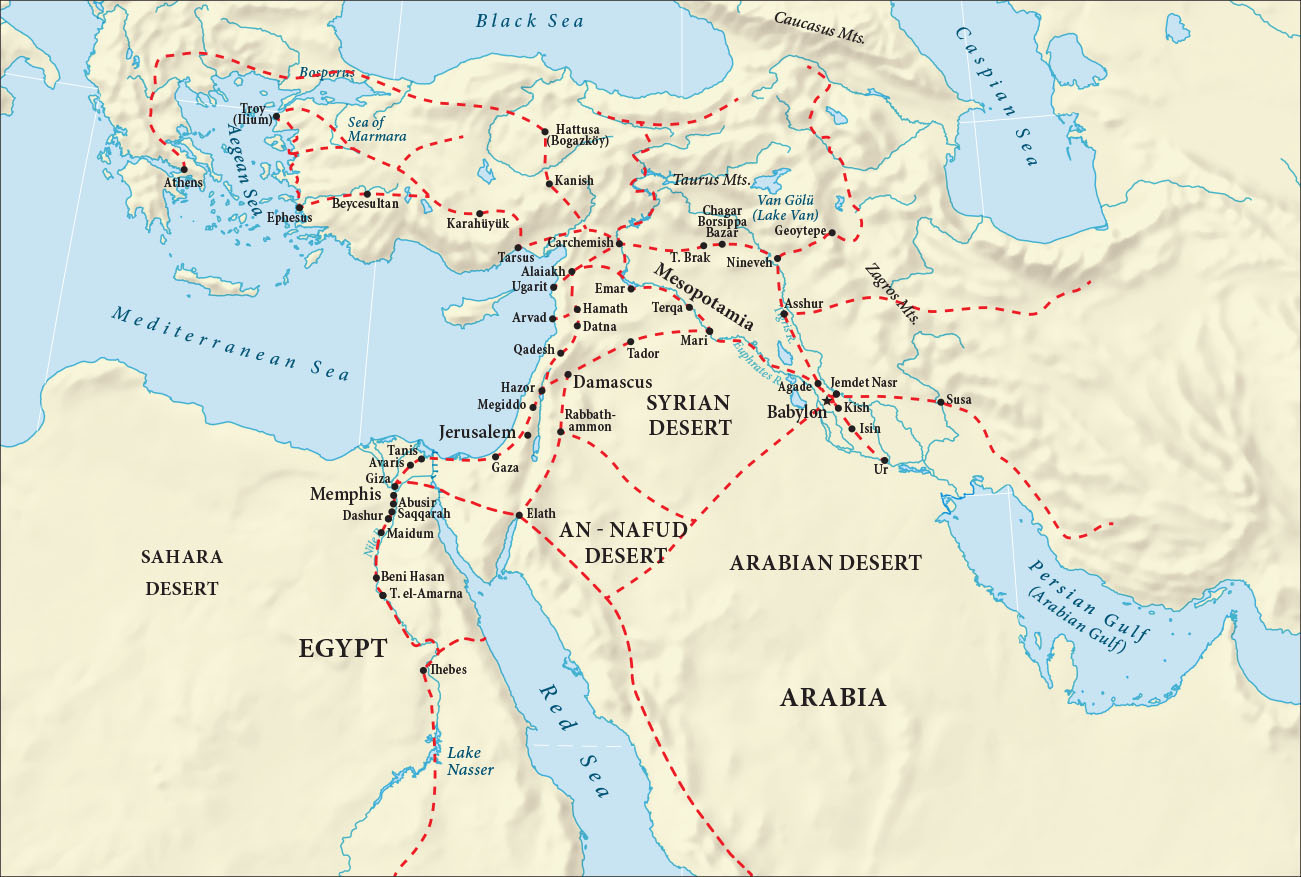
And there were benefits from maintaining control over vital trade routes and centers of commerce. The eastern Mediterranean regions of Canaan and Syria included routes connecting Mesopotamia with the sea and Cyprus. Major trading centers included Hazor and Qadesh. Megiddo was located at a mountain pass on the trade routes connecting Mesopotamia with important Canaanite cities on the way to Egypt (Figure 4.26). The value of these trade routes and commercial centers prompted Egypt to launch several campaigns into the area. Battles were fought at Qadesh and Megiddo in an effort to keep the Hittite and Mitanni kingdoms out and maintain Egyptian control over the area. These famous battles came at enormous cost in troops and wealth, and the results were mixed. The Battle of Qadesh was at best a draw. The Battle of Megiddo, fought in the fifteenth century BCE by the forces of Thutmose III, was largely an Egyptian success and led to the kingdom establishing firm control over the larger region.
英語のヒント
重要な交易路や商業の中心を支配する利益もあった。地中海東部のカナンとシリアには、メソポタミアを海やキプロスに結ぶ道が通っていた。ハツォルやカデシュは主要な交易拠点だった。メギドは山の峠に位置し、メソポタミアからカナンの重要都市を経てエジプトへ至る交易路上にあった(図4.26)。こうした道と商業中心の価値が、エジプトの数度の遠征を促した。カデシュやメギドの戦いは、ヒッタイトやミタンニを締め出し、エジプトの支配を保つために行われた。兵力と富に莫大な犠牲を伴い、結果は一様でなかった。カデシュの戦いは、よくても引き分けだった。紀元前15世紀、トトメス3世軍が戦ったメギドでは、エジプトが大きく成功し、より広い地域の支配を固めた。
Trade Routes in the Eastern Mediterranean.地中海東部の交易路。
(attribution: Copyright Rice University, OpenStax, under CC BY 4.0 license) · CC BY 4.0
Figure 4.26 The regions of Canaan and Syria connected vital trade routes (shown in red) that ran from Mesopotamia to Egypt and the Arabian Peninsula as well as Anatolia. (attribution: Copyright Rice University, OpenStax, under CC BY 4.0 license)
図4.26 カナンとシリアは、メソポタミアからエジプト、アラビア半島、アナトリアへ通じる、重要な交易路(赤線)を結んでいた。(出典:© Rice University, OpenStax、CC BY 4.0)
By maintaining their influence in Canaan, Syria, and Nubia, Egyptian pharaohs preserved the state’s access to vital trading resources. Tin and copper were transported from Anatolia via trading routes through Canaan. Phoenicia in northwestern Canaan was a major source of the cedar used to construct Egyptian ships. It was also through the Phoenician port city of Byblos that Egyptian papyrus frequently flowed to other parts of the Eastern Mediterranean. The Greek name for book, biblos, reflects this connection with Byblos and is the ancient origin of the English word “bible.” Ivory, ebony, leopard skins, incense, and gold were procured in Nubia. There were also mines in the Sinai for turquoise, alabaster, and quartzite. Trade goods coming from Egypt to other parts of the world included pottery, grains, papyrus, linen, and many other items. To protect the flow of trade, Egypt provided border protection, supervised toll roads, and generally ensured the safety of merchants. Records from New Kingdom Egypt note frequent deliveries of trade goods from foreign allies such as Mitanni, Babylon, and others. They are described as gifts, but scholars believe they were almost certainly trade.
英語のヒント
カナン、シリア、ヌビアでの影響力を保つことで、ファラオは重要な交易資源への道を確保した。スズと銅はアナトリアからカナン経由で運ばれた。カナン北西部のフェニキアは、エジプト船の建造に使うレバノンスギの主要供給地だった。エジプトのパピルスも、フェニキアの港市ビブロスから、地中海東部各地へ流れた。ギリシア語で本を意味するビブロスという語は、この港とのつながりを反映し、英語のbible(聖書)の古い語源でもある。ヌビアからは象牙、黒檀、ヒョウの皮、香、金を入手した。シナイにはトルコ石、アラバスター、珪岩の鉱山もあった。エジプトからは陶器、穀物、パピルス、亜麻布などを輸出した。交易を守るため、エジプトは国境を警備し、有料道路を監督し、商人の安全を確保した。新王国の記録には、ミタンニやバビロンなど外国の同盟国から、品物が頻繁に届いたことが記される。記録では贈物とされるが、研究者はほぼ確実に交易だったと考えている。
Toward the end of the New Kingdom era, Egypt’s ability to maintain control over the trade routes in Canaan and Syria declined steadily. Instability in the commercial centers and banditry on the roads became more common. One travel report from the tail end of the New Kingdom (c. 1100 BCE) describes some of the problems experienced by an Egyptian envoy sent to Phoenicia to buy a supply of cedar. First he was robbed by his own crew, then he was refused the cedar he was promised in Phoenicia, and finally he was attacked by roving migrants. He appealed to officials in Egypt, but little could be done. In earlier centuries, such difficulties would have been unthinkable, but by 1100 BCE, Egypt’s influence in the region was no longer strong.
英語のヒント
新王国末期になると、カナンとシリアの交易路を支配する力は次第に弱まった。商業中心の不安定化や、路上の盗賊行為が増えた。新王国の最末期、紀元前1100年頃の旅行報告には、レバノンスギを買いにフェニキアへ派遣されたエジプトの使節の苦難が記される。まず自分の船員に盗まれ、次に約束された木材をフェニキアで拒まれ、最後には移動する移民集団に襲われた。エジプトの役人に助けを求めても、ほとんど何もできなかった。それ以前の時代なら考えられない困難だったが、紀元前1100年までには、この地域での影響力はすでに弱まっていた。
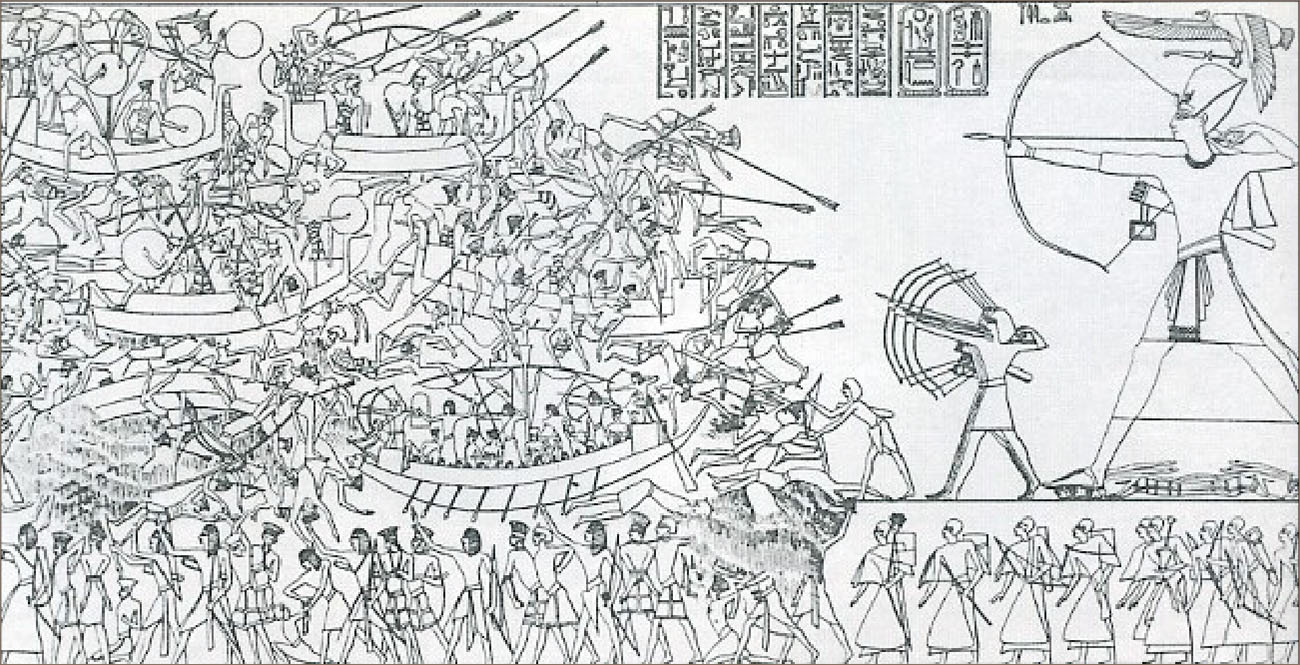
Many of the problems the envoy described were symptoms of the Late Bronze Age Collapse and were out of Egypt’s control. One of the consequences of this larger civilizational decline was that large numbers of migrants, such as those who attacked the envoy, were sweeping across the eastern Mediterranean bringing chaos and destruction. An Egyptian inscription from 1208 BCE described them as “coming from the sea,” which has led modern scholars to refer to them as the Sea Peoples (Figure 4.27). It appears that many came from the Aegean area.
英語のヒント
使節が述べた問題の多くは、青銅器時代末の崩壊の表れで、エジプトには制御できなかった。広い範囲の文明の衰退の結果、多数の移民集団が地中海東部を動き回り、混乱と破壊をもたらした。使節を襲った人々も、その一例だった。紀元前1208年のエジプトの碑文が彼らを「海から来る」と記したため、現代の研究者は「海の民」と呼ぶようになった(図4.27)。多くはエーゲ海地域から来たようである。
An Attack by the Sea Peoples.海の民の攻撃。
(credit: modification of work “A depiction of the army of Ramesses III fighting the Sea Peoples” by “Seebeer”/Wikimedia Commons, Public Domain) · Public Domain
Figure 4.27 This redrawing of a wall relief from the Temple of Ramesses III records the arrival of a group of Sea People (on the left) and the Egyptians led by Ramesses (the larger-than-life archer on the right) preparing to defend themselves. (credit: modification of work “A depiction of the army of Ramesses III fighting the Sea Peoples” by “Seebeer”/Wikimedia Commons, Public Domain)
図4.27 ラメセス3世神殿の壁の浮彫を写した図。左の海の民の到来と、右の大きな射手として描かれたラメセスに率いられ、防戦に備えるエジプト人を記録する。(出典:「Seebeer」/Wikimedia Commons「A depiction of the army of Ramesses III fighting the Sea Peoples」を改変、パブリックドメイン)
As inscriptions from the period demonstrate, Egypt resisted the invading forces. Many of the Sea Peoples were likely killed. But many others settled in Egypt and assimilated there, just as they did across the entire eastern Mediterranean. All this disruption took a toll on the region, however. The Mycenaean kingdoms in Greece and the Hittite kingdom in Anatolia suffered greatly and collapsed. City-states across Canaan were especially hard hit. Even kingdoms far from the Mediterranean, like Assyria and Babylon, weakened during this time of troubles.
英語のヒント
当時の碑文が示すように、エジプトは侵入勢力に抵抗した。海の民の多くは殺されたとみられるが、他の多くは、地中海東部の各地と同じく、エジプトに定住し、同化した。しかし混乱は地域全体に打撃を与えた。ギリシアのミケーネ諸王国とアナトリアのヒッタイト王国は大きく傷つき、崩壊した。カナンの都市国家の被害は特に深刻だった。地中海から遠いアッシリアやバビロンさえ、この混乱期には弱体化した。
Though Egypt proved more able to withstand the dangers of the period, it did experience problems. Grain prices, for example, soared during this time. Tomb robbing became common as workers who had not been paid found other ways to support their families. At the same time the Libyans and Sea Peoples were leading their attacks in northern Egypt, Nubian subjects rose up in rebellion to Egypt’s south. And the migrating Sea Peoples in Canaan greatly weakened Egypt’s control of the region. By 1070 BCE, the challenges had been mounting for years, and the New Kingdom came to an end.
英語のヒント
エジプトはこの時期の危険に比較的よく耐えたが、問題がなかったわけではない。穀物価格は高騰した。給料を受け取れなかった労働者が、家族を養う別の道を求め、墓荒らしも増えた。北でリビア人と海の民が攻撃する一方、南では従属するヌビア人が反乱を起こした。カナンへ移動した海の民も、同地のエジプト支配を大きく弱めた。紀元前1070年までには、困難が何年も積み重なり、新王国は終わった。