第4章古代オリエントThe Near East
The Hittitesヒッタイト
Unlike the Babylonians, the Hittites were not from Mesopotamia, nor were they members of the Semitic language group. Rather, they were an Indo-European-speaking group that emerged as a powerful force in Anatolia starting in the 1600s BCE. Their precise origins are not known, but they were likely immigrants to Anatolia who blended into the local population and adopted much of its culture and religion. By 1650 BCE, the Hittites dominated central Anatolia from their capital at Hattusas. Their expansion across Anatolia and into Syria continued into the early sixteenth century BCE under the reign of Mursilis, during which time the growing kingdom also set its sights on Babylon.
英語のヒント
バビロニア人と異なり、ヒッタイト人はメソポタミア出身でも、セム語系でもなかった。紀元前1600年代からアナトリアの強力な勢力となった、インド・ヨーロッパ語系の集団だった。正確な起源は不明だが、おそらく外からアナトリアへ入り、現地の人々と混ざり、その文化と宗教の多くを取り入れた。紀元前1650年までには、首都ハットゥシャからアナトリア中央部を支配した。アナトリアとシリアへの拡張は、紀元前16世紀初めのムルシリの治世にも続き、王国はバビロンにも狙いを定めた。
Possibly as a demonstration of military might or simply to seize an opportunity, the Hittite army descended into Mesopotamia and took the city of Babylon. Despite the success of the campaign, Mursilis’s power in Anatolia began to weaken during his absence. He was assassinated soon after he returned, and the Hittite Empire began to crumble as its subject kingdoms rebelled and it was consumed by war. By 1500 BCE, order had been restored, but the new rulers struggled to return the Hittites to their former glory.
英語のヒント
軍事力の誇示か、単に好機を利用するためか、ヒッタイト軍はメソポタミアへ下ってバビロンを奪った。しかし遠征が成功する間、留守のアナトリアではムルシリの権力が弱まった。帰還後まもなく暗殺され、従属王国の反乱と戦争によって帝国は崩れ始めた。紀元前1500年までに秩序は回復したが、新支配者は以前の栄光を取り戻すのに苦労した。
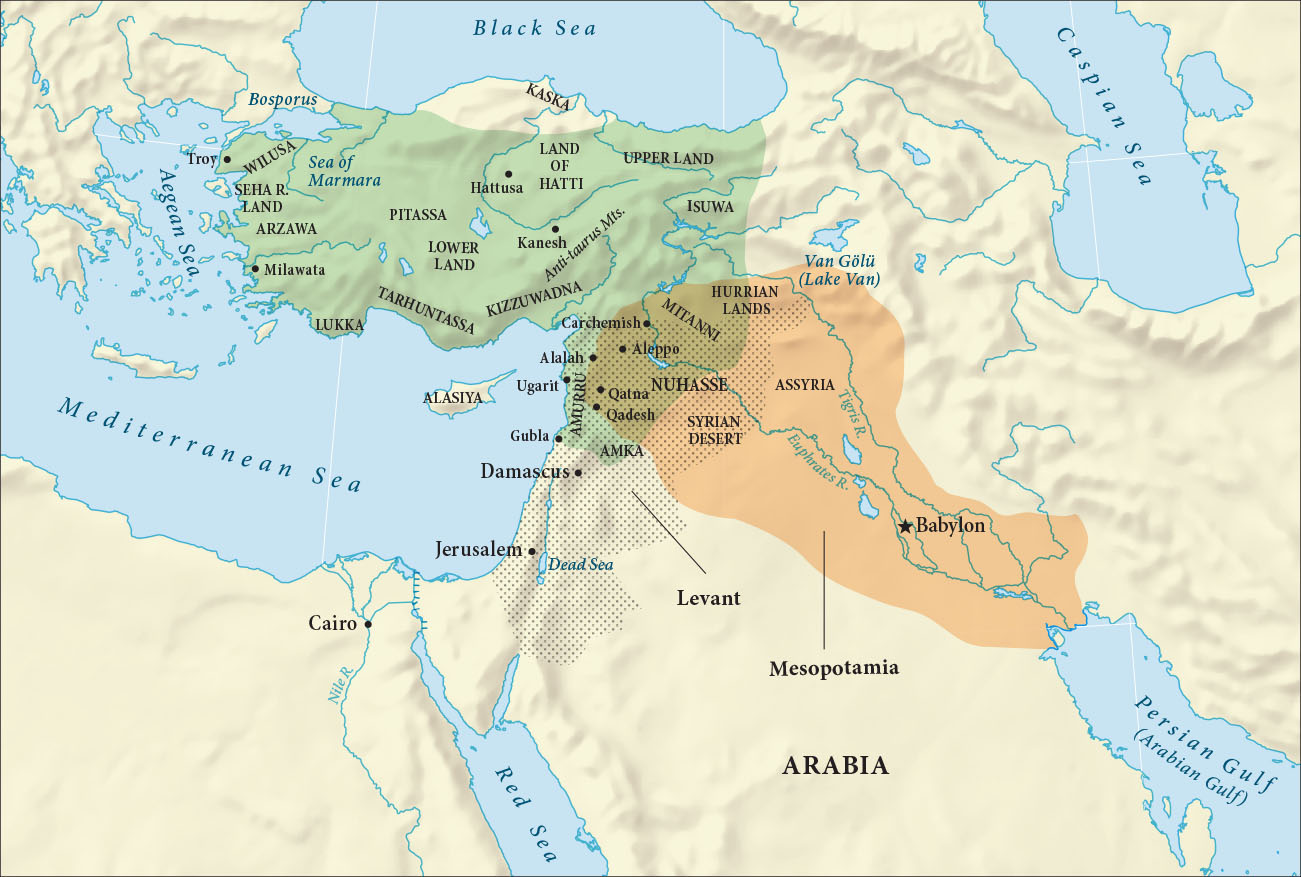
Beginning with the rise of the Hittite king Tudhaliyas I in 1420 BCE, the Hittite Empire experienced a revival and new imperial growth (Figure 4.6). By the reign of Suppiluliumas I in the mid-fourteenth century BCE, it had become arguably the most powerful empire in the Near East and a major rival of New Kingdom Egypt. The two realms vied for control of the eastern Mediterranean in the 1300s and 1200s BCE, eventually facing off in the epic Battle of Qadesh in 1274 BCE.
英語のヒント
紀元前1420年のトゥドハリヤ1世の台頭から、ヒッタイト帝国は復興し、再び成長した(図4.6)。紀元前14世紀半ばのシュッピルリウマ1世の治世には、近東最強ともいえる帝国となり、新王国エジプトの主要な対抗勢力となった。両国は紀元前1300~1200年代、東地中海の支配を争い、紀元前1274年の大きなカデシュの戦いで激突した。
The Hittite Empire.ヒッタイト帝国。
(attribution: Copyright Rice University, OpenStax, under CC BY 4.0 license) · CC BY 4.0
Figure 4.6 Shown in green at its greatest extent in the thirteenth century BCE, the Hittite Empire included all of Asia Minor to the borders of Assyria and parts of Syria. (attribution: Copyright Rice University, OpenStax, under CC BY 4.0 license)
図4.6 紀元前13世紀の最大領域を緑で示す。ヒッタイト帝国は、小アジア全域からアッシリア国境、シリアの一部までを含んだ。(出典:Rice University、OpenStax、CC BY 4.0)
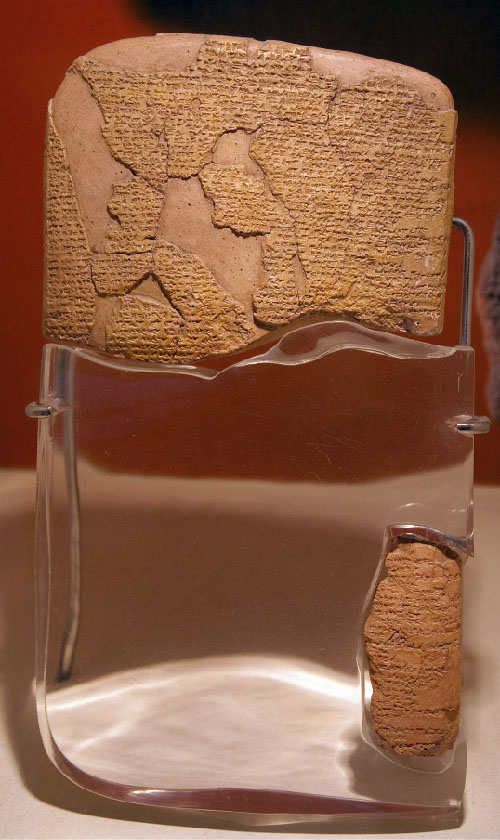
Generally accepted as a draw or possibly a narrow Hittite victory, the fighting at Qadesh is most memorable for ultimately leading the two forces to recognize that they had more to gain from peace than war. In 1258 BCE, the Hittite king Hattusilis II and the Egyptian Pharaoh Ramesses II signed one of early history’s greatest peace treaties (Figure 4.7). The agreement confirmed Hittite control of Syria and Egyptian dominance over the Phoenician ports of the eastern Mediterranean. However, little more than fifty years later, the once-powerful Hittite Empire collapsed, never to reappear.
英語のヒント
カデシュの戦いは、一般に引き分け、あるいはヒッタイトの僅差の勝利とされる。最も重要なのは、両国が戦争より和平から多くを得られると認識するに至ったことである。紀元前1258年、ヒッタイト王ハットゥシリ2世とエジプトのファラオ、ラムセス2世は、初期史上の重要な和平条約の一つを結んだ(図4.7)。条約はヒッタイトのシリア支配と、東地中海のフェニキア港市でのエジプトの優勢を認めた。しかし、50年余り後、かつて強大だったヒッタイト帝国は崩壊し、再興されなかった。
The Egypto-Hittite Peace Treaty.エジプト・ヒッタイト和平条約。
(credit: “Treaty of Kadesh” by Iocanus/Museum of the Ancient Orient/Wikimedia Commons, CC BY 3.0) · CC BY 3.0
Figure 4.7 These carved fragments are from one of many copies of the Egypto-Hittite Peace Treaty of 1258 BCE. (credit: “Treaty of Kadesh” by Iocanus/Museum of the Ancient Orient/Wikimedia Commons, CC BY 3.0)
図4.7 これらの刻文の破片は、紀元前1258年のエジプト・ヒッタイト和平条約の、多数ある写しの一つである。(出典:Iocanus/古代オリエント博物館/Wikimedia Commons「Treaty of Kadesh」、CC BY 3.0)
The Hittite Empire was not the only important Near Eastern power to disintegrate during this period. Across the eastern Mediterranean and Mesopotamia beginning around 1200 BCE, kingdoms and empires from Greece to Mesopotamia went into a decline so extensive it is now called the Late Bronze Age Collapse. Although its trigger remains unknown, the collapse coincided with widespread regional famine, epidemic disease, war, and waves of destructive migrations across the eastern Mediterranean. By the time calm returned around 1100 BCE, the region had entered a new era, the Iron Age. This was a period in which iron replaced bronze as the metal of choice for tools and weapons, and new and more sophisticated empires expanded across the Near East.
英語のヒント
この時代に崩壊した重要な近東勢力は、ヒッタイトだけではなかった。紀元前1200年頃から、東地中海とメソポタミアにわたり、ギリシアからメソポタミアの王国・帝国が広範囲に衰退した。現在、「後期青銅器時代の崩壊」と呼ばれる出来事である。引き金は不明だが、広域の飢饉、疫病、戦争、破壊的な移動の波と重なった。紀元前1100年頃に落ち着きが戻るまでに、地域は鉄器時代へ入っていた。道具や武器の主要金属として鉄が青銅に代わり、より高度な新帝国が近東へ広がる時代である。
The Neo-Assyrian Empire新アッシリア帝国
For a few centuries after the Late Bronze Age Collapse, Mesopotamia experienced transformations that dramatically reshaped the region and set the stage for a new imperial era. During the eleventh and tenth centuries BCE, decline came to both Assyria and especially to Babylonia, where dynasties competed for control. Complicating the situation for the Babylonians, a Semitic group of unknown origin called the Chaldeans took control of far southern Mesopotamia during this period. Assyria in the north fared a little better but also struggled to reestablish control over northern Mesopotamia. One of the major factors limiting Assyria’s ability to grow was the presence of a group of West-Semitic seminomads called Aramaeans. The Aramaeans likely emerged first in southern Syria; they exploited Assyrian and Babylonian weakness to expand into Mesopotamia, disrupting Assyrian trading routes as they went. By the tenth century BCE, they had become the dominant population in western Mesopotamia and controlled a number of powerful kingdoms there.
英語のヒント
後期青銅器時代の崩壊後の数世紀、メソポタミアは大きく姿を変え、新たな帝国時代への準備が進んだ。紀元前11~10世紀には、アッシリアと、とりわけ王朝が争うバビロニアが衰えた。起源不明のセム語系集団カルデア人が南端を支配し、バビロニアの状況をさらに複雑にした。北のアッシリアはややましだったが、北部メソポタミアの支配回復に苦労した。拡大を妨げた主要因の一つが、西セム語系の半遊牧民アラム人だった。おそらくシリア南部に現れ、アッシリアとバビロニアの弱体化を利用してメソポタミアへ広がり、アッシリアの交易路を妨げた。紀元前10世紀には、西部メソポタミアの主要な住民となり、複数の強国を支配した。
It was only around 900 BCE that Assyria was able to reestablish control over northern Mesopotamia. This marks the birth of what historians often refer to as the Neo-Assyrian Empire (to distinguish it from the Old Assyrian Empire of 2000–1600 BCE and the Middle Assyrian Empire of 1400–1100 BCE). Beginning in the reign of Ashurnasirpal II in the early ninth century BCE, the Neo-Assyrian Empire began a steady march toward imperial dominance across the Near East, asserting control over many Aramaean kingdoms in Syria and eventually over Babylonia itself. By the end of Tiglath-Pileser III’s reign in 727 BCE, the Neo-Assyrian Empire had become the dominant power in the Near East. Over the next several decades, successive Assyrian kings were able to build an expansive empire across Mesopotamia and the eastern Mediterranean through wars of conquest. In 671 BCE, King Esarhaddon invaded Egypt and added that center of wealth and power to his kingdom.
英語のヒント
アッシリアが北部メソポタミアの支配を回復できたのは、ようやく紀元前900年頃だった。歴史家は、これを新アッシリア帝国の始まりと呼ぶことが多い。古アッシリア(紀元前2000~1600年)、中アッシリア(紀元前1400~1100年)と区別するためである。紀元前9世紀初めのアッシュルナツィルパル2世から、新アッシリアは近東の覇権へ着実に進み、シリアのアラム諸国、やがてバビロニア自体を支配した。ティグラト・ピレセル3世の治世が終わる紀元前727年までに、近東の最有力勢力となった。その後数十年、歴代の王は征服戦争でメソポタミアと東地中海へ広大な帝国を築いた。紀元前671年、エサルハドン王がエジプトへ侵入し、この富と権力の中心を王国に加えた。
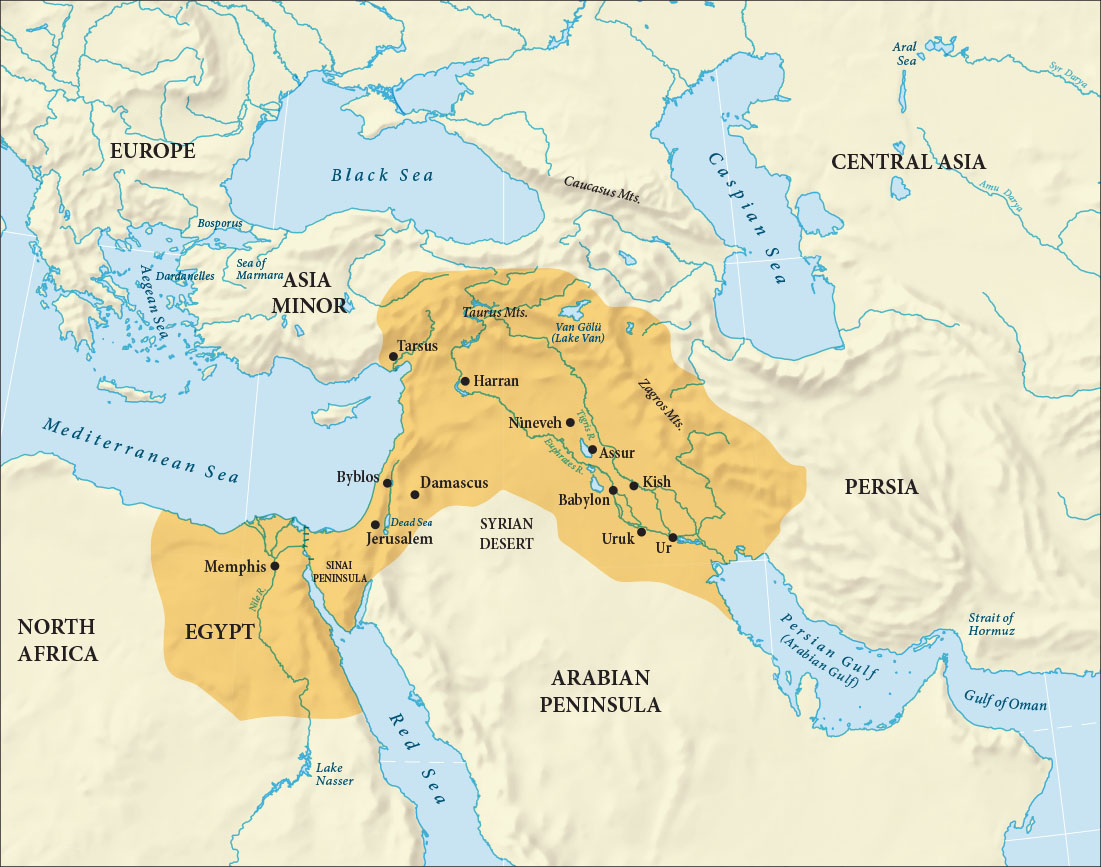
With this conquest, the Neo-Assyrian Empire achieved a degree of territorial control far surpassing that of any earlier empire of the region (Figure 4.8). But its supremacy was not to last. Beginning in the last decades of the seventh century BCE, two growing powers threatened and eventually overthrew Assyria. These kingdoms were Babylonia and Media.
英語のヒント
この征服によって、新アッシリア帝国の領土は、地域の先行するどの帝国をもはるかに上回った(図4.8)。しかし覇権は長続きしなかった。紀元前7世紀末から、二つの成長する勢力、バビロニアとメディアがアッシリアを脅かし、ついに倒した。
The Neo-Assyrian Empire.新アッシリア帝国。
(attribution: Copyright Rice University, OpenStax, under CC BY 4.0 license) · CC BY 4.0
Figure 4.8 This map shows the Neo-Assyrian Empire (in orange) at its height, around 670 BCE. Note the major cities and peoples consumed by its conquests. (attribution: Copyright Rice University, OpenStax, under CC BY 4.0 license)
図4.8 紀元前670年頃、最盛期の新アッシリア帝国を橙色で示す。征服に取り込まれた主要な都市と人々に注目しよう。(出典:Rice University、OpenStax、CC BY 4.0)
During the period of Assyrian expansion, Babylonia had been reduced to a vassal state of the empire, meaning it was nominally independent in the running of its internal affairs but had to bow to imperial demands and provide goods and soldiers when commanded. But in 616 BCE, the Chaldean Babylonian ruler Nabopolassar attempted to take advantage of a period of Assyrian weakness by launching a bold attack against the Old Assyrian capital of Asshur. Although the attack failed, it encouraged the Median dynasty to risk its own attack into Assyria. The Median Empire, a kingdom in northwestern Iran, had only recently unified and strengthened, largely because Assyria had devastated the rival kingdoms around it, such as Elam. The attack on Assyria proved successful, and Asshur was destroyed in 614 BCE. Shortly afterward, the Babylonians and the Medes entered into an alliance to overthrow Assyria. Assyria received support from Egypt, but it was unable to prevent the Babylonian-Median alliance from overwhelming its forces and capturing its cities. In 612 BCE, the Babylonians and the Medes reduced the once-great Assyrian city of Nineveh to rubble, killing the Assyrian king in the process. The remaining Assyrian forces fled west and held out for a few more years. By 605 BCE, however, the Assyrian Empire had been defeated and its people carried off into slavery.
英語のヒント
アッシリアの拡張期、バビロニアは属国となっていた。内政では名目上の独立を保つが、帝国の要求に従い、命じられれば物資と兵を出す立場だった。しかし紀元前616年、カルデア系のバビロニア王ナボポラッサルは、アッシリアの弱体化を利用し、古都アッシュルへ大胆に攻撃した。失敗したが、メディア王朝も攻撃を試みるきっかけとなった。イラン北西部のメディアは、アッシリアがエラムなど周囲の競争国を破壊したことも大きく作用し、つい最近統一され強化された王国だった。攻撃は成功し、紀元前614年にアッシュルは破壊された。まもなくバビロニアとメディアは、アッシリア打倒の同盟を結んだ。アッシリアはエジプトの支援を得たが、同盟軍による圧倒と都市の占領を防げなかった。紀元前612年、ニネヴェは瓦礫と化し、王も殺された。残る軍勢は西へ逃れ、数年抵抗したが、紀元前605年までに帝国は敗れ、人々は奴隷として連れ去られた。
The victors divided the spoils. The Median Empire took the areas to the east, north, and northeast and expanded its control to central Anatolia, much of western Iran, and the southern area between the Black and Caspian Seas.
英語のヒント
勝者たちは戦利を分けた。メディア帝国は東・北・北東を取り、アナトリア中央部、イラン西部の大部分、黒海とカスピ海の間の南部へ支配を広げた。
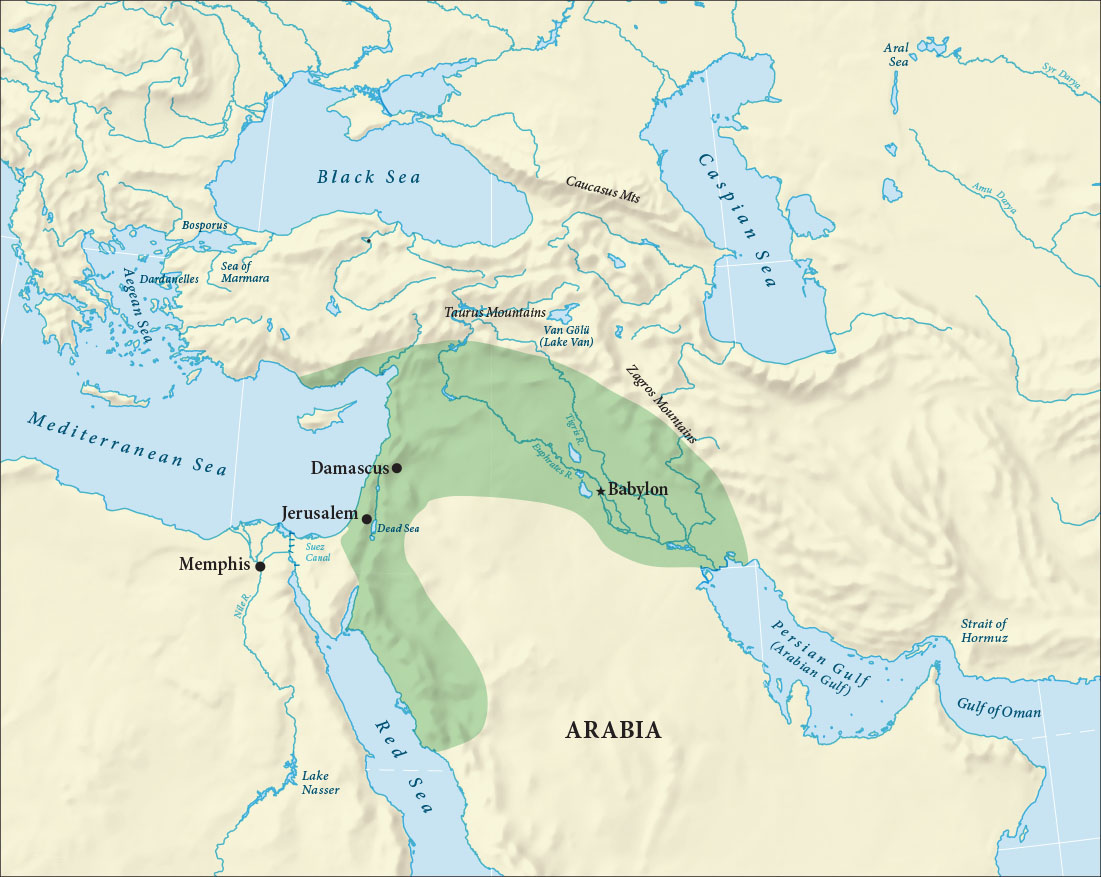
The Babylonians, often called the Neo-Babylonians to distinguish them from Hammurabi’s subjects in the Old Babylonian period, took control of the western portion of the former Neo-Assyrian Empire. This included much of Mesopotamia, Syria, and the important Phoenician ports along the Mediterranean (Figure 4.9). Under king Nebuchadnezzar II, they waged war in Syria and the eastern Mediterranean to weaken Egypt’s power. Then, in 601 BCE, Nebuchadnezzar attempted a bold invasion of Egypt itself, only to be repulsed by strong resistance.
英語のヒント
バビロニア人は、ハンムラビの古バビロニアと区別して、新バビロニア人と呼ばれることが多い。彼らはかつての新アッシリア帝国の西側を支配し、メソポタミアの多く、シリア、地中海沿いの重要なフェニキア港市を得た(図4.9)。ネブカドネザル2世の下で、エジプトの力を弱めるため、シリアと東地中海で戦った。紀元前601年にはエジプト本土への大胆な侵攻を試みたが、強い抵抗に撃退された。
The Neo-Babylonian Empire.新バビロニア帝国。
(attribution: Copyright Rice University, OpenStax, under CC BY 4.0 license) · CC BY 4.0
Figure 4.9 By 550 BCE, the Neo-Babylonian Empire (shown in green) had extended its control over Mesopotamia, Syria, and Judah, and even into the Arabian Peninsula. (attribution: Copyright Rice University, OpenStax, under CC BY 4.0 license)
図4.9 紀元前550年までに、新バビロニア帝国(緑色)は、メソポタミア、シリア、ユダ、さらにアラビア半島にも支配を広げた。(出典:Rice University、OpenStax、CC BY 4.0)