第4章古代オリエントThe Near East
4.1 From Old Babylon to the Medes4.1 古バビロニアからメディアへ
Learning Objectives学習の目標
By the end of this section, you will be able to:
この節を学ぶと、次のことができるようになる。
Describe the geography of the Ancient Near East
古代近東の地理を説明する。
Discuss the political norms, technological innovations, and unique social attributes of the major city-states of the Ancient Near East
古代近東の主要都市国家の政治的慣行、技術革新、独自の社会的特徴を論じる。
Explain how city-states of the Ancient Near East interacted with their neighbors
古代近東の都市国家が、近隣とどう関わったかを説明する。
When Sargon of Akkad built Mesopotamia’s first empire in approximately 2300 BCE, he inaugurated a new era in the Near East. Though it lasted only about a century and a half, his model of imperial expansion and administration was followed by a number of successive regional powers in the region. The Third Dynasty of Ur and Hammurabi’s Babylonian kingdom were in many ways imitators of Sargon’s earlier example. Later powers like the Hittites, Neo-Assyrians, and Neo-Babylonians continued to borrow from earlier empires and added unique traits as well. Within these different empires existed a diverse assortment of peoples, social classes, religions, and daily practices. From the archaeological record and surviving documents, historians have cataloged these groups and learned a little about how they lived.
英語のヒント
紀元前2300年頃、アッカドのサルゴンがメソポタミア最初の帝国を築き、近東の新時代を開いた。存続は約150年だったが、その帝国拡張と行政のモデルは、後の地域勢力に受け継がれた。ウル第3王朝とハンムラビのバビロニア王国は、多くの点でサルゴンの先例をまねた。後のヒッタイト、新アッシリア、新バビロニアも、以前の帝国から取り入れながら、独自の特徴を加えた。これらの帝国内には、多様な人々、階級、宗教、日々の慣行があった。歴史家は、考古資料と現存文書から、それらの集団を整理し、暮らしの一端を知ってきた。
Power Politics in the Near East近東の権力政治
The end of the third millennium BCE was a transformative, if sometimes chaotic, period in Mesopotamia. Foreign invaders from the north, east, and west put tremendous pressure on the rulers of the Third Dynasty of Ur, the last Sumerian dynasty. One of the greatest threats came from nomadic peoples then living in the desert regions of Syria. Raiding by these Amorites was considered such a problem that in approximately 2034 BCE, Shu-Sin, ruler of Ur, constructed a 170-mile wall from the banks of the Euphrates to the Tigris to keep them out. The strategy ultimately failed, and in the reign of Shu-Sin’s son Ibbi-Sin, the Amorites breached the wall and began attacking cities. They were soon joined by the Elamites from the east. As raids by these groups increased in volume and intensity, city after city fell, and the Third Dynasty of Ur disintegrated. By around 2004 BCE, all that remained of Ibbi-Sin’s empire was the city of Ur itself. In that year, it too was sacked by the Elamites and others.
英語のヒント
紀元前3千年紀末のメソポタミアは、時に混乱を伴う、大きな転換期だった。北・東・西の侵入者が、最後のシュメール王朝、ウル第3王朝に強い圧力をかけた。特に大きな脅威の一つが、シリアの砂漠地帯の遊牧民だった。アムル人と呼ばれる彼らの襲撃を防ぐため、ウル王シュ・シンは紀元前2034年頃、ユーフラテス川岸からティグリス川まで、全長170マイルの壁を築いた。しかし対策は失敗した。息子イビ・シンの治世に、アムル人は壁を突破して都市を攻撃し、まもなく東のエラム人も加わった。襲撃の規模と激しさが増すと、都市は次々と陥落し、第3王朝は崩れた。紀元前2004年頃、イビ・シンの帝国に残ったのはウル市だけだった。その年、ウルもエラム人などに略奪された。
Amorites then spread out across Mesopotamia, establishing powerful cities of their own. They adopted the region’s existing religious traditions, its local customs, and the Akkadian language. They also embraced the political culture of rivalry, and their two most prominent cities, Isin and Larsa, fought for supremacy. The drive for dominance stoked the same kinds of innovation and expansion that had characterized the first city, Ur.
英語のヒント
その後アムル人はメソポタミア各地へ広がり、自らの強力な都市を築いた。既存の宗教、地域の慣習、アッカド語を取り入れ、競い合う政治文化も受け継いだ。特に有力なイシンとラルサは覇権を争った。支配を目指す動きは、最初の都市ウルを特徴づけたものと同種の革新と拡張を促した。
The Rise of Babylonバビロンの興隆
During the later stages of the competition between Isin and Larsa, a new power emerged in southern Mesopotamia. This was the city of Babylon. Unlike Ur, Babylon had not previously been an important city-state. Its name is of unknown origin and was likely pronounced Babil. Akkadian speakers of the area called it Bab-ili, which meant “gateway of the gods.” In 1894 BCE, an Amorite chieftain named Sumu-adum took the city and installed himself as ruler. His successors expanded their control over the surrounding area, building public works projects and digging canals. But this expansion was modest, and by about 1800 BCE, Babylon controlled only a relatively small territory around the city itself. Indeed, at this time, it was just one of a handful of small states making up a loose coalition in Mesopotamia.
英語のヒント
イシンとラルサの競争の後期、メソポタミア南部に新たな勢力、バビロンが現れた。ウルと異なり、それ以前には重要な都市国家ではなかった。名の起源は不明で、おそらくバビルと発音された。地域のアッカド語話者は、「神々の門」を意味するバブ・イリと呼んだ。紀元前1894年、アムル人の首長スム・アブムが都市を奪い、支配者となった。後継者は公共事業や運河建設を行い、周囲へ支配を広げた。しかし拡張は小規模で、紀元前1800年頃にも、都市周辺の比較的狭い領域を治めるだけだった。当時は、メソポタミアの緩やかな連合を構成する、少数の小国家の一つにすぎなかった。
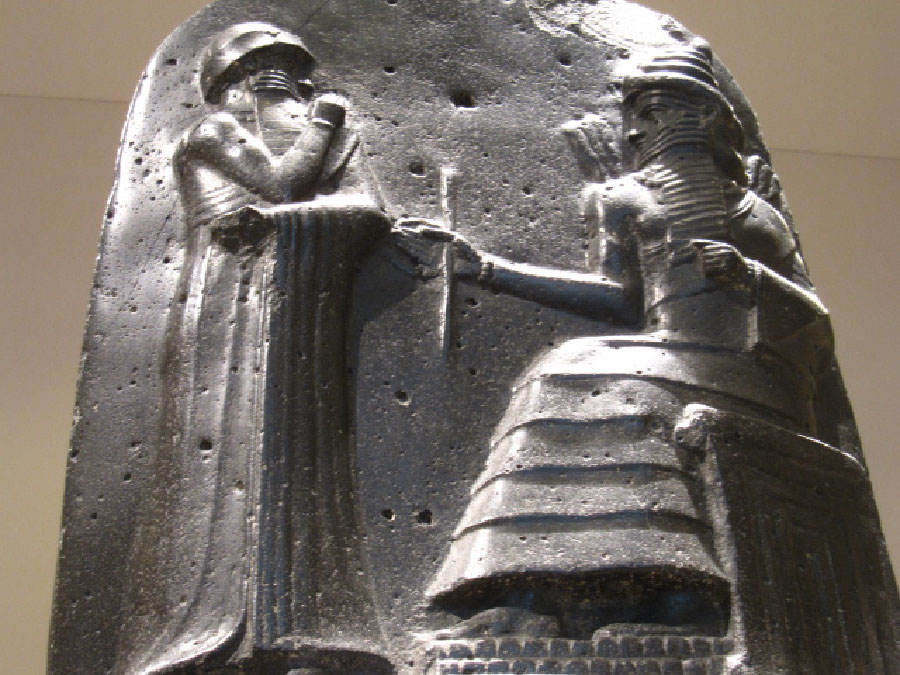
It was during the reign of Hammurabi in eighteenth century BCE that Babylon rose as a center of power and the administrative capital of a new Mesopotamian empire (Figure 4.4). Early in his reign, Hammurabi made an alliance with the powerful Assyrians to the north. This pact gave him the protection he needed to expand his kingdom, taking control of Isin, Uruk, and other key cities of southern Mesopotamia. Soon Babylon had become a major center of power in the south and the target of rival kingdoms. In approximately 1764 BCE, a coalition led by the city-states of Elam and Eshunna invaded Babylonian territory, hoping to capture Hammurabi’s powerful realm, but it failed, and Hammurabi turned his attention to the south. Eventually, he sent his armies even against his former ally, Assyria. By 1755 BCE, he had transformed the small kingdom he inherited into the center of a Mesopotamian empire to rival any that had come before it.
英語のヒント
紀元前18世紀のハンムラビの治世に、バビロンは勢力の中心、新しいメソポタミア帝国の行政首都へと成長した(図4.4)。治世初め、彼は北の強力なアッシリアと同盟し、その保護によってイシン、ウルクなど南部の要地を支配できた。まもなくバビロンは南部の主要勢力となり、競合王国の標的となった。紀元前1764年頃、エラムとエシュヌンナを中心とする連合が、ハンムラビの強国を奪おうと侵攻したが失敗した。彼は南へ目を向け、やがて、かつての同盟国アッシリアにも軍を送った。紀元前1755年までには、受け継いだ小王国を、先行するどの帝国にも比肩するメソポタミア帝国の中心へ変えていた。
Hammurabi.ハンムラビ。
(credit: “Louvre - Hammurabi's Code” by “Erin”/Flickr, CC BY 2.0) · CC BY 2.0
Figure 4.4 This relief at the top of a seven-foot stone stele from the time of King Hammurabi shows him (at left) receiving his royal insignia from a seated god, Shamash. This grant makes it clear that Hammurabi’s right to rule comes directly from the heavens. The lower portion of the stele includes his famous law code. (credit: “Louvre - Hammurabi's Code” by “Erin”/Flickr, CC BY 2.0)
図4.4 ハンムラビ王時代の高さ7フィートの石碑上部。左の王が、座る神、シャマシュから王権の標章を受ける。この授与は、統治の権利が天から直接与えられることを示す。石碑下部には有名な法典が刻まれる。(出典:「Erin」/Flickr「Louvre - Hammurabi’s Code」、CC BY 2.0)
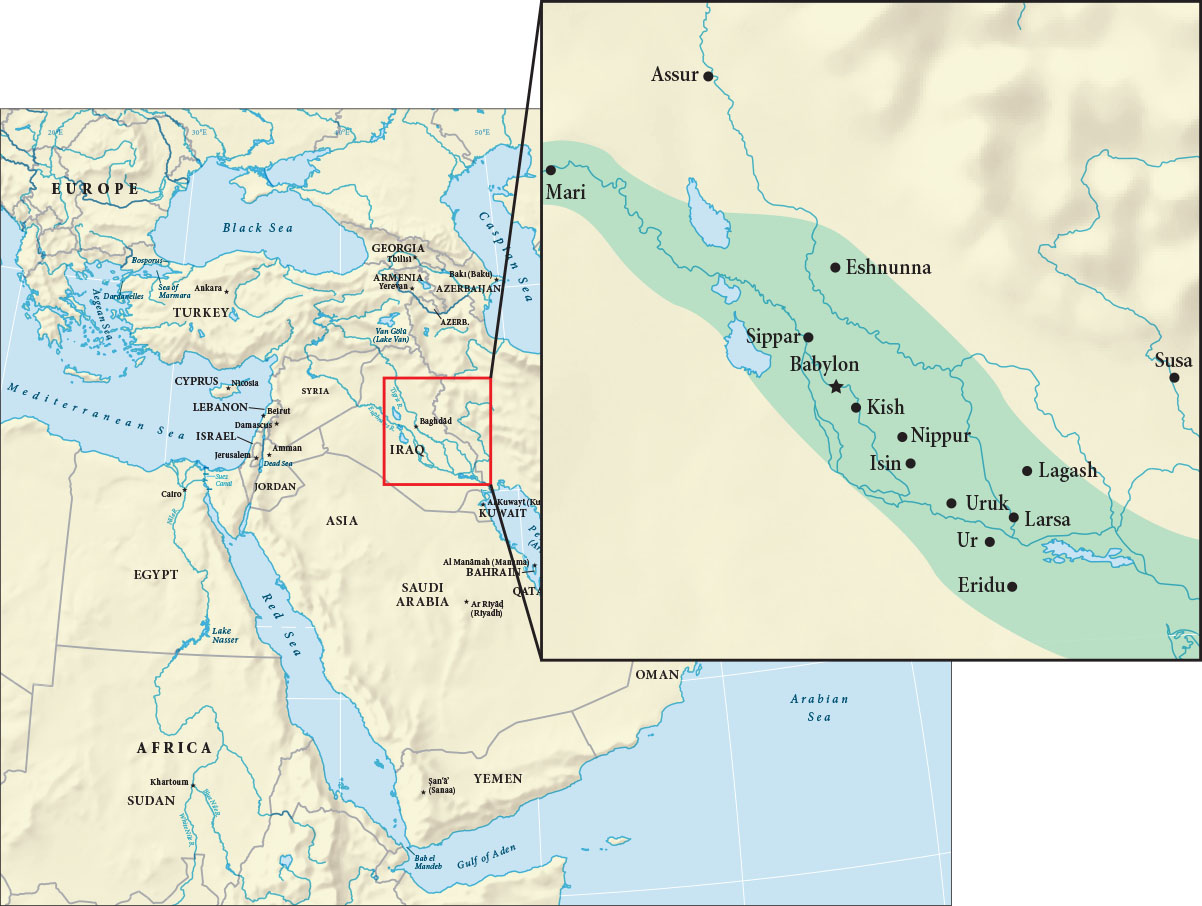
At its height during Hammurabi’s reign, the Babylonian Empire stretched from the upper reaches of the Euphrates River, not far from modern Aleppo in the north, to the Zagros Mountains in the east and the Persian Gulf in the south (Figure 4.5). But these extensive borders did not long survive the death of Hammurabi himself. Under the rule of his son Samsu-iluna, Babylon faced resistance from the Kassites of the Zagros Mountains and from a newly formed kingdom called Sealand in the marshy region near the Persian Gulf. The empire’s territorial control continued to decline until, by the reign of Samsu-ditana in the late sixteenth century BCE, all that remained was the small region around the city of Babylon itself. In this weakened state, Babylon was sacked by a new emerging power, the Hittites, and the dynasty of Hammurabi came to a definitive end.
英語のヒント
ハンムラビ治世の最盛期、バビロニア帝国は、北は現在のアレッポに近いユーフラテス上流、東はザグロス山脈、南はペルシア湾へ広がった(図4.5)。しかし、その広い領域は王の死後、長くは維持されなかった。息子サムス・イルナの治世には、ザグロスのカッシート人と、ペルシア湾近くの湿地に生まれた海の国が抵抗した。領土は減り続け、紀元前16世紀後半のサムス・ディタナの治世には、バビロン周辺の小地域しか残らなかった。弱体化したバビロンは、新たに台頭したヒッタイトに略奪され、ハンムラビの王朝は完全に終わった。
Hammurabi’s Realm.ハンムラビの領域。
(attribution: Copyright Rice University, OpenStax, under CC BY 4.0 license) · CC BY 4.0
Figure 4.5 Under Hammurabi, the Babylonians expanded out of Babylon to conquer much of Mesopotamia and construct an empire in the region, shown here in green. (attribution: Copyright Rice University, OpenStax, under CC BY 4.0 license)
図4.5 ハンムラビの下で、バビロニア人はバビロンから拡大してメソポタミアの多くを征服し、この地域に帝国を築いた。緑色がその領域である。(出典:Rice University、OpenStax、CC BY 4.0)