第4章古代オリエントThe Near East
Persian Culture and Daily Lifeペルシアの文化と日常生活
The social order of the Persian Empire included a number of hierarchically organized groups. At the bottom were the enslaved. While the Persians did not have a long history of using slavery before becoming a major power, it was common in the regions they conquered. Over time, the Persian nobility adapted to the practice and used enslaved people to work their land.
英語のヒント
ペルシア帝国の社会秩序は、上下関係のある複数の集団から成った。最下層は奴隷だった。ペルシア人には大国になる以前、奴隷を使う長い歴史はなかったが、征服した地域では一般的だった。やがてペルシアの貴族もこの慣行を取り入れ、自分たちの土地を奴隷に耕させた。
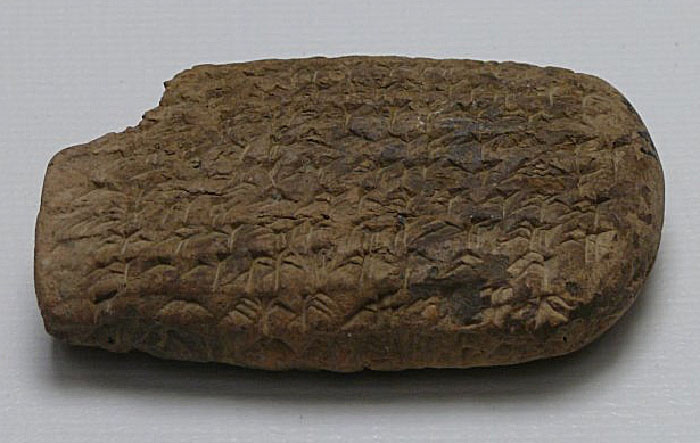
Next in the hierarchy were the free peasants, who generally worked the land and lived in the villages of the empire. On the next level were the various kinds of artisans, and higher still were the educated classes of scribes, imperial recordkeepers, and important merchants. And higher than all of these was the ruling order, including priests, nobles, and warriors (Figure 4.34).
英語のヒント
その上にいたのは自由農民で、普通は土地を耕し、帝国内の村に暮らした。次にはさまざまな職人、さらに上には、教育を受けた書記、帝国の記録官、有力な商人がいた。そしてこれらすべての上に、神官、貴族、戦士を含む支配層がいた(図4.34)。
Persian Recordkeeping.ペルシアの記録管理。
(credit: “Persepolis tablet” by “Pentocelo”/Wikimedia Commons, Public Domain) · Public Domain
Figure 4.34 Thousands of clay tablets like this one from the administrative archives at Persepolis have been key to helping historians understand the way the empire functioned and was socially organized. Like the rulers of earlier Near Eastern empires, the Persians also used cuneiform. (credit: “Persepolis tablet” by “Pentocelo”/Wikimedia Commons, Public Domain)
図4.34 ペルセポリスの行政文書庫にあった、このような数千枚の粘土板は、帝国の仕組みや社会組織を理解する鍵となってきた。以前の近東の帝国と同じく、ペルシアも楔形文字を用いた。(出典:「Pentocelo」/Wikimedia Commons「Persepolis tablet」、パブリックドメイン)
The Persian king occupied a place far above and removed from these groups. As the earthly representative of the god Ahura Mazda, he expected complete submission from everyone in the empire. Those in his presence had to position themselves on the ground to show his superiority over them. Servants who came near had to cover their mouths so as not to breathe on him. His power was absolute, though he was restrained by custom and the advice of leading nobles. One of the most important of these nobles was the “Commander of a Thousand,” who managed the large court, served as a gatekeeper to any audience with the king, and oversaw the king’s personal protection service. As was the case in the Assyrian Empire, kings were not necessarily eldest sons. Rather, the current king could select his heir and frequently chose a younger son for any number of reasons.
英語のヒント
ペルシア王は、これらの集団から遠く隔たった、はるか上の地位にあった。神アフラ・マズダの地上の代理として、帝国内のすべての人に完全な服従を求めた。御前の人々は、王の優越を示すため地面に身を低くし、近づく召使いは、息がかからないよう口を覆わねばならなかった。王の権力は絶対的だったが、慣習や有力貴族の助言による制約も受けた。最も重要な貴族の一人は「千人隊長」で、大きな宮廷を管理し、王への謁見を取り次ぎ、王の身辺警護を監督した。アッシリアと同じく、王位を継ぐのは必ずしも長男ではなかった。現王が後継者を選べ、さまざまな理由で、次男以降を選ぶことも多かった。
The Persian king and his court seem not to have remained in one centralized capital. Rather, they moved periodically between the cities and regions of Babylon, Susa, Rhagae, Parthia, Ecbatana, Persepolis, and possibly others. One motive was a desire to avoid extreme weather during certain seasons, but there were also political considerations. For example, by moving across the countryside, the king made himself visible not only to important individuals in the cities but also to the many peasants in the villages that dotted the landscape. Thus, he allowed them opportunities to present him with petitions or seek his guidance.
英語のヒント
王と宮廷は、一つの中心的な首都にとどまらなかったようである。バビロン、スサ、ラガエ、パルティア、エクバタナ、ペルセポリスなどの都市や地域を、定期的に移動した。季節による厳しい気候を避ける目的もあったが、政治的な配慮もあった。各地を回ることで、王は都市の有力者だけでなく、点在する村の多くの農民にも姿を見せた。人々は王へ請願を出したり、判断を求めたりする機会を得た。
Moving the court in this way was no easy feat, however. It required the efforts of thousands of people including officials, soldiers, religious leaders, wives, other women, and servants of all types, and the transport of horses, chariots, religious objects, treasure, and military equipment. In many ways, it was as though the state itself migrated with the seasons. The arrival of this migrating state in any major location was met with elaborate public ceremonies of greeting and welcome. Some contemporary descriptions detail how flowers and incense were laid along the city roads where the king moved. His dramatic entry was followed by the proper sacrifices to the local gods and an opportunity for the people to bring gifts to the king, such as exotic animals, jewels, precious metals, food, and wine. It was considered a great honor to present the king with a gift, and the gift-giving ceremonies served to strengthen the king’s relationship with his subjects.
英語のヒント
ただし宮廷を移動させるのは、容易ではなかった。役人、兵士、宗教指導者、妻たち、他の女性、各種の召使いなど、何千人もの働きが必要で、馬、戦車、祭具、財宝、軍装備も運んだ。多くの点で、国家そのものが季節とともに移動するかのようだった。移動する国家が主要な場所へ着くと、手の込んだ公共の歓迎儀礼で迎えられた。当時の記述には、王の通る道に花や香が置かれる様子もある。華々しい入城の後、現地の神々へ適切な犠牲を捧げ、人々が珍しい動物、宝石、貴金属、食物、酒などを献上する機会が設けられた。王への贈物は大きな名誉とされ、贈答儀礼は王と臣民の関係を強めた。
The vast army of Persia had its own ceremonies and customs. Herodotus records that it was made up of a great number of subject peoples from around the empire, all with their own colorful uniforms. Military training began at a very young age and included lessons in archery, horseback combat, and hand-to-hand combat. The most talented of the infantrymen in the Persian army might hope to rise to the ranks of the Immortals, an elite, heavy-infantry combat force that served both in war and in the king’s personal guard. The larger army was made up of various units of infantry, archers, and cavalry. The largest unit was the corps, made up of ten thousand men. Each corps had a commanding officer who answered to the supreme commander. In battle, the archers would rapidly fire their arrows into the enemy as the cavalry and infantry advanced in their respective formations. Occasionally, when rebellions were put down or new territories added, the Persians deported the conquered populations elsewhere within the empire.
英語のヒント
ペルシアの大軍にも、独自の儀礼と慣習があった。ヘロドトスによれば、帝国各地の多くの被支配民から成り、それぞれ色鮮やかな制服を持った。軍事訓練は幼い頃から始まり、弓術、騎馬戦、白兵戦を学んだ。特に優秀な歩兵は、戦場と王の親衛隊の双方で働く、精鋭重装歩兵「不死隊」に昇進できる可能性があった。軍全体は歩兵、弓兵、騎兵の各部隊で構成され、最大単位は1万人の軍団だった。各軍団の指揮官は最高司令官に直属した。戦闘では、騎兵と歩兵がそれぞれの隊形で前進する間、弓兵が敵へ次々と矢を放った。反乱を鎮圧したり領土を加えたりした際には、征服地の住民を帝国内の他地域へ移すこともあった。
Because most records from the Persian Empire focus on kings, wars, the military, and high-level officials and bureaucrats, we know little about commoners. But we know that most ordinary Persians had diets of bread or mash made of barley, supplemented by figs, dates, plums, apples, almonds, and other fruits and nuts. Much more rarely, meals might also include goat, mutton, or poultry. Besides the military, the empire supported a host of other necessary occupations, such as sentinels, messengers, various types of attendants, architects, merchants, and numerous types of lower professions. The many agricultural workers grew traditional crops of the Near East, like wheat and barley, in addition to rice (brought from India) and alfalfa (for horse feed). Merchants in the Persian Empire benefited greatly from the stability created by the government and the extensive network of crisscrossing roads that connected the far-flung regions. Although long-distance trade was prohibitively expensive for most things except luxury goods, trade across short distances was apparently common.
英語のヒント
記録の多くが王、戦争、軍、高官に集中するため、庶民についてはあまりわからない。ただし、普通のペルシア人の大半は、大麦のパンや粥を食べ、イチジク、ナツメヤシ、スモモ、リンゴ、アーモンドなどの果物や木の実を補っていた。ヤギ、羊、家禽の肉は、ずっとまれだった。軍以外にも、帝国には歩哨、伝令、各種の従者、建築家、商人、身分の低いさまざまな職業が必要だった。農業従事者は、近東伝統の小麦・大麦のほか、インドから伝わった米や、馬の飼料となるアルファルファを育てた。商人は、政府が作る安定と、遠い地域を結ぶ道路網から大きな利益を得た。長距離交易は、ぜいたく品以外の大半には費用が高すぎたが、近距離交易は広く行われていたらしい。
The religion of the Persians was a tradition we describe today as Zoroastrianism. Its name comes from Zoroaster, the Greek pronunciation of the name of its founder, Zarathustra. Scholars today believe that Zoroaster likely lived at some point between 1400 and 900 BCE and was almost certainly a Persian priest, prophet, or both. His followers likely practiced a polytheistic religion similar in many ways to the Vedic traditions held by Indo-European speakers who migrated into India. Among Zoroastrians’ many gods were both powerful heavenly deities and more terrestrial nature gods. Ceremonies included various rituals similar to those of other polytheistic religions, such as the sacrifice of animals on outdoor altars.
英語のヒント
ペルシア人の宗教は、今日ゾロアスター教と呼ぶ伝統だった。名は、創始者ザラスシュトラの名をギリシア語で発音したゾロアスターに由来する。現在の研究者は、紀元前1400~900年のどこかに生き、おそらくペルシアの祭司か預言者、またはその両方だったと考える。その信奉者たちは、インドへ移ったインド・ヨーロッパ語系話者のヴェーダの伝統に、多くの点で似た多神教を実践したとみられる。神々には強力な天界の神と、より地上的な自然の神がいた。屋外の祭壇で動物を犠牲にするなど、他の多神教に似た儀礼を行った。
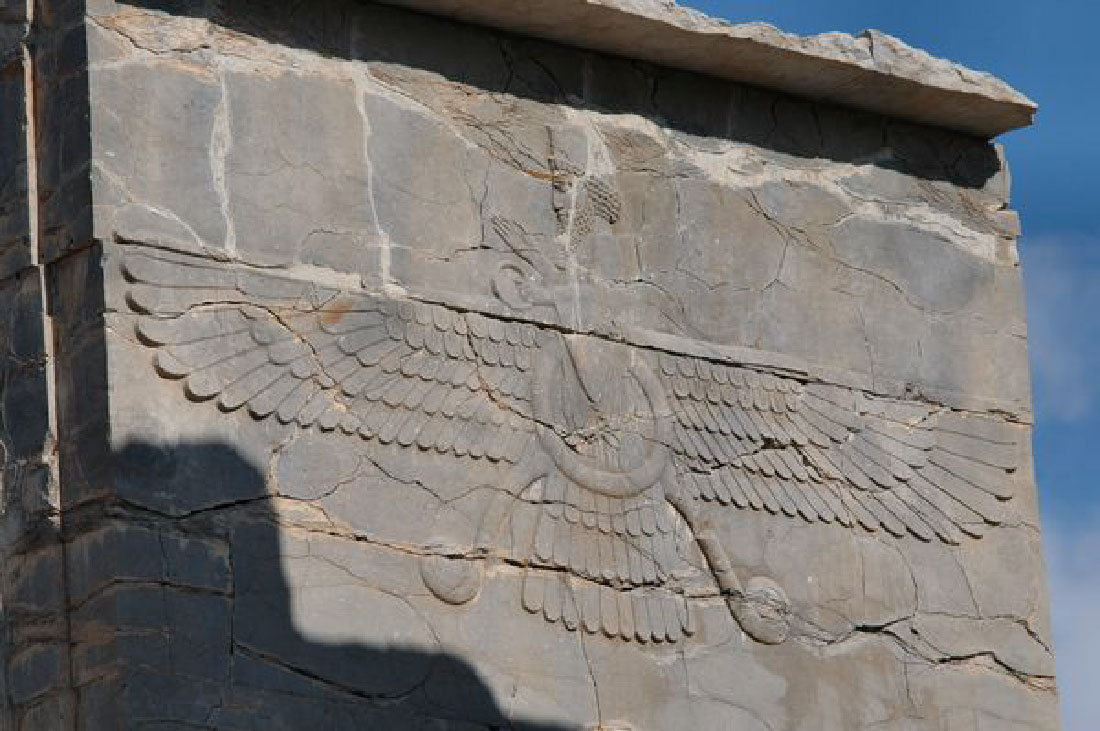
Zoroaster appears to have emphasized the perpetual conflict between the forces of justice and those of wickedness. Over time, he developed supernatural personifications of these forces: Ahura Mazda was the lord of wisdom and the force of good (Figure 4.35), and Angra Mainu was the destructive spirit and the force of evil. Each was supported by lesser supernatural beings. On the side of Ahura Mazda were the ahuras who worked to bring good to the world, and on the side of Angra Mainu were the daevas who served the interests of evil.
英語のヒント
ゾロアスターは、正義の勢力と悪の勢力の、絶えない対立を強調したようである。やがて両勢力を超自然的な存在として人格化した。アフラ・マズダは知恵の主、善の力であり(図4.35)、アンラ・マンユは破壊の霊、悪の力だった。それぞれを、より下位の超自然的存在が支えた。アフラ・マズダの側には世界へ善をもたらすアフラたち、アンラ・マンユの側には悪に仕えるダエーワたちがいた。
Ahura Mazda.アフラ・マズダ。
(credit: “Persepolis, Tripylon, eastern gate (2)” by Marco Prins/Wikimedia Commons, CC0 1.0) · CC0 1.0
Figure 4.35 The Persian god Ahura Mazda was the principal source of good as understood by followers of Zoroastrianism, a Persian religion. This large stone carving of him adorns a gate at the ruins of Persepolis (in modern Iran). (credit: “Persepolis, Tripylon, eastern gate (2)” by Marco Prins/Wikimedia Commons, CC0 1.0)
図4.35 ペルシアの宗教ゾロアスター教の信奉者にとって、神アフラ・マズダは善の主要な源だった。現在のイランにあるペルセポリス遺跡の門を、この大きな石彫が飾る。(出典:Marco Prins/Wikimedia Commons「Persepolis, Tripylon, eastern gate (2)」、CC0 1.0)
The Persian followers of Zoroastrianism believed Ahura Mazda had created the world as an entirely good place. However, Angra Mainu was dedicated to destroying this perfection with evil, so the two forces fought for the supremacy of good or evil on Earth. The world the Persians saw around them was the product of their pitched battle. However, the fight would not last forever. At some appointed time in the future, Ahura Mazda would overcome the forces of Angra Mainu, and the followers of evil would face judgment and punishment for their crimes. It was up to humans to decide for themselves what path to follow. At the final judgment, the dead would be resurrected and made to walk through a river of fire. Those consumed by the fire were unworthy and would be condemned to torment in hell, while those who survived would live forever in a paradise with no evil.
英語のヒント
ペルシアのゾロアスター教徒は、アフラ・マズダが完全に善なる世界を創造したと信じた。しかしアンラ・マンユが悪によってその完全さを壊そうとするため、両者は地上で善悪どちらが優勢となるかを争った。目の前の世界は、その激しい戦いの結果だった。戦いは永遠には続かない。未来の定められた時、アフラ・マズダは悪の勢力を破り、悪に従った者は罪への裁きと罰を受ける。どちらの道を選ぶかは、人間自身に任されていた。最後の審判で死者はよみがえり、火の川を歩かされる。火にのみ込まれる者は不適格とされ、地獄の苦痛に処せられるが、生き残る者は、悪のない楽園で永遠に生きる。
While Zoroaster’s beliefs were not readily accepted by his own people, he found protection and a following among others, and in the centuries after his death, his ideas spread and changed. For example, the Medes incorporated their own priestly class into the Zoroastrian traditions. The Achaemenids borrowed artistic traditions from the Mesopotamians to depict Ahura Mazda in the same way they styled their important gods. Later, Judeans within the Persian Empire, who were from the Canaanite kingdom of Judah and followers of Judaism, incorporated many Zoroastrian ideas into their own religious traditions. These ideas went on to influence the religions of Christianity and Islam.
英語のヒント
ゾロアスターの信仰は同胞にすぐには受け入れられなかったが、他の人々から保護と支持を得た。死後数世紀にわたり、思想は広がり、変化した。たとえばメディア人は、自分たちの祭司層をゾロアスター教の伝統へ組み込んだ。アケメネス朝は、メソポタミアの主要な神々の表現法を借りて、アフラ・マズダを描いた。後に、帝国内で暮らす、カナンのユダ王国出身のユダヤ教徒は、多くのゾロアスター教の思想を自らの伝統に取り入れた。これらはさらに、キリスト教とイスラームにも影響した。
While the religion of the Persians was Zoroastrianism, the empire included people of different religions, including Armenians, Nubians, Libyans, Phoenicians, Egyptians, Babylonians, Ionian Greeks, Bactrians, Judeans, and many others. Indeed, it was the Persian king Cyrus II who permitted the Judeans exiled in Babylon to return to Judah and rebuild their temple. The empire expected loyalty and the payment of tribute, but its kings were not interested in transforming their diverse peoples into Persians. Instead, they developed an imperial system that supported the maintenance of a multiethnic, multilingual, and multireligious empire.
英語のヒント
ペルシア人の宗教はゾロアスター教だったが、帝国には、アルメニア人、ヌビア人、リビア人、フェニキア人、エジプト人、バビロニア人、イオニアのギリシア人、バクトリア人、ユダの人々など、さまざまな信仰を持つ住民がいた。実際、バビロンに追放されたユダの人々が帰国し、神殿を再建するのを許したのは、キュロス2世だった。帝国は忠誠と貢納を要求したが、王たちは多様な人々をペルシア人に変えようとはしなかった。多民族、多言語、多宗教の帝国を維持する制度を築いたのである。