第4章古代オリエントThe Near East
4.2 Egypt’s New Kingdom4.2 エジプトの新王国
Learning Objectives学習の目標
By the end of this section, you will be able to:
この節を学ぶと、次のことができるようになる。
Explain the causes and consequences of the Hyksos invasion
ヒクソス侵入の原因と結果を説明する。
Analyze the successes and failures of key New Kingdom pharaohs
新王国の主要なファラオの成功と失敗を分析する。
Discuss Egypt’s interaction with its neighbors via immigration and trade
移住と交易を通じた、エジプトと近隣地域の関わりを論じる。
Identify the political and religious innovations of Egypt’s New Kingdom
エジプト新王国の政治・宗教上の革新を挙げる。
During the New Kingdom period, Egyptian pharaohs reunited Upper and Lower Egypt following two centuries of foreign rule. They also ended the isolation that had been typical of the Old and Middle Kingdoms and embarked on expansionist conquests. The New Kingdom pharaohs were among the greatest warriors and builders in Egyptian history. As a result of their conquests, trade flourished with the Near East and other areas, and significant advances took place in the arts.
英語のヒント
新王国時代、エジプトのファラオは、2世紀の異民族支配を経て、上・下エジプトを再統一した。また、古王国と中王国に典型的だった孤立状態を終わらせ、拡張を目指す征服に乗り出した。新王国のファラオには、エジプト史上でも屈指の戦士、建設者がいた。征服の結果、近東などとの交易が栄え、美術でも大きな進歩が起きた。
The Hyksos in Egyptエジプトのヒクソス
As centralized power in Egypt declined during the late Middle Kingdom, Egyptians were less able to enforce their borders and preserve their state’s integrity. The result was that Semitic-speaking immigrants from Canaan flowed into the Nile delta. It is not entirely clear to historians what prompted these Hyksos to leave Canaan, but some suspect they were driven into Egypt by foreign invasion of their land. Others suggest the early Hyksos may have been traders who settled in Egypt and later brought their extended families and others. However it happened, by about 1720 BCE, they were so numerous in Lower Egypt that some of their chieftains began to assert control over many local areas. This transformation coincided with the onset of the Second Intermediate Period (c. 1720–1540 BCE) and the general collapse of centralized Egyptian rule.
英語のヒント
中王国末期に中央の権力が弱まると、エジプト人は国境を守り、国家の一体性を保つ力を失っていった。その結果、カナンからセム系言語を話す移民がナイル川デルタへ流入した。なぜこれらのヒクソスがカナンを離れたのか、歴史家にも完全にはわかっていない。外国勢力の侵入に追われてエジプトへ来たと考える研究者もいる。初期のヒクソスは商人で、エジプトに定住した後、親族や他の人々を呼び寄せたとする説もある。どの経緯であれ、紀元前1720年頃には下エジプトで人数が非常に増え、一部の首長が各地の支配権を主張し始めた。この変化は、第2中間期(紀元前1720~1540年頃)の始まりと、エジプトの中央集権支配の全般的な崩壊に重なった。
Over the next several decades, many more Canaanite migrants made their way across the Sinai and into Lower Egypt. During this period, several Egyptian princes held onto power despite the changes occurring around them. Then, around 1650 BCE, one group of recently arrived Canaanites challenged the remaining princes, overthrew them, and assumed control of the entire delta, inaugurating an important new period in Egyptian history.
英語のヒント
続く数十年、多くのカナン人がシナイ半島を越え、下エジプトへ移ってきた。この間、周囲が変わっても、何人かのエジプトの諸侯は権力を保持した。紀元前1650年頃、新たに到来したカナン人の一集団が残る諸侯に挑み、彼らを倒してデルタ全体を支配した。こうしてエジプト史の重要な新時代が始まった。
These Canaanites are often referred to as the Hyksos. While that name is a much later Greek corruption of the Egyptian hekau khasut, meaning “chieftains of foreign lands,” it has stuck. The Hyksos ruled the delta for more than a century, from approximately 1650 to 1540 BCE. After they had been defeated, Egyptian tradition described their rule as one of wanton destruction, including the enslavement of Egyptians, the burning of cities, and the desecration of shrines. However, these descriptions are almost certainly rooted more in later New Kingdom propaganda than in reality. Like many others who came to Egypt, the Hyksos readily adopted Egyptian culture, art, language, writing, and religion. They established their own dynasty but relied on Egyptian patterns of rule and even included Egyptians in their bureaucracies.
英語のヒント
これらのカナン人は、一般にヒクソスと呼ばれる。「異国の首長」を意味するエジプト語ヘカウ・カスウトが、ずっと後にギリシア語で転訛した名称だが、それが定着した。ヒクソスは紀元前1650~1540年頃、1世紀以上デルタを支配した。彼らが敗れた後、エジプトの伝承では、その支配は、エジプト人の奴隷化、都市の焼却、聖所の冒瀆など、むやみな破壊の時代として描かれた。しかしこの描写は、現実よりも、後の新王国の宣伝に根差すと考えてほぼ間違いない。エジプトへ来た多くの人々と同じく、ヒクソスはエジプトの文化、美術、言語、文字、宗教を進んで取り入れた。独自の王朝を築いたが、統治はエジプトの方式に依拠し、官僚組織にはエジプト人も加えた。
Hyksos rule appears to have benefited Egypt in a number of ways. It was likely the Hyksos who brought sophisticated bronze-making technology into Egypt from Canaan, for example. The advantages of bronze over softer materials like copper were obvious to Egyptians, and the metal soon became the material of choice for weapons, armor, and other tools where hardness was desired. The Hyksos also introduced composite-bow technology (which made archery faster and more accurate), new types of protective armor, and most importantly, the horse-drawn, lighter-weight chariot with spoked wheels. They may have brought the horse itself to Egypt in this period, but we do not know for sure. The chariot, however, was an especially important arrival. By the 1500s BCE, horse-drawn chariots with riders armed with powerful and highly accurate composite bows had become a staple of Egyptian militaries, just as they were across all the powerful empires and kingdoms of the Near East.
英語のヒント
ヒクソスの支配は、いくつもの点でエジプトに利益をもたらしたように見える。たとえば、高度な青銅製作技術をカナンから伝えたのは、おそらくヒクソスだった。銅などの軟らかい材料より青銅が優れることは明らかで、武器、鎧、硬さが必要な道具には、まもなく青銅が好まれるようになった。ヒクソスは、射撃を速く正確にする複合弓、新しい防具、とりわけ重要な、輻のある車輪を備えた軽量の馬引き戦車も伝えた。この時期に馬そのものをエジプトへ持ち込んだ可能性もあるが、確かなことはわからない。戦車が重要な新来物だったことは確かである。紀元前1500年代までに、強力で精度の高い複合弓を持つ兵士の乗った馬引き戦車は、近東の他の強国と同様、エジプト軍でも欠かせない存在になっていた。
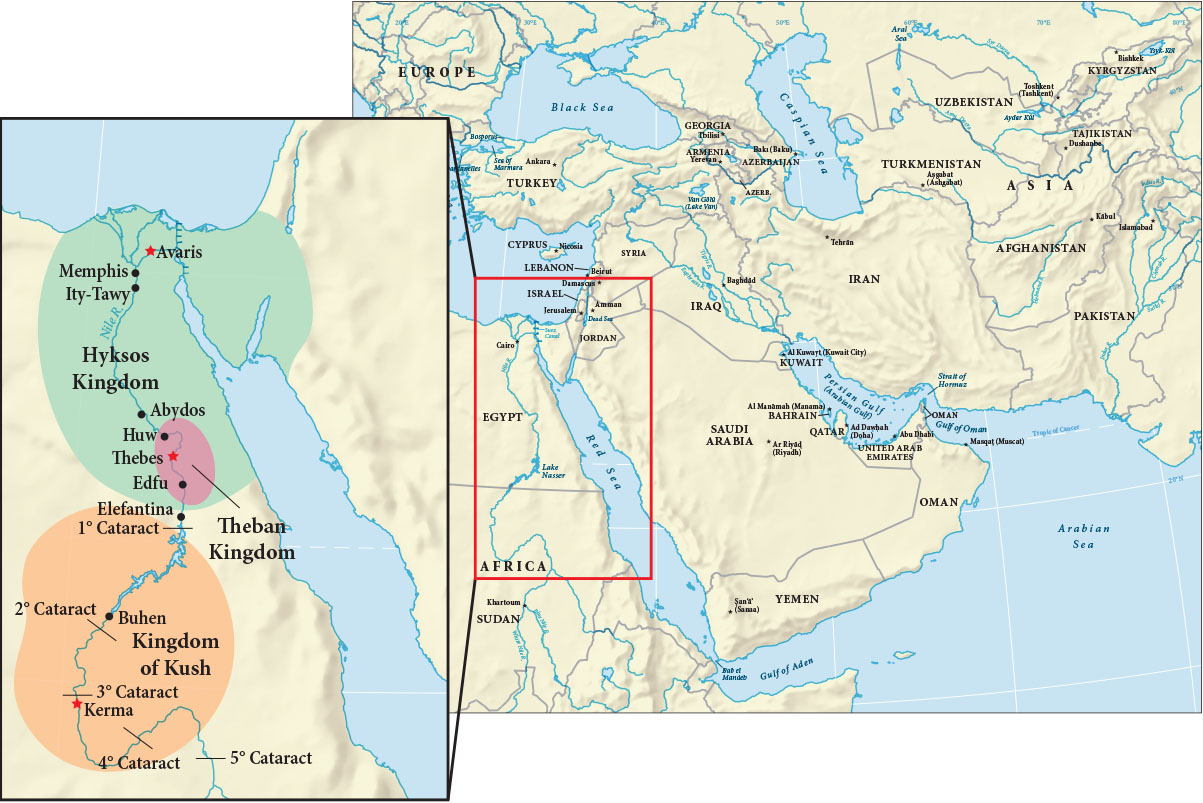
During this Second Intermediate Period, the once-vast domains of Middle Kingdom Egypt were effectively divided into three parts: the Hyksos kingdom in Lower Egypt (nearest the Mediterranean), the kingdom of Kush far upriver beyond the first cataract (an area of shallow rapids), and the Theban kingdom of Upper Egypt (Figure 4.18). Occupying all of Lower Egypt, the Hyksos kingdom had access to Canaan and by extension to the rest of the Near East. Inscriptions and archaeological evidence attest to a considerable flow of trade between Lower Egypt and the Canaanites in Palestine and Syria, though the extent of the Hyksos’ political power beyond Egypt was likely limited to a few city-states in Palestine, if that.
英語のヒント
この第2中間期、かつて広大だった中王国の領域は、事実上3つに分かれた。地中海に近い下エジプトのヒクソス王国、第1急湍(浅い急流地帯)よりもはるか上流のクシュ王国、そして上エジプトのテーベ王国である(図4.18)。下エジプト全体を占めたヒクソス王国は、カナンを経て、その先の近東各地へ通じていた。碑文と考古資料は、下エジプトと、パレスチナ・シリアのカナン人との間で、かなりの交易があったことを示す。ただし、エジプト国外でヒクソスの政治力が及んだのは、せいぜいパレスチナの少数の都市国家だったらしく、そこまで届かなかった可能性もある。
Three Kingdoms in Egypt.エジプトの3王国。
(attribution: Copyright Rice University, OpenStax, under CC BY 4.0 license) · CC BY 4.0
Figure 4.18 During the Second Intermediate Period, Egypt was effectively divided into three kingdoms, those of the Hyksos, the Kush, and the Thebans. (attribution: Copyright Rice University, OpenStax, under CC BY 4.0 license)
図4.18 第2中間期、エジプトは事実上、ヒクソス、クシュ、テーベの3王国に分かれていた。(出典:© Rice University, OpenStax、CC BY 4.0)
In the Theban kingdom, centered on the city of Thebes, indigenous Egyptian rulers still held sway. It is possible that in the early years of their rule in Lower Egypt, the Hyksos were able to exert some indirect control over Thebes, but distance made direct rule nearly impossible. Still, the connections between the two kingdoms continued, perhaps with some intermarrying.
英語のヒント
テーベ市を中心とする王国では、在来のエジプト人支配者が、なお権力を握っていた。下エジプト支配の初期、ヒクソスがテーベにも間接的な支配を及ぼせた可能性はあるが、距離があるため直接支配はほぼ不可能だった。それでも両王国のつながりは続き、婚姻関係を結ぶこともあったかもしれない。
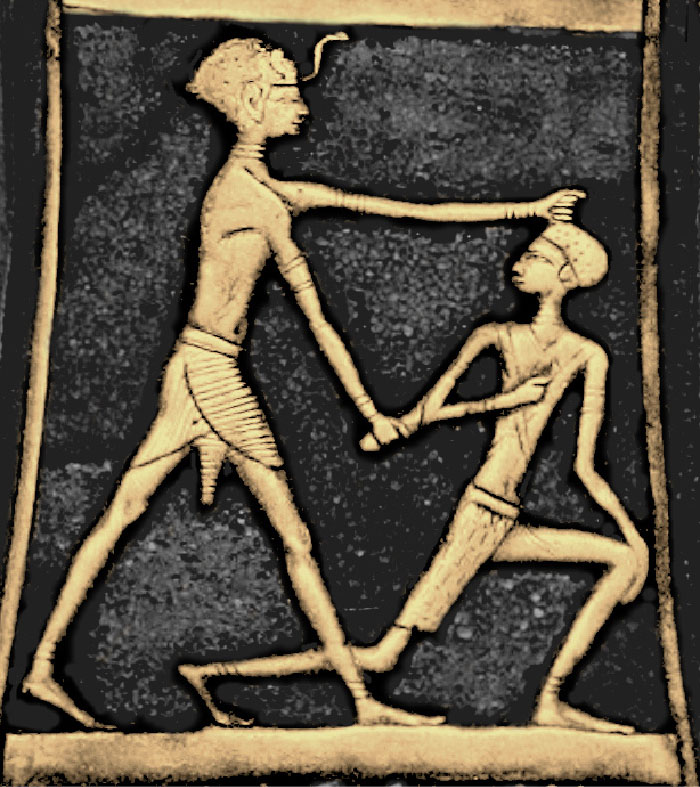
The Theban kings resisted Hyksos control of Lower Egypt. However, an alliance between the Hyksos and the kingdom of Kush in the far south made any effort to oust the Hyksos extremely risky. It was only beginning in the 1550s BCE that a string of Theban Egyptian rulers were able to go on the offensive against the Hyksos. After multiple failed attempts, these rulers eventually succeeded in capturing large portions of Hyksos territory and bringing the fight to the edges of Avaris, the capital of Hyksos Egypt. By approximately 1540 BCE, Pharaoh Ahmose I had broken the defenses around Avaris, destroyed the Hyksos kingdom, and reasserted Egyptian power in Lower Egypt (Figure 4.19). He then turned his attention south to Kush and east to Palestine, extending Egyptian control over these regions as well. His reign ushered in a new period of Egyptian greatness called the New Kingdom.
英語のヒント
テーベの王たちは、ヒクソスによる下エジプト支配に抵抗した。しかしヒクソスと南方のクシュ王国が同盟していたため、ヒクソスを追い出そうとする試みは、どれも極めて危険だった。歴代のテーベ王が攻勢に出られるようになったのは、紀元前1550年代に入ってからだった。何度もの失敗の後、王たちはヒクソス領の大部分を奪い、首都アヴァリスの周縁まで攻め込んだ。紀元前1540年頃までに、ファラオのアハモセ1世がアヴァリスの防御を破り、ヒクソス王国を滅ぼし、下エジプトのエジプト人支配を回復した(図4.19)。続いて南のクシュ、東のパレスチナにも支配を広げた。その治世は、新王国と呼ばれるエジプトの新しい繁栄期を開いた。
Ahmose I.アハモセ1世。
(credit: “Pharaoh Ahmose I slaying a Hyksos (axe of Ahmose I, from the Treasure of Queen Aahhotep II) Colorized per source” by Georges Émile Jules Daressy/Annales du Service des Antiquités de l’Égypte /Wikimedia Commons, Public Domain) · Public Domain
Figure 4.19 This colorized image of a decorative feature on the blade of a ceremonial Egyptian axe shows Pharaoh Ahmose I killing a Hyksos. Ahmose’s military victories ushered in Egypt’s New Kingdom period. (credit: “Pharaoh Ahmose I slaying a Hyksos (axe of Ahmose I, from the Treasure of Queen Aahhotep II) Colorized per source” by Georges Émile Jules Daressy/Annales du Service des Antiquités de l’Égypte /Wikimedia Commons, Public Domain)
図4.19 エジプトの儀式用斧の刃の装飾を着色した画像。アハモセ1世がヒクソス人を殺す場面を描く。アハモセの軍事的勝利は、エジプト新王国時代を開いた。(出典:Georges Émile Jules Daressy/Annales du Service des Antiquités de l’Égypte/Wikimedia Commons「Pharaoh Ahmose I slaying a Hyksos (axe of Ahmose I, from the Treasure of Queen Aahhotep II) Colorized per source」、パブリックドメイン)