第4章古代オリエントThe Near East
4.3 The Persian Empire4.3 ペルシア帝国
Learning Objectives学習の目標
By the end of this section, you will be able to:
この節を学ぶと、次のことができるようになる。
Discuss the history of Persia through the reign of Darius I
ダレイオス1世の治世までのペルシアの歴史を論じる。
Describe the origin and tenets of Zoroastrianism
ゾロアスター教の起源と教義を説明する。
Identify the achievements and innovations of the Persian Empire
ペルシア帝国の成果と革新を挙げる。
In conquering Mesopotamia, Syria, Canaan, and Egypt, the Neo-Assyrians created the largest empire the Near East had ever seen. Their dominance did not last, however, because Babylonia and Media destroyed the empire and carved up the spoils. But this proved to be a transitional period that set the stage for an empire that dwarfed even that of the Neo-Assyrians. Emerging from the area to the east of Mesopotamia, the founders of the Persian Empire proved to be both excellent warriors and efficient imperial organizers. Their kings commanded power, wealth, and authority over an area stretching from the Indus River to the Nile. Governors stationed in the many conquered regions served as extensions of the king’s authority, and trade flowed along a large network of roads under Persian military protection. For two centuries, Persia was the undisputed superpower of the ancient world.
英語のヒント
新アッシリアはメソポタミア、シリア、カナン、エジプトを征服し、近東でそれまで最大の帝国を築いた。しかしバビロニアとメディアが帝国を滅ぼし、その領土を分けたため、覇権は長続きしなかった。これは、新アッシリアさえ小さく見えるほどの帝国が生まれる、過渡期となった。メソポタミアの東から現れたペルシア帝国の創始者たちは、優れた戦士であるとともに、有能な帝国の組織者でもあった。王たちは、インダス川からナイル川までの地域で、力、富、権威を握った。征服地に置かれた総督は王権の延長として働き、交易はペルシア軍の保護のもと、広い道路網を通って流れた。2世紀の間、ペルシアは古代世界で並ぶもののない超大国だった。
The Rise of Persiaペルシアの興隆
The origins of the Persians are murky and stretch back to the arrival of nomadic Indo-European speakers in the Near East, possibly as early as 2000 BCE. Those who reached Persia (modern Iran) are often described as Indo-Iranians or Indo-Aryans. They were generally pastoralists, relying on animal husbandry, living a mostly migratory life, and using the horse-drawn chariot. The extent to which they displaced or blended with existing groups in the region is not clear. From written records of the rise of the Neo-Assyrian Empire during the ninth century BCE, we know the Assyrians conducted military campaigns against and exacted tribute from an Indo-Iranian group called the Persians. The Persians lived in the southern reaches of the Zagros Mountains and along the Persian Gulf, in general proximity to the Medes with whom they shared many cultural traits.
英語のヒント
ペルシア人の起源ははっきりしない。おそらく紀元前2000年にまでさかのぼる、インド・ヨーロッパ語系の言語を話す遊牧民の近東への到来につながる。ペルシア(現在のイラン)に達した人々は、インド・イラン人、またはインド・アーリア人と呼ばれることが多い。一般に牧畜に頼り、移動の多い暮らしを送り、馬引き戦車を使った。先住集団をどこまで置き換え、どこまで融合したのかは明らかでない。紀元前9世紀の新アッシリア興隆期の記録からは、アッシリアがペルシア人と呼ばれるインド・イラン系集団を攻撃し、貢納を取り立てたことがわかる。ペルシア人はザグロス山脈南部とペルシア湾沿いに暮らし、近くのメディア人とは、多くの文化的特徴を共有していた。
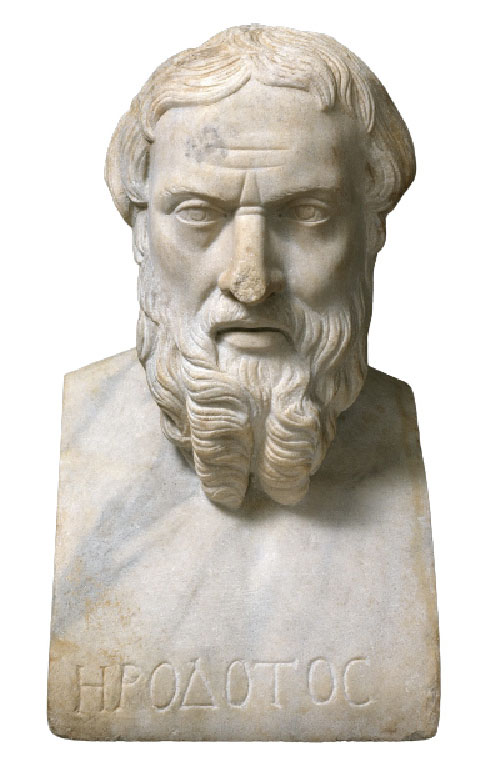
Much of what we know about the early Persians comes from the work of the ancient Greek historian Herodotus, who was born about 484 BCE (Figure 4.28). According to Herodotus, Persia was made a vassal of Media in the seventh century BCE but freed itself in the sixth century BCE under the leadership of Cyrus II, also called Cyrus the Great. Inscriptions from the period suggest that Cyrus was likely a member of the Persian royal family, the Achaemenid dynasty. Once in power, he reorganized the Persian state and its military to mirror those of the Median Empire. This step included creating divisions for cavalry, archers, and infantry and setting up special training for the cavalry. Then, in 550 BCE, just a few years into his reign, Cyrus sent his military to challenge the Medes, whereupon the Median troops revolted, handed over their king, and accepted Cyrus’s rule. He then proceeded to integrate the Median elite and officials into his own government. The Median domains had become the Persian Empire.
英語のヒント
初期ペルシアについてわかることの多くは、紀元前484年頃生まれのギリシアの歴史家ヘロドトスの著作に由来する(図4.28)。彼によれば、ペルシアは紀元前7世紀にメディアの属国となったが、紀元前6世紀、キュロス大王とも呼ばれるキュロス2世のもとで独立した。当時の碑文は、キュロスがペルシア王家、アケメネス朝の一員だった可能性を示す。権力を握ると、メディア帝国を手本に国家と軍を再編した。騎兵、弓兵、歩兵の部隊を作り、騎兵の特別訓練も設けた。即位から数年後の紀元前550年、メディアへ軍を送ると、メディア軍が反乱し、自国の王を引き渡してキュロスの支配を受け入れた。キュロスは、メディアのエリートや官僚を自分の政府へ組み込んだ。メディアの領土は、ペルシア帝国となった。
Herodotus.ヘロドトス。
(credit: “Marble bust of Herodotos” by The Metropolitan Museum of Art, Gift of George F. Baker, 1891/Wikimedia Commons, Public Domain) · Public Domain
Figure 4.28 The ancient Greek historian Herodotus is one of our major sources for information about the Persian Empire. This roughly life-sized stone bust of him is a second-century Roman copy of a fourth-century BCE bronze statue. (credit: “Marble bust of Herodotos” by The Metropolitan Museum of Art, Gift of George F. Baker, 1891/Wikimedia Commons, Public Domain)
図4.28 古代ギリシアの歴史家ヘロドトスは、ペルシア帝国についての主要な情報源の一つである。このほぼ等身大の石の胸像は、紀元前4世紀の青銅像を、ローマ時代の2世紀に複製したもの。(出典:メトロポリタン美術館、George F. Baker寄贈、1891年/Wikimedia Commons「Marble bust of Herodotos」、パブリックドメイン)
Between 550 and 539 BCE, Cyrus sent his armies east and west to expand his recently acquired realm. In 539 BCE, he turned his attention to the Neo-Babylonian Empire, defeating its armies and marching into Babylon. His Persian Empire now incorporated the territories controlled by Babylonia, including Mesopotamia, Syria, Phoenicia, and Judah, and had become the largest empire to have existed in the Near East to that point. Organizing and administering this massive domain required the use of governors, whom Cyrus generally selected from local areas, a prudent move in a world where rebellions were common.
英語のヒント
紀元前550~539年、キュロスは軍を東西へ送り、獲得したばかりの王国を広げた。紀元前539年には新バビロニア帝国へ向かい、軍を破ってバビロンに入城した。ペルシア帝国は、メソポタミア、シリア、フェニキア、ユダなど、バビロニアの支配地を取り込み、近東史上最大の帝国となった。この広大な領域の組織と統治には総督が必要で、キュロスは通常、現地の人から選んだ。反乱の多い世界では、賢明な措置だった。
Cyrus died in in battle in 530 BCE, leaving the throne and empire to his son Cambyses II. The first task for Cambyses was to continue preparing for the invasion of Egypt his father had planned. A large fleet was built in the Mediterranean and a massive land force assembled for crossing the Sinai. The invasion began in 525 BCE. The defending Egyptians were soon overwhelmed, and the pharaoh retreated up the Nile but was captured. Having now added Egypt to his already large empire, Cambyses took on the role of pharaoh, adopting the proper titles and caring for the Egyptian religious institutions. This practice of respecting local traditions was a common feature of Persian expansion and helped to win support in newly acquired areas.
英語のヒント
紀元前530年、キュロスは戦死し、王位と帝国を息子カンビュセス2世に残した。息子の最初の仕事は、父が計画したエジプト侵攻の準備を続けることだった。地中海に大艦隊を造り、シナイを越える大陸軍を集めた。紀元前525年に侵攻が始まると、エジプト軍はまもなく圧倒され、ファラオはナイル上流へ退いたものの捕らえられた。すでに広大だった帝国にエジプトを加えたカンビュセスは、ファラオの役割を引き受け、適切な称号を用い、エジプトの宗教施設を保護した。こうした現地の伝統への尊重は、ペルシアの拡張に共通し、新征服地の支持を得るのに役立った。
Under Cambyses II, the Persian Empire stretched from the edges of India to the shores of the Aral Sea, the Aegean coast of Anatolia, and the Nile River and included everything in between. Then, just as Cambyses was reaching the height of his power, a Persian revolt broke out in 522 BCE in support of his brother Bardiya. On his way to put down the rebellion, Cambyses II died, leaving the future of the empire uncertain but allowing for the rise of possibly Persia’s most famous and powerful leader, Darius I.
英語のヒント
カンビュセス2世のもとで、ペルシア帝国はインドの端からアラル海岸、アナトリアのエーゲ海岸、ナイル川まで、その間の全域に広がった。しかし権力の頂点に近づいたちょうどその時、紀元前522年に、弟バルディヤを支持する反乱が起きた。鎮圧へ向かう途中でカンビュセス2世は亡くなり、帝国の将来は不透明になった。同時に、おそらくペルシアで最も有名かつ強力な指導者、ダレイオス1世が台頭する道が開かれた。