第4章古代オリエントThe Near East
Daily Life and the Family in the Near East近東の日常生活と家族
The ability to purchase luxury trade items was the privilege of the elites, who were also treated differently under the law. Hammurabi’s Code, the list of judicial decisions issued by Hammurabi and inscribed on stone pillars erected throughout his kingdom, identified three social classes during the Old Babylonian period: nobles (awelum), commoners (mushkenum), and the enslaved (wardum). These classes were not fixed but were important for understanding how individuals were treated under the law. For example, if a commoner put out the eye or broke the bone of a noble, the noble was empowered to do the same to the offending commoner. However, a noble who injured a commoner could expect to merely pay a fine.
英語のヒント
交易で運ばれるぜいたく品を買えるのは、エリートの特権だった。彼らは法の下でも異なる扱いを受けた。ハンムラビが下した裁判上の判断を列挙し、王国各地に建てた石柱に刻んだハンムラビ法典は、古バビロニア時代の社会を、上層自由人(アウィルム)、一般自由人(ムシュケーヌム)、奴隷(ワルドゥム)の3階層に分けている。これらの階層は固定的ではなかったが、法が人をどう扱うかを理解するうえで重要だった。たとえば一般自由人が上層自由人の目をつぶしたり骨を折ったりすると、被害者は加害者に同じことをする権利を認められた。しかし上層自由人が一般自由人を傷つけた場合は、罰金だけで済むと考えられた。
Social distinctions also applied in the treatment of women under the law. For example, if a husband divorced his wife because she had not given birth to sons, he was required to return her dowry and pay her a sum equal to the bride price paid upon marriage. If no bride price had been paid and the husband was a noble, he was required to pay his wife one mina of silver, the equivalent of about a year’s wage for an average worker. However, if he were a commoner, he was expected to pay only one-third of a mina of silver.
英語のヒント
法による女性の扱いにも、身分差が適用された。たとえば、妻が息子を産まなかったために夫が離婚する場合、夫は持参財を返し、結婚時に払った婚資と同額を妻へ支払う義務を負った。婚資を払っておらず、夫が上層自由人なら、銀1ミナ、平均的な労働者の約1年分の賃金に相当する額を支払う必要があった。しかし一般自由人なら、銀3分の1ミナだけでよかった。
The homes of Babylonians in this period reflected these social distinctions. Commoners’ dwellings were typically windowless and made of mud with thick walls that protected the occupants from the oppressive summer heat. Some were of baked brick with a type of plaster along the walls to keep out moisture and preserve the brick. They were very simply furnished and usually contained a set of interior stairs leading to the roof, where occupants could dry vegetables or perform religious rituals. The homes of the wealthy, by contrast, were larger structures built around a central courtyard and included several rooms for different purposes, such as kitchens, bathrooms, reception rooms, and storage rooms. They contained various types of wooden furniture, and walls were decorated with paintings of animals or even insects. Enslaved people commonly lived within the home, especially women and girls who worked as servants.
英語のヒント
この時代のバビロニア人の住居にも、身分差が表れていた。一般自由人の家は、普通は窓のない泥造りで、厚い壁が住人を厳しい夏の暑さから守った。焼成レンガで造り、湿気を防いでレンガを保護するため、壁に一種の漆喰を塗る家もあった。家具はごく簡素で、たいてい屋上へ上がる屋内階段があり、住人は屋上で野菜を干したり、宗教儀礼を行ったりできた。対照的に富裕層の家は大きく、中庭を囲んで、台所、浴室、接客室、貯蔵室など、用途別の部屋があった。さまざまな木製家具が置かれ、壁には動物や、ときには昆虫の絵が描かれた。奴隷、とりわけ召使いとして働く女性や少女は、家の中で暮らすことが多かった。
All Babylonians were expected to serve the gods, who were regarded as an aristocracy of powerful lords ruling over all. These deities tended to take human forms and express human emotions and desires such as love, hate, and envy. By the time of Hammurabi, the large pantheon included gods of Sumerian origin as well as gods introduced by other groups that had influenced Mesopotamian religious practices, such as the Akkadians and the Amorites. During Hammurabi’s dynasty, the storm god Marduk was elevated to the highest tier of the pantheon and accepted as the patron god of Babylonia. Other powerful deities included Ea (Enki) (Figure 4.11), the god of fresh waters; Sin (Nanna), the god of the moon; and Shamash (Utu), the god of the sun and justice. Each city had its own patron god and corresponding temple. Individuals worshipped their city’s patron god but also believed they had their own personal deity who offered protection in exchange for daily worship and service.
英語のヒント
バビロニア人は皆、万物を支配する強力な領主の貴族層とみなされた神々に仕えるものとされた。神々は人間の姿を取り、愛、憎しみ、ねたみといった人間的な感情や欲望を示すことが多かった。ハンムラビの時代には、多数の神々の中に、シュメール起源の神だけでなく、アッカド人やアムル人など、メソポタミアの信仰に影響を与えた集団が伝えた神も含まれていた。ハンムラビの王朝では、嵐の神マルドゥクが神々の最上位に引き上げられ、バビロニアの守護神として受け入れられた。他の有力な神には、淡水の神エア(エンキ)(図4.11)、月神シン(ナンナ)、太陽と正義の神シャマシュ(ウトゥ)がいた。都市ごとに守護神とその神殿があった。人々は自分の都市の守護神を崇拝するとともに、日々の礼拝と奉仕に応えて守ってくれる、自分個人の神もいると信じた。
The Babylonian God Ea.バビロニアの神エア。
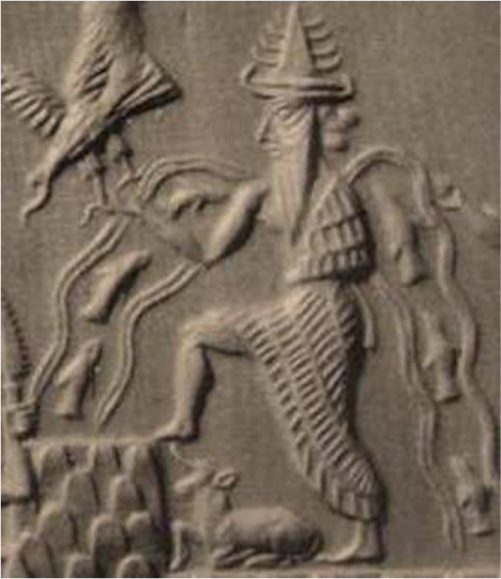
(credit: “Enki (detail of the Adda seal)” by British Museum/Wikimedia Commons, Public Domain) · Public Domain
Figure 4.11 In this detail from the Adda Seal, an ancient cylinder seal dating to approximately 2300 BCE and housed at the British Museum, the Babylonian god Ea, also known as Enki, is depicted wearing a horned helmet and surrounded by a river of flowing water. (credit: “Enki (detail of the Adda seal)” by British Museum/Wikimedia Commons, Public Domain)
図4.11 紀元前2300年頃の円筒印章「アッダの印章」の一部。大英博物館所蔵。エンキとも呼ばれるバビロニアの神エアが、角のある兜をかぶり、流れる水に囲まれている。(出典:大英博物館/Wikimedia Commons「Enki (detail of the Adda seal)」、パブリックドメイン)
The temples dedicated to the gods supported complex administrations consisting of singers, scribes, diviners, snake charmers, stone carvers, guards, exorcists, and male and female priests. Temple rituals included the carefully choreographed serving of meals for the gods accompanied by music, during which the gods were believed to consume the essence of the food provided. (Afterward, the actual food was consumed by the temple staff and the king.) The temple staff also participated in elaborate religious festivals performed in the cities, such as the New Year Festival. During these events, the divine images of the gods were carried from the temples and throughout the town in a grand procession where everyone might catch a glimpse of the deity.
英語のヒント
神々に捧げられた神殿は、歌い手、書記、占い師、蛇使い、石工、衛兵、悪霊払い、男女の神官から成る複雑な運営組織を維持していた。儀礼には、音楽に合わせて、細かく定められた手順で神々へ食事を出すものがあった。その間、神々は供物の食べ物の精を取り込むと信じられた。(その後、実物の食べ物は神殿の職員と王が食べた。)神殿の職員は、新年祭など、都市で行う手の込んだ宗教祭礼にも参加した。祭礼では神像を神殿から運び出し、市内を盛大な行列で練り歩いた。人々はそこで神の姿をひと目見ることができた。
Since Assyria was also part of the larger Mesopotamian world, there were many social and cultural similarities between the Babylonians and the Assyrians. The Assyrian population was made up of four hierarchically organized classes: the nobility, the professional class, the peasantry, and the enslaved. The nobility occupied the highest position and controlled large estates. Members of this class could expect to receive a thorough education in preparation for serving in elite positions within the empire, such as military officers, governors, and high-ranking priests. Priests were important not only as interpreters of divine will but also as points of connection between the center of political power and the rest of the empire.
英語のヒント
アッシリアも広いメソポタミア世界の一部だったため、バビロニア人とアッシリア人の間には、社会・文化上の多くの類似点があった。アッシリアの住民は、貴族、専門職層、農民層、奴隷という、上下関係を持つ4階層から成った。貴族は最高位にあり、大所領を支配した。この階層の人々は、将校、総督、高位の神官など、帝国の中枢的な地位に就く準備として、十分な教育を受けられた。神官は、神意を解釈するだけでなく、政治権力の中心と帝国の他地域を結ぶ役割も担った。
The large professional class included a host of skilled groups, from bankers and physicians to scribes and merchants. Each group maintained its own guild, which enforced high professional standards and saw to it that proper taxes were paid. The largest class, and the least well documented, was the peasantry. Most in this group were almost certainly poor farmers who worked the lands of the higher classes. At the very bottom of the social order were the enslaved, the majority of whom had been captured during war. They often worked the most dangerous jobs and had almost no rights. Those enslaved not by war but by unpaid debt had a somewhat higher status and could own property, conduct business, and even buy their way out of slavery in rare instances.
英語のヒント
大きな専門職層には、銀行業者、医師、書記、商人など、さまざまな技能集団が含まれた。各集団は独自の同業組合を持ち、高い職業上の水準を守らせ、税が適切に払われるよう取り計らった。最大でありながら、記録が最も乏しい階層は農民だった。大半は、ほぼ確実に、上位階層の土地を耕す貧しい農民だったと考えられる。社会の最下層には奴隷がおり、その多くは戦争で捕らえられた人だった。最も危険な仕事を任されることが多く、権利はほとんどなかった。戦争ではなく未払いの債務によって奴隷になった人々は、やや高い地位を持ち、財産を所有し、商売を行い、まれには金を払って奴隷身分を脱することもできた。
Above all these classes was the household of the Assyrian king. The kings of Assyria were considered viceroys of the gods, especially the chief deity Asshur. They were expected to emulate the gods through their own virtuous behavior and to act in accordance with divine omens interpreted by religious advisers. In acting on the omens, the ruler was fulfilling the dual role of defender of order against chaos and representative of humanity’s interests. When times were difficult and the gods displeased, the king might be expected to subject himself to penalties in order to calm the heavenly ire. For example, during the annual New Year Festival, the king underwent a form of ritual humiliation intended to satisfy the gods and protect his people from harm. In extreme situations, he might even need to symbolically die in order to appease the gods. In these instances, the king would step back and allow a substitute king to rule in his place for a period of weeks or months. Once that time was over, the substitute king was killed and the actual king returned to power.
英語のヒント
これらすべての階層の上に、アッシリア王の王家があった。王は神々、とりわけ主神アッシュルの代理とみなされた。徳ある行動で神々をまね、宗教上の助言者が解釈した神の前兆に従うことが求められた。前兆に従って行動することで、王は、混沌から秩序を守る者と、人間の利害を代表する者という二つの役割を果たした。困難な時期に神々が不満を抱くと、王自身が罰を受け、天の怒りを鎮めることを求められる場合があった。たとえば毎年の新年祭では、神々を満足させ、人々を災いから守るため、王は儀礼的な屈辱を受けた。極端な場合には、神々をなだめるため、象徴的に死なねばならないことさえあった。その場合、王は退き、身代わりの王が数週間から数か月、代わりに統治した。期間が終わると身代わりは殺され、本来の王が権力に戻った。
The constant wars of conquest undertaken during the Neo-Assyrian Empire necessitated a highly skilled and well-organized standing army. This army included charioteers, cavalry, archers, and wielders of slings and spears (Figure 4.12). All Assyrian men were expected to serve some period of military service. The king was the official head of the army, and his chief officials were high-ranking military officers. The Neo-Assyrian Empire was effectively a military state, and it was demonstrably efficient at expanding its territory and keeping its vassals in line.
英語のヒント
新アッシリア帝国が絶えず行った征服戦争には、高度な技能を持ち、よく組織された常備軍が必要だった。軍には戦車兵、騎兵、弓兵、投石器や槍を使う兵士がいた(図4.12)。アッシリアの男性は皆、一定期間の兵役に就くものとされた。王が正式な軍の最高指揮者で、主要な官僚も高位の軍人だった。新アッシリア帝国は事実上の軍事国家であり、領土の拡張と属国の統制に、明らかに高い効率を発揮した。
The Victorious Assyrian Army.勝利したアッシリア軍。
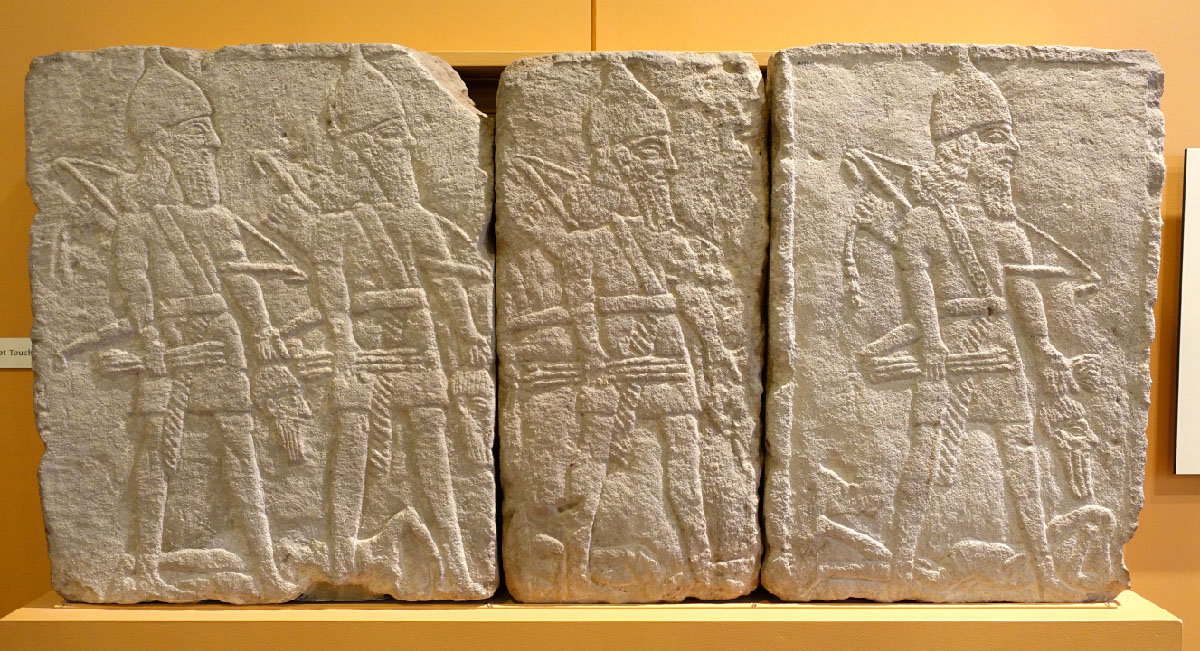
(credit: “Orthostats showing Assyrian soldiers, Tell Tayinat, Amuq Valley, Iron Age, 738 BC, limestone” by “Daderot”/Oriental Institute Museum, University of Chicago/Wikimedia Commons, CC0 1.0) · CC0 1.0
Figure 4.12 These large stone reliefs from the late eighth century BCE were carved to decorate an Assyrian palace or public building. They depict victorious Assyrian soldiers returning from battle carrying the heads of their enemies and standing on their headless bodies. (credit: “Orthostats showing Assyrian soldiers, Tell Tayinat, Amuq Valley, Iron Age, 738 BC, limestone” by “Daderot”/Oriental Institute Museum, University of Chicago/Wikimedia Commons, CC0 1.0)
図4.12 紀元前8世紀後半の大きな石造浮彫。アッシリアの宮殿または公共建築を飾るために彫られた。勝利した兵士たちが、敵の首を持って戦場から戻り、首のない遺体の上に立つ。(出典:「Daderot」/シカゴ大学オリエント研究所博物館/Wikimedia Commons「Orthostats showing Assyrian soldiers, Tell Tayinat, Amuq Valley, Iron Age, 738 BC, limestone」、CC0 1.0)
Those who defied the Assyrian war machine could expect swift and devastating consequences, including public torture and mutilation to demonstrate the price of rebellion (a response scholars have called “calculated frightfulness”). Another tactic to shut down regular or particularly difficult rebellions was the forced deportation of entire populations to other parts of the empire. The elite and skilled in a city were compelled to move to a previously depopulated region, there to be steadily assimilated into the surrounding culture until they became culturally indistinguishable from other Assyrians.
英語のヒント
アッシリアの軍事力に逆らえば、反乱の代償を示す公開の拷問や身体切断など、素早く壊滅的な報復を覚悟せねばならなかった。研究者はこの対応を「計算された恐怖」と呼んでいる。繰り返す反乱や、特に手ごわい反乱を抑えるもう一つの策は、住民全体を帝国の他地域へ強制移住させることだった。都市のエリートや技能を持つ人々は、以前に人口が失われた地域へ移され、周囲の文化へ徐々に同化し、他のアッシリア人と文化的に区別できなくなっていった。
Hittite society differed dramatically from that of the Assyrians and Babylonians. The entire empire included only a few large cities, like Hattusas, and most people lived in small rural villages or towns. With the exception of some leased acreage, village land was mostly held in common and worked by the people. Early in Hittite history, enslaved people had been relatively rare, but they became more numerous later on as the number of war captives rose. The Hittites practiced chattel slavery, meaning enslaved people were considered property and could be sold at will. They were frequently put to work in agricultural settings to free Hittite citizens for military service.
英語のヒント
ヒッタイト社会は、アッシリアやバビロニアの社会と大きく異なった。帝国全体でも、ハットゥシャのような大都市はわずかで、大半の人は小さな農村や町に住んだ。一部の貸し出された土地を除き、村の土地はほとんどが共同所有で、人々が耕した。ヒッタイト史の初期には奴隷は比較的少なかったが、後に戦争捕虜が増えるにつれて多くなった。ヒッタイトでは、奴隷を財産とみなし、所有者の意思で売却できる、動産としての奴隷制が行われた。奴隷は、ヒッタイト市民が兵役に就けるよう、農作業に回されることが多かった。
The religion of the Hittites incorporated elements from a number of different religious traditions, including that of Mesopotamia. Divination rituals, for example, were essentially Mesopotamian in origin and included studying the organs of sacrificed animals, consulting female soothsayers, and observing the movement of birds. Among the most important gods were the sun goddess Arinna and her consort the weather god Tarhunna (Figure 4.17). The former oversaw the government of the king and queen, the latter the rains and war. The king was the high priest and was responsible for performing specific rites at major religious festivals, such as the New Year Festival when gods laid out the course of events for the coming year. The people were expected to do their part by performing religious rites at cult centers, such as giving sacrificed animals and food and drink to the gods.
英語のヒント
ヒッタイトの宗教は、メソポタミアをはじめ、異なる多くの宗教伝統の要素を取り入れた。たとえば占いの儀礼は基本的にメソポタミア起源で、犠牲にした動物の臓器を調べる、女性の占い師に相談する、鳥の動きを観察する、といったものがあった。特に重要な神々には、太陽女神アリンナと、その配偶神で天候の神タルフンナがいた(図4.17)。前者は王と王妃の統治、後者は雨と戦争をつかさどった。王は最高神官であり、来年の出来事を神々が定める新年祭など、主要な宗教祭礼で所定の儀式を行う責任を負った。人々も、祭祀の中心地で犠牲獣や食べ物、飲み物を神々に捧げるなど、儀礼を行って役割を果たすものとされた。
The Hittite Weather God Tarhunna.ヒッタイトの天候神タルフンナ。
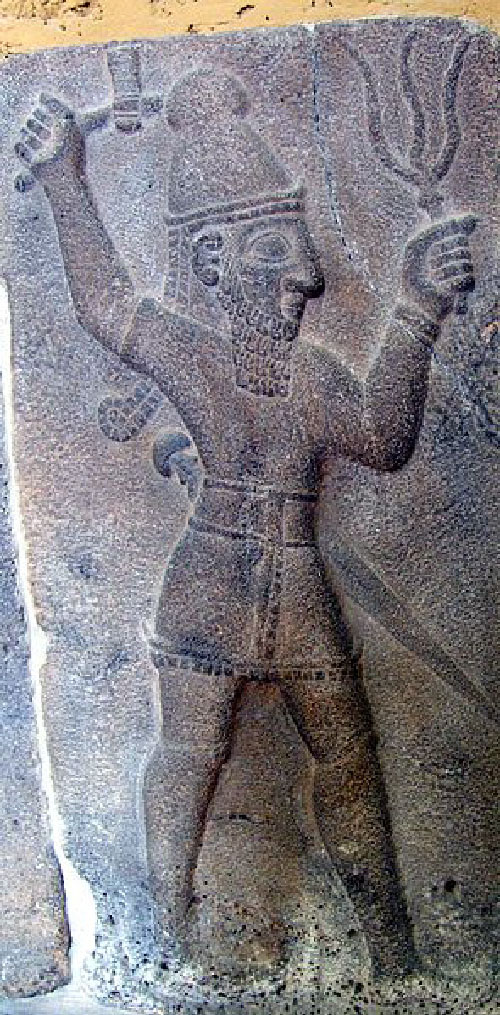
(credit: “God of Thunder. Hittite relief from Samal (now Zincirli)” by “Maur”/Pergamonmuseum/Wikimedia Commons, Public Domain) · Public Domain
Figure 4.17 This stone relief made between the tenth and eighth centuries BCE depicts the Hittite weather god Tarhunna. He is holding his traditional symbols, an axe in one hand and a three-pronged thunderbolt in the other. (credit: “God of Thunder. Hittite relief from Samal (now Zincirli)” by “Maur”/Pergamonmuseum/Wikimedia Commons, Public Domain)
図4.17 紀元前10~8世紀の石造浮彫に描かれた、ヒッタイトの天候神タルフンナ。伝統的な象徴である斧と三つ又の雷霆を、それぞれ片手に持つ。(出典:「Maur」/ペルガモン博物館/Wikimedia Commons「God of Thunder. Hittite relief from Samal (now Zincirli)」、パブリックドメイン)