第12章社会心理学
12.1 What Is Social Psychology?12.1 社会心理学とは何か
Learning Objectives学習目標
By the end of this section, you will be able to:
この節を学び終えると、次のことができるようになる。
- Define social psychology社会心理学を定義する
- Describe situational versus dispositional influences on behavior行動に対する状況的な影響と傾性的な影響について述べる
- Describe the fundamental attribution error基本的帰属錯誤について述べる
- Explain actor-observer bias行為者−観察者バイアスを説明する
- Describe self-serving bias自己奉仕バイアスについて述べる
- Explain the just-world hypothesis公正世界仮説を説明する
Social psychology examines how people affect one another, and it looks at the power of the situation. According to the American Psychological Association (n.d.), social psychologists "are interested in all aspects of personality and social interaction, exploring the influence of interpersonal and group relationships on human behavior." Throughout this chapter, we will examine how the presence of other individuals and groups of people impacts a person's behaviors, thoughts, and feelings. Essentially, people will change their behavior to align with the social situation at hand. If we are in a new situation or are unsure how to behave, we will take our cues from other individuals.
英語のヒント
社会心理学は、人々が互いにどのように影響し合うかを調べる学問であり、状況の力に目を向ける。アメリカ心理学会(n.d.)によれば、社会心理学者は「パーソナリティと社会的相互作用のあらゆる側面に関心を持ち、対人関係や集団の関係が人間の行動に与える影響を探究している」。この章を通して、ほかの個人や人々の集団がいることが、人の行動、思考、感情にどのように影響するのかを見ていく。要するに、人は目の前の社会的状況に合わせて自分の行動を変えるものである。新しい状況にいるときや、どう振る舞えばよいか分からないときには、私たちはほかの人々を手がかりにする。
The field of social psychology studies topics at both the intra- and interpersonal levels. Intrapersonal topics (those that pertain to the individual) include emotions and attitudes, the self, and social cognition (the ways in which we think about ourselves and others). Interpersonal topics (those that pertain to dyads and groups) include helping behavior (Figure 12.2), aggression, prejudice and discrimination, attraction and close relationships, and group processes and intergroup relationships.
英語のヒント
社会心理学という分野は、個人内と対人の両方の水準にわたる主題を研究する。個人内の主題(個人にかかわるもの)には、感情と態度、自己、社会的認知(私たちが自分自身や他者についてどのように考えるか)が含まれる。対人の主題(二者関係や集団にかかわるもの)には、援助行動(図12.2)、攻撃、偏見と差別、対人魅力と親密な関係、そして集団過程と集団間関係が含まれる。

OpenStax, Rice University; Psychology 2e. (credit: Sgt. Derec Pierson, U.S. Army) · CC BY 4.0 · Source出典
Figure 12.2図 12.2
Social psychology deals with all kinds of interactions between people, spanning a wide range of how we connect: from moments of confrontation to moments of working together and helping others, as shown here. (credit: Sgt. Derec Pierson, U.S. Army)
社会心理学は、人と人とのあらゆる種類の相互作用を扱い、私たちがつながる幅広いあり方に及ぶ。対立する瞬間から、ここに示したように力を合わせたり他者を助けたりする瞬間までである。(出典:Sgt. Derec Pierson, U.S. Army)
Social psychologists focus on how people conceptualize and interpret situations and how these interpretations influence their thoughts, feelings, and behaviors (Ross & Nisbett, 1991). Thus, social psychology studies individuals in a social context and how situational variables interact to influence behavior. In this chapter, we discuss the intrapersonal processes of self-presentation, cognitive dissonance and attitude change, and the interpersonal processes of conformity and obedience, aggression and altruism, and, finally, love and attraction.
英語のヒント
社会心理学者は、人が状況をどのように概念化し解釈するのか、そしてその解釈が人の思考、感情、行動にどのように影響するのかに焦点を当てる(Ross & Nisbett, 1991)。したがって社会心理学は、社会的な文脈の中の個人と、状況変数がどのように相互に作用して行動に影響を与えるのかを研究する。この章では、個人内の過程として自己呈示、認知的不協和と態度変容を、対人の過程として同調と服従、攻撃と利他性、そして最後に愛と対人魅力を論じる。
Situational and Dispositional Influences on Behavior行動に対する状況的影響と傾性的影響
Behavior is a product of both the situation (e.g., cultural influences, social roles, and the presence of bystanders) and of the person (e.g., personality characteristics). Subfields of psychology tend to focus on one influence or behavior over others. Situationism is the view that our behavior and actions are determined by our immediate environment and surroundings. In contrast, dispositionism holds that our behavior is determined by internal factors (Heider, 1958). An internal factor is an attribute of a person and includes personality traits and temperament. Social psychologists have tended to take the situationist perspective, whereas personality psychologists have promoted the dispositionist perspective. Modern approaches to social psychology, however, take both the situation and the individual into account when studying human behavior (Fiske, Gilbert, & Lindzey, 2010). In fact, the field of social-personality psychology has emerged to study the complex interaction of internal and situational factors that affect human behavior (Mischel, 1977; Richard, Bond, & Stokes-Zoota, 2003).
英語のヒント
行動は、状況(たとえば文化的な影響、社会的役割、傍観者がいること)と人(たとえばパーソナリティの特徴)の両方から生み出されるものである。心理学の下位分野は、ある一つの影響や行動にほかよりも重点を置く傾向がある。状況主義とは、私たちの行動や行為は身近な環境や周囲の状況によって決まるとする見方である。これに対して傾性主義は、私たちの行動は内的要因によって決まると考える(Heider, 1958)。内的要因とは人の属性のことで、パーソナリティ特性や気質が含まれる。社会心理学者はこれまで状況主義の視点をとる傾向があり、一方、パーソナリティ心理学者は傾性主義の視点を推し進めてきた。しかし、社会心理学の現代的なアプローチは、人間の行動を研究する際に、状況と個人の両方を考慮に入れる(Fiske, Gilbert, & Lindzey, 2010)。実際、人間の行動に影響を与える内的要因と状況的要因の複雑な相互作用を研究するために、社会・パーソナリティ心理学という分野が生まれている(Mischel, 1977; Richard, Bond, & Stokes-Zoota, 2003)。
Fundamental Attribution Error基本的帰属錯誤
In the United States, the predominant culture tends to favor a dispositional approach in explaining human behavior. Why do you think this is? We tend to think that people are in control of their own behaviors, and, therefore, any behavior change must be due to something internal, such as their personality, habits, or temperament. According to some social psychologists, people tend to overemphasize internal factors as explanations—or attributions—for the behavior of other people. They tend to assume that the behavior of another person is a trait of that person, and to underestimate the power of the situation on the behavior of others. They tend to fail to recognize when the behavior of another is due to situational variables, and thus to the person’s state. This erroneous assumption is called the fundamental attribution error (Ross, 1977; Riggio & Garcia, 2009). To better understand, imagine this scenario: Jamie returns home from work, and opens the front door to a happy greeting from spouse Morgan who inquires how the day has been. Instead of returning the spouse’s kind greeting, Jamie yells, “Leave me alone!” Why did Jamie yell? How would someone committing the fundamental attribution error explain Jamie’s behavior? The most common response is that Jamie is a mean, angry, or unfriendly person (traits). This is an internal or dispositional explanation. However, imagine that Jamie was just laid off from work due to company downsizing. Would your explanation for Jamie’s behavior change? Your revised explanation might be that Jamie was frustrated and disappointed about being laid off and was therefore in a bad mood (state). This is now an external or situational explanation for Jamie’s behavior.
英語のヒント
アメリカでは、支配的な文化は、人間の行動を説明するときに傾性的なアプローチを好む傾向がある。なぜそうなるのだと思うだろうか。人は自分の行動を自分で制御しており、したがって行動の変化はどれも、その人のパーソナリティや習慣、気質など、何か内的なものによるにちがいない、と私たちは考えがちである。一部の社会心理学者によれば、人は他者の行動を説明するもの、すなわち帰属として、内的要因を強調しすぎる傾向がある。人は、他者の行動をその人の特性だと思い込み、他者の行動に対する状況の力を過小評価しがちである。また、他者の行動が状況変数によるもの、したがってその人の状態によるものであるときに、そのことに気づかない傾向がある。この誤った思い込みは、基本的帰属錯誤と呼ばれる(Ross, 1977; Riggio & Garcia, 2009)。理解を深めるために、次の場面を想像してみよう。ジェイミーが仕事から帰宅して玄関のドアを開けると、配偶者のモーガンがうれしそうに出迎え、今日はどうだったかと尋ねる。ジェイミーは、配偶者の優しいあいさつに応えずに、「放っておいて!」と怒鳴る。ジェイミーはなぜ怒鳴ったのだろうか。基本的帰属錯誤を犯している人なら、ジェイミーの行動をどう説明するだろうか。最もよくある答えは、ジェイミーは意地の悪い、怒りっぽい、あるいは不親切な人だ(特性)というものである。これは内的な説明、すなわち傾性的な説明である。しかし、ジェイミーが会社の人員削減で解雇されたばかりだったと想像してみよう。ジェイミーの行動についてのあなたの説明は変わるだろうか。修正した説明は、ジェイミーは解雇されたことに不満と失望を感じており、そのせいで機嫌が悪かった(状態)というものになるかもしれない。これは今度は、ジェイミーの行動についての外的な、すなわち状況的な説明になっている。
The fundamental attribution error is so powerful that people often overlook obvious situational influences on behavior. A classic example was demonstrated in a series of experiments known as the quizmaster study (Ross, Amabile, & Steinmetz, 1977). Student participants were randomly assigned to play the role of a questioner (the quizmaster) or a contestant in a quiz game. Questioners developed difficult questions to which they knew the answers, and they presented these questions to the contestants. The contestants answered the questions correctly only 4 out of 10 times (Figure 12.3). After the task, the questioners and contestants were asked to rate their own general knowledge compared to the average student. Questioners did not rate their general knowledge higher than the contestants, but the contestants rated the questioners’ intelligence higher than their own. In a second study, observers of the interaction also rated the questioner as having more general knowledge than the contestant. The obvious influence on performance is the situation. The questioners wrote the questions, so of course they had an advantage. Both the contestants and observers made an internal attribution for the performance. They concluded that the questioners must be more intelligent than the contestants.
英語のヒント
基本的帰属錯誤は非常に強力なので、人は行動に対する明らかな状況の影響をしばしば見落とす。その古典的な例が、クイズマスター研究として知られる一連の実験で示された(Ross, Amabile, & Steinmetz, 1977)。学生の参加者は、クイズゲームで質問者(クイズマスター)か解答者のどちらかの役を演じるよう、無作為に割り当てられた。質問者は、自分が答えを知っている難しい問題をつくり、それを解答者に出題した。解答者が問題に正しく答えられたのは、10回中わずか4回だった(図12.3)。課題の後、質問者と解答者は、平均的な学生と比べた自分の一般知識を評定するよう求められた。質問者は自分の一般知識を解答者より高くは評定しなかったが、解答者は質問者の知性を自分より高く評定した。2つ目の研究では、このやりとりを見ていた観察者も、質問者の方が解答者より一般知識が多いと評定した。成績に明らかに影響しているのは状況である。問題をつくったのは質問者なのだから、有利だったのは当然である。解答者も観察者も、成績について内的な帰属をした。彼らは、質問者の方が解答者より知的であるにちがいないと結論づけたのである。
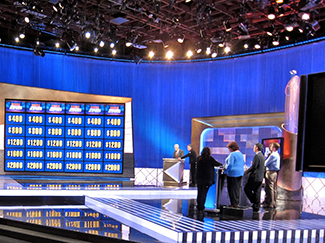


Figure 12.3図 12.3
In the quizmaster study, people tended to disregard the influence of the situation and wrongly concluded that a questioner’s knowledge was greater than their own. (credit: Steve Jurvetson)
クイズマスター研究では、人々は状況の影響を無視する傾向があり、質問者の知識は自分より多いと誤って結論づけた。(出典:Steve Jurvetson)
The halo effect refers to the tendency to let the overall impression of an individual color the way in which we feel about their character. For instance, we might assume that people who are physically attractive are more likely to be good people than less attractive individuals. Another example of how the halo effect might manifest would involve assuming that someone whom we perceive to be outgoing or friendly has a better moral character than someone who is not.
英語のヒント
ハロー効果とは、ある人の全体的な印象によって、その人の人柄についての私たちの感じ方が左右されてしまう傾向を指す。たとえば私たちは、外見的に魅力的な人の方が、それほど魅力的でない人よりも善い人である可能性が高いと思い込むかもしれない。ハロー効果の現れ方のもう一つの例としては、外向的だ、あるいは人当たりがよいと私たちが感じる人は、そうでない人よりも道徳的な人格が優れていると思い込むことが挙げられるだろう。
As demonstrated in the examples above, the fundamental attribution error is considered a powerful influence in how we explain the behaviors of others. However, it should be noted that some researchers have suggested that the fundamental attribution error may not be as powerful as it is often portrayed. In fact, a recent review of more than 173 published studies suggests that several factors (e.g., high levels of idiosyncrasy of the character and how well hypothetical events are explained) play a role in determining just how influential the fundamental attribution error is (Malle, 2006).
英語のヒント
上の例で示したように、基本的帰属錯誤は、私たちが他者の行動をどう説明するかに強い影響を与えるものとみなされている。しかし、基本的帰属錯誤は、しばしば描かれるほど強力ではないかもしれないと示唆している研究者もいることに注意すべきである。実際、公刊された173を超える研究を対象にした最近のレビューは、いくつかの要因(たとえば、登場人物の特異性の高さや、仮想的な出来事がどれだけうまく説明されているか)が、基本的帰属錯誤がいったいどれほどの影響力を持つのかを決めるうえで役割を果たしていることを示唆している(Malle, 2006)。