第12章社会心理学
12.2 Self-presentation12.2 自己呈示
Learning Objectives学習目標
By the end of this section, you will be able to:
この節を学び終えると、次のことができるようになる。
- Describe social roles and how they influence behavior社会的役割と、それが行動にどのように影響するかを説明する
- Explain what social norms are and how they influence behavior社会規範とは何か、それが行動にどのように影響するかを説明する
- Define scriptスクリプトを定義する
- Describe the findings and criticisms of Zimbardo’s Stanford prison experimentジンバルドーのスタンフォード監獄実験の知見と、それに対する批判を説明する
As you’ve learned, social psychology is the study of how people affect one another’s thoughts, feelings, and behaviors. We have discussed situational perspectives and social psychology’s emphasis on the ways in which a person’s environment, including culture and other social influences, affect behavior. In this section, we examine situational forces that have a strong influence on human behavior including social roles, social norms, and scripts. We discuss how humans use the social environment as a source of information, or cues, on how to behave. Situational influences on our behavior have important consequences, such as whether we will help a stranger in an emergency or how we would behave in an unfamiliar environment.
英語のヒント
すでに学んだように、社会心理学とは、人々が互いの思考、感情、行動にどのように影響し合うかを研究する学問である。これまでに、状況に注目する視点と、文化やそのほかの社会的影響を含めた人の環境が行動にどう影響するかを社会心理学が重視していることについて論じてきた。この節では、社会的役割、社会規範、スクリプトなど、人間の行動に強い影響を与える状況の力を検討する。また、人間が社会的環境を、どう振る舞えばよいかについての情報源、すなわち手がかりとしてどのように用いているかを論じる。行動に対する状況の影響は、重要な結果をもたらす。たとえば、緊急時に見知らぬ人を助けるかどうかや、なじみのない環境でどう振る舞うかといったことである。
Social Roles社会的役割
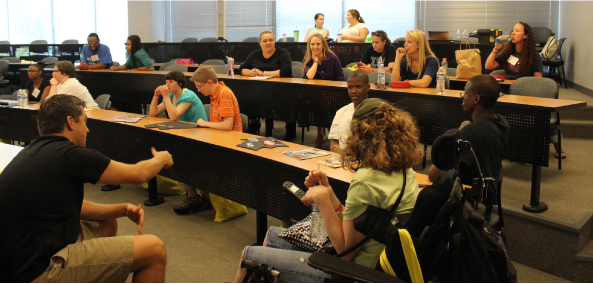
One major social determinant of human behavior is our social roles. A social role is a pattern of behavior that is expected of a person in a given setting or group (Hare, 2003). Each one of us has several social roles. You may be, at the same time, a student, a parent, an aspiring teacher, a son or daughter, a spouse, and a lifeguard. How do these social roles influence your behavior? Social roles are defined by culturally shared knowledge. That is, nearly everyone in a given culture knows what behavior is expected of a person in a given role. For example, what is the social role for a student? If you look around a college classroom you will likely see students engaging in studious behavior, taking notes, listening to the professor, reading the textbook, and sitting quietly at their desks (Figure 12.8). Of course you may see students deviating from the expected studious behavior such as texting on their phones or using Facebook on their laptops, but in all cases, the students that you observe are attending class—a part of the social role of students.
英語のヒント
人間の行動を決める大きな社会的要因の一つは、社会的役割である。社会的役割とは、ある場面や集団において人に期待される行動のパターンである(Hare, 2003)。私たちは一人ひとり、いくつもの社会的役割を持っている。あなたは同時に、学生であり、親であり、教師を目指す人であり、息子あるいは娘であり、配偶者であり、ライフガードであるかもしれない。こうした社会的役割は、あなたの行動にどのように影響するのだろうか。社会的役割は、文化の中で共有された知識によって定められている。つまり、ある文化に属するほとんど誰もが、ある役割にある人にどのような行動が期待されるかを知っている。たとえば、学生の社会的役割とはどのようなものだろうか。大学の教室を見回せば、学生たちがノートを取り、教授の話を聞き、教科書を読み、机について静かに座るなど、勉学にいそしむ行動をとっているのが見えるだろう(図12.8)。もちろん、携帯電話でメッセージを打ったり、ノートパソコンでFacebookを使ったりと、期待される勉学の行動から外れている学生を見かけることもあるだろう。しかしどの場合でも、あなたが目にする学生たちは授業に出席している。これは学生の社会的役割の一部である。
OpenStax, Rice University; Psychology 2e. (credit: modification of work by “Rural Institute”/Flickr) · CC BY 4.0 · Source出典

Figure 12.8図 12.8
Being a student is just one of the many social roles you have. (credit: modification of work by “Rural Institute”/Flickr)
学生であることは、あなたが持つ多くの社会的役割の一つにすぎない。(出典:“Rural Institute”/Flickrの作品を改変)
Social roles, and our related behavior, can vary across different settings. How do you behave when you are engaging in the role of a child attending a family function? Now imagine how you behave when you are engaged in the role of employee at your workplace. It is very likely that your behavior will be different. Perhaps you are more relaxed and outgoing with your family, making jokes and doing silly things. But at your workplace you might speak more professionally, and although you may be friendly, you are also serious and focused on getting the work completed. These are examples of how our social roles influence and often dictate our behavior to the extent that identity and personality can vary with context (that is, in different social groups) (Malloy, Albright, Kenny, Agatstein & Winquist, 1997).
英語のヒント
社会的役割とそれに関連する私たちの行動は、場面によって異なりうる。家族の集まりに出る子どもという役割を担っているとき、あなたはどのように振る舞うだろうか。では次に、職場で従業員という役割を担っているときの自分の振る舞いを想像してみよう。あなたの行動は違っている可能性が非常に高い。家族といるときは、もっとくつろいで打ち解けており、冗談を言ったり、ばかげたことをしたりしているかもしれない。しかし職場では、もっと職業人らしい話し方をするかもしれない。そして、親しみやすくはあっても、同時に真剣で、仕事を仕上げることに集中している。これらは、社会的役割が私たちの行動に影響を与え、しばしばそれを決定づけることを示す例である。その程度は、アイデンティティやパーソナリティが文脈によって(つまり、異なる社会集団の中で)変わりうるほどである(Malloy, Albright, Kenny, Agatstein & Winquist, 1997)。
Social Norms社会規範
As discussed previously, social roles are defined by a culture’s shared knowledge of what is expected behavior of an individual in a specific role. This shared knowledge comes from social norms. A social norm is a group’s expectation of what is appropriate and acceptable behavior for its members—how they are supposed to behave and think (Deutsch & Gerard, 1955; Berkowitz, 2004). How are we expected to act? What are we expected to talk about? What are we expected to wear? In our discussion of social roles we noted that colleges have social norms for students’ behavior in the role of student and workplaces have social norms for employees’ behaviors in the role of employee. Social norms are everywhere including in families, gangs, and on social media outlets. What are some social norms on Instagram?
英語のヒント
先に述べたように、社会的役割は、特定の役割にある個人に期待される行動とは何かについての、文化の中で共有された知識によって定められている。この共有された知識は、社会規範から生じる。社会規範とは、集団の成員にとって何が適切で受け入れられる行動か、すなわち成員がどのように振る舞い、考えるべきかについての、その集団の期待である(Deutsch & Gerard, 1955; Berkowitz, 2004)。私たちはどのように行動することを期待されているのか。何について話すことを期待されているのか。何を着ることを期待されているのか。社会的役割についての議論では、大学には学生という役割における学生の行動についての社会規範があり、職場には従業員という役割における従業員の行動についての社会規範があることを指摘した。社会規範は、家族の中にも、ギャングの中にも、ソーシャルメディアの上にも、あらゆるところにある。Instagramにはどのような社会規範があるだろうか。