第12章社会心理学
Is the Fundamental Attribution Error a Universal Phenomenon?基本的帰属錯誤は普遍的な現象か
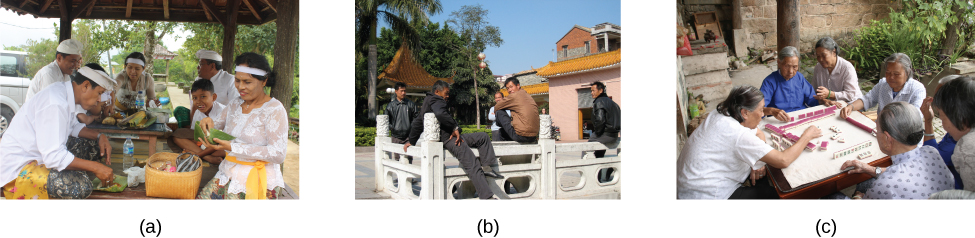
You may be able to think of examples of the fundamental attribution error in your life. Do people in all cultures commit the fundamental attribution error? Research suggests that they do not. People from an individualistic culture, that is, a culture that focuses on individual achievement and autonomy, have the greatest tendency to commit the fundamental attribution error. Individualistic cultures, which tend to be found in western countries such as the United States, Canada, and the United Kingdom, promote a focus on the individual. Therefore, a person’s disposition is thought to be the primary explanation for her behavior. In contrast, people from a collectivistic culture, that is, a culture that focuses on communal relationships with others, such as family, friends, and community (Figure 12.4), are less likely to commit the fundamental attribution error (Markus & Kitayama, 1991; Triandis, 2001).
英語のヒント
自分の生活の中で、基本的帰属錯誤の例を思い浮かべることができるかもしれない。では、あらゆる文化の人々が基本的帰属錯誤を犯すのだろうか。研究は、そうではないことを示唆している。個人主義文化、すなわち個人の達成と自律に焦点を当てる文化の人々は、基本的帰属錯誤を犯す傾向が最も強い。個人主義文化は、アメリカ、カナダ、イギリスなどの西洋の国々に多く見られ、個人に目を向けることを促す。そのため、人の行動の主な説明は、その人の傾性にあると考えられる。これに対して、集団主義文化、すなわち家族、友人、地域社会など(図12.4)、他者との共同体的な関係に焦点を当てる文化の人々は、基本的帰属錯誤を犯す可能性が低い(Markus & Kitayama, 1991; Triandis, 2001)。
OpenStax, Rice University; Psychology 2e. (credit a: modification of work by Arian Zwegers; credit b: modification of work by "conbon33"/Flickr; credit c: modification of work by Anja Disseldorp) · CC BY 4.0 · Source出典
Figure 12.4図 12.4
People from collectivistic cultures, such as some Asian cultures, are more likely to emphasize relationships with others than to focus primarily on the individual. Activities such as (a) preparing a meal, (b) hanging out, and (c) playing a game engage people in a group. (credit a: modification of work by Arian Zwegers; credit b: modification of work by "conbon33"/Flickr; credit c: modification of work by Anja Disseldorp)
一部のアジアの文化のような集団主義文化の人々は、主に個人に焦点を当てるよりも、他者との関係を重視する可能性が高い。(a)食事の支度、(b)一緒にくつろぐこと、(c)ゲームのような活動では、人々は集団として関わり合う。(出典a:Arian Zwegersの作品を改変、出典b:“conbon33”/Flickrの作品を改変、出典c:Anja Disseldorpの作品を改変)
Why do you think this is the case? Collectivistic cultures, which tend to be found in east Asian countries and in Latin American and African countries, focus on the group more than on the individual (Nisbett, Peng, Choi, & Norenzayan, 2001). This focus on others provides a broader perspective that takes into account both situational and cultural influences on behavior; thus, a more nuanced explanation of the causes of others’ behavior becomes more likely. Table 12.1 compares individualistic and collectivist cultures.
英語のヒント
なぜそうなるのだと思うだろうか。集団主義文化は、東アジアの国々や、ラテンアメリカ、アフリカの国々に多く見られ、個人よりも集団に焦点を当てる(Nisbett, Peng, Choi, & Norenzayan, 2001)。このように他者に目を向けることで、行動に対する状況の影響と文化の影響の両方を考慮に入れた、より広い視点がもたらされる。そのため、他者の行動の原因について、より細やかな説明がなされる可能性が高くなる。表12.1は、個人主義文化と集団主義文化を比較したものである。
Characteristics of Individualistic and Collectivistic Cultures 個人主義文化と集団主義文化の特徴 |
|
|---|---|
Individualistic Culture 個人主義文化 |
Collectivistic Culture 集団主義文化 |
Achievement oriented 達成志向 |
Relationship oriented 関係志向 |
Focus on autonomy 自律を重視 |
Focus on group harmony 集団の調和を重視 |
Dispositional perspective 傾性的な視点 |
Situational perspective 状況的な視点 |
Independent 独立的 |
Interdependent 相互依存的 |
Analytic thinking style 分析的な思考様式 |
Holistic thinking style 包括的な思考様式 |
Masuda and Nisbett (2001) demonstrated that the kinds of information that people attend to when viewing visual stimuli (e.g., an aquarium scene) can differ significantly depending on whether the observer comes from a collectivistic versus an individualistic culture. Japanese participants were much more likely to recognize objects that were presented when they occurred in the same context in which they were originally viewed. Manipulating the context in which object recall occurred had no such impact on American participants. Other researchers have shown similar differences across cultures. For example, Zhang, Fung, Stanley, Isaacowitz, and Zhang (2014) demonstrated differences in the ways that holistic thinking might develop between Chinese and American participants, and Ramesh and Gelfand (2010) demonstrated that job turnover rates are more related to the fit between a person and the organization in which they work in an Indian sample, but the fit between the person and their specific job was more predictive of turnover in an American sample.
英語のヒント
増田とニスベット(2001)は、視覚刺激(たとえば水槽の場面)を見るときに人が注意を向ける情報の種類が、観察者が集団主義文化の出身か個人主義文化の出身かによって大きく異なりうることを示した。日本人の参加者は、提示された物体が、最初に見たときと同じ文脈の中に現れた場合に、その物体を再認する可能性がはるかに高かった。物体の再生が行われる文脈を操作しても、アメリカ人の参加者にはそのような影響はなかった。ほかの研究者たちも、文化によって同様の違いがあることを示している。たとえば、チャン、フォン、スタンリー、アイザコウィッツ、チャン(2014)は、包括的思考がどのように発達しうるかについて、中国人の参加者とアメリカ人の参加者のあいだに違いがあることを示した。また、ラメシュとゲルファンド(2010)は、インドの標本では離職率が、人とその人が働く組織との適合により強く関連していたのに対し、アメリカの標本では、人とその人の具体的な仕事との適合の方が離職をよりよく予測したことを示した。
Actor-Observer Bias行為者−観察者バイアス
Returning to our earlier example, Jamie was laid off, but an observer would not know. So a naïve observer would tend to attribute Jamie’s hostile behavior to Jamie’s disposition rather than to the true, situational cause. Why do you think we underestimate the influence of the situation on the behaviors of others? One reason is that we often don’t have all the information we need to make a situational explanation for another person’s behavior. The only information we might have is what is observable. Due to this lack of information we have a tendency to assume the behavior is due to a dispositional, or internal, factor. When it comes to explaining our own behaviors, however, we have much more information available to us. If you came home from school or work angry and yelled at your dog or a loved one, what would your explanation be? You might say you were very tired or feeling unwell and needed quiet time—a situational explanation. The actor-observer bias is the phenomenon of attributing other people’s behavior to internal factors (fundamental attribution error) while attributing our own behavior to situational forces (Jones & Nisbett, 1971; Nisbett, Caputo, Legant, & Marecek, 1973; Choi & Nisbett, 1998). As actors of behavior, we have more information available to explain our own behavior. However as observers, we have less information available; therefore, we tend to default to a dispositionist perspective.
英語のヒント
先ほどの例に戻ろう。ジェイミーは解雇されたのだが、観察者にはそれが分からないだろう。そのため、事情を知らない観察者は、ジェイミーの敵意ある行動を、本当の原因である状況ではなく、ジェイミーの傾性に帰属させがちだろう。私たちはなぜ、他者の行動に対する状況の影響を過小評価するのだと思うだろうか。理由の一つは、他者の行動について状況による説明をするのに必要な情報を、私たちがすべて持っているわけではないことが多い、ということである。手元にある情報は、観察できるものだけかもしれない。この情報の不足のために、私たちはその行動が傾性的な要因、つまり内的な要因によるものだと思い込む傾向がある。しかし、自分自身の行動を説明するとなると、使える情報ははるかに多い。もしあなたが学校や職場から怒って帰宅し、飼い犬や大切な人に怒鳴ったとしたら、あなたはそれをどう説明するだろうか。とても疲れていた、あるいは気分がすぐれず、静かな時間が必要だった、と言うかもしれない。これは状況による説明である。行為者−観察者バイアスとは、他者の行動は内的要因に帰属させる(基本的帰属錯誤)一方で、自分自身の行動は状況の力に帰属させる現象である(Jones & Nisbett, 1971; Nisbett, Caputo, Legant, & Marecek, 1973; Choi & Nisbett, 1998)。行動の行為者としての私たちには、自分の行動を説明するのに使える情報がより多くある。しかし観察者としての私たちには、使える情報がより少ない。そのため、つい傾性主義の視点をとってしまいがちである。
One study on the actor-observer bias investigated reasons male participants gave for why they liked their girlfriend (Nisbett et al., 1973). When asked why participants liked their own girlfriend, participants focused on internal, dispositional qualities of their girlfriends (for example, her pleasant personality). The participants’ explanations rarely included causes internal to themselves, such as dispositional traits (for example, “I need companionship.”). In contrast, when speculating why a male friend likes his girlfriend, participants were equally likely to give dispositional and external explanations. This supports the idea that actors tend to provide few internal explanations but many situational explanations for their own behavior. In contrast, observers tend to provide more dispositional explanations for a friend’s behavior (Figure 12.5).
英語のヒント
行為者−観察者バイアスについてのある研究は、男性の参加者が、自分のガールフレンドを好きな理由として挙げたものを調べた(Nisbett et al., 1973)。自分のガールフレンドをなぜ好きなのかを尋ねられると、参加者はガールフレンドの内的で傾性的な性質(たとえば、彼女の感じのよい性格)に注目した。参加者の説明に、傾性的な特性のような自分自身の内にある原因(たとえば「自分には一緒にいてくれる相手が必要だ」)が含まれることはめったになかった。これに対して、ある男性の友人がなぜ彼のガールフレンドを好きなのかを推測するときには、参加者は傾性的な説明と外的な説明を同じくらい挙げた。これは、行為者は自分自身の行動について、内的な説明はほとんどせず、状況的な説明を多くする傾向があるという考えを支持する。一方、観察者は、友人の行動について、より傾性的な説明をする傾向がある(図12.5)。
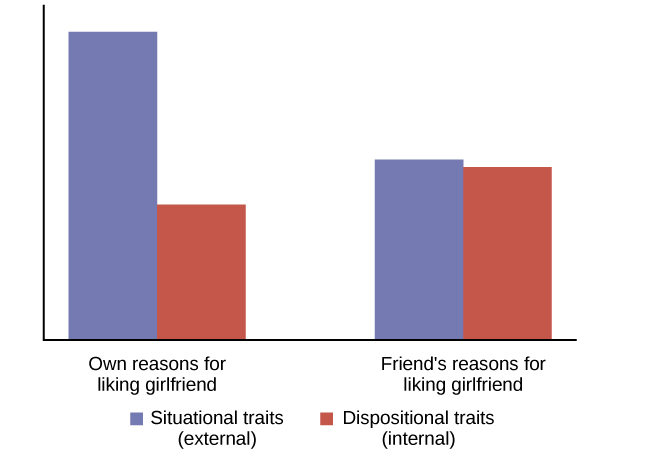


Figure 12.5図 12.5
Actor-observer bias is evident when subjects explain their own reasons for liking a girlfriend versus their impressions of others’ reasons for liking a girlfriend.
参加者が、ガールフレンドを好きな自分自身の理由を説明する場合と、他者がガールフレンドを好きな理由について自分の印象を説明する場合とを比べると、行為者−観察者バイアスがはっきり表れる。