第12章社会心理学
12.3 Attitudes and Persuasion12.3 態度と説得
Learning Objectives学習目標
By the end of this section, you will be able to:
この節を学び終えると、次のことができるようになる。
- Define attitude態度を定義する
- Describe how people’s attitudes are internally changed through cognitive dissonance人の態度が、認知的不協和を通じて内的にどのように変わるかを述べる
- Explain how people’s attitudes are externally changed through persuasion人の態度が、説得を通じて外的にどのように変わるかを説明する
- Describe the peripheral and central routes to persuasion説得の周辺ルートと中心ルートについて述べる
Social psychologists have documented how the power of the situation can influence our behaviors. Now we turn to how the power of the situation can influence our attitudes and beliefs. Attitude is our evaluation of a person, an idea, or an object. We have attitudes for many things ranging from products that we might pick up in the supermarket to people around the world to political policies. Typically, attitudes are favorable or unfavorable: positive or negative (Eagly & Chaiken, 1993). And, they have three components: an affective component (feelings), a behavioral component (the effect of the attitude on behavior), and a cognitive component (belief and knowledge) (Rosenberg & Hovland, 1960).
英語のヒント
社会心理学者たちは、状況の力が私たちの行動にどのように影響しうるかを明らかにしてきた。ここからは、状況の力が私たちの態度や信念にどのように影響しうるかに目を向ける。態度とは、ある人、考え、物事に対する私たちの評価である。私たちは、スーパーマーケットで手に取るかもしれない商品から、世界中の人々、さらには政治的な政策に至るまで、多くのものに対して態度を持っている。態度はふつう、好意的か非好意的か、つまり肯定的か否定的かのどちらかである(Eagly & Chaiken, 1993)。そして態度には三つの成分がある。感情的成分(気持ち)、行動的成分(態度が行動に及ぼす影響)、認知的成分(信念と知識)である(Rosenberg & Hovland, 1960)。
For example, you may hold a positive attitude toward recycling. This attitude should result in positive feelings toward recycling (such as “It makes me feel good to recycle” or “I enjoy knowing that I make a small difference in reducing the amount of waste that ends up in landfills”). Certainly, this attitude should be reflected in our behavior: You actually recycle as often as you can. Finally, this attitude will be reflected in favorable thoughts (for example, “Recycling is good for the environment” or “Recycling is the responsible thing to do”).
英語のヒント
たとえば、あなたはリサイクルに対して肯定的な態度を持っているかもしれない。この態度は、リサイクルに対する肯定的な気持ち(「リサイクルをすると気分がいい」や「埋め立て地に行き着くごみの量を減らすことに、自分が少しでも役立っていると知るのがうれしい」など)につながるはずである。当然、この態度は私たちの行動にも表れるはずだ。つまり、あなたは実際に、できるかぎり頻繁にリサイクルをする。最後に、この態度は好意的な考え(たとえば「リサイクルは環境によい」や「リサイクルは責任ある行動だ」)にも表れるだろう。
Our attitudes and beliefs are not only influenced by external forces, but also by internal influences that we control. Like our behavior, our attitudes and thoughts are not always changed by situational pressures, but they can be consciously changed by our own free will. In this section we discuss the conditions under which we would want to change our own attitudes and beliefs.
英語のヒント
私たちの態度や信念は、外的な力によって影響を受けるだけでなく、私たち自身が制御する内的な影響によっても左右される。行動と同じく、態度や考えも、いつも状況の圧力によって変えられるとはかぎらず、私たち自身の自由意志によって意識的に変えることもできる。この節では、私たちが自分自身の態度や信念を変えたいと思うのはどのような条件のもとでなのかを論じる。
What is Cognitive Dissonance?認知的不協和とは何か
Social psychologists have documented that feeling good about ourselves and maintaining positive self-esteem is a powerful motivator of human behavior (Tavris & Aronson, 2008). In the United States, members of the predominant culture typically think very highly of themselves and view themselves as good people who are above average on many desirable traits (Ehrlinger, Gilovich, & Ross, 2005). Often, our behavior, attitudes, and beliefs are affected when we experience a threat to our self-esteem or positive self-image. Psychologist Leon Festinger (1957) defined cognitive dissonance as psychological discomfort arising from holding two or more inconsistent attitudes, behaviors, or cognitions (thoughts, beliefs, or opinions). Festinger’s theory of cognitive dissonance states that when we experience a conflict in our behaviors, attitudes, or beliefs that runs counter to our positive self-perceptions, we experience psychological discomfort (dissonance). For example, if you believe smoking is bad for your health but you continue to smoke, you experience conflict between your belief and behavior (Figure 12.11).
英語のヒント
社会心理学者たちは、自分自身を肯定的に感じることと、肯定的な自尊心を保つことが、人間の行動の強力な動機づけ要因であることを示してきた(Tavris & Aronson, 2008)。アメリカでは、主流文化に属する人々はたいてい自分自身を非常に高く評価しており、自分は多くの望ましい特性において平均を上回る善い人間だとみなしている(Ehrlinger, Gilovich, & Ross, 2005)。自尊心や肯定的な自己像への脅威を経験すると、私たちの行動、態度、信念はしばしば影響を受ける。心理学者レオン・フェスティンガー(1957)は、認知的不協和を、互いに矛盾する二つ以上の態度、行動、または認知(考え、信念、意見)を抱えていることから生じる心理的な不快感と定義した。フェスティンガーの認知的不協和の理論によれば、肯定的な自己知覚に反するような葛藤を自分の行動、態度、信念の中に経験すると、私たちは心理的な不快感(不協和)を経験する。たとえば、喫煙は健康に悪いと信じているのに喫煙を続けているなら、あなたは信念と行動のあいだの葛藤を経験している(図12.11)。
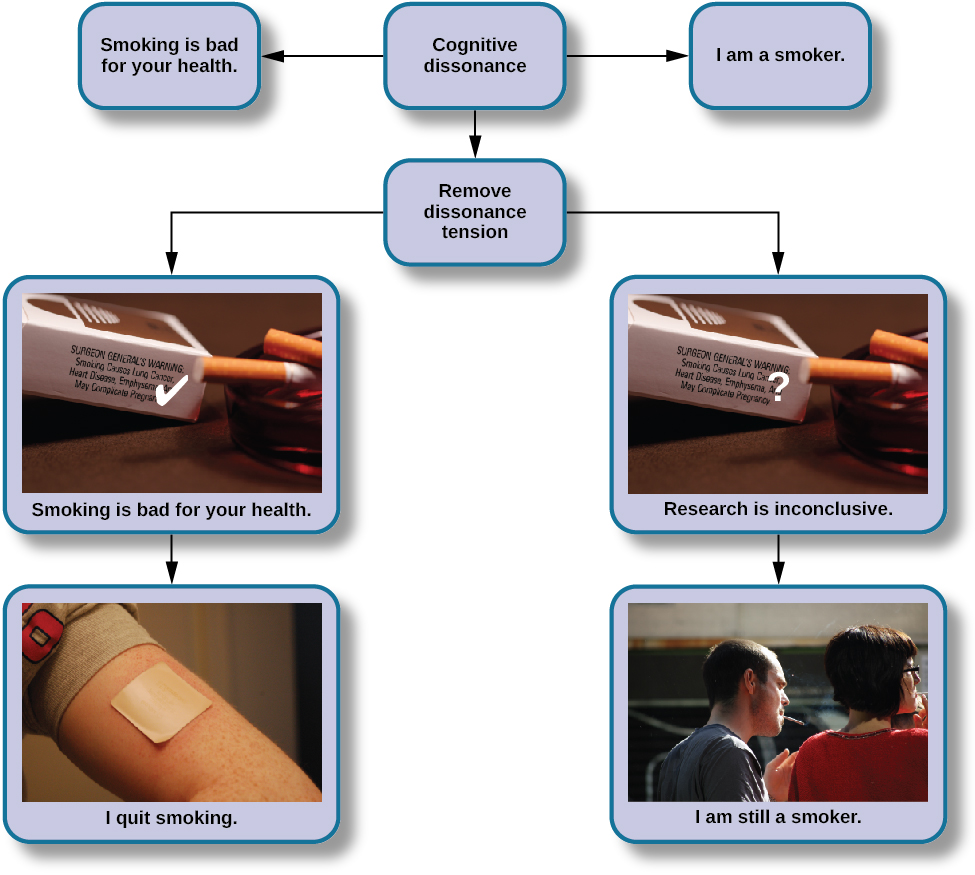
OpenStax, Rice University; Psychology 2e. (credit “cigarettes”: modification of work by CDC/Debora Cartagena; “patch”: modification of "RegBarc"/Wikimedia Commons; “smoking”: modification of work by Tim Parkinson) · CC BY 4.0 · Source出典
Figure 12.11図 12.11
Cognitive dissonance is aroused by inconsistent beliefs and behaviors. Believing cigarettes are bad for your health, but smoking cigarettes anyway, can cause cognitive dissonance. To reduce cognitive dissonance, individuals can change their behavior, as in quitting smoking, or change their belief, such as discounting the evidence that smoking is harmful. (credit “cigarettes”: modification of work by CDC/Debora Cartagena; “patch”: modification of "RegBarc"/Wikimedia Commons; “smoking”: modification of work by Tim Parkinson)
認知的不協和は、矛盾する信念と行動によって生じる。たばこは健康に悪いと信じていながら、それでもたばこを吸うことは、認知的不協和を引き起こしうる。認知的不協和を減らすために、人は禁煙のように行動を変えることも、喫煙が有害だという証拠を割り引いて考えるように信念を変えることもできる。(出典「たばこ」:CDC/Debora Cartagenaの作品を改変、出典「パッチ」:"RegBarc"/Wikimedia Commonsを改変、出典「喫煙」:Tim Parkinsonの作品を改変)
Later research documented that only conflicting cognitions that threaten individuals’ positive self-image cause dissonance (Greenwald & Ronis, 1978). Additional research found that dissonance is not only psychologically uncomfortable but also can cause physiological arousal (Croyle & Cooper, 1983) and activate regions of the brain important in emotions and cognitive functioning (van Veen, Krug, Schooler, & Carter, 2009). When we experience cognitive dissonance, we are motivated to decrease it because it is psychologically, physically, and mentally uncomfortable. We can reduce cognitive dissonance by bringing our cognitions, attitudes, and behaviors in line—that is, making them harmonious. This can be done in different ways, such as:
英語のヒント
その後の研究では、不協和を引き起こすのは、個人の肯定的な自己像を脅かすような対立する認知だけであることが示された(Greenwald & Ronis, 1978)。さらに別の研究では、不協和は心理的に不快であるだけでなく、生理的覚醒を引き起こしたり(Croyle & Cooper, 1983)、感情や認知機能にとって重要な脳の領域を活性化させたりしうることが分かった(van Veen, Krug, Schooler, & Carter, 2009)。認知的不協和を経験すると、それが心理的にも身体的にも精神的にも不快であるため、私たちはそれを減らそうと動機づけられる。認知的不協和は、認知、態度、行動の足並みをそろえること、つまりそれらを調和させることによって減らせる。そのやり方はいろいろあり、たとえば次のようなものがある。
- changing our discrepant behavior (e.g., stop smoking),
英語のヒント
食い違っている自分の行動を変える(例:喫煙をやめる) - changing our cognitions through rationalization or denial (e.g., telling ourselves that health risks can be reduced by smoking filtered cigarettes),
英語のヒント
合理化や否認によって認知を変える(例:フィルター付きのたばこを吸えば健康へのリスクは減らせると自分に言い聞かせる) - adding a new cognition (e.g., “Smoking suppresses my appetite so I don’t become overweight, which is good for my health.”).
英語のヒント
新しい認知を付け加える(例:「喫煙は食欲を抑えてくれるので、太りすぎにならない。それは健康にとってよいことだ」)
A classic example of cognitive dissonance is Joaquin, a 20-year-old who enlists in the military. During boot camp he is awakened at 5:00 a.m., is chronically sleep deprived, yelled at, covered in sand flea bites, physically bruised and battered, and mentally exhausted (Figure 12.12). It gets worse. Recruits that make it to week 11 of boot camp have to do 54 hours of continuous training.
英語のヒント
認知的不協和の典型的な例が、軍に入隊する20歳のホアキンである。新兵訓練のあいだ、彼は午前5時に起こされ、慢性的な睡眠不足で、怒鳴りつけられ、砂地のノミに刺された跡だらけになり、体はあざと打ち身だらけで、精神的にも疲れ果てている(図12.12)。事態はさらに悪くなる。新兵訓練の11週目までたどり着いた新兵は、54時間連続の訓練をこなさなければならない。
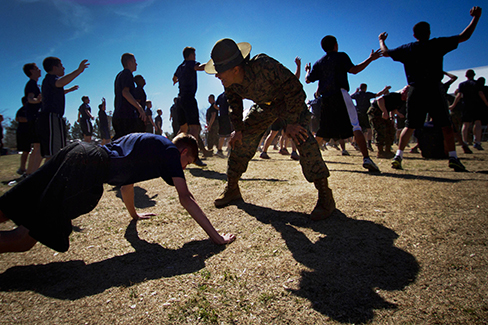


Figure 12.12図 12.12
A person who has chosen a difficult path must deal with cognitive dissonance in addition to many other discomforts. (credit: Tyler J. Bolken)
困難な道を選んだ人は、ほかの多くの不快に加えて、認知的不協和にも対処しなければならない。(出典:Tyler J. Bolken)
Not surprisingly, Joaquin is miserable. No one likes to be miserable. In this type of situation, people can change their beliefs, their attitudes, or their behaviors. The last option, a change of behaviors, is not available to Joaquin. He has signed on to the military for four years, and he cannot legally leave.
英語のヒント
当然ながら、ホアキンはみじめな思いをしている。みじめな思いをしたい人などいない。この種の状況では、人は信念、態度、行動のいずれかを変えることができる。最後の選択肢である行動の変更は、ホアキンには取れない。彼は4年間の契約で軍に入隊しており、法的に除隊することはできない。
If Joaquin keeps thinking about how miserable he is, it is going to be a very long four years. He will be in a constant state of cognitive dissonance. As an alternative to this misery, Joaquin can change his beliefs or attitudes. He can tell himself, “I am becoming stronger, healthier, and sharper. I am learning discipline and how to defend myself and my country. What I am doing is really important.” If this is his belief, he will realize that he is becoming stronger through his challenges. He then will feel better and not experience cognitive dissonance, which is an uncomfortable state.
英語のヒント
自分がどれほどみじめかをホアキンが考え続けるなら、4年間はとても長いものになるだろう。彼は絶えず認知的不協和の状態に置かれることになる。このみじめさに代わる道として、ホアキンは自分の信念や態度を変えることができる。自分にこう言い聞かせてもよい。「自分はより強く、より健康に、より鋭くなりつつある。規律を学び、自分自身と自分の国を守る方法を学んでいる。自分がしていることは本当に重要なのだ。」これが彼の信念であれば、彼は、困難を通して自分がより強くなりつつあることに気づくだろう。そうなれば気分もよくなり、不快な状態である認知的不協和を経験しなくなるだろう。