第12章社会心理学
Attraction魅力
We have discussed how proximity and similarity lead to the formation of relationships, and that reciprocity and self-disclosure are important for relationship maintenance. But, what features of a person do we find attractive? We don’t form relationships with everyone that lives or works near us, so how is it that we decide which specific individuals we will select as friends and lovers?
英語のヒント
ここまで、近接性と類似性がどのように関係の形成につながるのか、そして互恵性と自己開示が関係の維持にとって重要であることを論じてきた。しかし、私たちは人のどのような特徴に魅力を感じるのだろうか。私たちは、近くに住んだり働いたりしている人すべてと関係を築くわけではない。だとすれば、どの特定の人を友人や恋人として選ぶのかを、私たちはいったいどのようにして決めているのだろうか。
Researchers have documented several characteristics that humans find attractive. First we look for friends and lovers who are physically attractive. People differ in what they consider attractive, and attractiveness is culturally influenced. Research, however, suggests that some universally attractive features in women include large eyes, high cheekbones, a narrow jaw line, a slender build (Buss, 1989), and a lower waist-to-hip ratio (Singh, 1993). For men, attractive traits include being tall, having broad shoulders, and a narrow waist (Buss, 1989). Both men and women with high levels of facial and body symmetry are generally considered more attractive than asymmetric individuals (Fink, Neave, Manning, & Grammer, 2006; Penton-Voak et al., 2001; Rikowski & Grammer, 1999). Social traits that people find attractive in potential female mates include warmth, affection, and social skills; in males, the attractive traits include achievement, leadership qualities, and job skills (Regan & Berscheid, 1997). Although humans want mates who are physically attractive, this does not mean that we look for the most attractive person possible. In fact, this observation has led some to propose what is known as the matching hypothesis which asserts that people tend to pick someone they view as their equal in physical attractiveness and social desirability (Taylor, Fiore, Mendelsohn, & Cheshire, 2011). For example, you and most people you know likely would say that a very attractive movie star is out of your league. So, even if you had proximity to that person, you likely would not ask them out on a date because you believe you likely would be rejected. People weigh a potential partner’s attractiveness against the likelihood of success with that person. If you think you are particularly unattractive (even if you are not), you likely will seek partners that are fairly unattractive (that is, unattractive in physical appearance or in behavior).
英語のヒント
研究者たちは、人間が魅力を感じるいくつかの特徴を明らかにしてきた。まず、私たちは身体的に魅力のある友人や恋人を求める。何を魅力的と考えるかは人によって異なり、魅力は文化の影響を受ける。しかし研究からは、女性の普遍的に魅力的な特徴として、大きな目、高い頬骨、細いあごの線、ほっそりした体つき(Buss, 1989)、低いウエスト・ヒップ比(Singh, 1993)などがあることが示唆されている。男性の場合、魅力的な特性には、背が高いこと、肩幅が広いこと、ウエストが細いことがある(Buss, 1989)。顔と体の対称性の程度が高い人は、男女とも、非対称な人よりも一般に魅力的だとみなされる(Fink, Neave, Manning, & Grammer, 2006; Penton-Voak et al., 2001; Rikowski & Grammer, 1999)。人が配偶相手の候補となる女性に魅力を感じる社会的特性には、温かさ、愛情深さ、社交スキルがあり、男性の場合、魅力的な特性には、業績、リーダーシップの資質、仕事のスキルがある(Regan & Berscheid, 1997)。人間は身体的に魅力のある配偶相手を求めるが、だからといって、できるかぎり最も魅力的な人を探すわけではない。実際、この観察から、マッチング仮説として知られる考えを提唱する者も出てきた。この仮説は、人は身体的魅力と社会的望ましさの点で自分と同等だとみなす相手を選ぶ傾向がある、と主張する(Taylor, Fiore, Mendelsohn, & Cheshire, 2011)。たとえば、あなたも、あなたの知り合いの大半も、非常に魅力的な映画スターは自分には手の届かない相手だと、おそらく言うだろう。だから、たとえその人の近くにいたとしても、おそらくデートには誘わないだろう。断られる可能性が高いと思うからである。人は、相手候補の魅力を、その人とうまくいく見込みと天秤にかける。自分がとりわけ魅力に乏しいと思っているなら(実際にはそうでなくても)、かなり魅力に乏しい相手(つまり、外見や振る舞いが魅力的でない相手)を求める可能性が高い。
Sternberg’s Triangular Theory of Loveスタンバーグの愛の三角理論
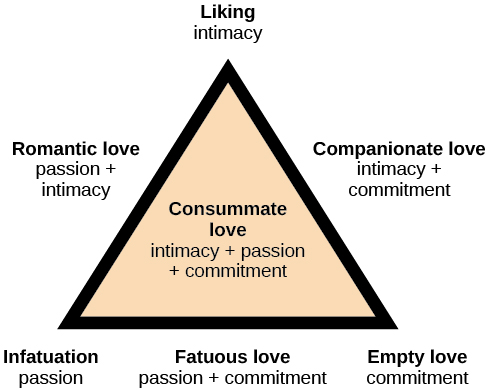
We typically love the people with whom we form relationships, but the type of love we have for our family, friends, and lovers differs. Robert Sternberg (1986) proposed that there are three components of love: intimacy, passion, and commitment. These three components form a triangle that defines multiple types of love: this is known as Sternberg’s triangular theory of love (Figure 12.28). Intimacy is the sharing of details and intimate thoughts and emotions. Passion is the physical attraction—the flame in the fire. Commitment is standing by the person—the “in sickness and health” part of the relationship.
英語のヒント
私たちはふつう、関係を築いた人々を愛するが、家族、友人、恋人に対して抱く愛の種類は異なる。ロバート・スタンバーグ(1986)は、愛には親密さ、情熱、コミットメントという三つの構成要素があると提唱した。この三つの構成要素が三角形をつくり、それによって複数の種類の愛が定まる。これはスタンバーグの愛の三角理論として知られている(図12.28)。親密さとは、細かな事柄や、胸の内にある考えや感情を分かち合うことである。情熱とは身体的に引かれることであり、火の中の炎である。コミットメントとは、その人のそばに居続けることであり、関係のうち「病めるときも健やかなるときも」の部分である。
OpenStax, Rice University; Psychology 2e. (credit: modification of work by “Lnesa”/Wikimedia Commons) · CC BY 4.0 · Source出典
Figure 12.28図 12.28
According to Sternberg’s triangular theory of love, seven types of love can be described from combinations of three components: intimacy, passion, and commitment. (credit: modification of work by “Lnesa”/Wikimedia Commons)
スタンバーグの愛の三角理論によれば、親密さ、情熱、コミットメントという三つの構成要素の組み合わせから、7種類の愛を描き分けられる。(出典:“Lnesa”/Wikimedia Commonsの作品を改変)
Sternberg (1986) states that a healthy relationship will have all three components of love—intimacy, passion, and commitment—which is described as consummate love (Figure 12.29). However, different aspects of love might be more prevalent at different life stages. Other forms of love include liking, which is defined as having intimacy but no passion or commitment. Infatuation is the presence of passion without intimacy or commitment. Empty love is having commitment without intimacy or passion. Companionate love, which is characteristic of close friendships and family relationships, consists of intimacy and commitment but no passion. Romantic love is defined by having passion and intimacy, but no commitment. Finally, fatuous love is defined by having passion and commitment, but no intimacy, such as a long term sexual love affair. Can you describe other examples of relationships that fit these different types of love?
英語のヒント
スタンバーグ(1986)によれば、健全な関係には愛の三つの構成要素、すなわち親密さ、情熱、コミットメントがすべてそろっており、これは完全な愛と呼ばれる(図12.29)。ただし、人生の段階によって、愛のどの側面が優勢になるかは異なるかもしれない。ほかの愛の形には好意がある。好意は、親密さはあるが情熱もコミットメントもないことと定義される。夢中の愛とは、親密さもコミットメントもなく情熱だけがある状態である。空虚な愛とは、親密さも情熱もなくコミットメントだけがある状態である。友愛的な愛は、親しい友人関係や家族関係に特徴的な愛で、親密さとコミットメントから成り、情熱はない。ロマンティックな愛は、情熱と親密さはあるがコミットメントはないことで定義される。最後に、愚かな愛は、情熱とコミットメントはあるが親密さはないことで定義され、長期にわたる性的な恋愛関係がその例である。これらのさまざまな種類の愛に当てはまる関係の例を、ほかにも挙げられるだろうか。

Figure 12.29図 12.29
According to Sternberg, consummate love describes a healthy relationship containing intimacy, passion, and commitment. (credit: Carloxito/Wikimedia)
スタンバーグによれば、完全な愛とは、親密さ、情熱、コミットメントを含む健全な関係を言い表すものである。(出典:Carloxito/Wikimedia)
Social Exchange Theory社会的交換理論
We have discussed why we form relationships, what attracts us to others, and different types of love. But what determines whether we are satisfied with and stay in a relationship? One theory that provides an explanation is social exchange theory. According to social exchange theory, we act as naïve economists in keeping a tally of the ratio of costs and benefits of forming and maintaining a relationship with others (Figure 12.30) (Rusbult & Van Lange, 2003).
英語のヒント
ここまで、私たちがなぜ関係を築くのか、何が私たちを他者に引きつけるのか、そしてさまざまな種類の愛について論じてきた。では、ある関係に満足し、その関係にとどまるかどうかは、何によって決まるのだろうか。それを説明する理論の一つが、社会的交換理論である。社会的交換理論によれば、私たちは素朴な経済学者として振る舞い、他者との関係を築き、維持することのコストと利益の比率を記録し続けている(図12.30)(Rusbult & Van Lange, 2003)。
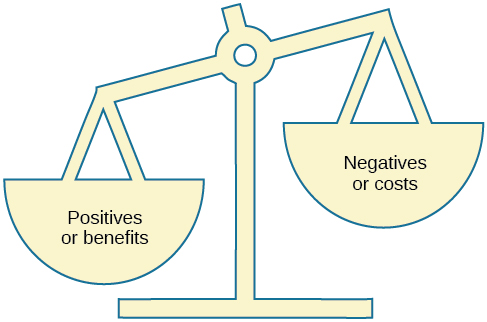


Figure 12.30図 12.30
Acting like naïve economists, people may keep track of the costs and benefits of maintaining a relationship. Typically, only those relationships in which the benefits outweigh the costs will be maintained.
人は素朴な経済学者のように振る舞い、関係を維持することのコストと利益を把握しているのかもしれない。通常、利益がコストを上回る関係だけが維持される。
People are motivated to maximize the benefits of social exchanges, or relationships, and minimize the costs. People prefer to have more benefits than costs, or to have nearly equal costs and benefits, but most people are dissatisfied if their social exchanges create more costs than benefits. Let’s discuss an example. If you have ever decided to commit to a romantic relationship, you probably considered the advantages and disadvantages of your decision. What are the benefits of being in a committed romantic relationship? You may have considered having companionship, intimacy, and passion, but also being comfortable with a person you know well. What are the costs of being in a committed romantic relationship? You may think that over time boredom from being with only one person may set in; moreover, it may be expensive to share activities such as attending movies and going to dinner. However, the benefits of dating your romantic partner presumably outweigh the costs, or you wouldn’t continue the relationship.
英語のヒント
人は、社会的交換、すなわち関係から得られる利益を最大にし、コストを最小にしようと動機づけられている。人は、コストより利益が多いこと、あるいはコストと利益がほぼ等しいことを好むが、たいていの人は、社会的交換から利益よりも多くのコストが生じると不満を抱く。例を挙げて考えてみよう。恋愛関係を真剣に続けていこうと決めたことがあるなら、あなたはおそらく、その決断の利点と欠点を考えただろう。真剣な恋愛関係にあることの利益は何だろうか。一緒にいてくれる相手がいること、親密さ、情熱に加えて、よく知っている人と一緒にいる気楽さも考えたかもしれない。真剣な恋愛関係にあることのコストは何だろうか。一人の相手とだけ一緒にいると、時がたつにつれて退屈さが忍び寄ってくるのではないか、と考えるかもしれない。さらに、映画を見に行ったり夕食に出かけたりといった活動を共にするのは、お金がかかるかもしれない。それでも、恋愛相手と付き合うことの利益は、おそらくコストを上回っているのだろう。そうでなければ、あなたは関係を続けてはいないはずである。