第12章社会心理学
Self-Serving Bias自己奉仕バイアス
We can understand self-serving bias by digging more deeply into attribution, a belief about the cause of a result. One model of attribution proposes three main dimensions: locus of control (internal versus external), stability (stable versus unstable), and controllability (controllable versus uncontrollable). In this context, stability refers to the extent in which the circumstances that result in a given outcome are changeable. The circumstances are considered stable if they are unlikely to change. Controllability refers to the extent to which the circumstances that are associated with a given outcome can be controlled. Obviously, those things that we have the power to control would be labeled controllable (Weiner, 1979).
英語のヒント
自己奉仕バイアスは、帰属、すなわち結果の原因についての信念を、もっと深く掘り下げることで理解できる。帰属のあるモデルは、三つの主な次元を提案している。統制の所在(内的か外的か)、安定性(安定か不安定か)、統制可能性(統制可能か統制不可能か)である。この文脈では、安定性とは、ある結果をもたらす事情がどの程度変わりうるかを指す。事情が変わる可能性が低ければ、その事情は安定しているとみなされる。統制可能性とは、ある結果と結びついた事情をどの程度統制できるかを指す。当然ながら、私たちが統制する力を持っている事柄は、統制可能と分類されるだろう(Weiner, 1979)。
Following an outcome, self-serving biases are those attributions that enable us to see ourselves in a favorable light (for example, making internal attributions for success and external attributions for failures). When you do well at a task, for example acing an exam, it is in your best interest to make a dispositional attribution for your behavior (“I’m smart,”) instead of a situational one (“The exam was easy,”). Self-serving bias is the tendency to explain our successes as due to dispositional (internal) characteristics, but to explain our failures as due to situational (external) factors. Again, this is culture dependent. This bias serves to protect self-esteem. You can imagine that if people always made situational attributions for their behavior, they would never be able to take credit and feel good about their accomplishments.
英語のヒント
自己奉仕バイアスとは、ある結果が出た後に、自分自身を好ましく見ることができるようにする帰属のことである(たとえば、成功については内的な帰属をし、失敗については外的な帰属をすること)。課題でうまくいったとき、たとえば試験で高得点をとったときには、自分の行動について、状況的な帰属(「試験が簡単だった」)ではなく、傾性的な帰属(「自分は頭がいい」)をするのが自分にとって最も得になる。自己奉仕バイアスとは、自分の成功は傾性的(内的)な特徴によるものとして説明し、失敗は状況的(外的)な要因によるものとして説明する傾向である。ここでも、これは文化によって異なる。このバイアスは自尊心を守る働きをする。もし人がいつも自分の行動について状況的な帰属をしていたら、自分の手柄を認めて、成し遂げたことに満足することはけっしてできないだろう、と想像できるだろう。
Consider the example of how we explain our favorite sports team’s wins. Research shows that we make internal, stable, and controllable attributions for our team’s victory (Figure 12.6) (Grove, Hanrahan, & McInman, 1991). For example, we might tell ourselves that our team is talented (internal), consistently works hard (stable), and uses effective strategies (controllable). In contrast, we are more likely to make external, unstable, and uncontrollable attributions when our favorite team loses. For example, we might tell ourselves that the other team has more experienced players or that the referees were unfair (external), the other team played at home (unstable), and the cold weather affected our team’s performance (uncontrollable).
英語のヒント
ひいきのスポーツチームの勝利を私たちがどう説明するかを例に考えてみよう。研究によれば、私たちは自分のチームの勝利について、内的で、安定した、統制可能な帰属をする(図12.6)(Grove, Hanrahan, & McInman, 1991)。たとえば、自分のチームには才能がある(内的)、いつも懸命に努力している(安定)、効果的な戦略を使っている(統制可能)、と自分に言い聞かせるかもしれない。これに対して、ひいきのチームが負けたときには、外的で、不安定で、統制不可能な帰属をする可能性が高い。たとえば、相手チームの方が経験豊富な選手がそろっていた、あるいは審判が不公平だった(外的)、相手チームはホームで試合をした(不安定)、寒い天候が自分のチームのプレーに影響した(統制不可能)、と自分に言い聞かせるかもしれない。

OpenStax, Rice University; Psychology 2e. (credit: "TheAHL"/Flickr) Embedded rights notice: PhotoGraphics · CC BY 4.0 · Source出典
Figure 12.6図 12.6
We tend to believe that our team wins because it’s better, but loses for reasons it cannot control (Roesch & Amirkham, 1997). (credit: "TheAHL"/Flickr)
私たちは、自分のチームが勝つのはチームが優れているからであり、負けるのはチームには統制できない理由によるのだと考えがちである(Roesch & Amirkham, 1997)。(出典:“TheAHL”/Flickr)
Just-World Hypothesis公正世界仮説
One consequence of westerners’ tendency to provide dispositional explanations for behavior is victim blame (Jost & Major, 2001). When people experience bad fortune, others tend to assume that they somehow are responsible for their own fate. A common ideology, or worldview, in the United States is the just-world hypothesis. The just-world hypothesis is the belief that people get the outcomes they deserve (Lerner & Miller, 1978). In order to maintain the belief that the world is a fair place, people tend to think that good people experience positive outcomes, and bad people experience negative outcomes (Jost, Banaji, & Nosek, 2004; Jost & Major, 2001). The ability to think of the world as a fair place, where people get what they deserve, allows us to feel that the world is predictable and that we have some control over our life outcomes (Jost et al., 2004; Jost & Major, 2001). For example, if you want to experience positive outcomes, you just need to work hard to get ahead in life.
英語のヒント
行動を傾性的に説明する西洋人の傾向がもたらす結果の一つが、被害者非難である(Jost & Major, 2001)。人が不運に見舞われると、ほかの人々は、その人が何らかの形で自分の運命に責任を負っていると思い込みがちである。アメリカで一般的なイデオロギー、つまり世界観の一つが、公正世界仮説である。公正世界仮説とは、人は自分にふさわしい結果を得るという信念である(Lerner & Miller, 1978)。世界は公正な場所だという信念を保つために、人は、善い人には良い結果が起こり、悪い人には悪い結果が起こると考えがちである(Jost, Banaji, & Nosek, 2004; Jost & Major, 2001)。世界を、人がそれぞれにふさわしいものを得る公正な場所だと考えることができると、私たちは、世界は予測可能であり、自分の人生の結果をある程度統制できると感じられる(Jost et al., 2004; Jost & Major, 2001)。たとえば、良い結果を経験したいなら、人生で成功するために懸命に努力しさえすればよい、ということになる。
Can you think of a negative consequence of the just-world hypothesis? One negative consequence is people’s tendency to blame poor individuals for their plight. What common explanations are given for why people live in poverty? Have you heard statements such as, “The poor are lazy and just don’t want to work” or “Poor people just want to live off the government”? What types of explanations are these, dispositional or situational? These dispositional explanations are clear examples of the fundamental attribution error. Blaming poor people for their poverty ignores situational factors that impact them, such as high unemployment rates, recession, poor educational opportunities, and the familial cycle of poverty (Figure 12.7). Other research shows that people who hold just-world beliefs have negative attitudes toward people who are unemployed and people living with AIDS (Sutton & Douglas, 2005). In the United States and other countries, victims of sexual assault may find themselves blamed for their abuse. Victim advocacy groups, such as Domestic Violence Ended (DOVE), attend court in support of victims to ensure that blame is directed at the perpetrators of sexual violence, not the victims.
英語のヒント
公正世界仮説がもたらす悪い結果を思いつくだろうか。悪い結果の一つは、貧しい人々の苦境を本人のせいにする人々の傾向である。人々が貧困の中で暮らしている理由について、どのような説明がよくなされるだろうか。「貧乏人は怠け者で、とにかく働きたくないのだ」とか、「貧しい人は政府にたかって暮らしたいだけだ」といった発言を聞いたことがあるだろうか。これらは傾性的な説明と状況的な説明の、どちらの種類だろうか。こうした傾性的な説明は、基本的帰属錯誤の明らかな例である。貧しい人々を貧困のことで責めるのは、高い失業率、景気後退、乏しい教育機会、家族の中で続く貧困の連鎖など、彼らに影響を与える状況的要因を無視することである(図12.7)。ほかの研究は、公正世界の信念を持つ人々が、失業している人々やエイズとともに生きる人々に対して否定的な態度を持つことを示している(Sutton & Douglas, 2005)。アメリカやほかの国々では、性的暴行の被害者が、その被害について自分が責められる立場に置かれることがある。Domestic Violence Ended(DOVE)のような被害者支援団体は、非難が被害者ではなく性暴力の加害者に向けられるように、被害者を支援して法廷に出席する。
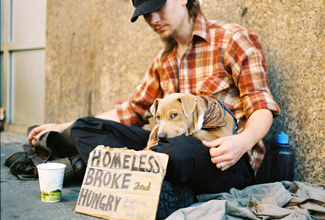


Figure 12.7図 12.7
People who hold just-world beliefs tend to blame the people in poverty for their circumstances, ignoring situational and cultural causes of poverty. (credit: Adrian Miles)
公正世界の信念を持つ人々は、貧困の状況的・文化的な原因を無視して、貧困の中にいる人々をその境遇のことで責める傾向がある。(出典:Adrian Miles)