第12章社会心理学
12.7 Prosocial Behavior12.7 向社会的行動
Learning Objectives学習目標
By the end of this section, you will be able to:
この節を学び終えると、次のことができるようになる。
- Describe altruism利他性を説明する
- Describe conditions that influence the formation of relationships関係の形成に影響する条件を説明する
- Identify what attracts people to each other人を互いに引きつけるものが何かを特定する
- Describe the triangular theory of love愛の三角理論を説明する
- Explain social exchange theory in relationships関係における社会的交換理論を説明する
You’ve learned about many of the negative behaviors of social psychology, but the field also studies many positive social interactions and behaviors. What makes people like each other? With whom are we friends? Whom do we date? Researchers have documented several features of the situation that influence whether we form relationships with others. There are also universal traits that humans find attractive in others. In this section we discuss conditions that make forming relationships more likely, what we look for in friendships and romantic relationships, the different types of love, and a theory explaining how our relationships are formed, maintained, and terminated.
英語のヒント
ここまで、社会心理学が扱う否定的な行動の多くについて学んできたが、この分野は、肯定的な社会的相互作用や行動も数多く研究している。人が互いを好きになるのはなぜだろうか。私たちは誰と友人になるのだろうか。誰とデートするのだろうか。研究者たちは、私たちが他者と関係を築くかどうかに影響する状況の特徴を、いくつも明らかにしてきた。また、人間が他者に魅力を感じる普遍的な特性もある。この節では、関係を築く可能性を高める条件、友人関係や恋愛関係で私たちが求めるもの、さまざまな種類の愛、そして人間関係がどのように形成され、維持され、終わるのかを説明する理論について論じる。
Prosocial Behavior and Altruism向社会的行動と利他性
Do you voluntarily help others? Voluntary behavior with the intent to help other people is called prosocial behavior. Why do people help other people? Is personal benefit such as feeling good about oneself the only reason people help one another? Research suggests there are many other reasons. Altruism is people’s desire to help others even if the costs outweigh the benefits of helping. In fact, people acting in altruistic ways may disregard the personal costs associated with helping (Figure 12.26). For example, news accounts of the 9/11 terrorist attacks on the World Trade Center in New York reported an employee in the first tower helped his co-workers make it to the exit stairwell. After helping a co-worker to safety he went back in the burning building to help additional co-workers. In this case the costs of helping were great, and the hero lost his life in the destruction (Stewart, 2002).
英語のヒント
あなたは自分から進んで他者を助けるだろうか。他者を助ける意図を持った自発的な行動は、向社会的行動と呼ばれる。人はなぜ他者を助けるのだろうか。自分に満足感を覚えられるといった個人的な利益だけが、人が互いに助け合う理由なのだろうか。研究からは、ほかにも多くの理由があることが示唆されている。利他性とは、助けることのコストがその利益を上回るとしても、他者を助けたいと思う人々の欲求である。実際、利他的に行動する人は、助けることにともなう個人的なコストを顧みないことがある(図12.26)。たとえば、ニューヨークの世界貿易センターを狙った9.11同時多発テロの報道によれば、最初のタワーにいたある従業員は、同僚たちが非常階段にたどり着くのを助けた。一人の同僚を安全な場所へ送り届けたあと、彼はさらにほかの同僚を助けるために、燃えているビルの中へ戻っていった。この場合、助けることのコストは大きく、この英雄はビルの崩壊の中で命を落とした(Stewart, 2002)。
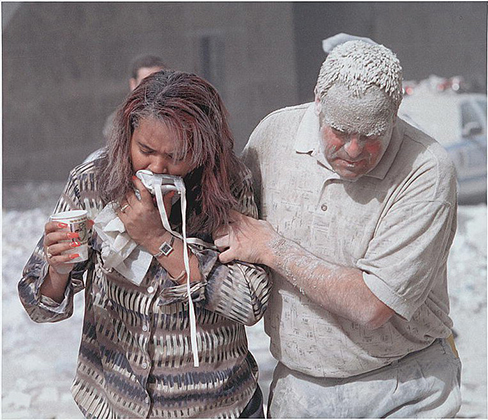
Don Halasy; man covered with ashes assisting a woman, September 11, 2001 (Library of Congress LC-DIG-ppmsca-01813). Released into the public domain by the photographer; Library of Congress rights advisory: no restrictions on publication. OpenStax, Psychology 2e. · Public domain · Source出典

Figure 12.26図 12.26
The events of 9/11 unleashed an enormous show of altruism and heroism on the parts of first responders and many ordinary people. (credit: Don Halasy)
9.11の出来事をきっかけに、最初に現場に駆けつけた救助隊員たちや多くの一般の人々が、途方もない規模で利他性と英雄的な行為を示した。(出典:Don Halasy)
Some researchers suggest that altruism operates on empathy. Empathy is the capacity to understand another person’s perspective, to feel what they feel. An empathetic person makes an emotional connection with others and feels compelled to help (Batson, 1991). Other researchers argue that altruism is a form of selfless helping that is not motivated by benefits or feeling good about oneself. Certainly, after helping, people feel good about themselves, but some researchers argue that this is a consequence of altruism, not a cause. Other researchers argue that helping is always self-serving because our egos are involved, and we receive benefits from helping (Cialdini, Brown, Lewis, Luce, & Neuberg 1997). It is challenging to determine experimentally the true motivation for helping, whether it is largely self-serving (egoism) or selfless (altruism). Thus, a debate on whether pure altruism exists continues.
英語のヒント
利他性は共感に基づいて働くと考える研究者もいる。共感とは、他者の視点を理解し、その人が感じていることを感じ取る能力である。共感的な人は、他者と感情的なつながりを持ち、助けずにはいられないと感じる(Batson, 1991)。ほかの研究者たちは、利他性とは、利益や自分への満足感によって動機づけられているのではない、無私の援助の一形態だと論じる。確かに、人は助けたあとで自分に満足感を覚えるが、それは利他性の結果であって原因ではない、と論じる研究者もいる。さらに別の研究者たちは、自我がかかわっており、助けることで私たちは利益を得るのだから、援助は常に自己の利益にかなうものだと論じる(Cialdini, Brown, Lewis, Luce, & Neuberg 1997)。援助の本当の動機が、主に自己の利益のためのもの(利己性)なのか、無私のもの(利他性)なのかを実験によって見きわめるのは難しい。そのため、純粋な利他性が存在するかどうかをめぐる議論は続いている。
Forming Relationships関係の形成
What do you think is the single most influential factor in determining with whom you become friends and with whom you form romantic relationships? You might be surprised to learn that the answer is simple: the people with whom you have the most contact. This most important factor is proximity. You are more likely to be friends with people you have regular contact with. For example, there are decades of research that shows that you are more likely to become friends with people who live in your dorm, your apartment building, or your immediate neighborhood than with people who live farther away (Festinger, Schachler, & Back, 1950). It is simply easier to form relationships with people you see often because you have the opportunity to get to know them.
英語のヒント
あなたが誰と友人になり、誰と恋愛関係を築くかを決めるうえで、最も影響力の大きい要因をただ一つ挙げるとしたら、何だと思うだろうか。答えが単純なものだと知ったら、驚くかもしれない。それは、最もよく接触している人々である。この最も重要な要因は近接性である。人は、日常的に接触している人と友人である可能性が高い。たとえば、同じ寮や同じ集合住宅、あるいはすぐ近所に住んでいる人とは、もっと遠くに住んでいる人とよりも友人になる可能性が高いことを示す研究が、数十年にわたって積み重ねられてきた(Festinger, Schachler, & Back, 1950)。よく会う人とは、知り合う機会があるので、単純に関係を築きやすいのである。
Similarity is another factor that influences who we form relationships with. We are more likely to become friends or lovers with someone who is similar to us in background, attitudes, and lifestyle. In fact, there is no evidence that opposites attract. Rather, we are attracted to people who are most like us (Figure 12.27) (McPherson, Smith-Lovin, & Cook, 2001). Why do you think we are attracted to people who are similar to us? Sharing things in common will certainly make it easy to get along with others and form connections. When you and another person share similar music taste, hobbies, food preferences, and so on, deciding what to do with your time together might be easy. Homophily is the tendency for people to form social networks, including friendships, marriage, business relationships, and many other types of relationships, with others who are similar (McPherson et al., 2001).
英語のヒント
類似性も、私たちが誰と関係を築くかに影響する要因の一つである。私たちは、背景、態度、生活様式が自分と似ている人と、友人や恋人になる可能性が高い。実際、正反対の者どうしが引かれ合うという証拠はない。むしろ、私たちは自分に最もよく似た人に引かれる(図12.27)(McPherson, Smith-Lovin, & Cook, 2001)。私たちが自分に似た人に引かれるのはなぜだと思うだろうか。共通点があれば、確かに他者とうまくやっていき、つながりを築きやすくなるだろう。あなたと相手が、音楽の好み、趣味、食べ物の好みなどが似ていれば、一緒に過ごす時間に何をするかを決めるのも簡単かもしれない。同類性とは、友人関係、結婚、仕事上の関係、そのほか多くの種類の関係を含む社会的ネットワークを、自分と似た他者とのあいだで形成する人々の傾向である(McPherson et al., 2001)。

OpenStax, Rice University; Psychology 2e. (credit: modification of work by Shiraz Chanawala) · CC BY 4.0 · Source出典

Figure 12.27図 12.27
People tend to be attracted to similar people. Many couples share a cultural background. This can be quite obvious in a ceremony such as a wedding, and more subtle (but no less significant) in the day-to-day workings of a relationship. (credit: modification of work by Shiraz Chanawala)
人は似た人に引かれる傾向がある。多くのカップルは文化的背景を共有している。このことは、結婚式のような儀式ではかなりはっきりと表れることがあり、関係の日々の営みの中では、より目立たない(しかし重要さでは劣らない)形で表れることもある。(出典:Shiraz Chanawalaの作品を改変)
But, homophily limits our exposure to diversity (McPherson et al., 2001). By forming relationships only with people who are similar to us, we will have homogenous groups and will not be exposed to different points of view. In other words, because we are likely to spend time with those who are most like ourselves, we will have limited exposure to those who are different than ourselves, including people of different races, ethnicities, social-economic status, and life situations.
英語のヒント
しかし、同類性は、私たちが多様性に触れる機会を狭める(McPherson et al., 2001)。自分と似た人とだけ関係を築いていると、集団は均質なものになり、異なる視点に触れることがなくなる。言い換えれば、私たちは自分に最もよく似た人と時間を過ごす可能性が高いため、人種、民族、社会経済的地位、生活状況の異なる人々をはじめ、自分と異なる人々に触れる機会が限られてしまうのである。
Once we form relationships with people, we desire reciprocity. Reciprocity is the give and take in relationships. We contribute to relationships, but we expect to receive benefits as well. That is, we want our relationships to be a two way street. We are more likely to like and engage with people who like us back. Self-disclosure is part of the two way street. Self-disclosure is the sharing of personal information (Laurenceau, Barrett, & Pietromonaco, 1998). We form more intimate connections with people with whom we disclose important information about ourselves. Indeed, self-disclosure is a characteristic of healthy intimate relationships, as long as the information disclosed is consistent with our own views (Cozby, 1973).
英語のヒント
いったん人と関係を築くと、私たちは互恵性を求める。互恵性とは、関係におけるギブ・アンド・テイク(与えることと受け取ること)である。私たちは関係に貢献するが、同時に利益を受け取ることも期待する。つまり、関係が双方向のものであってほしいのである。私たちは、自分に好意を返してくれる人を好きになり、その人と関わる可能性が高い。自己開示は、この双方向のやりとりの一部である。自己開示とは、個人的な情報を共有することである(Laurenceau, Barrett, & Pietromonaco, 1998)。私たちは、自分についての重要な情報を打ち明ける相手と、より親密なつながりを築く。実際、自己開示は、開示される情報が私たち自身の見方と一致しているかぎり、健全な親密関係の特徴である(Cozby, 1973)。