第12章社会心理学
The Effect of Initiation入会儀礼の効果
The military example demonstrates the observation that a difficult initiation into a group influences us to like the group more. Another social psychology concept, justification of effort, suggests that we value goals and achievements that we put a lot of effort into. According to this theory, if something is difficult for us to achieve, we believe it is more worthwhile. For example, if you move to an apartment and spend hours assembling a dresser you bought from Ikea, you will value that more than a fancier dresser someone else bought you. We do not want to have wasted time and effort to join a group that we eventually leave. A classic experiment by Aronson and Mills (1959) demonstrated this justification of effort effect. College students volunteered to join a campus group that would meet regularly to discuss the psychology of sex. Participants were randomly assigned to one of three conditions: no initiation, an easy initiation, and a difficult initiation into the group. After participating in the first discussion, which was deliberately made very boring, participants rated how much they liked the group. Participants who underwent a difficult initiation process to join the group rated the group more favorably than did participants with an easy initiation or no initiation (Figure 12.13).
英語のヒント
軍隊の例は、集団に入る際の厳しい入会儀礼によって、私たちがその集団をより好きになるという観察結果を示している。社会心理学のもう一つの概念である努力の正当化は、私たちが多くの努力を注ぎ込んだ目標や成果を高く評価することを示唆している。この理論によれば、何かを達成するのが難しいと、私たちはそれにいっそう価値があると信じる。たとえば、アパートに引っ越して、イケアで買ったたんすの組み立てに何時間も費やしたなら、あなたはそのたんすを、ほかの誰かが買ってくれたもっとしゃれたたんすよりも大切に思うだろう。私たちは、結局は抜けることになる集団に入るために、時間と努力を無駄にしたとは思いたくないのである。アロンソンとミルズ(1959)による古典的な実験は、この努力の正当化の効果を実証した。大学生たちが、性の心理学について話し合うために定期的に集まる学内のグループへの参加を志願した。参加者は、入会儀礼なし、易しい入会儀礼、厳しい入会儀礼という三つの条件のいずれかに無作為に割り当てられた。わざと非常に退屈なものにしてあった最初の話し合いに参加した後、参加者はそのグループをどのくらい好きかを評定した。グループに加わるために厳しい入会儀礼を経た参加者は、易しい入会儀礼を受けた参加者や入会儀礼のなかった参加者よりも、グループを好意的に評定した(図12.13)。
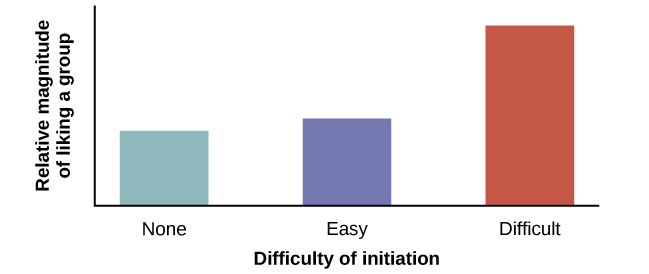
Figure 12.13図 12.13
Justification of effort has a distinct effect on a person liking a group. Students in the difficult initiation condition liked the group more than students in other conditions due to the justification of effort.
努力の正当化は、人が集団を好きになることにはっきりとした効果を及ぼす。厳しい入会儀礼の条件に置かれた学生は、努力の正当化のために、ほかの条件の学生よりもそのグループを好きになった。
Similar effects can be seen in a more recent study of how student effort affects course evaluations. Heckert, Latier, Ringwald-Burton, and Drazen (2006) surveyed 463 undergraduates enrolled in courses at a midwestern university about the amount of effort that their courses required of them. In addition, the students were also asked to evaluate various aspects of the course. Given what you’ve just read, it will come as no surprise that those courses that were associated with the highest level of effort were evaluated as being more valuable than those that were not. Furthermore, students indicated that they learned more in courses that required more effort, regardless of the grades that they received in those courses (Heckert et al., 2006).
英語のヒント
同様の効果は、学生の努力が授業評価にどう影響するかを調べた、より最近の研究にも見られる。ヘッカート、ラティア、リングウォルド=バートン、ドレイゼン(2006)は、中西部のある大学で授業を履修している学部生463人を対象に、それぞれの授業でどれだけの努力を求められたかを調査した。さらに学生たちは、授業のさまざまな側面を評価するようにも求められた。いま読んだことを考えれば、最も高い水準の努力と関連していた授業が、そうでない授業よりも価値があると評価されたことは、驚くにはあたらないだろう。さらに学生たちは、それらの授業で受けた成績にかかわらず、より多くの努力を必要とした授業のほうが多くを学んだと答えた(Heckert et al., 2006)。
Besides the classic military example and group initiation, can you think of other examples of cognitive dissonance? Here is one: Maria and Marco live in Fairfield County, Connecticut, which is one of the wealthiest areas in the United States and has a very high cost of living. Maria telecommutes from home and Marco does not work outside of the home. They rent a very small house for more than $3000 a month. Marco shops at consignment stores for clothes and economizes when possible. They complain that they never have any money and that they cannot buy anything new. When asked why they do not move to a less expensive location, since Maria telecommutes, they respond that Fairfield County is beautiful, they love the beaches, and they feel comfortable there. How does the theory of cognitive dissonance apply to Maria and Marco’s choices?
英語のヒント
軍隊という古典的な例や集団の入会儀礼のほかに、認知的不協和の例を思いつくだろうか。一つ挙げてみよう。マリアとマルコは、コネチカット州フェアフィールド郡に住んでいる。そこはアメリカで最も裕福な地域の一つで、生活費が非常に高い。マリアは自宅でテレワークをしており、マルコは家の外では働いていない。二人は、月3000ドルを超える家賃で非常に小さな家を借りている。マルコは委託販売店で服を買い、できるときには節約している。二人は、お金がまったくない、新しいものは何も買えない、とこぼしている。マリアはテレワークで働いているのに、なぜもっと安い場所に引っ越さないのかと聞かれると、二人は、フェアフィールド郡は美しく、ビーチが大好きで、そこにいると居心地がよいのだと答える。認知的不協和の理論は、マリアとマルコの選択にどのように当てはまるだろうか。
Persuasion説得
In the previous section we discussed that the motivation to reduce cognitive dissonance leads us to change our attitudes, behaviors, and/or cognitions to make them consonant. Persuasion is the process of changing our attitude toward something based on some kind of communication. Much of the persuasion we experience comes from outside forces. How do people convince others to change their attitudes, beliefs, and behaviors (Figure 12.14)? What communications do you receive that attempt to persuade you to change your attitudes, beliefs, and behaviors?
英語のヒント
前の節では、認知的不協和を減らそうとする動機づけによって、私たちが態度、行動、認知の一部またはすべてを変え、それらを協和した状態にすることを論じた。説得とは、何らかのコミュニケーションに基づいて、ある物事に対する態度を変える過程である。私たちが経験する説得の多くは、外部の力から来る。人はどのようにして、態度、信念、行動を変えるよう他者を納得させるのだろうか(図12.14)。あなたは、態度、信念、行動を変えるよう説得しようとするどのようなコミュニケーションを受け取っているだろうか。



Figure 12.14図 12.14
We encounter attempts at persuasion attempts everywhere. Persuasion is not limited to formal advertising; we are confronted with it throughout our everyday world. (credit: Robert Couse-Baker)
私たちは、いたるところで説得の試みに出会う。説得は正式な広告に限られず、日常の世界のあらゆる場面で私たちに向けられている。(出典:Robert Couse-Baker)
A subfield of social psychology studies persuasion and social influence, providing us with a plethora of information on how humans can be persuaded by others.
英語のヒント
社会心理学の一分野は説得と社会的影響を研究しており、人間が他者によってどのように説得されうるかについて、豊富な情報をもたらしている。
Yale Attitude Change Approachイェール態度変容アプローチ
The topic of persuasion has been one of the most extensively researched areas in social psychology (Fiske et al., 2010). During the Second World War, Carl Hovland extensively researched persuasion for the U.S. Army. After the war, Hovland continued his exploration of persuasion at Yale University. Out of this work came a model called the Yale attitude change approach, which describes the conditions under which people tend to change their attitudes. Hovland demonstrated that certain features of the source of a persuasive message, the content of the message, and the characteristics of the audience will influence the persuasiveness of a message (Hovland, Janis, & Kelley, 1953).
英語のヒント
説得というテーマは、社会心理学で最も広く研究されてきた領域の一つである(Fiske et al., 2010)。第二次世界大戦中、カール・ホヴランドはアメリカ陸軍のために説得について幅広く研究した。戦後、ホヴランドはイェール大学で説得の探究を続けた。この研究から生まれたのが、イェール態度変容アプローチと呼ばれるモデルであり、このモデルは、人がどのような条件のもとで態度を変える傾向があるかを説明する。ホヴランドは、説得的メッセージの送り手の特定の特徴、メッセージの内容、受け手の特性が、メッセージの説得力に影響することを実証した(Hovland, Janis, & Kelley, 1953)。
Features of the source of the persuasive message include the credibility of the speaker (Hovland & Weiss, 1951) and the physical attractiveness of the speaker (Eagly & Chaiken, 1975; Petty, Wegener, & Fabrigar, 1997). Thus, speakers who are credible, or have expertise on the topic, and who are deemed as trustworthy are more persuasive than less credible speakers. Similarly, more attractive speakers are more persuasive than less attractive speakers. The use of famous actors and athletes to advertise products on television and in print relies on this principle. The immediate and long term impact of the persuasion also depends, however, on the credibility of the messenger (Kumkale & Albarracín, 2004).
英語のヒント
説得的メッセージの送り手の特徴には、話し手の信憑性(Hovland & Weiss, 1951)と、話し手の身体的魅力(Eagly & Chaiken, 1975; Petty, Wegener, & Fabrigar, 1997)がある。したがって、信憑性のある、すなわちそのテーマについて専門知識を持ち、しかも信頼できるとみなされている話し手は、信憑性の低い話し手よりも説得力がある。同様に、より魅力的な話し手は、魅力の劣る話し手よりも説得力がある。テレビや印刷物で商品を宣伝するのに有名な俳優やスポーツ選手を起用するのは、この原理に基づいている。ただし、説得の直後の影響と長期的な影響も、メッセージの送り手の信憑性に左右される(Kumkale & Albarracín, 2004)。
Features of the message itself that affect persuasion include subtlety (the quality of being important, but not obvious) (Petty & Cacioppo, 1986; Walster & Festinger, 1962); sidedness (that is, having more than one side) (Crowley & Hoyer, 1994; Igou & Bless, 2003; Lumsdaine & Janis, 1953); timing (Haugtvedt & Wegener, 1994; Miller & Campbell, 1959), and whether both sides are presented. Messages that are more subtle are more persuasive than direct messages. Arguments that occur first, such as in a debate, are more influential if messages are given back-to-back. However, if there is a delay after the first message, and before the audience needs to make a decision, the last message presented will tend to be more persuasive (Miller & Campbell, 1959).
英語のヒント
説得に影響するメッセージそのものの特徴には、さりげなさ(重要ではあるが、あからさまではないという性質)(Petty & Cacioppo, 1986; Walster & Festinger, 1962)、多面性(すなわち、二つ以上の側面を持つこと)(Crowley & Hoyer, 1994; Igou & Bless, 2003; Lumsdaine & Janis, 1953)、タイミング(Haugtvedt & Wegener, 1994; Miller & Campbell, 1959)、そして両方の側面が提示されるかどうかがある。よりさりげないメッセージは、直接的なメッセージよりも説得力がある。討論などで最初に出される議論は、メッセージが立て続けに示される場合には、より大きな影響力を持つ。しかし、最初のメッセージの後、受け手が決定を下す必要が生じる前に時間があく場合には、最後に提示されたメッセージのほうが説得力を持つ傾向がある(Miller & Campbell, 1959)。
Features of the audience that affect persuasion are attention (Albarracín & Wyer, 2001; Festinger & Maccoby, 1964), intelligence, self-esteem (Rhodes & Wood, 1992), and age (Krosnick & Alwin, 1989). In order to be persuaded, audience members must be paying attention. People with lower intelligence are more easily persuaded than people with higher intelligence; whereas people with moderate self-esteem are more easily persuaded than people with higher or lower self-esteem (Rhodes & Wood, 1992). Finally, younger adults aged 18–25 are more persuadable than older adults.
英語のヒント
説得に影響する受け手の特徴は、注意(Albarracín & Wyer, 2001; Festinger & Maccoby, 1964)、知能、自尊心(Rhodes & Wood, 1992)、年齢(Krosnick & Alwin, 1989)である。説得されるためには、受け手は注意を払っていなければならない。知能の低い人は知能の高い人よりも説得されやすい。一方、自尊心が中程度の人は、自尊心が高い人や低い人よりも説得されやすい(Rhodes & Wood, 1992)。最後に、18〜25歳の若い成人は、年長の成人よりも説得されやすい。