第12章社会心理学
12.4 Conformity, Compliance, and Obedience12.4 同調、追従、服従
Learning Objectives学習目標
By the end of this section, you will be able to:
この節を学び終えると、次のことができるようになる。
- Explain the Asch effectアッシュ効果を説明する
- Define conformity and types of social influence同調と社会的影響の種類を定義する
- Describe Stanley Milgram’s experiment and its implicationsスタンレー・ミルグラムの実験とその意味するところを説明する
- Define groupthink, social facilitation, and social loafing集団浅慮、社会的促進、社会的手抜きを定義する
In this section, we discuss additional ways in which people influence others. The topics of conformity, social influence, obedience, and group processes demonstrate the power of the social situation to change our thoughts, feelings, and behaviors. We begin this section with a discussion of a famous social psychology experiment that demonstrated how susceptible humans are to outside social pressures.
英語のヒント
この節では、人が他者に影響を与えるさらに別のあり方を論じる。同調、社会的影響、服従、集団過程といった話題は、社会的状況が私たちの思考、感情、行動を変える力を持っていることを示している。この節は、人間が外からの社会的圧力にどれほど影響されやすいかを示した、社会心理学の有名な実験の話から始める。
Conformity同調
Solomon Asch conducted several experiments in the 1950s to determine how people are affected by the thoughts and behaviors of other people. In one study, a group of participants was shown a series of printed line segments of different lengths: a, b, and c (Figure 12.17). Participants were then shown a fourth line segment: x. They were asked to identify which line segment from the first group (a, b, or c) most closely resembled the fourth line segment in length.
英語のヒント
ソロモン・アッシュは1950年代に、人が他者の考えや行動によってどのように影響を受けるかを明らかにするために、いくつかの実験を行った。ある研究では、参加者の集団が、長さの異なる一連の線分a、b、cを印刷したものを見せられた(図12.17)。次に参加者は、4本目の線分xを見せられた。そして、最初の組の線分(a、b、c)のうち、長さが4本目の線分に最もよく似ているのはどれかを答えるよう求められた。
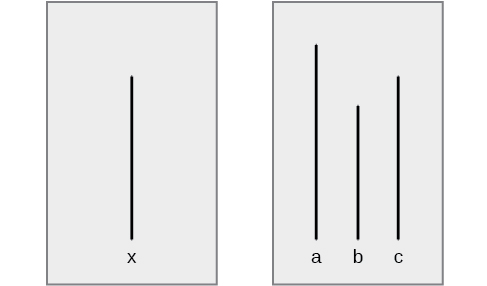
Figure 12.17図 12.17
These line segments illustrate the judgment task in Asch’s conformity study. Which line on the right—a, b, or c—is the same length as line x on the left?
これらの線分は、アッシュの同調研究における判断課題を示している。右側の線a、b、cのうち、左側の線xと同じ長さなのはどれか。
Each group of participants had only one true, naïve subject. The remaining members of the group were confederates of the researcher. A confederate is a person who is aware of the experiment and works for the researcher. Confederates are used to manipulate social situations as part of the research design, and the true, naïve participants believe that confederates are, like them, uninformed participants in the experiment. In Asch’s study, the confederates identified a line segment that was obviously shorter than the target line—a wrong answer. The naïve participant then had to identify aloud the line segment that best matched the target line segment.
英語のヒント
参加者の各集団には、事情を知らない本当の対象者が一人しかいなかった。集団の残りのメンバーは、研究者のサクラだった。サクラとは、実験のことを知っていて、研究者のために働く人物である。サクラは研究デザインの一部として社会的状況を操作するために用いられ、事情を知らない本当の参加者は、サクラも自分と同じく何も知らされていない実験の参加者だと信じている。アッシュの研究では、サクラたちは、基準の線より明らかに短い線分、つまり誤った答えを選んだ。その後、事情を知らない参加者は、基準の線分に最もよく一致する線分を声に出して答えなければならなかった。
How often do you think the true participant aligned with the confederates’ response? That is, how often do you think the group influenced the participant, and the participant gave the wrong answer? Asch (1955) found that 76% of participants conformed to group pressure at least once by indicating the incorrect line. Conformity is the change in a person’s behavior to go along with the group, even if he does not agree with the group. Why would people give the wrong answer? What factors would increase or decrease someone giving in or conforming to group pressure?
英語のヒント
本当の参加者は、どれくらいの頻度でサクラの答えに合わせたと思うだろうか。つまり、集団が参加者に影響を与え、参加者が誤った答えを出したのは、どれくらいの頻度だったと思うだろうか。アッシュ(1955)は、参加者の76%が、誤った線を示すことで、少なくとも一度は集団の圧力に同調したことを見いだした。同調とは、集団に同意していなくても、集団に合わせるように人の行動が変わることである。人はなぜ誤った答えを出すのだろうか。人が集団の圧力に屈したり同調したりすることは、どのような要因によって増えたり減ったりするのだろうか。
The Asch effect is the influence of the group majority on an individual’s judgment.
英語のヒント
アッシュ効果とは、集団の多数派が個人の判断に及ぼす影響である。
What factors make a person more likely to yield to group pressure? Research shows that the size of the majority, the presence of another dissenter, and the public or relatively private nature of responses are key influences on conformity.
英語のヒント
どのような要因が、人が集団の圧力に屈する可能性を高めるのだろうか。研究によれば、多数派の人数、ほかに異を唱える人がいること、そして回答が公開されるか比較的非公開かという性質が、同調に影響を与える重要な要因である。
- The size of the majority: The greater the number of people in the majority, the more likely an individual will conform. There is, however, an upper limit: a point where adding more members does not increase conformity. In Asch’s study, conformity increased with the number of people in the majority—up to seven individuals. At numbers beyond seven, conformity leveled off and decreased slightly (Asch, 1955).
英語のヒント
多数派の人数:多数派の人数が多いほど、個人が同調する可能性は高くなる。ただし上限がある。それ以上メンバーを増やしても同調が増えなくなる点である。アッシュの研究では、同調は多数派の人数とともに増えたが、それは7人までだった。7人を超えると、同調は横ばいになり、わずかに減少した(Asch, 1955)。 - The presence of another dissenter: If there is at least one dissenter, conformity rates drop to near zero (Asch, 1955).
英語のヒント
ほかに異を唱える人がいること:異を唱える人が少なくとも一人いれば、同調率はほぼゼロにまで下がる(Asch, 1955)。 - The public or private nature of the responses: When responses are made publicly (in front of others), conformity is more likely; however, when responses are made privately (e.g., writing down the response), conformity is less likely (Deutsch & Gerard, 1955).
英語のヒント
回答が公開か非公開かという性質:回答を公の場で(他者の前で)行うと、同調が起こる可能性は高くなる。しかし、回答を非公開で(たとえば答えを書き留める形で)行うと、同調が起こる可能性は低くなる(Deutsch & Gerard, 1955)。
The finding that conformity is more likely to occur when responses are public than when they are private is the reason government elections require voting in secret, so we are not coerced by others (Figure 12.18). The Asch effect can be easily seen in children when they have to publicly vote for something. For example, if the teacher asks whether the children would rather have extra recess, no homework, or candy, once a few children vote, the rest will comply and go with the majority. In a different classroom, the majority might vote differently, and most of the children would comply with that majority. When someone’s vote changes if it is made in public versus private, this is known as compliance. Compliance can be a form of conformity. Compliance is going along with a request or demand, even if you do not agree with the request. In Asch’s studies, the participants complied by giving the wrong answers, but privately did not accept that the obvious wrong answers were correct.
英語のヒント
回答が非公開のときよりも公開のときの方が同調が起こりやすいという知見は、政府の選挙で秘密投票が求められている理由であり、これによって私たちは他者に強制されずにすむ(図12.18)。アッシュ効果は、子どもが何かについて人前で投票しなければならないときに、容易に見てとることができる。たとえば、先生が子どもたちに、休み時間を増やしてもらうのと、宿題をなしにしてもらうのと、お菓子をもらうのとではどれがいいかを尋ねると、何人かの子どもが投票したとたんに、残りの子どもたちはそれに従い、多数派に合わせるだろう。別の教室では多数派が違うものに投票するかもしれないが、その場合も、子どもたちの大半はその多数派に従うだろう。投票が人前で行われるか非公開で行われるかによってその人の票が変わるとき、これは追従として知られている。追従は同調の一形態でありうる。追従とは、たとえ要請に同意していなくても、要請や要求に従うことである。アッシュの研究で、参加者は誤った答えを出すことで追従したが、内心では、明らかに誤った答えが正しいとは受け入れていなかった。
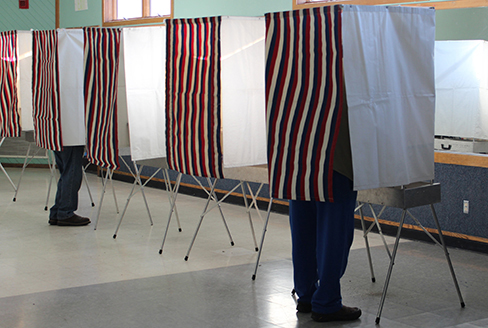


Figure 12.18図 12.18
Voting for government officials in the United States is private to reduce the pressure of conformity. (credit: Nicole Klauss)
アメリカでは、公職者を選ぶ投票は、同調の圧力を減らすために非公開で行われる。(出典:Nicole Klauss)
Now that you have learned about the Asch line experiments, why do you think the participants conformed? The correct answer to the line segment question was obvious, and it was an easy task. Researchers have categorized the motivation to conform into two types: normative social influence and informational social influence (Deutsch & Gerard, 1955).
英語のヒント
アッシュの線分実験について学んだところで、参加者はなぜ同調したのだと思うだろうか。線分の問いの正解は明らかで、簡単な課題だった。研究者たちは、同調への動機づけを、規範的社会的影響と情報的社会的影響の二つの型に分類している(Deutsch & Gerard, 1955)。
In normative social influence, people conform to the group norm to fit in, to feel good, and to be accepted by the group. However, with informational social influence, people conform because they believe the group is competent and has the correct information, particularly when the task or situation is ambiguous. What type of social influence was operating in the Asch conformity studies? Since the line judgment task was unambiguous, participants did not need to rely on the group for information. Instead, participants complied to fit in and avoid ridicule, an instance of normative social influence.
英語のヒント
規範的社会的影響では、人は、集団になじみ、いい気分になり、集団に受け入れられるために、集団の規範に同調する。一方、情報的社会的影響では、人は、集団には能力があり正しい情報を持っていると信じているために同調する。課題や状況があいまいなときには、とくにそうである。アッシュの同調研究で働いていたのは、どちらの型の社会的影響だったのだろうか。線の判断課題にはあいまいさがなかったので、参加者は情報を集団に頼る必要がなかった。そうではなく、参加者は集団になじみ、嘲笑を避けるために追従したのであり、これは規範的社会的影響の一例である。
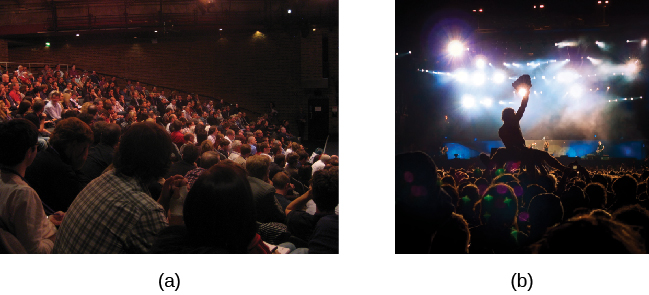
An example of informational social influence may be what to do in an emergency situation. Imagine that you are in a movie theater watching a film and what seems to be smoke comes in the theater from under the emergency exit door. You are not certain that it is smoke—it might be a special effect for the movie, such as a fog machine. When you are uncertain you will tend to look at the behavior of others in the theater. If other people show concern and get up to leave, you are likely to do the same. However, if others seem unconcerned, you are likely to stay put and continue watching the movie (Figure 12.19).
英語のヒント
情報的社会的影響の例として、緊急事態で何をすべきかということが挙げられるだろう。映画館で映画を見ていると、非常口の扉の下から、煙のように見えるものが館内に入ってきたところを想像してほしい。それが煙だという確信はない。フォグマシンのような、映画の特殊効果かもしれない。確信が持てないとき、あなたは館内のほかの人々の行動に目を向ける傾向があるだろう。ほかの人々が心配そうな様子を見せ、立ち上がって出ていこうとすれば、あなたも同じことをする可能性が高い。しかし、ほかの人々が気にしていないように見えれば、あなたはその場にとどまって映画を見続ける可能性が高い(図12.19)。
OpenStax, Rice University; Psychology 2e. (credit a: modification of work by Matt Brown; credit b: modification of work by Christian Holmér) · CC BY 4.0 · Source出典

Figure 12.19図 12.19
People in crowds tend to take cues from others and act accordingly. (a) An audience is listening to a lecture and people are relatively quiet, still, and attentive to the speaker on the stage. (b) An audience is at a rock concert where people are dancing, singing, and possibly engaging in activities like crowd surfing. (credit a: modification of work by Matt Brown; credit b: modification of work by Christian Holmér)
群衆の中の人々は、他者から手がかりを得て、それに合わせて行動する傾向がある。(a)講演を聞いている聴衆。人々は比較的静かで、じっとしており、壇上の話し手に注意を向けている。(b)ロックコンサートの観客。人々は踊ったり歌ったりしており、クラウドサーフィンのような行動をしている人もいるかもしれない。(出典a:Matt Brownの作品を改変、出典b:Christian Holmérの作品を改変)
How would you have behaved if you were a participant in Asch’s study? Many students say they would not conform, that the study is outdated, and that people nowadays are more independent. To some extent this may be true. Research suggests that overall rates of conformity may have reduced since the time of Asch’s research. Furthermore, efforts to replicate Asch’s study have made it clear that many factors determine how likely it is that someone will demonstrate conformity to the group. These factors include the participant’s age, gender, and socio-cultural background (Bond & Smith, 1996; Larsen, 1990; Walker & Andrade, 1996).
英語のヒント
もしあなたがアッシュの研究の参加者だったら、どのように振る舞っただろうか。多くの学生は、自分なら同調しないだろう、その研究は時代遅れだ、今の人々はもっと独立心が強い、と言う。ある程度は、これは正しいかもしれない。研究からは、全体としての同調率が、アッシュの研究の時代から低下しているかもしれないことが示唆されている。さらに、アッシュの研究を追試する試みによって、ある人が集団への同調を示す可能性がどの程度あるかは、多くの要因によって決まることが明らかになっている。こうした要因には、参加者の年齢、性別、社会文化的背景が含まれる(Bond & Smith, 1996; Larsen, 1990; Walker & Andrade, 1996)。