第12章社会心理学
Scriptsスクリプト
Because of social roles, people tend to know what behavior is expected of them in specific, familiar settings. A script is a person’s knowledge about the sequence of events expected in a specific setting (Schank & Abelson, 1977). How do you act on the first day of school, when you walk into an elevator, or are at a restaurant? For example, at a restaurant in the United States, if we want the server’s attention, we try to make eye contact. In Brazil, you would make the sound “psst” to get the server’s attention. You can see the cultural differences in scripts. To an American, saying “psst” to a server might seem rude, yet to a Brazilian, trying to make eye contact might not seem an effective strategy. Scripts are important sources of information to guide behavior in given situations. Can you imagine being in an unfamiliar situation and not having a script for how to behave? This could be uncomfortable and confusing. How could you find out about social norms in an unfamiliar culture?
英語のヒント
社会的役割があるため、人はたいてい、特定のなじみのある場面で自分にどのような行動が期待されているかを知っている。スクリプトとは、特定の場面で予期される出来事の順序について、人が持っている知識である(Schank & Abelson, 1977)。学校の初日や、エレベーターに乗り込むとき、レストランにいるとき、あなたはどのように振る舞うだろうか。たとえばアメリカのレストランでは、給仕係の注意を引きたいとき、私たちは目を合わせようとする。ブラジルでは、給仕係の注意を引くために「psst」という音を出すだろう。ここに、スクリプトの文化による違いが見てとれる。アメリカ人にとって、給仕係に「psst」と言うのは失礼に思えるかもしれないが、ブラジル人にとっては、目を合わせようとするのは効果的なやり方に思えないかもしれない。スクリプトは、ある状況での行動を導く重要な情報源である。なじみのない状況に置かれ、どう振る舞えばよいかのスクリプトを持っていない状態を想像できるだろうか。それは居心地が悪く、戸惑うものかもしれない。なじみのない文化の社会規範について、どうすれば知ることができるだろうか。
Zimbardo’s Stanford Prison Experimentジンバルドーのスタンフォード監獄実験
The famous Stanford prison experiment, conducted by social psychologist Philip Zimbardo and his colleagues at Stanford University, demonstrated the power of social roles, social norms, and scripts. In the summer of 1971, an advertisement was placed in a California newspaper asking for male volunteers to participate in a study about the psychological effects of prison life. More than 70 men volunteered, and these volunteers then underwent psychological testing to eliminate candidates who had underlying psychiatric issues, medical issues, or a history of crime or drug abuse. The pool of volunteers was whittled down to 24 healthy male college students. Each student was paid $15 per day (equivalent to about $80 today) and was randomly assigned to play the role of either a prisoner or a guard in the study. Based on what you have learned about research methods, why is it important that participants were randomly assigned?
英語のヒント
有名なスタンフォード監獄実験は、社会心理学者フィリップ・ジンバルドーとスタンフォード大学の同僚たちが行ったもので、社会的役割、社会規範、スクリプトの力を実証した。1971年の夏、カリフォルニアの新聞に、監獄生活の心理的影響についての研究に参加する男性ボランティアを募る広告が掲載された。70人を超える男性が応募し、応募者たちはその後、精神医学的な問題や医学的な問題を潜在的に抱えている人、あるいは犯罪歴や薬物乱用歴のある人を候補から除外するために、心理検査を受けた。応募者は、健康な男子大学生24人にまで絞り込まれた。学生にはそれぞれ1日15ドル(現在の約80ドルに相当)が支払われ、研究の中で囚人か看守のどちらかの役割を演じるよう、無作為に割り当てられた。研究法について学んだことに基づいて考えると、参加者が無作為に割り当てられたことはなぜ重要なのだろうか。
A mock prison was constructed in the basement of the psychology building at Stanford. Participants assigned to play the role of prisoners were “arrested” at their homes by Palo Alto police officers, booked at a police station, and subsequently taken to the mock prison. The experiment was scheduled to run for several weeks. To the surprise of the researchers, both the “prisoners” and “guards” assumed their roles with zeal. On the second day of the experiment, the guards forced the prisoners to strip, took their beds, and isolated the ringleaders using solitary confinement. In a relatively short time, the guards came to harass the prisoners in an increasingly sadistic manner, through a complete lack of privacy, lack of basic comforts such as mattresses to sleep on, and through degrading chores and late-night counts.
英語のヒント
スタンフォード大学の心理学棟の地下に、模擬監獄がつくられた。囚人の役割を演じるよう割り当てられた参加者は、自宅でパロアルト警察の警察官に「逮捕」され、警察署で逮捕の手続きを受けたのち、模擬監獄へ連れて行かれた。実験は数週間続く予定だった。研究者たちが驚いたことに、「囚人」も「看守」も、熱意をもって自分の役割を担った。実験の2日目、看守たちは囚人に服を脱ぐよう強制し、ベッドを取り上げ、首謀者たちを独房に監禁して隔離した。比較的短い期間のうちに、看守たちはますますサディスティックなやり方で囚人たちを苦しめるようになった。プライバシーをまったく与えず、寝るためのマットレスのような基本的な快適さも与えず、屈辱的な雑用や深夜の点呼を課したのである。
The prisoners, in turn, began to show signs of severe anxiety and hopelessness—they began tolerating the guards’ abuse. Even the Stanford professor who designed the study and was the head researcher, Philip Zimbardo, found himself acting as if the prison was real and his role, as prison supervisor, was real as well. After only six days, the experiment had to be ended due to the participants’ deteriorating behavior. Zimbardo explained,
英語のヒント
それを受けて囚人たちは、深刻な不安と絶望の兆候を示しはじめ、看守の虐待を甘んじて受け入れるようになった。研究を計画し主任研究者を務めていたスタンフォード大学の教授フィリップ・ジンバルドーでさえ、気がつくと、監獄が本物であり、監獄の所長という自分の役割もまた本物であるかのように振る舞っていた。参加者の行動が悪化していったため、実験はわずか6日で打ち切らざるをえなかった。ジンバルドーは次のように説明している。
At this point it became clear that we had to end the study. We had created an overwhelmingly powerful situation—a situation in which prisoners were withdrawing and behaving in pathological ways, and in which some of the guards were behaving sadistically. Even the “good” guards felt helpless to intervene, and none of the guards quit while the study was in progress. Indeed, it should be noted that no guard ever came late for his shift, called in sick, left early, or demanded extra pay for overtime work. (Zimbardo, 2013)英語のヒント
この時点で、研究を終わらせなければならないことが明らかになった。私たちは圧倒的に強力な状況をつくり出してしまっていた。囚人たちが引きこもり、病的な振る舞いをし、看守の一部がサディスティックに振る舞うような状況である。「善良な」看守たちでさえ、止めに入ることはできないと無力感を覚えており、研究が続いているあいだ、看守は誰一人やめなかった。実際、特筆しておくべきことに、シフトに遅刻したり、病欠の連絡をしたり、早退したり、残業代を要求したりした看守は一人もいなかった。(Zimbardo, 2013)
The Stanford Prison Experiment has been used as a memorable demonstration of the incredible power that social roles, norms, and scripts have in affecting human behavior. However, multiple aspects of the study have been subject to criticism since its inception. The nature of these criticisms range from ethical concerns to issues of generalizability (Bartels, Milovich, & Moussier, 2016; Griggs, 2014; Le Texier, 2019). One criticism is that the way students were recruited for the experiment may have impacted the outcome (Carnahan & McFarland, 2007). Another criticism questions the conclusions that can be drawn from the study. Zimbardo appears to have provided specific guidelines of the types of behaviors that were expected of the guards (Zimbardo, 2007). Subsequent research suggests that such guidelines likely created an expectation of the types of behavior that Zimbardo reported observing in the Stanford Prison Experiment (Bartels, 2019), and that given these expectations, the guards simply acted as they thought they were expected to act. It has also been problematic that attempts to replicate aspects of the study have not been successful. For example, when no guidelines were presented to the guards, researchers documented different outcomes than those observed by Zimbardo. (Reicher & Haslam, 2006).
英語のヒント
スタンフォード監獄実験は、社会的役割、規範、スクリプトが人間の行動に影響を及ぼすうえで持つ驚くべき力を示す、印象深い実例として用いられてきた。しかし、この研究のさまざまな側面は、その開始以来、批判にさらされてきた。批判の中身は、倫理的な懸念から一般化可能性の問題にまで及ぶ(Bartels, Milovich, & Moussier, 2016; Griggs, 2014; Le Texier, 2019)。批判の一つは、実験のための学生の募集の仕方が、結果に影響したかもしれないというものである(Carnahan & McFarland, 2007)。もう一つの批判は、この研究から引き出せる結論に疑問を投げかける。ジンバルドーは、看守に期待される行動の種類について、具体的な指針を与えていたようである(Zimbardo, 2007)。その後の研究は、そうした指針が、ジンバルドーがスタンフォード監獄実験で観察したと報告した種類の行動への期待を生み出した可能性が高いこと(Bartels, 2019)、そして、そうした期待があったことを考えると、看守たちは単に、自分たちに期待されていると考えたとおりに行動したにすぎないことを示唆している。この研究の諸側面を追試しようとする試みが成功していないことも、問題となってきた。たとえば、看守に指針が示されなかった場合、研究者たちは、ジンバルドーが観察したのとは異なる結果を記録した(Reicher & Haslam, 2006)。
The Stanford Prison Experiment has some parallels with the abuse of prisoners of war by U.S. Army troops and CIA personnel at the Abu Ghraib prison in 2003 and 2004 during the Iraq War. The offenses at Abu Ghraib were documented by photographs of the abuse, some taken by the abusers themselves (Figure 12.10).
英語のヒント
スタンフォード監獄実験には、イラク戦争中の2003年と2004年に、アブグレイブ刑務所でアメリカ陸軍の部隊とCIAの職員が行った捕虜虐待と、いくつかの類似点がある。アブグレイブでの違法行為は虐待の写真によって記録されており、その一部は虐待を行った者たち自身が撮影したものだった(図12.10)。
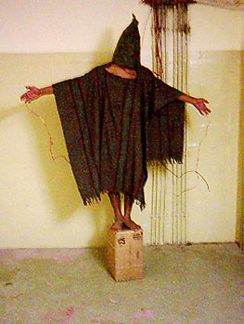
OpenStax, Rice University; Psychology 2e. (credit: United States Department of Defense) · CC BY 4.0 · Source出典

Figure 12.10図 12.10
Iraqi prisoners of war were abused by their American captors in Abu Ghraib prison, during the second Iraq war. (credit: United States Department of Defense)
第二次イラク戦争中、アブグレイブ刑務所で、イラク人の捕虜たちが、彼らを捕らえていたアメリカ人たちから虐待を受けた。(出典:United States Department of Defense)