第12章社会心理学
12.5 Prejudice and Discrimination12.5 偏見と差別
Learning Objectives学習目標
By the end of this section, you will be able to:
この節を学び終えると、次のことができるようになる。
- Define and distinguish among prejudice, stereotypes, and discrimination偏見、ステレオタイプ、差別を定義し、区別する
- Provide examples of prejudice, stereotypes, and discrimination偏見、ステレオタイプ、差別の例を挙げる
- Explain why prejudice and discrimination exist偏見と差別がなぜ存在するのかを説明する
Human conflict can result in crime, war, and mass murder, such as genocide. Prejudice and discrimination often are root causes of human conflict, which explains how strangers come to hate one another to the extreme of causing others harm. Prejudice and discrimination affect everyone. In this section we will examine the definitions of prejudice and discrimination, examples of these concepts, and causes of these biases.
英語のヒント
人間どうしの対立は、犯罪や戦争、さらにはジェノサイド(集団殺害)のような大量殺人につながることがある。偏見と差別はしばしば人間の対立の根本的な原因であり、そのことから、見知らぬ者どうしが、相手に危害を加えるほど極端に互いを憎むようになる仕組みが説明できる。偏見と差別は、すべての人に影響を及ぼす。この節では、偏見と差別の定義、これらの概念の例、そしてこうしたバイアスの原因を検討する。
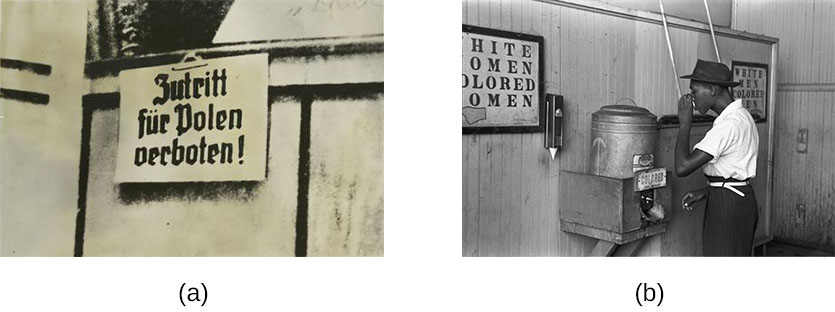
OpenStax, Rice University; Psychology 2e. (credit b: modification of work by United States Farm Security Administration) · CC BY 4.0 · Source出典

Figure 12.21図 12.21
Prejudice and discrimination occur across the globe. (a) A 1939 sign in German-occupied Poland warns “No Entrance for Poles!” (b) An African-American male drinks from a designated “colored” water fountain in Oklahoma in 1939 during the era of racial segregation as a practice of discrimination. (credit b: modification of work by United States Farm Security Administration)
偏見と差別は世界中で起きている。(a)ドイツ占領下のポーランドにあった1939年の看板は、「ポーランド人立ち入り禁止!」と警告している。(b)差別の慣行として人種分離が行われていた時代にあたる1939年のオクラホマ州で、アフリカ系アメリカ人の男性が、「有色人種」用に指定された水飲み器から水を飲んでいる。(出典b:United States Farm Security Administrationの作品を改変)
Understanding Prejudice and Discrimination偏見と差別を理解する
As we discussed in the opening story of Trayvon Martin, humans are very diverse and although we share many similarities, we also have many differences. The social groups we belong to help form our identities (Tajfel, 1974). These differences may be difficult for some people to reconcile, which may lead to prejudice toward people who are different. Prejudice is a negative attitude and feeling toward an individual based solely on one’s membership in a particular social group (Allport, 1954; Brown, 2010). Prejudice is common against people who are members of an unfamiliar cultural group. Thus, certain types of education, contact, interactions, and building relationships with members of different cultural groups can reduce the tendency toward prejudice. In fact, simply imagining interacting with members of different cultural groups might affect prejudice. Indeed, when experimental participants were asked to imagine themselves positively interacting with someone from a different group, this led to an increased positive attitude toward the other group and an increase in positive traits associated with the other group. Furthermore, imagined social interaction can reduce anxiety associated with inter-group interactions (Crisp & Turner, 2009). What are some examples of social groups that you belong to that contribute to your identity? Social groups can include gender, race, ethnicity, nationality, social class, religion, sexual orientation, profession, and many more. And, as is true for social roles, you can simultaneously be a member of more than one social group. An example of prejudice is having a negative attitude toward people who are not born in the United States. Although people holding this prejudiced attitude do not know all people who were not born in the United States, they dislike them due to their status as foreigners.
英語のヒント
冒頭のトレイボン・マーティンの話で論じたように、人間はきわめて多様であり、多くの共通点を持つ一方で、多くの違いも持っている。私たちが属する社会集団は、私たちのアイデンティティの形成を助ける(Tajfel, 1974)。こうした違いに折り合いをつけるのが難しい人もいるかもしれず、そのことが、自分とは異なる人々への偏見につながりうる。偏見とは、ある個人に対して、その人が特定の社会集団の一員であるというだけの理由で抱かれる、否定的な態度と感情である(Allport, 1954; Brown, 2010)。偏見は、なじみのない文化集団の一員である人々に対してよく見られる。したがって、ある種の教育、接触、交流、そして異なる文化集団の人々との関係づくりは、偏見に向かう傾向を減らしうる。実際、異なる文化集団の人々と交流するところを想像するだけでも、偏見に影響するかもしれない。現に、実験の参加者に、異なる集団の誰かと好意的に交流している自分を想像するよう求めると、相手の集団に対する肯定的な態度が強まり、相手の集団と結びつけられる肯定的な特性も増えた。さらに、想像上の社会的交流は、集団間の交流にともなう不安を減らしうる(Crisp & Turner, 2009)。あなたが属していて、あなたのアイデンティティの一部となっている社会集団には、どのようなものがあるだろうか。社会集団には、性別、人種、民族、国籍、社会階級、宗教、性的指向、職業など、ほかにも多くのものが含まれうる。そして、社会的役割の場合と同じように、人は同時に複数の社会集団の一員でありうる。偏見の一例は、アメリカ生まれでない人々に対して否定的な態度を持つことである。こうした偏見のある態度を持つ人は、アメリカ生まれでない人を全員知っているわけではないのに、外国人という立場を理由に彼らを嫌うのである。
Can you think of a prejudiced attitude you have held toward a group of people? How did your prejudice develop? Prejudice often begins in the form of a stereotype—that is, a specific belief or assumption about individuals based solely on their membership in a group, regardless of their individual characteristics. Stereotypes become overgeneralized and applied to all members of a group. For example, someone holding prejudiced attitudes toward older adults, may believe that older adults are slow and incompetent (Cuddy, Norton, & Fiske, 2005; Nelson, 2004). We cannot possibly know each individual person of advanced age to know that all older adults are slow and incompetent. Therefore, this negative belief is overgeneralized to all members of the group, even though many of the individual group members may in fact be spry and intelligent.
英語のヒント
ある集団の人々に対して、あなたがこれまでに抱いたことのある偏見のある態度を、何か思い浮かべられるだろうか。その偏見はどのようにして生まれたのだろうか。偏見はしばしばステレオタイプという形で始まる。ステレオタイプとは、個人の特徴にかかわらず、ある集団の一員であるというだけの理由で、その人たちについて抱かれる特定の信念や思い込みである。ステレオタイプは過度に一般化され、集団のすべての成員に当てはめられるようになる。たとえば、高齢者に偏見のある態度を持つ人は、高齢者はのろくて無能だと信じているかもしれない(Cuddy, Norton, & Fiske, 2005; Nelson, 2004)。高齢の人を一人ひとりすべて知ったうえで、高齢者はみなのろくて無能だと知ることなど、私たちにはとうていできない。したがって、この否定的な信念は、集団のすべての成員へと過度に一般化されている。実際には、その集団の個々の成員の多くが、元気で聡明であるかもしれないにもかかわらずである。
Another example of a well-known stereotype involves beliefs about racial differences among athletes. As Hodge, Burden, Robinson, and Bennett (2008) point out, Black athletes are often believed to be more athletic, yet less intelligent, than their White counterparts. These beliefs persist despite a number of high profile examples to the contrary. Sadly, such beliefs often influence how these athletes are treated by others and how they view themselves and their own capabilities. Whether or not you agree with a stereotype, stereotypes are generally well-known within a given culture (Devine, 1989).
英語のヒント
よく知られたステレオタイプのもう一つの例は、スポーツ選手の人種による違いについての信念にかかわるものである。ホッジ、バーデン、ロビンソン、ベネット(2008)が指摘するように、黒人のスポーツ選手は、白人の選手に比べて運動能力は高いが知性は劣る、としばしば信じられている。こうした信念は、それに反する注目度の高い例が数多くあるにもかかわらず、根強く残っている。残念なことに、このような信念はしばしば、こうした選手が他者からどう扱われるか、そして選手自身が自分と自分の能力をどう見るかに影響を与える。あるステレオタイプに賛成するかどうかにかかわらず、ステレオタイプは一般に、ある文化の中で広く知られている(Devine, 1989)。
Sometimes people will act on their prejudiced attitudes toward a group of people, and this behavior is known as discrimination. Discrimination is negative action toward an individual as a result of one’s membership in a particular group (Allport, 1954; Dovidio & Gaertner, 2004). As a result of holding negative beliefs (stereotypes) and negative attitudes (prejudice) about a particular group, people often treat the target of prejudice poorly, such as excluding older adults from their circle of friends. In this way, discrimination is a form of oppression. An example of a psychologist experiencing gender discrimination is found in the life and studies of Mary Whiton Calkins. Calkins was given special permission to attend graduate seminars at Harvard (at that time in the late 1880s, Harvard did not accept women) and at one point was the sole student of the famous psychologist William James. She passed all the requirements needed for a PhD and was described by psychologist Hugo Münsterberg as “one of the strongest professors of psychology in this country.” However, Harvard refused to grant Calkins a PhD because she was a woman (Harvard University, 2019). Table 12.3 summarizes the characteristics of stereotypes, prejudice, and discrimination. Have you ever been the target of discrimination? If so, how did this negative treatment make you feel?
英語のヒント
人は、ある集団の人々に対して抱いている偏見のある態度に基づいて、行動に出ることがある。この行動は差別として知られている。差別とは、ある個人に対して、その人が特定の集団の一員であることの結果として向けられる否定的な行為である(Allport, 1954; Dovidio & Gaertner, 2004)。特定の集団について否定的な信念(ステレオタイプ)と否定的な態度(偏見)を抱いている結果として、人はしばしば偏見の対象をひどく扱う。たとえば、高齢者を自分の友人の輪から締め出すといったことである。このように、差別は抑圧の一形態である。性別による差別を経験した心理学者の例は、メアリー・ホイトン・カルキンズの生涯と学業に見いだされる。カルキンズは特別な許可を得てハーバード大学の大学院のゼミに出席し(1880年代後半の当時、ハーバードは女性を受け入れていなかった)、一時は著名な心理学者ウィリアム・ジェームズのただ一人の学生だった。彼女はPhD取得に必要な要件をすべて満たし、心理学者ヒューゴー・ミュンスターバーグからは「この国で最も優れた心理学の教授の一人」と評された。しかし、ハーバードは、女性であるという理由でカルキンズにPhDを授与することを拒んだ(Harvard University, 2019)。表12.3は、ステレオタイプ、偏見、差別の特徴をまとめたものである。あなたはこれまでに差別の対象になったことがあるだろうか。あるとすれば、その否定的な扱いによって、あなたはどのような気持ちになっただろうか。
Connecting Stereotypes, Prejudice, and Discrimination ステレオタイプ、偏見、差別の結びつき |
|||
|---|---|---|---|
Item 項目 |
Function 働き |
Connection つながり |
Example 例 |
Stereotype ステレオタイプ |
Cognitive; thoughts about people 認知的:人々についての考え |
Overgeneralized beliefs about people may lead to prejudice. 人々についての過度に一般化された信念が、偏見につながることがある。 |
“Yankees fans are arrogant and obnoxious.” 「ヤンキースのファンは傲慢で鼻持ちならない。」 |
Prejudice 偏見 |
Affective; feelings about people, both positive and negative 感情的:人々についての感情。肯定的なものも否定的なものも含む |
Feelings may influence treatment of others, leading to discrimination. 感情が他者の扱い方に影響し、差別につながることがある。 |
“I hate Yankees fans; they make me angry.” 「ヤンキースのファンは大嫌いだ。あいつらには腹が立つ。」 |
Discrimination 差別 |
Behavior; positive or negative treatment of others 行動:他者に対する肯定的または否定的な扱い |
Holding stereotypes and harboring prejudice may lead to excluding, avoiding, and biased treatment of group members. ステレオタイプを持ち、偏見を抱いていることが、集団の成員を締め出したり、避けたり、偏った扱いをしたりすることにつながりうる。 |
“I would never hire nor become friends with a person if I knew they were a Yankees fan.” 「ヤンキースのファンだと分かったら、その人は決して雇わないし、友だちにもならない。」 |
So far, we’ve discussed stereotypes, prejudice, and discrimination as negative thoughts, feelings, and behaviors because these are typically the most problematic. However, it is important to also point out that people can hold positive thoughts, feelings, and behaviors toward individuals based on group membership; for example, they would show preferential treatment for people who are like themselves—that is, who share the same gender, race, or favorite sports team.
英語のヒント
ここまでは、ステレオタイプ、偏見、差別を、否定的な考え・感情・行動として論じてきた。一般にそれらが最も問題になるからである。しかし、人は集団の成員であることに基づいて、個人に対して肯定的な考え・感情・行動を持つこともありうる、という点も指摘しておくことが重要である。たとえば人は、自分と似た人、つまり同じ性別や人種の人、あるいは同じスポーツチームを好きな人を優遇するだろう。