第10章液体と固体
10.6 Lattice Structures in Crystalline Solids10.6 結晶性固体の格子構造
Learning Objectives学習目標
By the end of this section, you will be able to:
この節を学ぶと、次のことができるようになる。
- Describe the arrangement of atoms and ions in crystalline structures結晶構造中の原子とイオンの配列を説明する。
- Compute ionic radii using unit cell dimensions単位格子の寸法を使ってイオン半径を計算する。
- Explain the use of X-ray diffraction measurements in determining crystalline structures結晶構造の決定にX線回折測定をどのように使うかを説明する。
Over 90% of naturally occurring and man-made solids are crystalline. Most solids form with a regular arrangement of their particles because the overall attractive interactions between particles are maximized, and the total intermolecular energy is minimized, when the particles pack in the most efficient manner. The regular arrangement at an atomic level is often reflected at a macroscopic level. In this module, we will explore some of the details about the structures of metallic and ionic crystalline solids, and learn how these structures are determined experimentally.
英語のヒント
自然に存在する固体と人工の固体の90%以上は結晶性である。大部分の固体では、粒子が規則正しく並ぶ。粒子が最も効率よく詰まると、粒子間の引力的な相互作用が全体として最大になり、分子間エネルギーの総和が最小になるためである。原子レベルの規則的配列は、巨視的なレベルにも現れることが多い。この節では、金属結晶とイオン結晶の構造を詳しく調べ、その構造を実験でどのように決定するかを学ぶ。
The Structures of Metals金属の構造
We will begin our discussion of crystalline solids by considering elemental metals, which are relatively simple because each contains only one type of atom. A pure metal is a crystalline solid with metal atoms packed closely together in a repeating pattern. Some of the properties of metals in general, such as their malleability and ductility, are largely due to having identical atoms arranged in a regular pattern. The different properties of one metal compared to another partially depend on the sizes of their atoms and the specifics of their spatial arrangements. We will explore the similarities and differences of four of the most common metal crystal geometries in the sections that follow.
英語のヒント
結晶性固体の説明は、比較的単純な単体金属から始める。単体金属に含まれる原子は一種類だけだからである。純粋な金属は、金属原子が繰り返しパターンに従って密に詰まった結晶性固体である。展性や延性など、金属に一般的に見られる性質の一部は、同じ原子が規則正しく並んでいることに主として由来する。金属ごとの性質の違いは、原子の大きさや空間配列の具体的な違いにも依存する。以下では、代表的な四つの金属結晶構造の共通点と相違点を調べる。
Unit Cells of Metals金属の単位格子
The structure of a crystalline solid, whether a metal or not, is best described by considering its simplest repeating unit, which is referred to as its unit cell. The unit cell consists of lattice points that represent the locations of atoms or ions. The entire structure then consists of this unit cell repeating in three dimensions, as illustrated in Figure 10.47.
英語のヒント
結晶性固体の構造は、金属かどうかにかかわらず、最も単純な繰り返し単位を考えると最もよく説明できる。この単位を単位格子という。単位格子には、原子やイオンの位置を表す格子点がある。図10.47のように、この単位格子が三次元的に繰り返されて、全体の構造ができる。
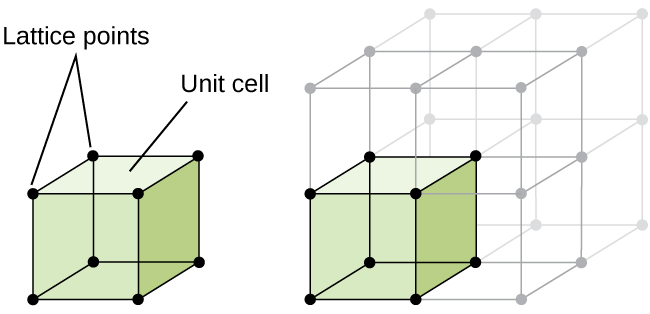
Figure 10.47図 10.47
A unit cell shows the locations of lattice points repeating in all directions.
単位格子は、あらゆる方向に繰り返す格子点の位置を示す。
Let us begin our investigation of crystal lattice structure and unit cells with the most straightforward structure and the most basic unit cell. To visualize this, imagine taking a large number of identical spheres, such as tennis balls, and arranging them uniformly in a container. The simplest way to do this would be to make layers in which the spheres in one layer are directly above those in the layer below, as illustrated in Figure 10.48. This arrangement is called simple cubic structure, and the unit cell is called the simple cubic unit cell or primitive cubic unit cell.
英語のヒント
結晶格子構造と単位格子を、最も単純な構造と最も基本的な単位格子から調べよう。その姿を思い浮かべるため、テニスボールのような同じ球を多数用意し、容器の中に一様に並べると考える。最も単純なのは、図10.48のように、ある層の球がその下の層の球の真上に来るよう、層を重ねる並べ方である。この配列を単純立方構造といい、その単位格子を単純立方単位格子、または原始立方単位格子という。
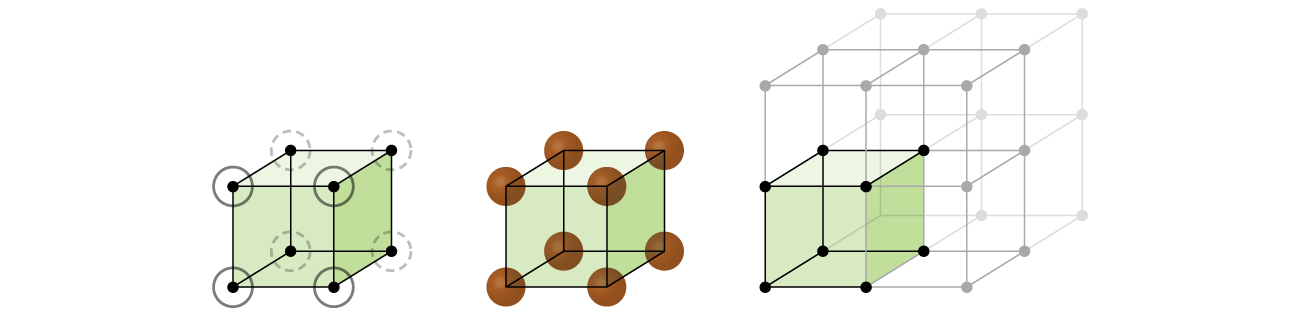
Figure 10.48図 10.48
When metal atoms are arranged with spheres in one layer directly above or below spheres in another layer, the lattice structure is called simple cubic. Note that the spheres are in contact.
金属原子を、一つの層の球が別の層の球の真上または真下に来るように並べた格子構造を、単純立方構造という。球どうしは接触していることに注意しよう。
In a simple cubic structure, the spheres are not packed as closely as they could be, and they only “fill” about 52% of the volume of the container. This is a relatively inefficient arrangement, and only one metal (polonium, Po) crystallizes in a simple cubic structure. As shown in Figure 10.49, a solid with this type of arrangement consists of planes (or layers) in which each atom contacts only the four nearest neighbors in its layer; one atom directly above it in the layer above; and one atom directly below it in the layer below. The number of other particles that each particle in a crystalline solid contacts is known as its coordination number. For a polonium atom in a simple cubic array, the coordination number is, therefore, six.
英語のヒント
単純立方構造では、球は可能な限り密には詰まっておらず、容器の体積の約52%しか「埋めて」いない。これは比較的効率の悪い配列で、単純立方構造に結晶化する金属はポロニウムPoだけである。図10.49のように、この配列の固体はいくつもの面、すなわち層からできており、各原子は同じ層内の最も近い四つの原子、上の層の真上の原子一つ、下の層の真下の原子一つにだけ接する。結晶性固体の各粒子が接するほかの粒子の数を、配位数という。したがって、単純立方配列中のポロニウム原子の配位数は6である。
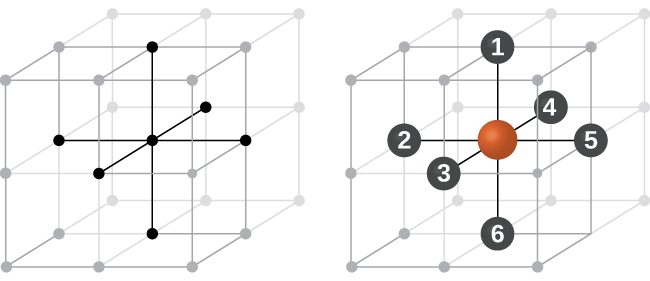
Figure 10.49図 10.49
An atom in a simple cubic lattice structure contacts six other atoms, so it has a coordination number of six.
単純立方格子中の原子はほかの6原子に接するため、配位数は6である。
In a simple cubic lattice, the unit cell that repeats in all directions is a cube defined by the centers of eight atoms, as shown in Figure 10.50. Atoms at adjacent corners of this unit cell contact each other, so the edge length of this cell is equal to two atomic radii, or one atomic diameter. A cubic unit cell contains only the parts of these atoms that are within it. Since an atom at a corner of a simple cubic unit cell is contained by a total of eight unit cells, only one-eighth of that atom is within a specific unit cell. And since each simple cubic unit cell has one atom at each of its eight “corners,” there is atom within one simple cubic unit cell.
英語のヒント
単純立方格子において、あらゆる方向に繰り返される単位格子は、図10.50のように8個の原子の中心を頂点とする立方体である。隣接する頂点の原子どうしは接しているため、単位格子の辺の長さは原子半径の2倍、すなわち原子直径一つ分に等しい。立方体の単位格子に含まれるのは、これらの原子のうち、その内部にある部分だけである。単純立方単位格子の頂点にある原子は、合計8個の単位格子にまたがるので、特定の単位格子に含まれるのは、その原子の8分の1だけである。各単位格子の8個の「頂点」にはそれぞれ原子が一つあるため、一つの単純立方単位格子には個の原子が含まれる。
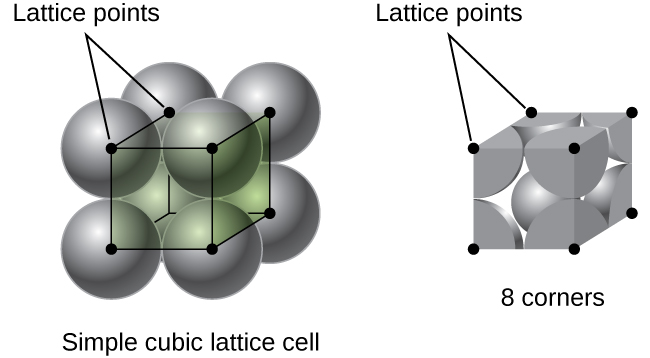
Figure 10.50図 10.50
A simple cubic lattice unit cell contains one-eighth of an atom at each of its eight corners, so it contains one atom total.
単純立方格子の単位格子は、8個の頂点のそれぞれに原子の8分の1を含むため、全体で原子1個を含む。
Example 10.14例題 10.14
Calculation of Atomic Radius and Density for Metals, Part 1金属の原子半径と密度の計算:その1
The edge length of the unit cell of alpha polonium is 336 pm.
αポロニウムの単位格子の辺の長さは336 pmである。
(a) Determine the radius of a polonium atom.
(a) ポロニウム原子の半径を求めなさい。
(b) Determine the density of alpha polonium.
(b) αポロニウムの密度を求めなさい。
Solution解法
Alpha polonium crystallizes in a simple cubic unit cell:
αポロニウムは単純立方単位格子を持つ結晶になる。
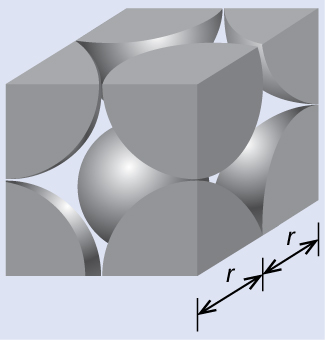
(a) Two adjacent Po atoms contact each other, so the edge length of this cell is equal to two Po atomic radii: l = 2r. Therefore, the radius of Po is
(a) 隣接する二つのPo原子は接しているため、単位格子の辺の長さはPoの原子半径の2倍である。すなわち、l=2r。したがって、Poの半径はとなる。
(b) Density is given by The density of polonium can be found by determining the density of its unit cell (the mass contained within a unit cell divided by the volume of the unit cell). Since a Po unit cell contains one-eighth of a Po atom at each of its eight corners, a unit cell contains one Po atom.
(b) 密度はで与えられる。ポロニウムの密度は、単位格子の密度、すなわち単位格子内の質量を単位格子の体積で割った値から求められる。Poの単位格子は8個の頂点のそれぞれにPo原子の8分の1を含むため、単位格子全体ではPo原子1個を含む。
The mass of a Po unit cell can be found by:
Poの単位格子の質量は、次のように求められる。
The volume of a Po unit cell can be found by:
Poの単位格子の体積は、次のように求められる。
(Note that the edge length was converted from pm to cm to get the usual volume units for density.)
(密度に通常用いられる体積の単位を得るため、辺の長さをpmからcmへ換算していることに注意しよう。)
Therefore, the density of
したがって、密度はとなる。
Check Your Learning理解を確かめよう
The edge length of the unit cell for nickel is 0.3524 nm. The density of Ni is 8.90 g/cm3. Does nickel crystallize in a simple cubic structure? Explain.
ニッケルの単位格子の辺の長さは0.3524 nm、Niの密度は8.90 g/cm3である。ニッケルは単純立方構造に結晶化するか。理由も説明しなさい。
Most metal crystals are one of the four major types of unit cells. For now, we will focus on the three cubic unit cells: simple cubic (which we have already seen), body-centered cubic unit cell, and face-centered cubic unit cell—all of which are illustrated in Figure 10.51. (Note that there are actually seven different lattice systems, some of which have more than one type of lattice, for a total of 14 different types of unit cells. We leave the more complicated geometries for later in this module.)
英語のヒント
大部分の金属結晶は、主要な四種類の単位格子のいずれかを持つ。ここでは、すでに見た単純立方単位格子、体心立方単位格子、面心立方単位格子という三つの立方単位格子に注目する。いずれも図10.51に示す。(実際には七つの異なる格子系があり、そのうちいくつかは複数の格子の種類を持つため、単位格子は合計14種類になる。より複雑な形状は、この節の後半で扱う。)
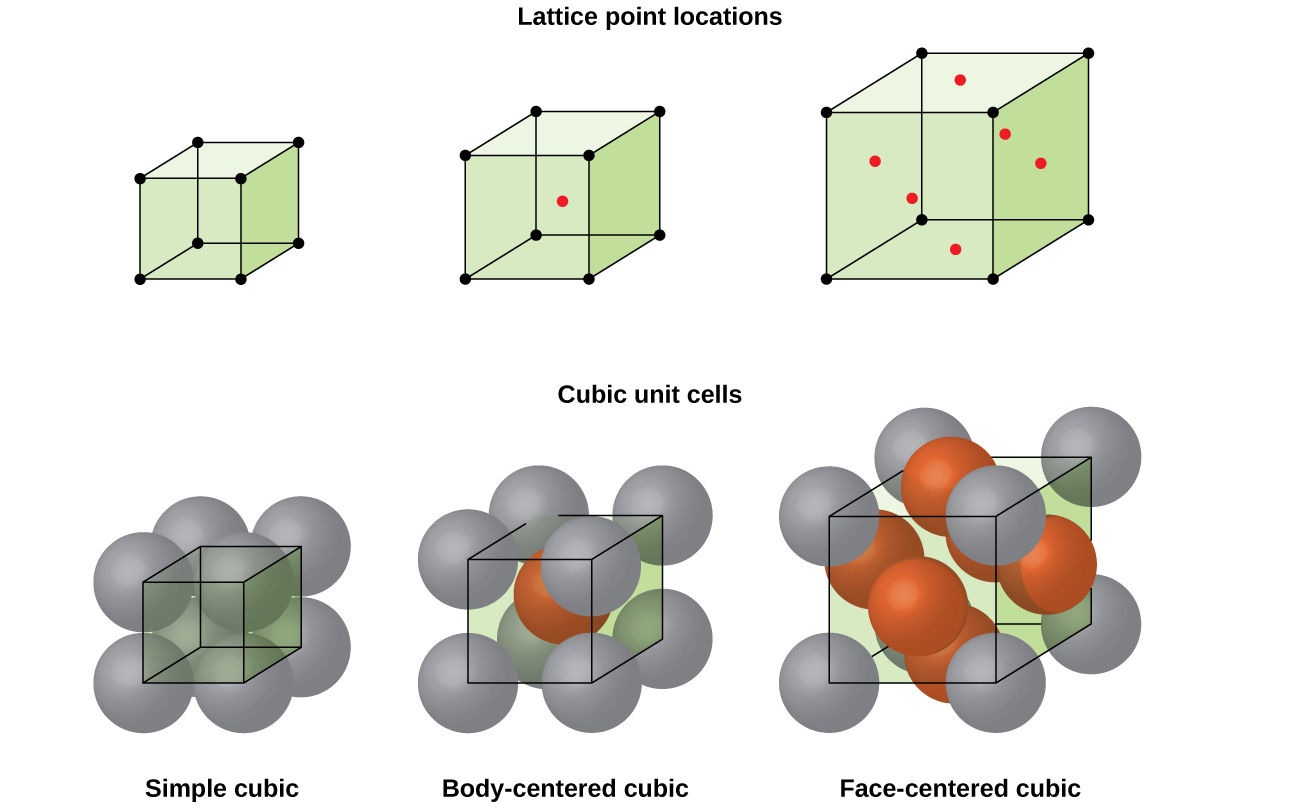
Figure 10.51図 10.51
Cubic unit cells of metals show (in the upper figures) the locations of lattice points and (in the lower figures) metal atoms located in the unit cell.
金属の立方単位格子。上の図は格子点の位置、下の図は単位格子内の金属原子を示す。
Some metals crystallize in an arrangement that has a cubic unit cell with atoms at all of the corners and an atom in the center, as shown in Figure 10.52. This is called a body-centered cubic (BCC) solid. Atoms in the corners of a BCC unit cell do not contact each other but contact the atom in the center. A BCC unit cell contains two atoms: one-eighth of an atom at each of the eight corners atom from the corners) plus one atom from the center. Any atom in this structure touches four atoms in the layer above it and four atoms in the layer below it. Thus, an atom in a BCC structure has a coordination number of eight.
図10.52のように、立方単位格子の全頂点と中心に原子を持つ配列で結晶化する金属もある。これを体心立方(BCC)構造の固体という。BCC単位格子の頂点の原子どうしは接していないが、中心の原子には接している。BCC単位格子に含まれる原子は2個である。8個の頂点それぞれに原子の8分の1があり、頂点からの寄与は個となり、これに中心の1個が加わる。この構造のどの原子も、上の層の4原子と下の層の4原子に接する。したがって、BCC構造の原子の配位数は8である。
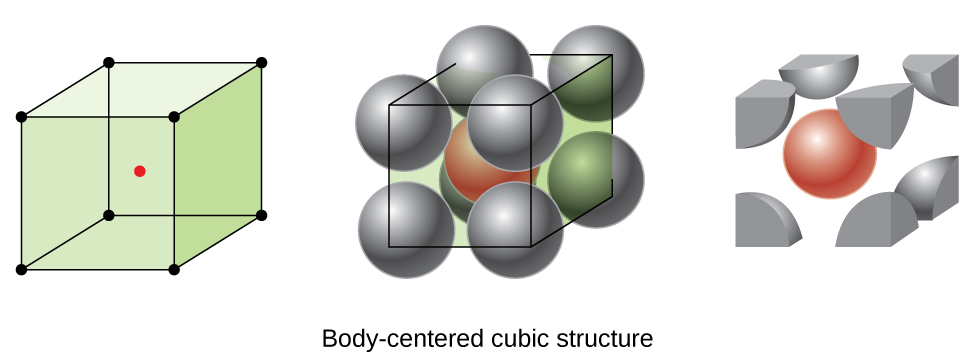
Figure 10.52図 10.52
In a body-centered cubic structure, atoms in a specific layer do not touch each other. Each atom touches four atoms in the layer above it and four atoms in the layer below it.
体心立方構造では、同じ層の原子どうしは接しない。各原子は、上の層の4原子と下の層の4原子に接する。
Atoms in BCC arrangements are much more efficiently packed than in a simple cubic structure, occupying about 68% of the total volume. Isomorphous metals with a BCC structure include K, Ba, Cr, Mo, W, and Fe at room temperature. (Elements or compounds that crystallize with the same structure are said to be isomorphous.)
英語のヒント
BCC配列では単純立方構造よりもはるかに効率よく原子が詰まり、原子は全体積の約68%を占める。室温でBCC構造を持つ同形の金属には、K、Ba、Cr、Mo、W、Feがある。(同じ構造で結晶化する元素や化合物は、同形であるという。)
Many other metals, such as aluminum, copper, and lead, crystallize in an arrangement that has a cubic unit cell with atoms at all of the corners and at the centers of each face, as illustrated in Figure 10.53. This arrangement is called a face-centered cubic (FCC) solid. A FCC unit cell contains four atoms: one-eighth of an atom at each of the eight corners atom from the corners) and one-half of an atom on each of the six faces atoms from the faces). The atoms at the corners touch the atoms in the centers of the adjacent faces along the face diagonals of the cube. Because the atoms are on identical lattice points, they have identical environments.
アルミニウム、銅、鉛など多くの金属は、図10.53のように、立方単位格子の全頂点と各面の中心に原子がある配列で結晶化する。これを面心立方(FCC)構造の固体という。FCC単位格子には原子4個が含まれる。8個の頂点それぞれの原子の8分の1、すなわち頂点からの寄与個と、6個の面それぞれの原子の2分の1、すなわち面からの寄与個がある。頂点の原子は、立方体の面対角線に沿って、隣接する面の中心の原子と接している。原子は等価な格子点にあるため、同じ環境を持つ。
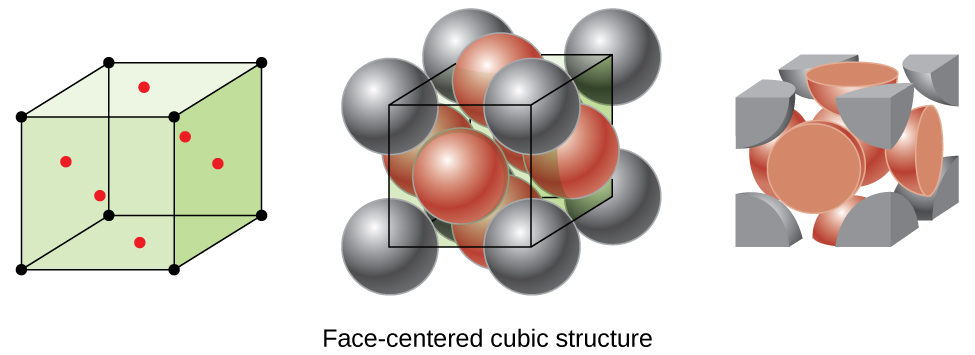
Figure 10.53図 10.53
A face-centered cubic solid has atoms at the corners and, as the name implies, at the centers of the faces of its unit cells.
面心立方構造の固体では、単位格子の頂点と、その名が示すように各面の中心に原子がある。
Atoms in an FCC arrangement are packed as closely together as possible, with atoms occupying 74% of the volume. This structure is also called cubic closest packing (CCP). In CCP, there are three repeating layers of hexagonally arranged atoms. Each atom contacts six atoms in its own layer, three in the layer above, and three in the layer below. In this arrangement, each atom touches 12 near neighbors, and therefore has a coordination number of 12. The fact that FCC and CCP arrangements are equivalent may not be immediately obvious, but why they are actually the same structure is illustrated in Figure 10.54.
英語のヒント
FCC配列の原子は可能な限り密に詰まっており、体積の74%を占める。この構造は立方最密充填(CCP)とも呼ばれる。CCPでは、六方に配列した原子の三つの層が繰り返される。各原子は同じ層の6原子、上の層の3原子、下の層の3原子に接する。この配列では各原子が近隣の12原子に接するため、配位数は12である。FCCとCCPが等価な配列であることは、すぐにはわかりにくいかもしれないが、実際に同じ構造である理由を図10.54に示す。
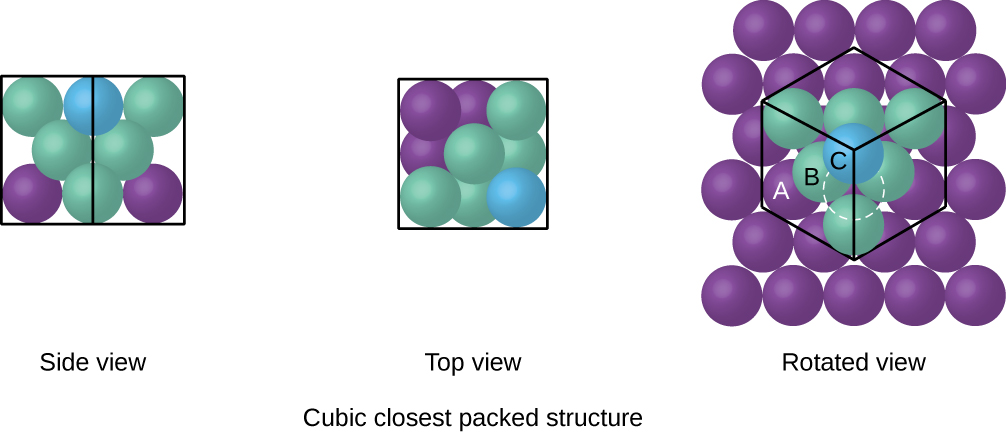
Figure 10.54図 10.54
A CCP arrangement consists of three repeating layers (ABCABC…) of hexagonally arranged atoms. Atoms in a CCP structure have a coordination number of 12 because they contact six atoms in their layer, plus three atoms in the layer above and three atoms in the layer below. By rotating our perspective, we can see that a CCP structure has a unit cell with a face containing an atom from layer A at one corner, atoms from layer B across a diagonal (at two corners and in the middle of the face), and an atom from layer C at the remaining corner. This is the same as a face-centered cubic arrangement.
CCP配列は、六方に並んだ原子の三つの層の繰り返し(ABCABC…)からなる。CCP構造の原子は、同じ層の6原子、上の層の3原子、下の層の3原子に接するので、配位数は12である。見る向きを変えると、CCP構造には次のような面を持つ単位格子があるとわかる。一つの頂点にA層の原子、対角線上の両端と面の中央にB層の原子、残りの頂点にC層の原子がある。これは面心立方配列と同じである。
Because closer packing maximizes the overall attractions between atoms and minimizes the total intermolecular energy, the atoms in most metals pack in this manner. We find two types of closest packing in simple metallic crystalline structures: CCP, which we have already encountered, and hexagonal closest packing (HCP) shown in Figure 10.55. Both consist of repeating layers of hexagonally arranged atoms. In both types, a second layer (B) is placed on the first layer (A) so that each atom in the second layer is in contact with three atoms in the first layer. The third layer is positioned in one of two ways. In HCP, atoms in the third layer are directly above atoms in the first layer (i.e., the third layer is also type A), and the stacking consists of alternating type A and type B close-packed layers (i.e., ABABAB⋯). In CCP, atoms in the third layer are not above atoms in either of the first two layers (i.e., the third layer is type C), and the stacking consists of alternating type A, type B, and type C close-packed layers (i.e., ABCABCABC⋯). About two–thirds of all metals crystallize in closest-packed arrays with coordination numbers of 12. Metals that crystallize in an HCP structure include Cd, Co, Li, Mg, Na, and Zn, and metals that crystallize in a CCP structure include Ag, Al, Ca, Cu, Ni, Pb, and Pt.
英語のヒント
密に詰まるほど、原子間引力の総和は最大に、分子間エネルギーの総和は最小になるため、大部分の金属の原子はこのように詰まる。単純な金属結晶構造には、最密充填が二種類ある。すでに見たCCPと、図10.55の六方最密充填(HCP)である。いずれも、六方に並んだ原子の層が繰り返された構造を持つ。どちらでも、第2層(B)は第1層(A)の上に置かれ、第2層の各原子が第1層の3原子と接する。第3層の置き方には二通りある。HCPでは第3層の原子が第1層の原子の真上に来る。つまり第3層もA型であり、A型とB型の最密充填層が交互に積み重なる(ABABAB…)。CCPでは、第3層の原子は最初の二層のどちらの原子の真上にも来ない。つまり第3層はC型であり、A型、B型、C型の最密充填層が順に積み重なる(ABCABCABC…)。全金属の約3分の2は、配位数12の最密充填配列で結晶化する。HCP構造で結晶化する金属にはCd、Co、Li、Mg、Na、Znがあり、CCP構造にはAg、Al、Ca、Cu、Ni、Pb、Ptがある。
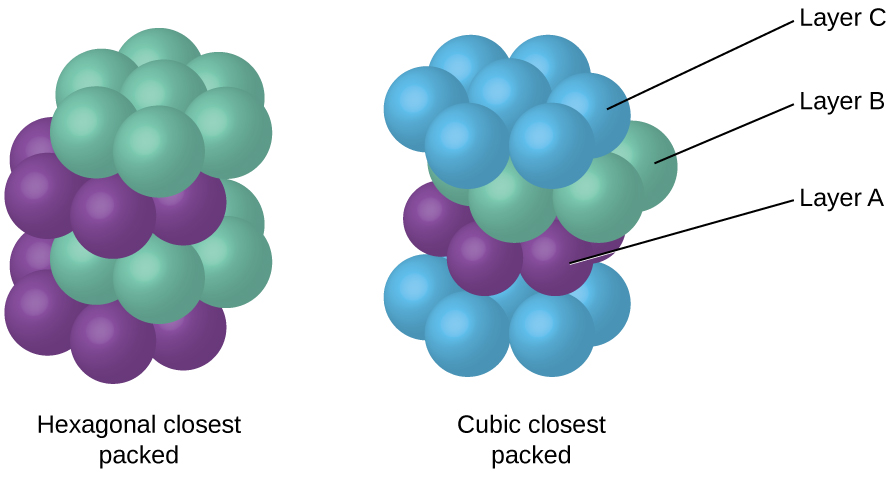
Figure 10.55図 10.55
In both types of closest packing, atoms are packed as compactly as possible. Hexagonal closest packing consists of two alternating layers (ABABAB…). Cubic closest packing consists of three alternating layers (ABCABCABC…).
どちらの最密充填でも、原子は可能な限り密に詰まっている。六方最密充填では二つの層が交互に繰り返される(ABABAB…)。立方最密充填では三つの層が順に繰り返される(ABCABCABC…)。
Example 10.15例題 10.15
Calculation of Atomic Radius and Density for Metals, Part 2金属の原子半径と密度の計算:その2
Calcium crystallizes in a face-centered cubic structure. The edge length of its unit cell is 558.8 pm.
カルシウムは面心立方構造で結晶化する。単位格子の辺の長さは558.8 pmである。
(a) What is the atomic radius of Ca in this structure?
(a) この構造におけるCaの原子半径はいくらか。
(b) Calculate the density of Ca.
(b) Caの密度を計算しなさい。
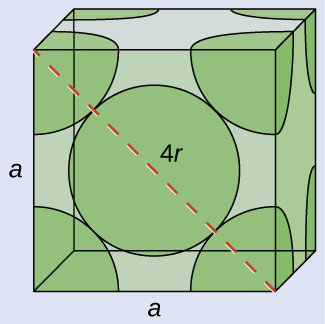
(a) In an FCC structure, Ca atoms contact each other across the diagonal of the face, so the length of the diagonal is equal to four Ca atomic radii (d = 4r). Two adjacent edges and the diagonal of the face form a right triangle, with the length of each side equal to 558.8 pm and the length of the hypotenuse equal to four Ca atomic radii:
英語のヒント
(a) FCC構造ではCa原子が面の対角線上で接するので、対角線の長さはCaの原子半径の4倍に等しい(d=4r)。隣接する二つの辺と面対角線は直角三角形を作り、各辺の長さは558.8 pm、斜辺の長さはCaの原子半径の4倍である。
Solving this gives
これを解くと、が得られる。
(b) Density is given by The density of calcium can be found by determining the density of its unit cell: for example, the mass contained within a unit cell divided by the volume of the unit cell. A face-centered Ca unit cell has one-eighth of an atom at each of the eight corners atom) and one-half of an atom on each of the six faces ( atoms), for a total of four atoms in the unit cell.
(b) 密度はで与えられる。カルシウムの密度は単位格子の密度から求められる。例えば、単位格子内の質量を単位格子の体積で割ればよい。Caの面心立方単位格子には、8個の頂点それぞれに原子の8分の1(個)、6個の面それぞれに原子の2分の1(個)があり、合計4個の原子が含まれる。
The mass of the unit cell can be found by:
単位格子の質量は、次のように求められる。
The volume of a Ca unit cell can be found by:
Caの単位格子の体積は、次のように求められる。
(Note that the edge length was converted from pm to cm to get the usual volume units for density.)
(密度に通常用いられる体積の単位を得るため、辺の長さをpmからcmへ換算していることに注意しよう。)
Then, the density of
したがって、密度はとなる。
Check Your Learning理解を確かめよう
Silver crystallizes in an FCC structure. The edge length of its unit cell is 409 pm.
銀はFCC構造で結晶化する。単位格子の辺の長さは409 pmである。
(a) What is the atomic radius of Ag in this structure?
(a) この構造におけるAgの原子半径はいくらか。
(b) Calculate the density of Ag.
(b) Agの密度を計算しなさい。
In general, a unit cell is defined by the lengths of three axes (a, b, and c) and the angles (α, β, and γ) between them, as illustrated in Figure 10.56. The axes are defined as being the lengths between points in the space lattice. Consequently, unit cell axes join points with identical environments.
一般に単位格子は、図10.56のように、三つの軸の長さ(a、b、c)と軸間の角度(α、β、γ)で定まる。軸は、空間格子中の点と点の間の長さとして定義される。したがって、単位格子の軸は、同じ環境を持つ点どうしを結ぶ。
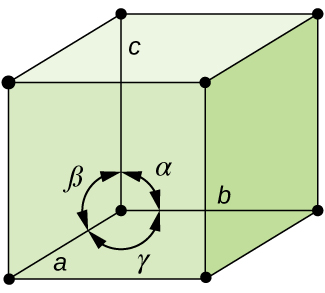
Figure 10.56図 10.56
A unit cell is defined by the lengths of its three axes (a, b, and c) and the angles (α, β, and γ) between the axes.
単位格子は、三つの軸の長さ(a、b、c)と軸間の角度(α、β、γ)で定まる。
There are seven different lattice systems, some of which have more than one type of lattice, for a total of fourteen different unit cells, which have the shapes shown in Figure 10.57.
異なる格子系は七つある。そのうちいくつかは複数の格子の種類を持つので、単位格子は合計14種類となり、それぞれ図10.57に示す形をとる。
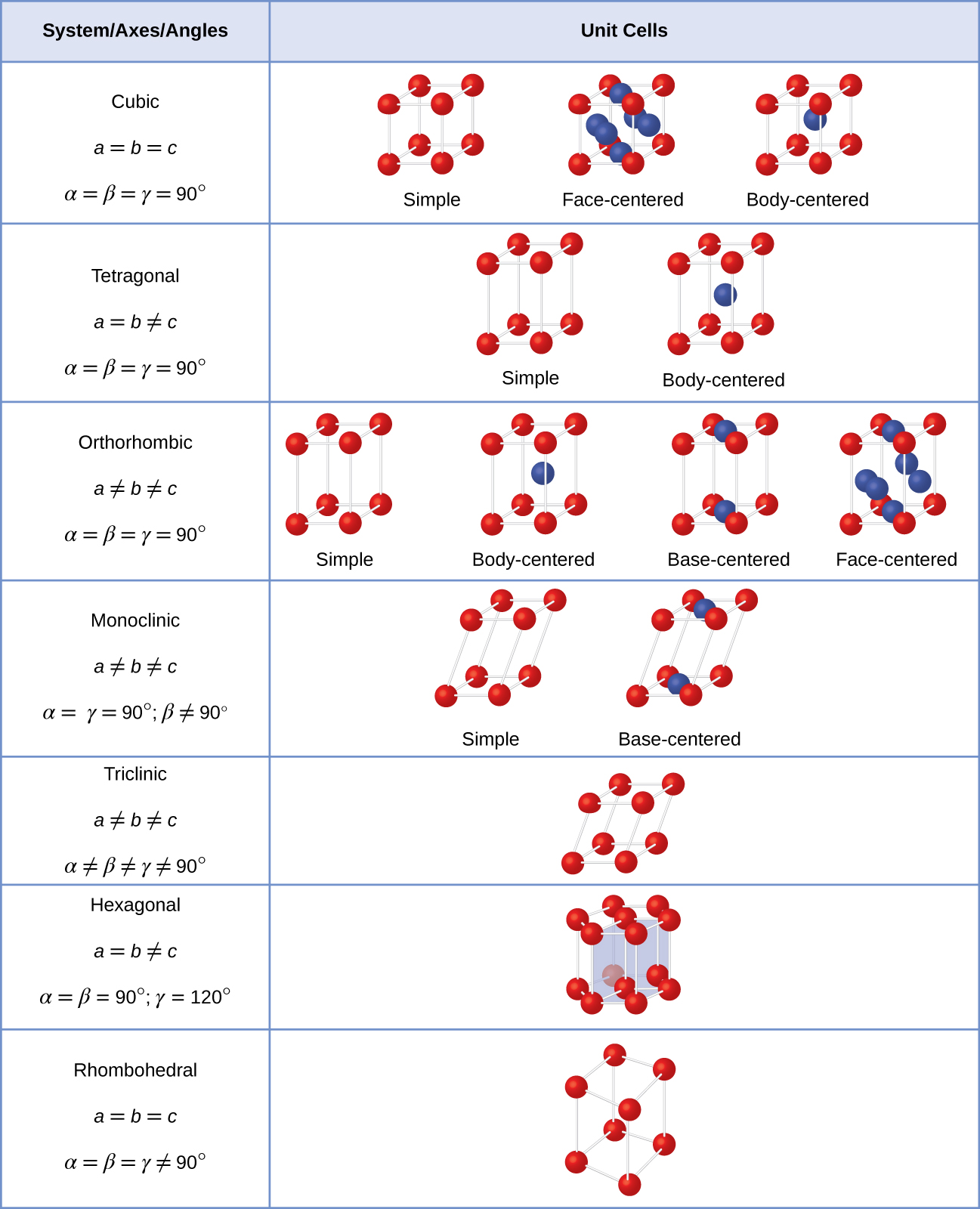


Figure 10.57図 10.57
There are seven different lattice systems and 14 different unit cells.
七つの異なる格子系と14種類の単位格子がある。