第10章液体と固体
Key Concepts and Summary重要な概念とまとめ
The temperature and pressure conditions at which a substance exists in solid, liquid, and gaseous states are summarized in a phase diagram for that substance. Phase diagrams are combined plots of pressure-temperature equilibrium curves representing the relationships between phase transition temperatures and pressures. The point of intersection of any three curves in a phase diagram represents a substance’s triple point—the temperature and pressure at which three different phases are in equilibrium. At pressures below a solid-liquid-gas triple point, a substance cannot exist in the liquid state, regardless of its temperature. The terminus of the liquid-gas curve represents the substance’s critical point, the pressure and temperature above which a liquid phase cannot exist.
英語のヒント
物質が固体、液体、気体として存在する温度と圧力の条件は、その物質の相図にまとめられる。相図は、相転移の温度と圧力の関係を表す圧力−温度の平衡曲線を、一つのグラフに示したものである。相図で三つの曲線が交わる点は、その物質の三重点、すなわち異なる三つの相が平衡にある温度と圧力を表す。固体−液体−気体の三重点より低い圧力では、物質は温度にかかわらず液体として存在できない。液体−気体曲線の終点は、その物質の臨界点を表し、これを超える圧力と温度では液相は存在できない。
Chemistry End of Chapter Exercises章末問題
Exercises 54–63練習問題 54–63
Exercise 54問題 54
From the phase diagram for water (Figure 10.32), determine the state of water at:
水の相図(図10.32)から、次の条件での水の状態を求めなさい。
(a) 35 °C and 85 kPa
(a) 35 °C、85 kPa
(b) −15 °C and 40 kPa
(b) −15 °C、40 kPa
(c) −15 °C and 0.1 kPa
(c) −15 °C、0.1 kPa
(d) 75 °C and 3 kPa
(d) 75 °C、3 kPa
(e) 40 °C and 0.1 kPa
(e) 40 °C、0.1 kPa
(f) 60 °C and 50 kPa
(f) 60 °C、50 kPa
Exercise 55問題 55
What phase changes will take place when water is subjected to varying pressure at a constant temperature of 0.005 °C? At 40 °C? At −40 °C?
英語のヒント
水の温度を0.005 °Cに保って圧力を変えると、どのような相変化が起こるか。40 °Cではどうか。−40 °Cではどうか。
Solution解き方
At low pressures and 0.005 °C, the water is a gas. As the pressure increases to 4.6 torr, the water becomes a solid; as the pressure increases still more, it becomes a liquid. At 40 °C, water at low pressure is a vapor; at pressures higher than about 75 torr, it converts into a liquid. At −40 °C, water goes from a gas to a solid as the pressure increases above very low values.
0.005 °C、低圧では水は気体である。圧力が4.6 torrまで上がると固体になり、さらに圧力が上がると液体になる。40 °Cでは、低圧の水は水蒸気であり、約75 torrを超えると液体になる。−40 °Cでは、非常に低い値から圧力が上がるにつれて、水は気体から固体へ変わる。
Exercise 56問題 56
Pressure cookers allow food to cook faster because the higher pressure inside the pressure cooker increases the boiling temperature of water. A particular pressure cooker has a safety valve that is set to vent steam if the pressure exceeds 3.4 atm. What is the approximate maximum temperature that can be reached inside this pressure cooker? Explain your reasoning.
英語のヒント
圧力鍋では内部の圧力が高くなって水の沸点が上がるため、食品を速く調理できる。ある圧力鍋には、圧力が3.4 atmを超えると蒸気を逃がすよう設定された安全弁がある。この圧力鍋の内部で達し得る最高温度はおよそ何°Cか。理由も説明しなさい。
Exercise 57問題 57
From the phase diagram for carbon dioxide in Figure 10.35, determine the state of CO2 at:
図10.35の二酸化炭素の相図から、次の条件でのCO2の状態を求めなさい。
(a) 20 °C and 1000 kPa
(a) 20 °C、1000 kPa
(b) 10 °C and 2000 kPa
(b) 10 °C、2000 kPa
(c) 10 °C and 100 kPa
(c) 10 °C、100 kPa
(d) −40 °C and 500 kPa
(d) −40 °C、500 kPa
(e) −80 °C and 1500 kPa
(e) −80 °C、1500 kPa
(f) −80 °C and 10 kPa
(f) −80 °C、10 kPa
Solution解き方
(a) gas; (b) gas; (c) gas; (d) gas; (e) solid; (f) gas
(a) 気体、(b) 気体、(c) 気体、(d) 気体、(e) 固体、(f) 気体。
Exercise 58問題 58
Determine the phase changes that carbon dioxide undergoes as pressure is increased at a constant temperature of (a) −50 °C and (b) 50 °C. If the temperature is held at −40 °C? At 20 °C? (See the phase diagram in Figure 10.35.)
二酸化炭素の温度を(a) −50 °C、(b) 50 °Cに保って圧力を上げたときの相変化を求めなさい。温度を−40 °Cに保った場合はどうか。20 °Cではどうか。(図10.35の相図を参照。)
Exercise 59問題 59
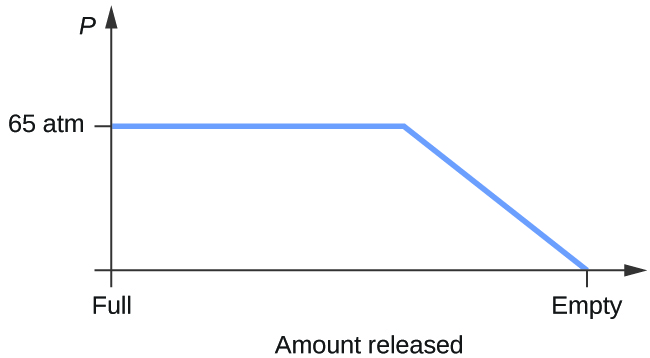
Consider a cylinder containing a mixture of liquid carbon dioxide in equilibrium with gaseous carbon dioxide at an initial pressure of 65 atm and a temperature of 20 °C. Sketch a plot depicting the change in the cylinder pressure with time as gaseous carbon dioxide is released at constant temperature.
英語のヒント
初期圧力65 atm、温度20 °Cで、液体の二酸化炭素と気体の二酸化炭素が平衡状態で共存している容器を考える。温度を一定に保ちながら気体の二酸化炭素を放出するとき、容器内の圧力が時間とともにどう変わるか、グラフの概形を描きなさい。
Exercise 60問題 60
Dry ice, CO2(s), does not melt at atmospheric pressure. It sublimes at a temperature of −78 °C. What is the lowest pressure at which CO2(s) will melt to give CO2(l)? At approximately what temperature will this occur? (See Figure 10.35 for the phase diagram.)
ドライアイスCO2(s)は大気圧では融けず、−78 °Cで昇華する。CO2(s)が融けてCO2(l)になる最低の圧力はいくらか。それはおよそ何°Cで起こるか。(相図は図10.35を参照。)
Exercise 61問題 61
If a severe storm results in the loss of electricity, it may be necessary to use a clothesline to dry laundry. In many parts of the country in the dead of winter, the clothes will quickly freeze when they are hung on the line. If it does not snow, will they dry anyway? Explain your answer.
英語のヒント
激しい嵐で停電すると、洗濯物を干し綱に掛けて乾かす必要があるかもしれない。国内の多くの地域では、真冬に干し綱に掛けた衣類はすぐに凍る。雪が降らなければ、それでも衣類は乾くだろうか。理由も説明しなさい。
Solution解き方
Yes, ice will sublime, although it may take it several days. Ice has a small vapor pressure, and some ice molecules form gas and escape from the ice crystals. As time passes, more and more solid converts to gas until eventually the clothes are dry.
乾く。数日かかるかもしれないが、氷は昇華する。氷にもわずかな蒸気圧があり、氷の分子の一部が気体となって結晶から離れる。時間とともに固体が次々に気体へ変わり、やがて衣類は乾く。
Exercise 62問題 62
Is it possible to liquefy nitrogen at room temperature (about 25 °C)? Is it possible to liquefy sulfur dioxide at room temperature? Explain your answers.
窒素は室温(約25 °C)で液化できるか。二酸化硫黄は室温で液化できるか。理由も説明しなさい。
Exercise 63問題 63
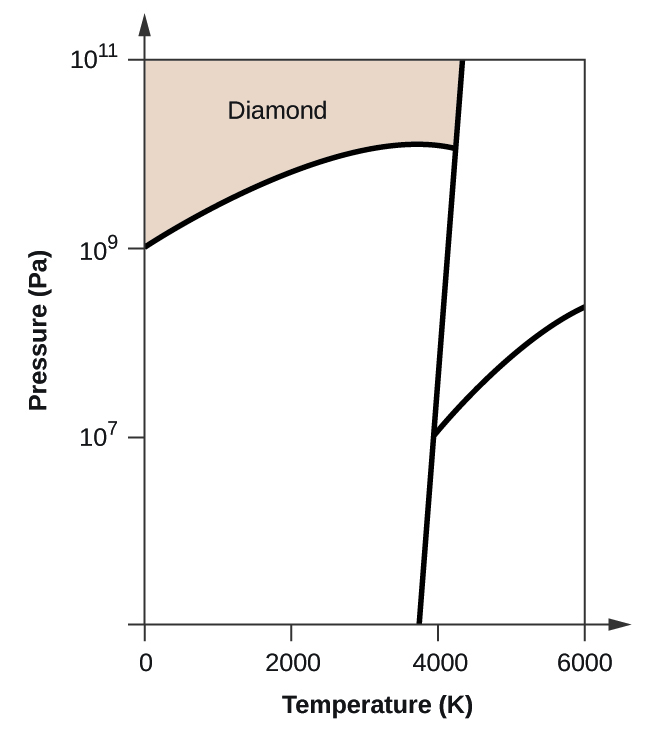
Elemental carbon has one gas phase, one liquid phase, and two different solid phases, as shown in the phase diagram:
単体の炭素には、次の相図に示すように、一つの気相、一つの液相、異なる二つの固相がある。
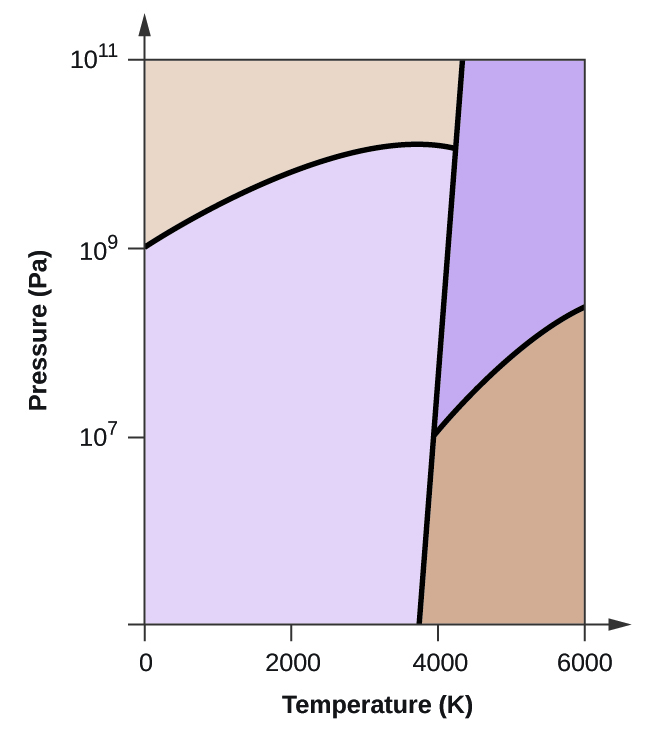
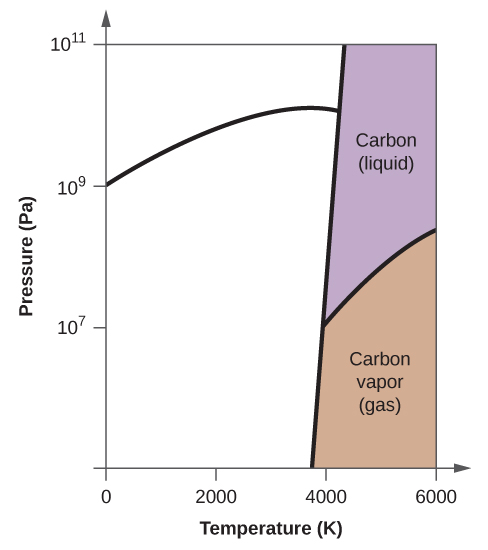
(a) On the phase diagram, label the gas and liquid regions.
(a) 相図の気体領域と液体領域に名前を記しなさい。
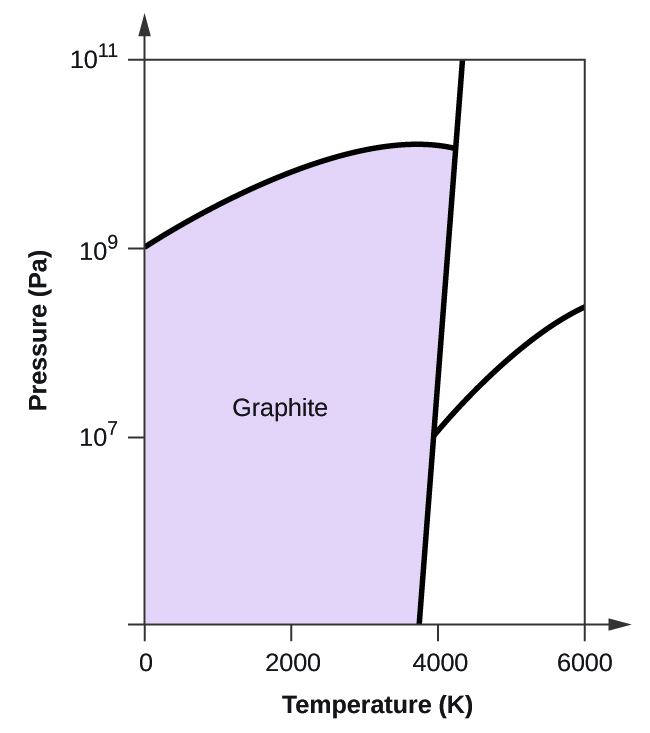
(b) Graphite is the most stable phase of carbon at normal conditions. On the phase diagram, label the graphite phase.
英語のヒント
(b) 通常の条件で最も安定な炭素の相は黒鉛である。相図の黒鉛の相に名前を記しなさい。
(c) If graphite at normal conditions is heated to 2500 K while the pressure is increased to 1010 Pa, it is converted into diamond. Label the diamond phase.
(c) 通常の条件にある黒鉛を2500 Kまで加熱し、同時に圧力を1010 Paまで上げると、ダイヤモンドへ変わる。ダイヤモンドの相に名前を記しなさい。
(d) Circle each triple point on the phase diagram.
(d) 相図にある三重点をそれぞれ丸で囲みなさい。
(e) In what phase does carbon exist at 5000 K and 108 Pa?
(e) 5000 K、108 Paで炭素はどの相として存在するか。
(f) If the temperature of a sample of carbon increases from 3000 K to 5000 K at a constant pressure of 106 Pa, which phase transition occurs, if any?
英語のヒント
(f) 炭素の試料の圧力を106 Paに保ち、温度を3000 Kから5000 Kへ上げると、相転移は起こるか。起こるならどの相転移か。
Solution解き方
(a)
(a)
(b)
(b)
(c)
(c)
(d)
(d)
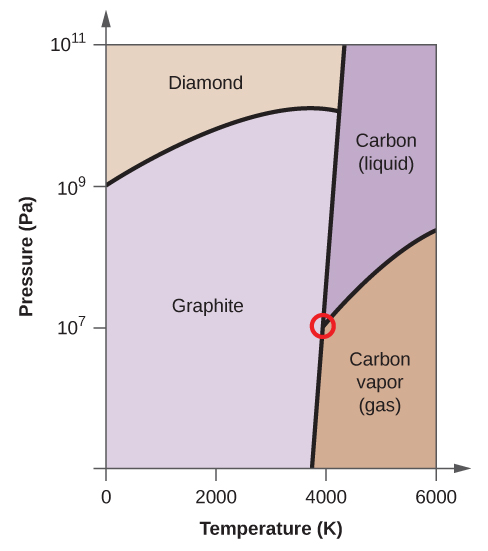


(e) liquid phase (f) sublimation
(e) 液相、(f) 昇華。
critical point
臨界点
temperature and pressure above which a gas cannot be condensed into a liquid
これを超えると気体を凝縮させて液体にすることができない温度と圧力。
phase diagram
相図
pressure-temperature graph summarizing conditions under which the phases of a substance can exist
物質の各相が存在できる条件をまとめた圧力−温度のグラフ。
supercritical fluid
超臨界流体
substance at a temperature and pressure higher than its critical point; exhibits properties intermediate between those of gaseous and liquid states
臨界点より高い温度と圧力にある物質。気体と液体の中間の性質を示す。
triple point
三重点
temperature and pressure at which three phases of a substance are in equilibrium
物質の三つの相が平衡にある温度と圧力。