第10章液体と固体
Crystal Defects結晶の欠陥
In a crystalline solid, the atoms, ions, or molecules are arranged in a definite repeating pattern, but occasional defects may occur in the pattern. Several types of defects are known, as illustrated in Figure 10.46. Vacancies are defects that occur when positions that should contain atoms or ions are vacant. Less commonly, some atoms or ions in a crystal may occupy positions, called interstitial sites, located between the regular positions for atoms. Other distortions are found in impure crystals, as, for example, when the cations, anions, or molecules of the impurity are too large to fit into the regular positions without distorting the structure. Trace amounts of impurities are sometimes added to a crystal (a process known as doping) in order to create defects in the structure that yield desirable changes in its properties. For example, silicon crystals are doped with varying amounts of different elements to yield suitable electrical properties for their use in the manufacture of semiconductors and computer chips.
英語のヒント
結晶性固体では原子、イオン、分子が一定の繰り返しパターンで並ぶが、ときにはその配列に欠陥が生じる。図10.46に示すように、いくつかの種類の欠陥が知られている。原子やイオンがあるはずの位置が空になった欠陥を空孔という。それより少ないが、原子やイオンが、原子の通常の位置の間にある格子間位置を占めることもある。不純物を含む結晶には、ほかの歪みも見られる。例えば、不純物の陽イオン、陰イオン、分子が大きすぎると、構造を歪めずに通常の位置へ収まることができない。性質に望ましい変化をもたらす欠陥を構造中に作るため、結晶に微量の不純物を加えることもある。この操作をドーピングという。例えば、半導体やコンピューターチップの製造に適した電気的性質を得るため、ケイ素結晶にはさまざまな元素が、量を変えて添加される。
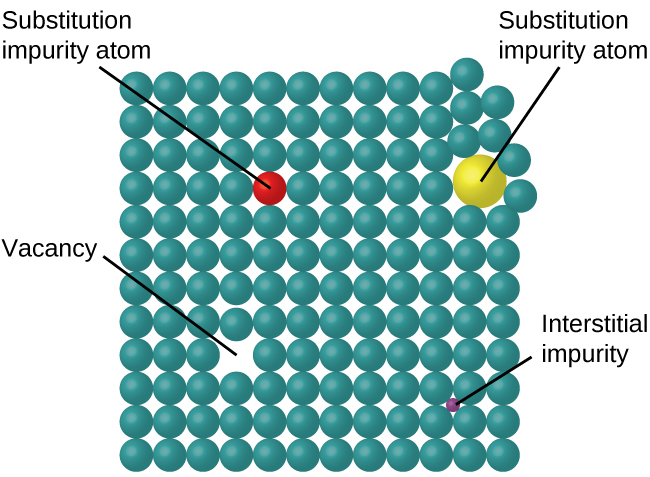

Figure 10.46図 10.46
Types of crystal defects include vacancies, interstitial atoms, and substitutions impurities.
結晶欠陥には、空孔、格子間原子、置換不純物などがある。
Key Concepts and Summary重要な概念とまとめ
Some substances form crystalline solids consisting of particles in a very organized structure; others form amorphous (noncrystalline) solids with an internal structure that is not ordered. The main types of crystalline solids are ionic solids, metallic solids, covalent network solids, and molecular solids. The properties of the different kinds of crystalline solids are due to the types of particles of which they consist, the arrangements of the particles, and the strengths of the attractions between them. Because their particles experience identical attractions, crystalline solids have distinct melting temperatures; the particles in amorphous solids experience a range of interactions, so they soften gradually and melt over a range of temperatures. Some crystalline solids have defects in the definite repeating pattern of their particles. These defects (which include vacancies, atoms or ions not in the regular positions, and impurities) change physical properties such as electrical conductivity, which is exploited in the silicon crystals used to manufacture computer chips.
英語のヒント
物質の中には、粒子が非常に規則正しい構造で並ぶ結晶性固体を作るものもあれば、内部構造に秩序のない非晶質(非結晶性)固体を作るものもある。結晶性固体の主な種類は、イオン結晶、金属結晶、共有結合の網目構造を持つ結晶、分子結晶である。それぞれの性質は、構成粒子の種類、粒子の配列、粒子間引力の強さによって決まる。結晶性固体の粒子には同じ引力が働くため、融ける温度が明確に定まる。一方、非晶質固体の粒子に働く相互作用には幅があるため、徐々に軟らかくなり、ある温度範囲にわたって融ける。結晶性固体の中には、粒子の一定の繰り返しパターンに欠陥があるものもある。空孔、通常の位置にない原子やイオン、不純物などの欠陥は、電気伝導性などの物理的性質を変える。この性質は、コンピューターチップ製造用のケイ素結晶で利用されている。
Chemistry End of Chapter Exercises章末問題
Exercises 64–74練習問題 64–74
Exercise 64問題 64
What types of liquids typically form amorphous solids?
一般に、どのような液体が非晶質固体を作るか。
Exercise 65問題 65
At very low temperatures oxygen, O2, freezes and forms a crystalline solid. Which best describes these crystals?
非常に低い温度で酸素O2は凝固し、結晶性固体になる。この結晶を最もよく表すものはどれか。
(a) ionic
(a) イオン結晶
(b) covalent network
(b) 共有結合の網目構造
(c) metallic
(c) 金属結晶
(d) amorphous
(d) 非晶質
(e) molecular crystals
(e) 分子結晶
Solution解き方
(e) molecular crystals
(e) 分子結晶
Exercise 66問題 66
As it cools, olive oil slowly solidifies and forms a solid over a range of temperatures. Which best describes the solid?
オリーブ油は冷却するとゆっくり固まり、ある温度範囲にわたって固体になる。この固体を最もよく表すものはどれか。
(a) ionic
(a) イオン結晶
(b) covalent network
(b) 共有結合の網目構造
(c) metallic
(c) 金属結晶
(d) amorphous
(d) 非晶質
(e) molecular crystals
(e) 分子結晶
Exercise 67問題 67
Explain why ice, which is a crystalline solid, has a melting temperature of 0 °C, whereas butter, which is an amorphous solid, softens over a range of temperatures.
結晶性固体の氷は0 °Cという融点を持つのに対し、非晶質固体のバターはある温度範囲にわたって軟らかくなる。その理由を説明しなさい。
Solution解き方
Ice has a crystalline structure stabilized by hydrogen bonding. These intermolecular forces are of comparable strength and thus require the same amount of energy to overcome. As a result, ice melts at a single temperature and not over a range of temperatures. The various, very large molecules that compose butter experience varied van der Waals attractions of various strengths that are overcome at various temperatures, and so the melting process occurs over a wide temperature range.
氷は水素結合によって安定化された結晶構造を持つ。この分子間力はほぼ同じ強さなので、打ち勝つのに必要なエネルギー量も同じである。そのため、氷は温度範囲にわたってではなく、一つの温度で融ける。バターを構成するさまざまな非常に大きい分子には、強さの異なるファンデルワールス引力が働き、それぞれ異なる温度で打ち勝たれるため、広い温度範囲にわたって融解が起こる。
Exercise 68問題 68
Identify the type of crystalline solid (metallic, network covalent, ionic, or molecular) formed by each of the following substances:
次の各物質が作る結晶性固体の種類(金属結晶、共有結合の網目構造、イオン結晶、分子結晶)を答えなさい。
(a) SiO2
(a) SiO2
(b) KCl
(b) KCl
(c) Cu
(c) Cu
(d) CO2
(d) CO2
(e) C (diamond)
(e) C(ダイヤモンド)
(f) BaSO4
(f) BaSO4
(g) NH3
(g) NH3
(h) NH4F
(h) NH4F
(i) C2H5OH
(i) C2H5OH
Exercise 69問題 69
Identify the type of crystalline solid (metallic, network covalent, ionic, or molecular) formed by each of the following substances:
次の各物質が作る結晶性固体の種類(金属結晶、共有結合の網目構造、イオン結晶、分子結晶)を答えなさい。
(a) CaCl2
(a) CaCl2
(b) SiC
(b) SiC
(c) N2
(c) N2
(d) Fe
(d) Fe
(e) C (graphite)
(e) C(黒鉛)
(f) CH3CH2CH2CH3
(f) CH3CH2CH2CH3
(g) HCl
(g) HCl
(h) NH4NO3
(h) NH4NO3
(i) K3PO4
(i) K3PO4
Solution解き方
(a) ionic; (b) covalent network; (c) molecular; (d) metallic; (e) covalent network; (f) molecular; (g) molecular; (h) ionic; (i) ionic
(a) イオン結晶、(b) 共有結合の網目構造、(c) 分子結晶、(d) 金属結晶、(e) 共有結合の網目構造、(f) 分子結晶、(g) 分子結晶、(h) イオン結晶、(i) イオン結晶。
Exercise 70問題 70
Classify each substance in the table as either a metallic, ionic, molecular, or covalent network solid:
表の各物質を、金属結晶、イオン結晶、分子結晶、共有結合の網目構造を持つ結晶のいずれかに分類しなさい。
Substance 物質 |
Appearance 外観 |
Melting Point 融点 |
Electrical Conductivity 電気伝導性 |
Solubility in Water 水への溶解性 |
|---|---|---|---|---|
X |
lustrous, malleable 光沢があり、展性を持つ |
1500 °C |
high 高い |
insoluble 不溶 |
Y |
soft, yellow 軟らかく、黄色 |
113 °C |
none なし |
insoluble 不溶 |
Z |
hard, white 硬く、白色 |
800 °C |
only if melted/dissolved 融解または溶解したときのみ |
soluble 可溶 |
Exercise 71問題 71
Classify each substance in the table as either a metallic, ionic, molecular, or covalent network solid:
表の各物質を、金属結晶、イオン結晶、分子結晶、共有結合の網目構造を持つ結晶のいずれかに分類しなさい。
Substance 物質 |
Appearance 外観 |
Melting Point 融点 |
Electrical Conductivity 電気伝導性 |
Solubility in Water 水への溶解性 |
|---|---|---|---|---|
X |
brittle, white もろく、白色 |
800 °C |
only if melted/dissolved 融解または溶解したときのみ |
soluble 可溶 |
Y |
shiny, malleable 光沢があり、展性を持つ |
1100 °C |
high 高い |
insoluble 不溶 |
Z |
hard, colorless 硬く、無色 |
3550 °C |
none なし |
insoluble 不溶 |
Solution解き方
X = ionic; Y = metallic; Z = covalent network
X=イオン結晶、Y=金属結晶、Z=共有結合の網目構造。
Exercise 72問題 72
Identify the following substances as ionic, metallic, covalent network, or molecular solids:
次の物質が、イオン結晶、金属結晶、共有結合の網目構造を持つ結晶、分子結晶のどれかを答えなさい。
Substance A is malleable, ductile, conducts electricity well, and has a melting point of 1135 °C. Substance B is brittle, does not conduct electricity as a solid but does when molten, and has a melting point of 2072 °C. Substance C is very hard, does not conduct electricity, and has a melting point of 3440 °C. Substance D is soft, does not conduct electricity, and has a melting point of 185 °C.
英語のヒント
物質Aは展性と延性を持ち、電気をよく通し、融点は1135 °Cである。物質Bはもろく、固体では電気を通さないが融けると通し、融点は2072 °Cである。物質Cは非常に硬く、電気を通さず、融点は3440 °Cである。物質Dは軟らかく、電気を通さず、融点は185 °Cである。
Exercise 73問題 73
Substance A is shiny, conducts electricity well, and melts at 975 °C. Substance A is likely a(n):
物質Aは光沢があり、電気をよく通し、975 °Cで融ける。物質Aは次のどれと考えられるか。
(a) ionic solid
(a) イオン結晶
(b) metallic solid
(b) 金属結晶
(c) molecular solid
(c) 分子結晶
(d) covalent network solid
(d) 共有結合の網目構造を持つ結晶
Solution解き方
(b) metallic solid
(b) 金属結晶
Exercise 74問題 74
Substance B is hard, does not conduct electricity, and melts at 1200 °C. Substance B is likely a(n):
物質Bは硬く、電気を通さず、1200 °Cで融ける。物質Bは次のどれと考えられるか。
(a) ionic solid
(a) イオン結晶
(b) metallic solid
(b) 金属結晶
(c) molecular solid
(c) 分子結晶
(d) covalent network solid
(d) 共有結合の網目構造を持つ結晶
amorphous solid
非晶質固体
(also, noncrystalline solid) solid in which the particles lack an ordered internal structure
非結晶性固体ともいう。粒子の内部構造に秩序がない固体。
covalent network solid
共有結合の網目構造を持つ結晶
solid whose particles are held together by covalent bonds
粒子が共有結合によって結びついた固体。
crystalline solid
結晶性固体
solid in which the particles are arranged in a definite repeating pattern
粒子が一定の繰り返しパターンで配列した固体。
interstitial sites
格子間位置
spaces between the regular particle positions in any array of atoms or ions
原子やイオンの配列において、粒子の通常の位置の間にある空間。
ionic solid
イオン結晶
solid composed of positive and negative ions held together by strong electrostatic attractions
強い静電引力で結びついた正負のイオンからなる固体。
metallic solid
金属結晶
solid composed of metal atoms
金属原子からなる固体。
molecular solid
分子結晶
solid composed of neutral molecules held together by intermolecular forces of attraction
分子間引力によって結びついた中性分子からなる固体。
vacancy
空孔
defect that occurs when a position that should contain an atom or ion is vacant
原子やイオンがあるはずの位置が空になることで生じる欠陥。