第10章液体と固体
10.3 Phase Transitions10.3 相転移
Learning Objectives学習目標
By the end of this section, you will be able to:
この節を終えると、次のことができるようになる。
- Define phase transitions and phase transition temperatures相転移と相転移温度を定義する。
- Explain the relation between phase transition temperatures and intermolecular attractive forces相転移温度と分子間引力の関係を説明する。
- Describe the processes represented by typical heating and cooling curves, and compute heat flows and enthalpy changes accompanying these processes典型的な加熱曲線・冷却曲線が表す過程を説明し、それに伴う熱の移動とエンタルピー変化を計算する。
We witness and utilize changes of physical state, or phase transitions, in a great number of ways. As one example of global significance, consider the evaporation, condensation, freezing, and melting of water. These changes of state are essential aspects of our earth’s water cycle as well as many other natural phenomena and technological processes of central importance to our lives. In this module, the essential aspects of phase transitions are explored.
英語のヒント
私たちはさまざまな場面で物理的な状態の変化、すなわち相転移を目にし、利用している。地球規模で重要な例として、水の蒸発、凝縮、凝固、融解を考えよう。これらの状態変化は地球の水循環に不可欠であり、私たちの生活で中心的な役割を果たす多くの自然現象や技術的な過程にも欠かせない。この節では、相転移の基本的な側面を調べる。
Vaporization and Condensation気化と凝縮
When a liquid vaporizes in a closed container, gas molecules cannot escape. As these gas phase molecules move randomly about, they will occasionally collide with the surface of the condensed phase, and in some cases, these collisions will result in the molecules re-entering the condensed phase. The change from the gas phase to the liquid is called condensation. When the rate of condensation becomes equal to the rate of vaporization, neither the amount of the liquid nor the amount of the vapor in the container changes. The vapor in the container is then said to be in equilibrium with the liquid. Keep in mind that this is not a static situation, as molecules are continually exchanged between the condensed and gaseous phases. Such is an example of a dynamic equilibrium, the status of a system in which reciprocal processes (for example, vaporization and condensation) occur at equal rates. The pressure exerted by the vapor in equilibrium with a liquid in a closed container at a given temperature is called the liquid’s vapor pressure (or equilibrium vapor pressure). The area of the surface of the liquid in contact with a vapor and the size of the vessel have no effect on the vapor pressure, although they do affect the time required for the equilibrium to be reached. We can measure the vapor pressure of a liquid by placing a sample in a closed container, like that illustrated in Figure 10.23, and using a manometer to measure the increase in pressure that is due to the vapor in equilibrium with the condensed phase.
英語のヒント
液体が密閉容器の中で気化すると、気体分子は外へ逃げられない。気相の分子が無作為に動き回ると、ときどき凝縮相の表面に衝突し、その一部は凝縮相へ戻る。気相から液体への変化を凝縮という。凝縮速度が気化速度と等しくなると、容器内の液体の量も蒸気の量も変わらなくなる。このとき、容器内の蒸気は液体と平衡にあるという。これは静止した状態ではなく、分子は凝縮相と気相の間で絶えず交換されていることを忘れないようにしよう。これは動的平衡の例であり、気化と凝縮のような互いに逆向きの過程が、等しい速度で起こる系の状態をいう。ある温度の密閉容器内で液体と平衡にある蒸気が及ぼす圧力を、その液体の蒸気圧、または平衡蒸気圧という。蒸気に接している液面の面積や容器の大きさは、平衡に達する時間には影響するが、蒸気圧には影響しない。図10.23のような密閉容器に液体試料を入れ、凝縮相と平衡にある蒸気による圧力の増加を圧力計で測ることによって、液体の蒸気圧を測定できる。
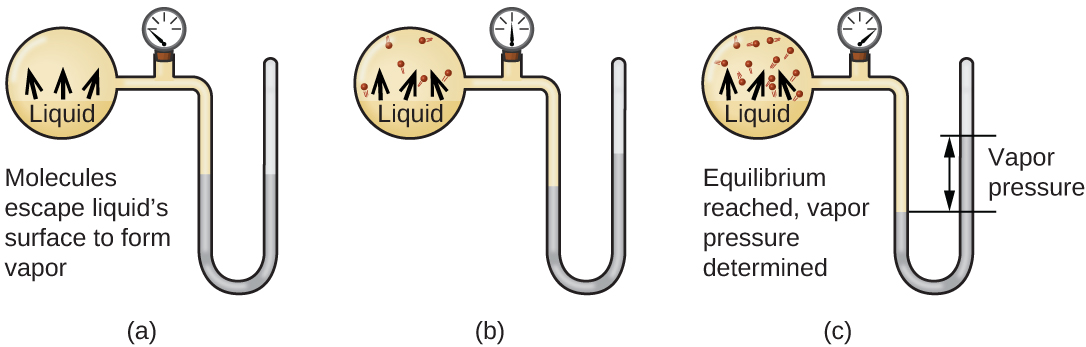
Figure 10.23図 10.23
In a closed container, dynamic equilibrium is reached when (a) the rate of molecules escaping from the liquid to become the gas (b) increases and eventually (c) equals the rate of gas molecules entering the liquid. When this equilibrium is reached, the vapor pressure of the gas is constant, although the vaporization and condensation processes continue.
密閉容器内では、(a) 液体から分子が抜け出して気体になる速度が、(b) 増加し、やがて(c) 気体分子が液体に入る速度と等しくなると、動的平衡に達する。この平衡に達すると、気化と凝縮は続いていても、気体の蒸気圧は一定になる。
The chemical identities of the molecules in a liquid determine the types (and strengths) of intermolecular attractions possible; consequently, different substances will exhibit different equilibrium vapor pressures. Relatively strong intermolecular attractive forces will serve to impede vaporization as well as favoring “recapture” of gas-phase molecules when they collide with the liquid surface, resulting in a relatively low vapor pressure. Weak intermolecular attractions present less of a barrier to vaporization, and a reduced likelihood of gas recapture, yielding relatively high vapor pressures. The following example illustrates this dependence of vapor pressure on intermolecular attractive forces.
英語のヒント
液体を構成する分子の化学的な種類が、働きうる分子間引力の種類と強さを決めるため、物質によって平衡蒸気圧は異なる。比較的強い分子間引力は、気化を妨げるとともに、気相分子が液面に衝突した際の「再捕獲」を起こりやすくし、その結果、蒸気圧を比較的低くする。弱い分子間引力は、気化の障壁が小さく、気体分子の再捕獲の可能性も低いため、比較的高い蒸気圧をもたらす。次の例題では、蒸気圧が分子間引力に依存することを示す。
Example 10.5例題 10.5
Explaining Vapor Pressure in Terms of IMFs分子間力による蒸気圧の説明
Given the shown structural formulas for these four compounds, explain their relative vapor pressures in terms of types and extents of IMFs:
示された4種類の化合物の構造式をもとに、分子間力の種類と強さを用いて、蒸気圧の大小関係を説明しなさい。

Solution解法
Diethyl ether has a very small dipole and most of its intermolecular attractions are London forces. Although this molecule is the largest of the four under consideration, its IMFs are the weakest and, as a result, its molecules most readily escape from the liquid. It also has the highest vapor pressure. Due to its smaller size, ethanol exhibits weaker dispersion forces than diethyl ether. However, ethanol is capable of hydrogen bonding and, therefore, exhibits stronger overall IMFs, which means that fewer molecules escape from the liquid at any given temperature, and so ethanol has a lower vapor pressure than diethyl ether. Water is much smaller than either of the previous substances and exhibits weaker dispersion forces, but its extensive hydrogen bonding provides stronger intermolecular attractions, fewer molecules escaping the liquid, and a lower vapor pressure than for either diethyl ether or ethanol. Ethylene glycol has two −OH groups, so, like water, it exhibits extensive hydrogen bonding. It is much larger than water and thus experiences larger London forces. Its overall IMFs are the largest of these four substances, which means its vaporization rate will be the slowest and, consequently, its vapor pressure the lowest.
英語のヒント
ジエチルエーテルの双極子は非常に小さく、分子間引力の大部分はロンドン力である。この分子は四つの中で最大だが、分子間力は最も弱いため、分子は液体から最も容易に逃げ出す。したがって、蒸気圧も最も高い。エタノールはジエチルエーテルより小さいため、分散力は弱い。しかし水素結合を形成できるため、分子間力全体では強くなる。したがって、同じ温度で液体から逃げる分子は少なくなり、エタノールの蒸気圧はジエチルエーテルより低い。水はこの二つの物質よりはるかに小さく、分散力も弱いが、広範囲にわたる水素結合がより強い分子間引力をもたらす。そのため液体から逃げる分子は少なく、ジエチルエーテルやエタノールのいずれよりも蒸気圧が低い。エチレングリコールには−OH基が二つあり、水と同様に広範囲の水素結合を形成する。水よりはるかに大きいので、ロンドン力も大きい。分子間力全体は四つの物質の中で最も大きく、そのため気化速度が最も遅く、蒸気圧も最も低い。
Check Your Learning理解度の確認
At 20 °C, the vapor pressures of several alcohols are given in this table. Explain these vapor pressures in terms of types and extents of IMFs for these alcohols:
いくつかのアルコールの20 °Cでの蒸気圧を表に示す。これらのアルコールの分子間力の種類と強さを用いて、蒸気圧を説明しなさい。
Compound 化合物 |
methanol CH3OH メタノール CH3OH |
ethanol C2H5OH エタノール C2H5OH |
propanol C3H7OH プロパノール C3H7OH |
butanol C4H9OH ブタノール C4H9OH |
Vapor Pressure at 20 °C 20 °Cでの蒸気圧 |
11.9 kPa |
5.95 kPa |
2.67 kPa |
0.56 kPa |
As temperature increases, the vapor pressure of a liquid also increases due to the increased average KE of its molecules. Recall that at any given temperature, the molecules of a substance experience a range of kinetic energies, with a certain fraction of molecules having a sufficient energy to overcome IMF and escape the liquid (vaporize). At a higher temperature, a greater fraction of molecules have enough energy to escape from the liquid, as shown in Figure 10.24. The escape of more molecules per unit of time and the greater average speed of the molecules that escape both contribute to the higher vapor pressure.
英語のヒント
温度が上がると、分子の平均運動エネルギーが増すため、液体の蒸気圧も高くなる。ある温度での分子の運動エネルギーには幅があり、その一部は分子間力に打ち勝って液体から逃げ出す、すなわち気化するのに十分なエネルギーを持つことを思い出そう。高温では、図10.24に示すように、液体から逃げるのに十分なエネルギーを持つ分子の割合が増える。単位時間に逃げる分子の数が増えることと、逃げる分子の平均の速さが大きくなることの両方が、蒸気圧の上昇に寄与する。
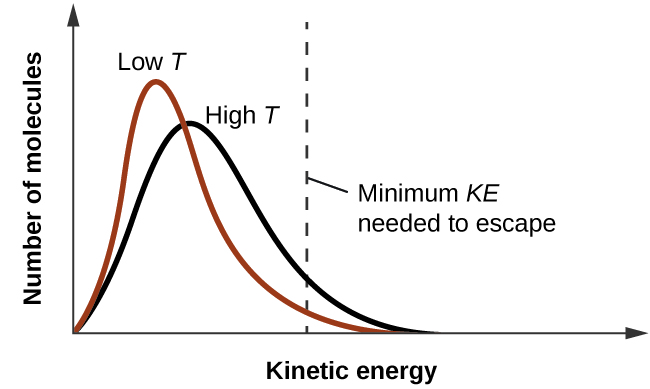


Figure 10.24図 10.24
Temperature affects the distribution of kinetic energies for the molecules in a liquid. At the higher temperature, more molecules have the necessary kinetic energy, KE, to escape from the liquid into the gas phase.
温度は、液体中の分子の運動エネルギー分布に影響する。温度が高いほど、液体から気相へ逃げるのに必要な運動エネルギーKEを持つ分子が多い。