第10章液体と固体
10.5 The Solid State of Matter10.5 物質の固体状態
Learning Objectives学習目標
By the end of this section, you will be able to:
この節を学ぶと、次のことができるようになる。
- Define and describe the bonding and properties of ionic, molecular, metallic, and covalent network crystalline solidsイオン結晶、分子結晶、金属結晶、共有結合の網目構造を持つ結晶を定義し、その結合と性質を説明する。
- Describe the main types of crystalline solids: ionic solids, metallic solids, covalent network solids, and molecular solids結晶性固体の主な種類であるイオン結晶、金属結晶、共有結合の網目構造を持つ結晶、分子結晶を説明する。
- Explain the ways in which crystal defects can occur in a solid固体中に結晶欠陥が生じる仕組みを説明する。
When most liquids are cooled, they eventually freeze and form crystalline solids, solids in which the atoms, ions, or molecules are arranged in a definite repeating pattern. It is also possible for a liquid to freeze before its molecules become arranged in an orderly pattern. The resulting materials are called amorphous solids or noncrystalline solids (or, sometimes, glasses). The particles of such solids lack an ordered internal structure and are randomly arranged (Figure 10.38).
英語のヒント
大部分の液体は冷却するとやがて凝固し、原子、イオン、分子が一定の繰り返しパターンで配列した結晶性固体になる。一方、分子が規則正しく並ぶ前に液体が凝固することもある。このようにしてできた物質を非晶質固体、非結晶性固体、またはガラスという。その粒子には秩序ある内部構造がなく、無秩序に配列している(図10.38)。
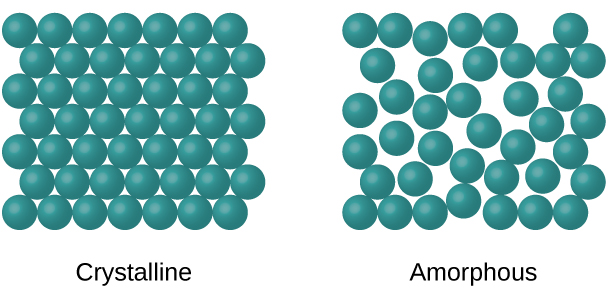
Figure 10.38図 10.38
The entities of a solid phase may be arranged in a regular, repeating pattern (crystalline solids) or randomly (amorphous).
固相を構成する粒子は、規則的な繰り返しパターンで並ぶこともあれば(結晶性固体)、無秩序に並ぶこともある(非晶質)。
Metals and ionic compounds typically form ordered, crystalline solids. Substances that consist of large molecules, or a mixture of molecules whose movements are more restricted, often form amorphous solids. For examples, candle waxes are amorphous solids composed of large hydrocarbon molecules. Some substances, such as silicon dioxide (shown in Figure 10.39), can form either crystalline or amorphous solids, depending on the conditions under which it is produced. Also, amorphous solids may undergo a transition to the crystalline state under appropriate conditions.
英語のヒント
金属やイオン化合物は、一般に秩序ある結晶性固体を作る。大きな分子からなる物質や、動きが制限された分子の混合物は、非晶質固体になりやすい。例えば、ろうそくのろうは、大きな炭化水素分子からなる非晶質固体である。図10.39の二酸化ケイ素のように、生成条件に応じて結晶性固体にも非晶質固体にもなる物質もある。また、非晶質固体は、適切な条件のもとで結晶状態へ移ることがある。
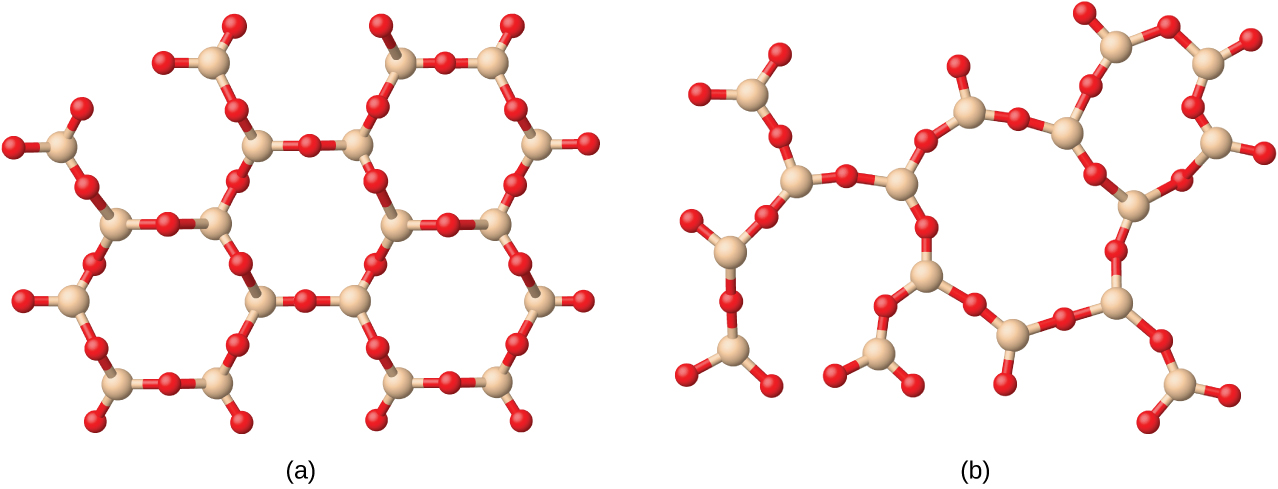
Figure 10.39図 10.39
(a) Silicon dioxide, SiO2, is abundant in nature as one of several crystalline forms of the mineral quartz. (b) Rapid cooling of molten SiO2 yields an amorphous solid known as “fused silica”.
(a) 二酸化ケイ素SiO2は、鉱物の石英がとる複数の結晶形の一つとして、自然界に豊富に存在する。(b) 融けたSiO2を急冷すると、「石英ガラス」と呼ばれる非晶質固体が得られる。
Crystalline solids are generally classified according to the nature of the forces that hold its particles together. These forces are primarily responsible for the physical properties exhibited by the bulk solids. The following sections provide descriptions of the major types of crystalline solids: ionic, metallic, covalent network, and molecular.
英語のヒント
結晶性固体は一般に、粒子どうしを結びつける力の性質によって分類される。この力が、固体全体に現れる物理的性質を主に決めている。以下では、結晶性固体の主な種類であるイオン結晶、金属結晶、共有結合の網目構造を持つ結晶、分子結晶について説明する。
Ionic Solidsイオン結晶
Ionic solids, such as sodium chloride and nickel oxide, are composed of positive and negative ions that are held together by electrostatic attractions, which can be quite strong (Figure 10.40). Many ionic crystals also have high melting points. This is due to the very strong attractions between the ions—in ionic compounds, the attractions between full charges are (much) larger than those between the partial charges in polar molecular compounds. This will be looked at in more detail in a later discussion of lattice energies. Although they are hard, they also tend to be brittle, and they shatter rather than bend. Ionic solids do not conduct electricity; however, they do conduct when molten or dissolved because their ions are free to move. Many simple compounds formed by the reaction of a metallic element with a nonmetallic element are ionic.
英語のヒント
塩化ナトリウムや酸化ニッケルなどのイオン結晶は、正負のイオンが静電引力によって結びついたもので、この引力は非常に強くなることがある(図10.40)。多くのイオン結晶は融点も高い。これは、イオン間の引力が非常に強いためである。イオン化合物における完全な電荷どうしの引力は、極性分子からなる化合物の部分電荷間の引力よりも、はるかに大きい。この点は、後に格子エネルギーを扱う際に詳しく説明する。イオン結晶は硬いが、もろい傾向もあり、曲がるよりも砕ける。固体では電気を通さないが、融けたり溶けたりするとイオンが自由に動けるようになるため、電気を通す。金属元素と非金属元素の反応でできる単純な化合物の多くは、イオン性である。
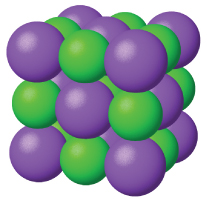
Figure 10.40図 10.40
Sodium chloride is an ionic solid.
塩化ナトリウムはイオン結晶である。
Metallic Solids金属結晶
Metallic solids such as crystals of copper, aluminum, and iron are formed by metal atoms (Figure 10.41). The structure of metallic crystals is often described as a uniform distribution of atomic nuclei within a “sea” of delocalized electrons. The atoms within such a metallic solid are held together by a unique force known as metallic bonding that gives rise to many useful and varied bulk properties. All exhibit high thermal and electrical conductivity, metallic luster, and malleability. Many are very hard and quite strong. Because of their malleability (the ability to deform under pressure or hammering), they do not shatter and, therefore, make useful construction materials. The melting points of the metals vary widely. Mercury is a liquid at room temperature, and the alkali metals melt below 200 °C. Several post-transition metals also have low melting points, whereas the transition metals melt at temperatures above 1000 °C. These differences reflect differences in strengths of metallic bonding among the metals.
英語のヒント
銅、アルミニウム、鉄などの金属結晶は、金属原子からできている(図10.41)。金属結晶の構造は、非局在化した電子の「海」の中に原子核が一様に分布しているものとして説明されることが多い。このような固体では、原子は金属結合という特有の力で結びついており、この結合が物質全体に多様で有用な性質をもたらす。いずれも熱伝導性と電気伝導性が高く、金属光沢と展性を持つ。非常に硬く、強度の高いものも多い。展性、すなわち圧力や打撃で変形できる性質があるため、砕けず、有用な建設材料となる。金属の融点は大きく異なる。水銀は室温で液体であり、アルカリ金属は200 °C未満で融ける。遷移後金属のいくつかも融点が低いが、遷移金属は1000 °Cを超える温度で融ける。こうした違いは、金属ごとの金属結合の強さの違いを反映している。
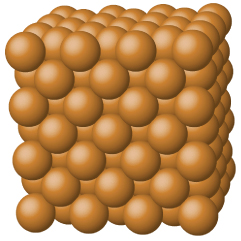
Figure 10.41図 10.41
Copper is a metallic solid.
銅は金属結晶である。
Covalent Network Solid共有結合の網目構造を持つ結晶
Covalent network solids include crystals of diamond, silicon, some other nonmetals, and some covalent compounds such as silicon dioxide (sand) and silicon carbide (carborundum, the abrasive on sandpaper). Many minerals have networks of covalent bonds. The atoms in these solids are held together by a network of covalent bonds, as shown in Figure 10.42. To break or to melt a covalent network solid, covalent bonds must be broken. Because covalent bonds are relatively strong, covalent network solids are typically characterized by hardness, strength, and high melting points. For example, diamond is one of the hardest substances known and melts above 3500 °C.
英語のヒント
共有結合の網目構造を持つ結晶には、ダイヤモンド、ケイ素、ほかのいくつかの非金属の結晶や、二酸化ケイ素(砂)、炭化ケイ素(カーボランダム、紙やすりの研磨材)などの共有結合性化合物がある。多くの鉱物にも共有結合の網目構造がある。これらの固体では、図10.42のように、原子が共有結合の網目によって結びついている。この種の固体を壊したり融かしたりするには、共有結合を切らなければならない。共有結合は比較的強いため、一般に硬く、強度が高く、融点も高い。例えば、ダイヤモンドは知られている物質の中でも特に硬く、3500 °Cを超える温度で融ける。
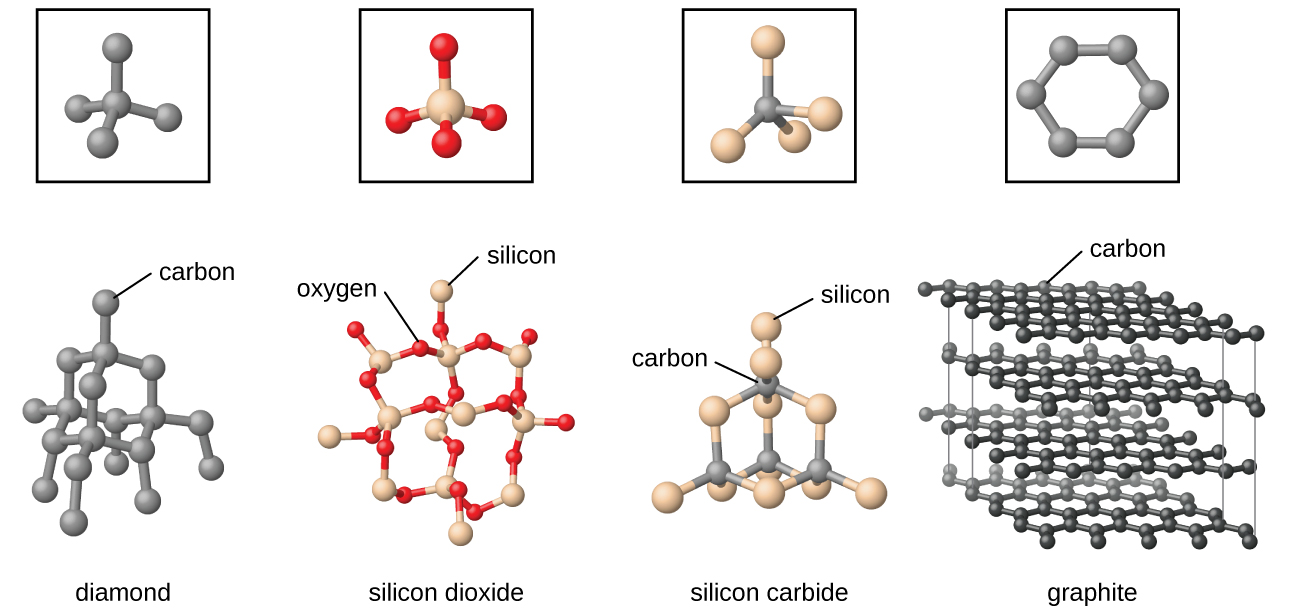


Figure 10.42図 10.42
A covalent crystal contains a three-dimensional network of covalent bonds, as illustrated by the structures of diamond, silicon dioxide, silicon carbide, and graphite. Graphite is an exceptional example, composed of planar sheets of covalent crystals that are held together in layers by noncovalent forces. Unlike typical covalent solids, graphite is very soft and electrically conductive.
ダイヤモンド、二酸化ケイ素、炭化ケイ素、黒鉛の構造に示すように、共有結合性結晶は共有結合の三次元的な網目構造を持つ。黒鉛は例外的で、平面状の共有結合性結晶のシートが、共有結合以外の力によって層状に結びついている。一般的な共有結合性固体とは異なり、黒鉛は非常に軟らかく、電気を通す。