第10章液体と固体
Key Concepts and Summary重要な概念とまとめ
The physical properties of condensed matter (liquids and solids) can be explained in terms of the kinetic molecular theory. In a liquid, intermolecular attractive forces hold the molecules in contact, although they still have sufficient KE to move past each other.
凝縮物質(液体と固体)の物理的性質は、分子運動論によって説明できる。液体では、分子は互いのそばを通って動くのに十分な運動エネルギーを持つ一方、分子間引力によって接触した状態に保たれる。
Intermolecular attractive forces, collectively referred to as van der Waals forces, are responsible for the behavior of liquids and solids and are electrostatic in nature. Dipole-dipole attractions result from the electrostatic attraction of the partial negative end of one polar molecule for the partial positive end of another. The temporary dipole that results from the motion of the electrons in an atom can induce a dipole in an adjacent atom and give rise to the London dispersion force. London forces increase with increasing molecular size. Hydrogen bonds are a special type of dipole-dipole attraction that results when hydrogen is bonded to one of the three most electronegative elements: F, O, or N.
分子間引力はまとめてファン・デル・ワールス力と呼ばれ、液体や固体の振る舞いを生み出すもので、その本質は静電力である。双極子間引力は、一つの極性分子の部分的に負の端と、別の分子の部分的に正の端との静電的な引力から生じる。原子内の電子の運動から生じる一時的な双極子は、隣接する原子に双極子を誘起し、ロンドン分散力を生じさせる。ロンドン力は分子が大きくなるほど増す。水素結合は、水素が電気陰性度の最も高い三つの元素、F、O、Nのいずれかに結合しているときに生じる、特別な双極子間引力である。
Chemistry End of Chapter Exercises章末演習
Exercises 1–21練習問題 1–21
Exercise 1問題 1
In terms of their bulk properties, how do liquids and solids differ? How are they similar?
液体と固体は、巨視的な性質についてどのように異なるか。どのような点が共通するか。
Solution解き方
Liquids and solids are similar in that they are matter composed of atoms, ions, or molecules. They are incompressible and have similar densities that are both much larger than those of gases. They are different in that liquids have no fixed shape, and solids are rigid.
英語のヒント
液体と固体は、原子、イオン、分子からなる物質である点が共通する。どちらも圧縮されにくく、密度は互いに近く、気体よりはるかに大きい。液体には一定の形がないのに対し、固体は形を保つという違いがある。
Exercise 2問題 2
In terms of the kinetic molecular theory, in what ways are liquids similar to solids? In what ways are liquids different from solids?
分子運動論の観点から、液体と固体はどのような点が似ているか。どのような点が異なるか。
Exercise 3問題 3
In terms of the kinetic molecular theory, in what ways are liquids similar to gases? In what ways are liquids different from gases?
分子運動論の観点から、液体と気体はどのような点が似ているか。どのような点が異なるか。
Solution解き方
They are similar in that the atoms or molecules are free to move from one position to another. They differ in that the particles of a liquid are confined to the shape of the vessel in which they are placed. In contrast, a gas will expand without limit to fill the space into which it is placed.
原子や分子がある位置から別の位置へ自由に移動できる点は共通する。液体の粒子は、入れられた容器の形の範囲にとどまる。一方、気体は与えられた空間を満たすまで際限なく膨張する、という違いがある。
Exercise 4問題 4
Explain why liquids assume the shape of any container into which they are poured, whereas solids are rigid and retain their shape.
英語のヒント
液体は注ぎ込まれたどのような容器の形にもなるのに対し、固体は形を保つ。その理由を説明しなさい。
Exercise 5問題 5
What is the evidence that all neutral atoms and molecules exert attractive forces on each other?
すべての中性原子や分子が互いに引力を及ぼすことを示す証拠は何か。
Solution解き方
All atoms and molecules will condense into a liquid or solid in which the attractive forces exceed the kinetic energy of the molecules, at sufficiently low temperature.
十分に温度を低くすると、すべての原子や分子は、引力が分子の運動エネルギーを上回る液体または固体へと凝縮する。
Exercise 6問題 6
Open the PhET States of Matter Simulation to answer the following questions:
PhETの物質の状態のシミュレーションを開き、次の問いに答えなさい。
(a) Select the Solid, Liquid, Gas tab. Explore by selecting different substances, heating and cooling the systems, and changing the state. What similarities do you notice between the four substances for each phase (solid, liquid, gas)? What differences do you notice?
(a) 「Solid, Liquid, Gas」(固体・液体・気体)タブを選びなさい。異なる物質を選び、加熱や冷却をし、状態を変えて調べなさい。各相(固体、液体、気体)について、4種類の物質にはどのような共通点があるか。どのような違いがあるか。
(b) For each substance, select each of the states and record the given temperatures. How do the given temperatures for each state correlate with the strengths of their intermolecular attractions? Explain.
(b) 各物質でそれぞれの状態を選び、表示された温度を記録しなさい。その温度は、各物質の分子間引力の強さとどのように関係しているか。説明しなさい。
(c) Select the Interaction Potential tab, and use the default neon atoms. Move the Ne atom on the right and observe how the potential energy changes. Select the Total Force button, and move the Ne atom as before. When is the total force on each atom attractive and large enough to matter? Then select the Component Forces button, and move the Ne atom. When do the attractive (van der Waals) and repulsive (electron overlap) forces balance? How does this relate to the potential energy versus the distance between atoms graph? Explain.
(c) 「Interaction Potential」(相互作用ポテンシャル)タブを選び、初期設定のネオン原子を使いなさい。右側のNe原子を動かし、ポテンシャルエネルギーの変化を観察する。「Total Force」(合力)ボタンを選び、同様にNe原子を動かす。各原子に働く合力が引力で、かつ無視できないほど大きくなるのはいつか。次に「Component Forces」(力の成分)ボタンを選び、Ne原子を動かす。引力(ファン・デル・ワールス力)と斥力(電子の重なり)が釣り合うのはいつか。これは、原子間距離に対するポテンシャルエネルギーのグラフとどのように関係するか。説明しなさい。
Exercise 7問題 7
Define the following and give an example of each:
次を定義し、それぞれ例を挙げなさい。
(a) dispersion force
(a) 分散力。
(b) dipole-dipole attraction
(b) 双極子間引力。
(c) hydrogen bond
(c) 水素結合。
Solution解き方
(a) Dispersion forces occur as an atom develops a temporary dipole moment when its electrons are distributed asymmetrically about the nucleus. This structure is more prevalent in large atoms such as argon or radon. A second atom can then be distorted by the appearance of the dipole in the first atom. The electrons of the second atom are attracted toward the positive end of the first atom, which sets up a dipole in the second atom. The net result is rapidly fluctuating, temporary dipoles that attract one another (e.g., Ar). (b) A dipole-dipole attraction is a force that results from an electrostatic attraction of the positive end of one polar molecule for the negative end of another polar molecule (e.g., ICI molecules attract one another by dipole-dipole interaction). (c) Hydrogen bonds form whenever a hydrogen atom is bonded to one of the more electronegative atoms, such as a fluorine, oxygen, or nitrogen atom. The electrostatic attraction between the partially positive hydrogen atom in one molecule and the partially negative atom in another molecule gives rise to a strong dipole-dipole interaction called a hydrogen bond (e.g.,
(a) 分散力は、原子の電子が原子核のまわりに非対称に分布し、一時的な双極子モーメントを生じるときに現れる。この構造は、アルゴンやラドンのような大きい原子で生じやすい。最初の原子に双極子が現れると、2個目の原子もゆがめられる。2個目の原子の電子は最初の原子の正の端へ引き寄せられ、2個目にも双極子が生じる。その結果、素早く変動する一時的な双極子が互いに引き合う(例:Ar)。(b) 双極子間引力とは、一つの極性分子の正の端と、別の極性分子の負の端との静電的な引力から生じる力である(例:ICI分子は双極子間相互作用によって互いに引き合う)。(c) 水素原子がフッ素、酸素、窒素のような電気陰性度の高い原子に結合していると、水素結合が形成される。一つの分子の部分的に正の水素原子と、別の分子の部分的に負の原子との静電的な引力により、水素結合という強い双極子間相互作用が生じる(例:)。
Exercise 8問題 8
The types of intermolecular forces in a substance are identical whether it is a solid, a liquid, or a gas. Why then does a substance change phase from a gas to a liquid or to a solid?
ある物質に存在する分子間力の種類は、固体、液体、気体のどの状態でも同じである。それなら、なぜ物質は気体から液体や固体へ相を変えるのか。
Exercise 9問題 9
Why do the boiling points of the noble gases increase in the order He < Ne < Ar < Kr < Xe?
希ガスの沸点がHe < Ne < Ar < Kr < Xeの順に高くなるのはなぜか。
Solution解き方
The London forces typically increase as the number of electrons increase.
一般に、電子数が増えるほどロンドン力が強くなるからである。
Exercise 10問題 10
Neon and HF have approximately the same molecular masses.
ネオンとHFは、分子質量がほぼ等しい。
(a) Explain why the boiling points of Neon and HF differ.
(a) ネオンとHFの沸点が異なる理由を説明しなさい。
(b) Compare the change in the boiling points of Ne, Ar, Kr, and Xe with the change of the boiling points of HF, HCl, HBr, and HI, and explain the difference between the changes with increasing atomic or molecular mass.
(b) Ne、Ar、Kr、Xeの沸点の変化を、HF、HCl、HBr、HIの沸点の変化と比較し、原子質量や分子質量が増したときの変化の違いを説明しなさい。
Exercise 11問題 11
Arrange each of the following sets of compounds in order of increasing boiling point temperature:
次の各組の化合物を、沸点の低い順に並べなさい。
(a) HCl, H2O, SiH4
(a) HCl、H2O、SiH4
(b) F2, Cl2, Br2
(b) F2、Cl2、Br2
(c) CH4, C2H6, C3H8
(c) CH4、C2H6、C3H8
(d) O2, NO, N2
(d) O2、NO、N2
Solution解き方
(a) SiH4 < HCl < H2O; (b) F2 < Cl2 < Br2; (c) CH4 < C2H6 < C3H8; (d) N2 < O2 < NO
(a) SiH4 < HCl < H2O;(b) F2 < Cl2 < Br2;(c) CH4 < C2H6 < C3H8;(d) N2 < O2 < NO
Exercise 12問題 12
The molecular mass of butanol, C4H9OH, is 74.14; that of ethylene glycol, CH2(OH)CH2OH, is 62.08, yet their boiling points are 117.2 °C and 174 °C, respectively. Explain the reason for the difference.
ブタノールC4H9OHの分子質量は74.14、エチレングリコールCH2(OH)CH2OHは62.08である。それにもかかわらず、沸点はそれぞれ117.2 °Cと174 °Cである。この違いの理由を説明しなさい。
Exercise 13問題 13
On the basis of intermolecular attractions, explain the differences in the boiling points of n–butane (−1 °C) and chloroethane (12 °C), which have similar molar masses.
分子間引力に基づいて、モル質量が近いn-ブタン(−1 °C)とクロロエタン(12 °C)の沸点の違いを説明しなさい。
Solution解き方
Only rather small dipole-dipole interactions from C-H bonds are available to hold n-butane in the liquid state. Chloroethane, however, has rather large dipole interactions because of the Cl-C bond; the interaction, therefore, is stronger, leading to a higher boiling point.
n-ブタンを液体に保つために利用できるのは、C−H結合に由来する、かなり小さな双極子間相互作用だけである。一方、クロロエタンにはCl−C結合によるかなり大きな双極子間相互作用がある。そのため相互作用が強く、沸点が高くなる。
Exercise 14問題 14
On the basis of dipole moments and/or hydrogen bonding, explain in a qualitative way the differences in the boiling points of acetone (56.2 °C) and 1-propanol (97.4 °C), which have similar molar masses.
双極子モーメントや水素結合に基づいて、モル質量が近いアセトン(56.2 °C)と1-プロパノール(97.4 °C)の沸点の違いを定性的に説明しなさい。
Exercise 15問題 15
The melting point of H2O(s) is 0 °C. Would you expect the melting point of H2S(s) to be −85 °C, 0 °C, or 185 °C? Explain your answer.
H2O(s)の融点は0 °Cである。H2S(s)の融点は−85 °C、0 °C、185 °Cのどれだと予想するか。答えの理由を説明しなさい。
Solution解き方
−85 °C. Water has stronger hydrogen bonds, so it melts at a higher temperature.
−85 °C。水にはより強い水素結合があるので、高い温度で融ける。
Exercise 16問題 16
Silane (SiH4), phosphine (PH3), and hydrogen sulfide (H2S) melt at −185 °C, −133 °C, and −85 °C, respectively. What does this suggest about the polar character and intermolecular attractions of the three compounds?
シラン(SiH4)、ホスフィン(PH3)、硫化水素(H2S)の融点は、それぞれ−185 °C、−133 °C、−85 °Cである。このことから、三つの化合物の極性と分子間引力について何がわかるか。
Exercise 17問題 17
Explain why a hydrogen bond between two water molecules is weaker than a hydrogen bond between two hydrogen fluoride molecules.
水分子2個の間の水素結合が、フッ化水素分子2個の間の水素結合より弱い理由を説明しなさい。
Solution解き方
The hydrogen bond between two hydrogen fluoride molecules is stronger than that between two water molecules because the electronegativity of F is greater than that of O. Consequently, the partial negative charge on F is greater than that on O. The hydrogen bond between the partially positive H and the larger partially negative F will be stronger than that formed between H and O.
Fの電気陰性度はOより高いため、フッ化水素分子2個の間の水素結合は、水分子2個の間のものより強い。その結果、Fの部分的な負電荷はOより大きい。部分的に正のHと、より大きい部分負電荷を持つFとの間の水素結合は、HとOの間のものより強くなる。
Exercise 18問題 18
Under certain conditions, molecules of acetic acid, CH3COOH, form “dimers,” pairs of acetic acid molecules held together by strong intermolecular attractions:
英語のヒント
ある条件では、酢酸CH3COOHの分子は、強い分子間引力で保持された2個の酢酸分子の組である「二量体」を作る。
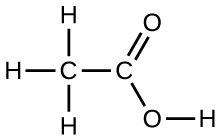
Draw a dimer of acetic acid, showing how two CH3COOH molecules are held together, and stating the type of IMF that is responsible.
酢酸の二量体を描き、2個のCH3COOH分子がどのように保持されるかを示し、その原因となる分子間力の種類を述べなさい。
Exercise 19問題 19
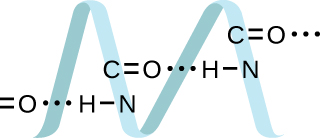
Proteins are chains of amino acids that can form in a variety of arrangements, one of which is a helix. What kind of IMF is responsible for holding the protein strand in this shape? On the protein image, show the locations of the IMFs that hold the protein together:
タンパク質はアミノ酸の鎖であり、さまざまな配置を取りうる。その一つがらせんである。タンパク質の鎖をこの形に保つのは、どの種類の分子間力か。図に、タンパク質を保持する分子間力の位置を示しなさい。


Solution解き方
H-bonding is the principle IMF holding the protein strands together. The H-bonding is between the and
タンパク質の鎖を保持する主な分子間力は水素結合である。水素結合はとの間にある。
Exercise 20問題 20
The density of liquid NH3 is 0.64 g/mL; the density of gaseous NH3 at STP is 0.0007 g/mL. Explain the difference between the densities of these two phases.
液体NH3の密度は0.64 g/mL、標準状態の気体NH3の密度は0.0007 g/mLである。二つの相の密度の違いを説明しなさい。
Exercise 21問題 21
Identify the intermolecular forces present in the following solids:
次の固体に存在する分子間力を答えなさい。
(a) CH3CH2OH
(a) CH3CH2OH
(b) CH3CH2CH3
(b) CH3CH2CH3
(c) CH3CH2Cl
(c) CH3CH2Cl
Solution解き方
(a) hydrogen bonding, dipole-dipole attraction, and dispersion forces; (b) dispersion forces; (c) dipole-dipole attraction and dispersion forces
(a) 水素結合、双極子間引力、分散力;(b) 分散力;(c) 双極子間引力と分散力。
dipole-dipole attraction
双極子間引力
intermolecular attraction between two permanent dipoles
二つの永久双極子間に働く分子間引力。
dispersion force
分散力
(also, London dispersion force) attraction between two rapidly fluctuating, temporary dipoles; significant only when particles are very close together
ロンドン分散力ともいう。素早く変動する二つの一時的な双極子間の引力で、粒子同士が非常に近い場合にのみ重要になる。
hydrogen bonding
水素結合
occurs when exceptionally strong dipoles attract; bonding that exists when hydrogen is bonded to one of the three most electronegative elements: F, O, or N
非常に強い双極子が引き合うときに生じる。水素が、電気陰性度の最も高い三つの元素F、O、Nのいずれかに結合しているときに存在する結合。
induced dipole
誘起双極子
temporary dipole formed when the electrons of an atom or molecule are distorted by the instantaneous dipole of a neighboring atom or molecule
隣の原子や分子の瞬間双極子によって、原子や分子の電子分布がゆがめられたときに生じる一時的な双極子。
instantaneous dipole
瞬間双極子
temporary dipole that occurs for a brief moment in time when the electrons of an atom or molecule are distributed asymmetrically
原子や分子の電子が非対称に分布するとき、ほんの一瞬だけ生じる一時的な双極子。
intermolecular force
分子間力
noncovalent attractive force between atoms, molecules, and/or ions
原子、分子、イオンの間に働く、共有結合によらない引力。
polarizability
分極率
measure of the ability of a charge to distort a molecule’s charge distribution (electron cloud)
ある電荷が分子の電荷分布(電子雲)をゆがめる能力の尺度。
van der Waals force
ファン・デル・ワールス力
attractive or repulsive force between molecules, including dipole-dipole, dipole-induced dipole, and London dispersion forces; does not include forces due to covalent or ionic bonding, or the attraction between ions and molecules
分子間の引力または斥力で、双極子間力、双極子−誘起双極子間力、ロンドン分散力を含む。共有結合やイオン結合による力、およびイオンと分子の間の引力は含まない。