第10章液体と固体
10.2 Properties of Liquids10.2 液体の性質
Learning Objectives学習目標
By the end of this section, you will be able to:
この節を終えると、次のことができるようになる。
- Distinguish between adhesive and cohesive forces付着力と凝集力を区別する。
- Define viscosity, surface tension, and capillary rise粘度、表面張力、毛細管上昇を定義する。
- Describe the roles of intermolecular attractive forces in each of these properties/phenomenaこれらの性質や現象における分子間引力の役割を説明する。
When you pour a glass of water, or fill a car with gasoline, you observe that water and gasoline flow freely. But when you pour syrup on pancakes or add oil to a car engine, you note that syrup and motor oil do not flow as readily. The viscosity of a liquid is a measure of its resistance to flow. Water, gasoline, and other liquids that flow freely have a low viscosity. Honey, syrup, motor oil, and other liquids that do not flow freely, like those shown in Figure 10.15, have higher viscosities. We can measure viscosity by measuring the rate at which a metal ball falls through a liquid (the ball falls more slowly through a more viscous liquid) or by measuring the rate at which a liquid flows through a narrow tube (more viscous liquids flow more slowly).
英語のヒント
コップに水を注ぐときや、自動車にガソリンを入れるとき、水やガソリンがさらさらと流れることがわかる。一方、パンケーキにシロップをかけたり、車のエンジンにオイルを入れたりすると、シロップやエンジンオイルはそれほど容易に流れないことに気付く。液体の粘度は、流れにくさの尺度である。水やガソリンなど、容易に流れる液体は粘度が低い。図10.15のような蜂蜜、シロップ、エンジンオイルなど、流れにくい液体は粘度が高い。粘度は、液体中を金属球が落ちる速さを測る方法(粘度が高いほど球の落下は遅い)や、細い管を液体が流れる速さを測る方法(粘度が高いほど流れが遅い)で測定できる。
Image omitted because its reuse rights could not be verified.権利の確認ができないため画像を割愛。
Figure 10.15図 10.15
(a) Honey and (b) motor oil are examples of liquids with high viscosities; they flow slowly. (credit a: modification of work by Scott Bauer; credit b: modification of work by David Nagy)
(a) 蜂蜜と(b) エンジンオイルは、高粘度の液体の例であり、ゆっくり流れる。(クレジットa:Scott Bauerの作品を改変;b:David Nagyの作品を改変)
The IMFs between the molecules of a liquid, the size and shape of the molecules, and the temperature determine how easily a liquid flows. As Table 10.2 shows, the more structurally complex are the molecules in a liquid and the stronger the IMFs between them, the more difficult it is for them to move past each other and the greater is the viscosity of the liquid. As the temperature increases, the molecules move more rapidly and their kinetic energies are better able to overcome the forces that hold them together; thus, the viscosity of the liquid decreases.
英語のヒント
液体の流れやすさは、分子間力、分子の大きさと形、温度によって決まる。表10.2が示すように、液体中の分子の構造が複雑であるほど、また分子間力が強いほど、分子は互いのそばを通って動きにくくなり、液体の粘度は大きくなる。温度が上がると分子は速く動き、その運動エネルギーによって分子を結び付ける力に打ち勝ちやすくなるので、液体の粘度は下がる。
Viscosities of Common Substances at 25 °C 25 °Cにおける身近な物質の粘度 |
||
|---|---|---|
Substance 物質 |
Formula 化学式 |
Viscosity (mPa·s) 粘度(mPa·s) |
water 水 |
H2O |
0.890 |
mercury 水銀 |
Hg |
1.526 |
ethanol エタノール |
C2H5OH |
1.074 |
octane オクタン |
C8H18 |
0.508 |
ethylene glycol エチレングリコール |
CH2(OH)CH2(OH) |
16.1 |
honey 蜂蜜 |
variable さまざま |
~2,000–10,000 |
motor oil エンジンオイル |
variable さまざま |
~50–500 |
The various IMFs between identical molecules of a substance are examples of cohesive forces. The molecules within a liquid are surrounded by other molecules and are attracted equally in all directions by the cohesive forces within the liquid. However, the molecules on the surface of a liquid are attracted only by about one-half as many molecules. Because of the unbalanced molecular attractions on the surface molecules, liquids contract to form a shape that minimizes the number of molecules on the surface—that is, the shape with the minimum surface area. A small drop of liquid tends to assume a spherical shape, as shown in Figure 10.16, because in a sphere, the ratio of surface area to volume is at a minimum. Larger drops are more greatly affected by gravity, air resistance, surface interactions, and so on, and as a result, are less spherical.
英語のヒント
同じ物質の同一の分子同士に働くさまざまな分子間力は、凝集力の例である。液体内部の分子はほかの分子に囲まれ、液体内の凝集力によってすべての方向に等しく引かれている。しかし、表面の分子を引き付ける分子の数は、そのおよそ半分しかない。このように表面の分子に働く引力が釣り合っていないため、液体は収縮して、表面にある分子数を最小にする形、つまり表面積が最小の形を取る。図10.16のように、小さな液滴は球形になる傾向がある。球では体積に対する表面積の比が最小だからである。大きい液滴は、重力、空気抵抗、表面との相互作用などの影響をより強く受け、その結果、球形から離れる。
Image omitted because its reuse rights could not be verified.権利の確認ができないため画像を割愛。
Figure 10.16図 10.16
Attractive forces result in a spherical water drop that minimizes surface area; cohesive forces hold the sphere together; adhesive forces keep the drop attached to the web. (credit photo: modification of work by “OliBac”/Flickr)
引力によって水滴は表面積を最小にする球形となり、凝集力が球をまとめ、付着力が水滴をクモの巣につなぎとめる。(写真クレジット:「OliBac」/Flickrの作品を改変)
Surface tension is defined as the energy required to increase the surface area of a liquid, or the force required to increase the length of a liquid surface by a given amount. This property results from the cohesive forces between molecules at the surface of a liquid, and it causes the surface of a liquid to behave like a stretched rubber membrane. Surface tensions of several liquids are presented in Table 10.3. Among common liquids, water exhibits a distinctly high surface tension due to strong hydrogen bonding between its molecules. As a result of this high surface tension, the surface of water represents a relatively “tough skin” that can withstand considerable force without breaking. A steel needle carefully placed on water will float. Some insects, like the one shown in Figure 10.17, even though they are denser than water, move on its surface because they are supported by the surface tension.
英語のヒント
Surface Tensions of Common Substances at 25 °C 25 °Cにおける身近な物質の表面張力 |
||
|---|---|---|
Substance 物質 |
Formula 化学式 |
Surface Tension (mN/m) 表面張力(mN/m) |
water 水 |
H2O |
71.99 |
mercury 水銀 |
Hg |
458.48 |
ethanol エタノール |
C2H5OH |
21.97 |
octane オクタン |
C8H18 |
21.14 |
ethylene glycol エチレングリコール |
CH2(OH)CH2(OH) |
47.99 |
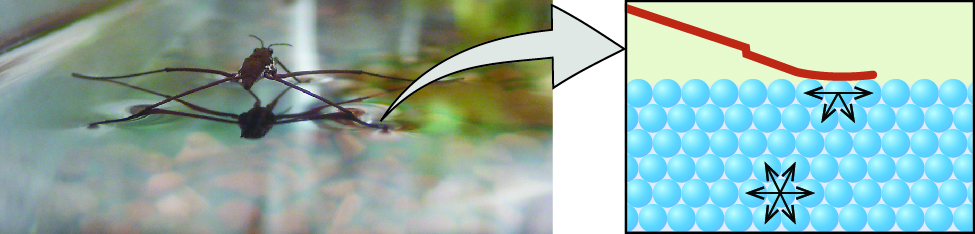
Figure 10.17図 10.17
Surface tension (right) prevents this insect, a “water strider,” from sinking into the water.
表面張力(右)が、この昆虫「アメンボ」が水中に沈むのを防いでいる。
Surface tension is affected by a variety of variables, including the introduction of additional substances on the surface. In the late 1800s, Agnes Pockels, who was initially blocked from pursuing a scientific career but studied on her own, began investigating the impact and characteristics of soapy and greasy films in water. Using homemade materials, she developed an instrument known as a trough for measuring surface contaminants and their effects. With the support of renowned scientist Lord Rayleigh, her 1891 paper showed that surface contamination significantly reduces surface tension, and also that changing the characteristics of the surface (compressing or expanding it) also affects surface tension. Decades later, Irving Langmuir and Katharine Blodgett built on Pockels' work in their own trough and important advances in surface chemistry. Langmuir pioneered methods for producing single-molecule layers of film; Blodgett applied these to the development of non-reflective glass (critical for film-making and other applications), and also studied methods related to cleaning surfaces, which are important in semiconductor fabrication.
英語のヒント
表面張力には、表面に別の物質を加えることなど、さまざまな要因が影響する。1800年代後半、当初は科学の専門家として進む道を閉ざされながら独学を続けたアグネス・ポッケルスは、水にある石けんや油の膜の影響と性質を調べ始めた。手製の材料を使い、表面の汚染物とその影響を測るための、トラフと呼ばれる装置を開発した。著名な科学者レイリー卿の支援を受けた1891年の論文では、表面の汚染が表面張力を大きく下げること、また、表面を圧縮・拡張してその特性を変えることも表面張力に影響することを示した。数十年後、アーヴィング・ラングミュアとキャサリン・ブロジェットはポッケルスの研究を発展させ、独自のトラフと表面化学における重要な進歩につなげた。ラングミュアは分子1層の膜を作る方法を開拓した。ブロジェットはこれを、映画製作などに重要な無反射ガラスの開発に応用し、半導体の製造で重要な表面洗浄に関する方法も研究した。
The IMFs of attraction between two different molecules are called adhesive forces. Consider what happens when water comes into contact with some surface. If the adhesive forces between water molecules and the molecules of the surface are weak compared to the cohesive forces between the water molecules, the water does not “wet” the surface. For example, water does not wet waxed surfaces or many plastics such as polyethylene. Water forms drops on these surfaces because the cohesive forces within the drops are greater than the adhesive forces between the water and the plastic. Water spreads out on glass because the adhesive force between water and glass is greater than the cohesive forces within the water. When water is confined in a glass tube, its meniscus (surface) has a concave shape because the water wets the glass and creeps up the side of the tube. On the other hand, the cohesive forces between mercury atoms are much greater than the adhesive forces between mercury and glass. Mercury therefore does not wet glass, and it forms a convex meniscus when confined in a tube because the cohesive forces within the mercury tend to draw it into a drop (Figure 10.18).
英語のヒント
異なる分子同士に働く分子間引力を付着力という。水がある表面に触れたときに何が起こるか考えよう。水分子と表面の分子との付着力が、水分子同士の凝集力より弱ければ、水はその表面を「ぬらさない」。例えば、水はワックスを塗った表面や、ポリエチレンなど多くのプラスチックをぬらさない。これらの表面では、滴の中の凝集力が、水とプラスチックの間の付着力より強いため、水は滴になる。ガラス上では、水とガラスとの付着力が水の内部の凝集力より強いため、水は広がる。水をガラス管に入れると、ガラスをぬらして管の側面をはい上がるため、メニスカス(液面)は凹形になる。一方、水銀原子同士の凝集力は、水銀とガラスとの付着力よりはるかに強い。したがって水銀はガラスをぬらさず、管に入れると、水銀内部の凝集力が滴にまとめようとするため、凸形のメニスカスを作る(図10.18)。
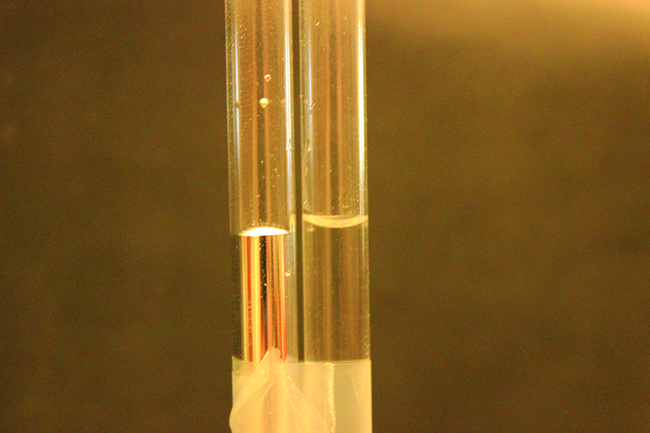
Figure 10.18図 10.18
Differences in the relative strengths of cohesive and adhesive forces result in different meniscus shapes for mercury (left) and water (right) in glass tubes. (credit: Mark Ott)
凝集力と付着力の相対的な強さが異なるため、ガラス管内の水銀(左)と水(右)では、メニスカスの形が異なる。(クレジット:Mark Ott)
If you place one end of a paper towel in spilled wine, as shown in Figure 10.19, the liquid wicks up the paper towel. A similar process occurs in a cloth towel when you use it to dry off after a shower. These are examples of capillary action—when a liquid flows within a porous material due to the attraction of the liquid molecules to the surface of the material and to other liquid molecules. The adhesive forces between the liquid and the porous material, combined with the cohesive forces within the liquid, may be strong enough to move the liquid upward against gravity.
英語のヒント
図10.19のように、こぼれたワインにペーパータオルの端をつけると、液体はタオルを伝って吸い上がる。シャワーの後に布タオルで体を拭くときにも、同じような過程が起こる。これは毛細管現象の例であり、液体分子が材料の表面やほかの液体分子に引き付けられることによって、多孔質の材料内を液体が流れる現象である。液体と多孔質材料の間の付着力は、液体内の凝集力と組み合わさって、重力に逆らって液体を上へ移動させるほど強くなることがある。
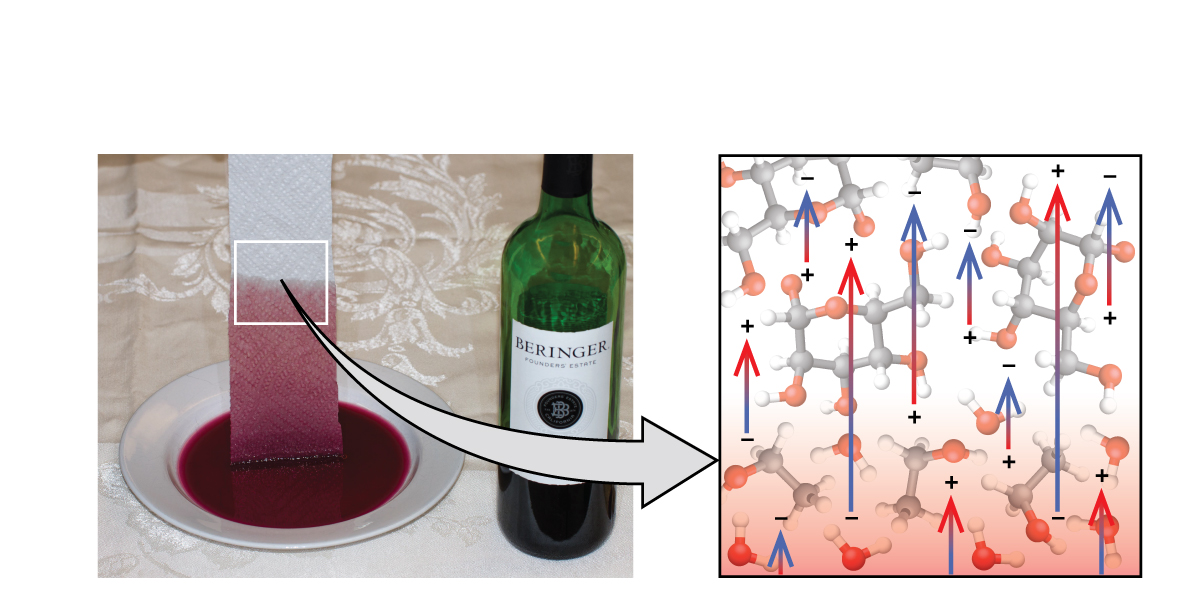
Figure 10.19図 10.19
Wine wicks up a paper towel (left) because of the strong attractions of water (and ethanol) molecules to the −OH groups on the towel’s cellulose fibers and the strong attractions of water molecules to other water (and ethanol) molecules (right). (credit photo: modification of work by Mark Blaser)
ワインがペーパータオルを吸い上がる(左)のは、水分子やエタノール分子がタオルのセルロース繊維の−OH基に強く引き付けられ、さらに水分子がほかの水分子やエタノール分子に強く引き付けられるためである(右)。(写真クレジット:Mark Blaserの作品を改変)
Towels soak up liquids like water because the fibers of a towel are made of molecules that are attracted to water molecules. Most cloth towels are made of cotton, and paper towels are generally made from paper pulp. Both consist of long molecules of cellulose that contain many −OH groups. Water molecules are attracted to these −OH groups and form hydrogen bonds with them, which draws the H2O molecules up the cellulose molecules. The water molecules are also attracted to each other, so large amounts of water are drawn up the cellulose fibers.
英語のヒント
タオルが水などの液体を吸うのは、タオルの繊維が水分子に引き付けられる分子からできているためである。布タオルの多くは綿でできており、ペーパータオルは通常、紙パルプから作られる。どちらも多数の−OH基を含む長いセルロース分子からなる。水分子はこれらの−OH基に引き付けられ、水素結合を形成し、それによってH2O分子がセルロース分子に沿って引き上げられる。水分子同士も引き合うため、大量の水がセルロース繊維を伝って吸い上げられる。
Capillary action can also occur when one end of a small diameter tube is immersed in a liquid, as illustrated in Figure 10.20. If the liquid molecules are strongly attracted to the tube molecules, the liquid creeps up the inside of the tube until the weight of the liquid and the adhesive forces are in balance. The smaller the diameter of the tube is, the higher the liquid climbs. It is partly by capillary action occurring in plant cells called xylem that water and dissolved nutrients are brought from the soil up through the roots and into a plant. Capillary action is the basis for thin layer chromatography, a laboratory technique commonly used to separate small quantities of mixtures. You depend on a constant supply of tears to keep your eyes lubricated and on capillary action to pump tear fluid away.
英語のヒント
図10.20のように、細い管の一端を液体に浸した場合にも毛細管現象が起こる。液体分子が管の分子に強く引き付けられると、液体の重さと付着力が釣り合うまで、液体は管の内側をはい上がる。管の直径が小さいほど、液体は高く上がる。土壌の水や溶けた栄養分が根を通り、植物の内部へ運ばれるのは、木部と呼ばれる植物細胞内で起こる毛細管現象も一因である。毛細管現象は、少量の混合物を分離するために実験室でよく用いられる薄層クロマトグラフィーの基礎でもある。目が潤いを保つには涙が絶えず供給されることが必要であり、その涙を排出するのにも毛細管現象が使われている。
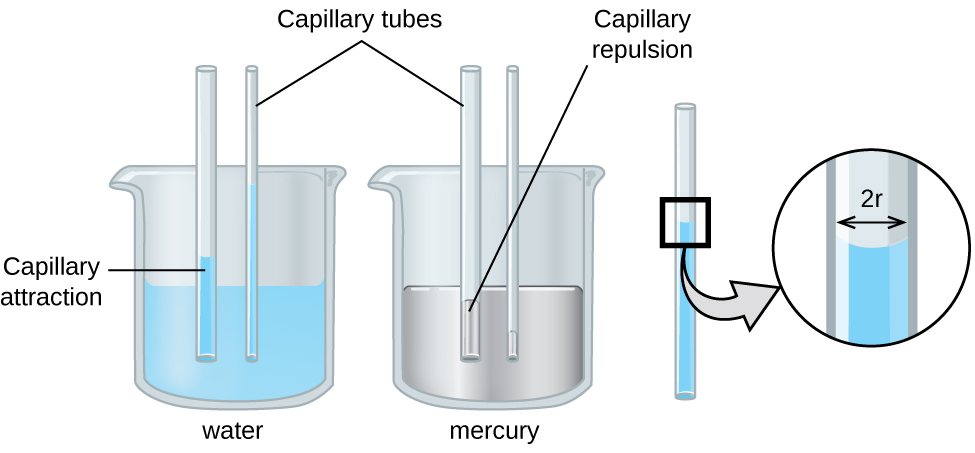


Figure 10.20図 10.20
Depending upon the relative strengths of adhesive and cohesive forces, a liquid may rise (such as water) or fall (such as mercury) in a glass capillary tube. The extent of the rise (or fall) is directly proportional to the surface tension of the liquid and inversely proportional to the density of the liquid and the radius of the tube.
付着力と凝集力の相対的な強さに応じて、ガラスの毛細管内の液面は、水のように上がる場合と、水銀のように下がる場合がある。上昇または下降の大きさは、液体の表面張力に正比例し、液体の密度と管の半径に反比例する。
The height to which a liquid will rise in a capillary tube is determined by several factors as shown in the following equation:
毛細管内で液体が上がる高さは、次式に示すいくつかの要因によって決まる。
In this equation, h is the height of the liquid inside the capillary tube relative to the surface of the liquid outside the tube, T is the surface tension of the liquid, θ is the contact angle between the liquid and the tube, r is the radius of the tube, ρ is the density of the liquid, and g is the acceleration due to gravity, 9.8 m/s2. When the tube is made of a material to which the liquid molecules are strongly attracted, they will spread out completely on the surface, which corresponds to a contact angle of 0°. This is the situation for water rising in a glass tube.
この式で、hは管外の液面を基準とした毛細管内の液面の高さ、Tは液体の表面張力、θは液体と管との接触角、rは管の半径、ρは液体の密度、gは重力加速度9.8 m/s2である。液体分子を強く引き付ける材料で管を作ると、分子は表面全体に完全に広がり、これは接触角0°に対応する。ガラス管を上昇する水は、この場合にあたる。
Example 10.4例題 10.4
Capillary Rise毛細管上昇
At 25 °C, how high will water rise in a glass capillary tube with an inner diameter of 0.25 mm?
25 °Cで、水は内径0.25 mmのガラス毛細管をどの高さまで上がるか。
For water, T = 71.99 mN/m and ρ = 1.0 g/cm3.
水について、T = 71.99 mN/m、ρ = 1.0 g/cm3である。
Solution解法
The liquid will rise to a height h given by:
液体は、次式で与えられる高さhまで上がる。
The Newton is defined as a kg m/s2, and so the provided surface tension is equivalent to 0.07199 kg/s2. The provided density must be converted into units that will cancel appropriately: ρ = 1000 kg/m3. The diameter of the tube in meters is 0.00025 m, so the radius is 0.000125 m. For a glass tube immersed in water, the contact angle is θ = 0°, so cos θ = 1. Finally, acceleration due to gravity on the earth is g = 9.8 m/s2. Substituting these values into the equation, and cancelling units, we have:
ニュートンはkg m/s2と定義されるので、与えられた表面張力は0.07199 kg/s2に等しい。密度は、単位を適切に約分できるよう、ρ = 1000 kg/m3に換算する必要がある。管の直径は0.00025 mなので、半径は0.000125 mである。水に浸したガラス管では接触角θ = 0°なので、cos θ = 1となる。最後に、地球上の重力加速度はg = 9.8 m/s2である。これらの値を代入して単位を約分すると、次式を得る。
Check Your Learning理解度の確認
Water rises in a glass capillary tube to a height of 8.4 cm. What is the diameter of the capillary tube?
水がガラス毛細管内で8.4 cmの高さまで上がる。この毛細管の直径はいくらか。