第10章液体と固体
Enthalpy of Vaporization蒸発エンタルピー
Vaporization is an endothermic process. The cooling effect can be evident when you leave a swimming pool or a shower. When the water on your skin evaporates, it removes heat from your skin and causes you to feel cold. The energy change associated with the vaporization process is the enthalpy of vaporization, ΔHvap. For example, the vaporization of water at standard temperature is represented by:
気化は吸熱過程である。その冷却効果は、プールやシャワーから出たときに実感できる。皮膚の水が蒸発すると皮膚から熱を奪うため、冷たく感じる。気化に伴うエネルギー変化が、蒸発エンタルピーΔHvapである。例えば、標準温度での水の気化は次のように表される。
As described in the chapter on thermochemistry, the reverse of an endothermic process is exothermic. And so, the condensation of a gas releases heat:
熱化学の章で述べたように、吸熱過程の逆は発熱過程である。したがって、気体の凝縮は熱を放出する。
Example 10.9例題 10.9
Using Enthalpy of Vaporization蒸発エンタルピーを用いる
One way our body is cooled is by evaporation of the water in sweat (Figure 10.26). In very hot climates, we can lose as much as 1.5 L of sweat per day. Although sweat is not pure water, we can get an approximate value of the amount of heat removed by evaporation by assuming that it is. How much heat is required to evaporate 1.5 L of water (1.5 kg) at T = 37 °C (normal body temperature); ΔHvap = 43.46 kJ/mol at 37 °C.
英語のヒント
体が冷やされる仕組みの一つは、汗に含まれる水の蒸発である(図10.26)。非常に暑い気候では、1日に1.5 Lもの汗を失うことがある。汗は純水ではないが、純水だと仮定すれば、蒸発で奪われる熱量のおおよその値を求められる。T = 37 °C(通常の体温)で1.5 Lの水(1.5 kg)を蒸発させるには、どれだけの熱が必要か。37 °CでΔHvap = 43.46 kJ/molである。
Image omitted because its reuse rights could not be verified.権利の確認ができないため画像を割愛。
Figure 10.26図 10.26
Evaporation of sweat helps cool the body. (credit: “Kullez”/Flickr)
汗の蒸発は体を冷やす働きをする。(クレジット:「Kullez」/Flickr)
Solution解法
We start with the known volume of sweat (approximated as just water) and use the given information to convert to the amount of heat needed:
汗を水と近似し、既知の体積を出発点として、与えられた情報で必要な熱量に換算する。
Thus, 3600 kJ of heat are removed by the evaporation of 1.5 L of water.
したがって、1.5 Lの水の蒸発によって3600 kJの熱が奪われる。
Check Your Learning理解度の確認
How much heat is required to evaporate 100.0 g of liquid ammonia, NH3, at its boiling point if its enthalpy of vaporization is 4.8 kJ/mol?
液体アンモニアNH3の蒸発エンタルピーが4.8 kJ/molの場合、沸点で100.0 gを蒸発させるにはどれだけの熱が必要か。
Melting and Freezing融解と凝固
When we heat a crystalline solid, we increase the average energy of its atoms, molecules, or ions and the solid gets hotter. At some point, the added energy becomes large enough to partially overcome the forces holding the molecules or ions of the solid in their fixed positions, and the solid begins the process of transitioning to the liquid state, or melting. At this point, the temperature of the solid stops rising, despite the continual input of heat, and it remains constant until all of the solid is melted. Only after all of the solid has melted will continued heating increase the temperature of the liquid (Figure 10.27).
英語のヒント
結晶性固体を加熱すると、原子、分子、イオンの平均エネルギーが増し、固体の温度が上がる。あるところで、加えたエネルギーが、分子やイオンを決まった位置に保つ力に部分的に打ち勝つのに十分となり、固体は液体状態への移行、すなわち融解を始める。この時点で、熱を加え続けても固体の温度上昇は止まり、すべてが融けるまで温度は一定のままである。固体がすべて融けて初めて、加熱を続けることで液体の温度が上がる(図10.27)。
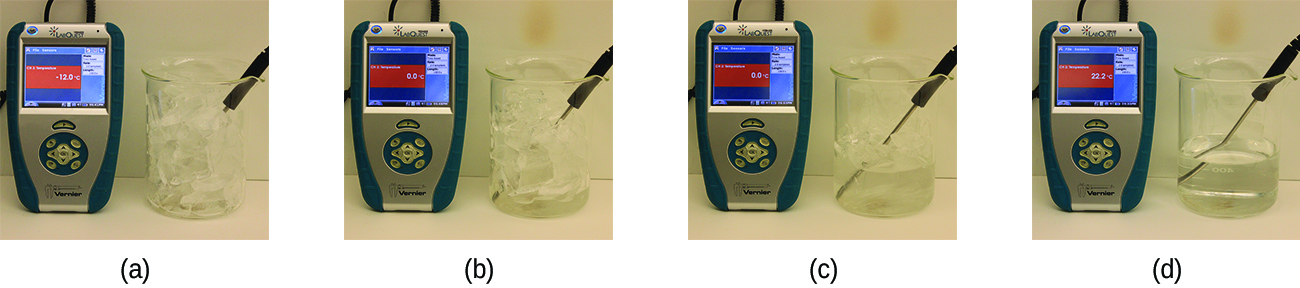
Figure 10.27図 10.27
(a) This beaker of ice has a temperature of −12.0 °C. (b) After 10 minutes the ice has absorbed enough heat from the air to warm to 0 °C. A small amount has melted. (c) Thirty minutes later, the ice has absorbed more heat, but its temperature is still 0 °C. The ice melts without changing its temperature. (d) Only after all the ice has melted does the heat absorbed cause the temperature to increase to 22.2 °C. (credit: modification of work by Mark Ott)
(a) このビーカーの氷は−12.0 °Cである。(b) 10分後、氷は空気から十分な熱を吸収して0 °Cになり、少し融けている。(c) 30分後にはさらに熱を吸収しているが、温度はまだ0 °Cである。氷は温度を変えずに融ける。(d) 氷がすべて融けて初めて、吸収した熱が温度を22.2 °Cまで上げる。(クレジット:Mark Ottの作品を改変)
If we stop heating during melting and place the mixture of solid and liquid in a perfectly insulated container so no heat can enter or escape, the solid and liquid phases remain in equilibrium. This is almost the situation with a mixture of ice and water in a very good thermos bottle; almost no heat gets in or out, and the mixture of solid ice and liquid water remains for hours. In a mixture of solid and liquid at equilibrium, the reciprocal processes of melting and freezing occur at equal rates, and the quantities of solid and liquid therefore remain constant. The temperature at which the solid and liquid phases of a given substance are in equilibrium is called the melting point of the solid or the freezing point of the liquid. Use of one term or the other is normally dictated by the direction of the phase transition being considered, for example, solid to liquid (melting) or liquid to solid (freezing).
英語のヒント
融解の途中で加熱をやめ、固体と液体の混合物を、熱が出入りしない完全な断熱容器に入れると、固相と液相は平衡に保たれる。これは、性能のよい魔法瓶に氷と水を入れたときにほぼ相当する。熱はほとんど出入りせず、固体の氷と液体の水の混合物は何時間も残る。平衡にある固体と液体の混合物では、融解と凝固という逆向きの過程が同じ速度で起こり、固体と液体の量は一定に保たれる。ある物質の固相と液相が平衡になる温度を、固体の融点、または液体の凝固点という。どちらの語を使うかは、通常、考えている相転移の方向、例えば固体から液体への融解か、液体から固体への凝固かによって決まる。
The enthalpy of fusion and the melting point of a crystalline solid depend on the strength of the attractive forces between the units present in the crystal. Molecules with weak attractive forces form crystals with low melting points. Crystals consisting of particles with stronger attractive forces melt at higher temperatures.
結晶性固体の融解エンタルピーと融点は、結晶内の構成単位の間の引力の強さに依存する。引力の弱い分子は、融点の低い結晶を作る。より強い引力を持つ粒子からなる結晶は、より高い温度で融ける。
The amount of heat required to change one mole of a substance from the solid state to the liquid state is the enthalpy of fusion, ΔHfus of the substance. The enthalpy of fusion of ice is 6.0 kJ/mol at 0 °C. Fusion (melting) is an endothermic process:
物質1 molを固体から液体へ変えるのに必要な熱量を、その物質の融解エンタルピーΔHfusという。氷の融解エンタルピーは0 °Cで6.0 kJ/molである。融解は吸熱過程である。
The reciprocal process, freezing, is an exothermic process whose enthalpy change is −6.0 kJ/mol at 0 °C:
逆の過程である凝固は発熱過程であり、0 °Cでのエンタルピー変化は−6.0 kJ/molである。