第10章液体と固体
Forces between Molecules分子の間に働く力
Under appropriate conditions, the attractions between all gas molecules will cause them to form liquids or solids. This is due to intermolecular forces, not intramolecular forces. Intramolecular forces are those within the molecule that keep the molecule together, for example, the bonds between the atoms. Intermolecular forces are the attractions between molecules, which determine many of the physical properties of a substance. Figure 10.5 illustrates these different molecular forces. The strengths of these attractive forces vary widely, though usually the IMFs between small molecules are weak compared to the intramolecular forces that bond atoms together within a molecule. For example, to overcome the IMFs in one mole of liquid HCl and convert it into gaseous HCl requires only about 17 kilojoules. However, to break the covalent bonds between the hydrogen and chlorine atoms in one mole of HCl requires about 25 times more energy—430 kilojoules.
英語のヒント
適切な条件では、どの気体でも、分子間の引力によって液体や固体ができる。これは分子内力ではなく、分子間力による。分子内力は、原子間の結合のように、分子の内部で分子を一つに保つ力である。分子間力は分子同士の引力であり、物質の多くの物理的性質を決める。図10.5に、これらの異なる分子の力を示す。引力の強さには大きな幅があるが、通常、小さい分子同士の分子間力は、分子内で原子を結び付ける分子内力に比べて弱い。例えば、液体のHCl 1 molの分子間力に打ち勝ち、気体のHClに変えるには、約17キロジュールしか必要としない。しかし、HCl 1 mol中の水素原子と塩素原子の共有結合を切るには、約25倍の430キロジュールが必要である。
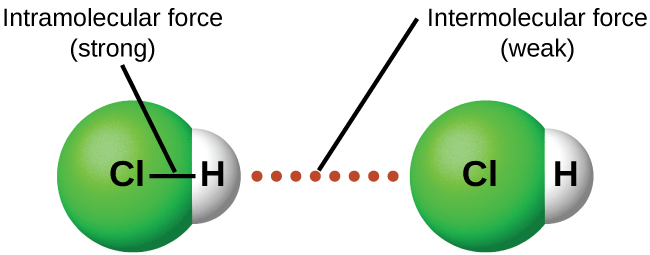
Figure 10.5図 10.5
Intramolecular forces keep a molecule intact. Intermolecular forces hold multiple molecules together and determine many of a substance’s properties.
英語のヒント
分子内力は、分子を壊れずに一つの形に保つ。分子間力は複数の分子を結び付け、物質の多くの性質を決める。
All of the attractive forces between neutral atoms and molecules are known as van der Waals forces, although they are usually referred to more informally as intermolecular attraction. We will consider the various types of IMFs in the next three sections of this module.
英語のヒント
中性の原子や分子の間の引力は、まとめてファン・デル・ワールス力と呼ばれるが、一般にはより簡単に分子間引力とも呼ばれる。この節の次の三つの項目で、さまざまな種類の分子間力を考える。
Dispersion Forces分散力
One of the three van der Waals forces is present in all condensed phases, regardless of the nature of the atoms or molecules composing the substance. This attractive force is called the London dispersion force in honor of German-born American physicist Fritz London who, in 1928, first explained it. This force is often referred to as simply the dispersion force. Because the electrons of an atom or molecule are in constant motion (or, alternatively, the electron’s location is subject to quantum-mechanical variability), at any moment in time, an atom or molecule can develop a temporary, instantaneous dipole if its electrons are distributed asymmetrically. The presence of this dipole can, in turn, distort the electrons of a neighboring atom or molecule, producing an induced dipole. These two rapidly fluctuating, temporary dipoles thus result in a relatively weak electrostatic attraction between the species—a so-called dispersion force like that illustrated in Figure 10.6.
英語のヒント
三つあるファン・デル・ワールス力のうちの一つは、物質を構成する原子や分子の性質にかかわらず、すべての凝縮相に存在する。この引力は、1928年に初めて説明したドイツ生まれの米国の物理学者フリッツ・ロンドンにちなんで、ロンドン分散力と呼ばれる。単に分散力と呼ばれることも多い。原子や分子の電子は絶えず動いているため(別の言い方をすれば、電子の位置は量子力学的な変動を受けるため)、ある瞬間に電子が非対称に分布すると、原子や分子に一時的で瞬間的な双極子が生じうる。この双極子は、さらに隣の原子や分子の電子の分布をゆがめ、誘起双極子を生じさせる。このように、素早く変動する二つの一時的な双極子が、粒子間に比較的弱い静電引力を生じさせる。これが、図10.6に示すような、いわゆる分散力である。
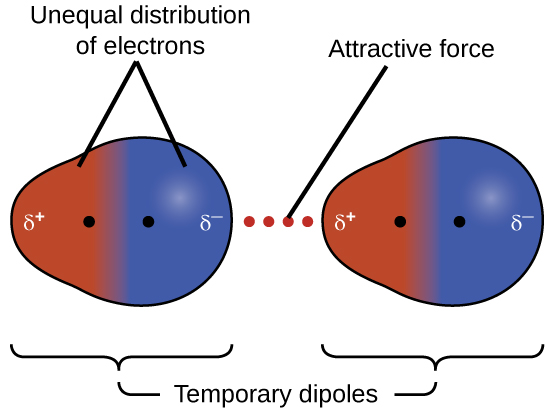
Figure 10.6図 10.6
Dispersion forces result from the formation of temporary dipoles, as illustrated here for two nonpolar diatomic molecules.
分散力は一時的な双極子ができることで生じる。ここでは二つの無極性二原子分子について示している。
Dispersion forces that develop between atoms in different molecules can attract the two molecules to each other. The forces are relatively weak, however, and become significant only when the molecules are very close. Larger and heavier atoms and molecules exhibit stronger dispersion forces than do smaller and lighter atoms and molecules. F2 and Cl2 are gases at room temperature (reflecting weaker attractive forces); Br2 is a liquid, and I2 is a solid (reflecting stronger attractive forces). Trends in observed melting and boiling points for the halogens clearly demonstrate this effect, as seen in Table 10.1.
異なる分子に属する原子の間に生じる分散力は、その二つの分子を互いに引き付ける。しかし、この力は比較的弱く、分子が非常に近づいたときだけ重要になる。大きく重い原子や分子は、小さく軽い原子や分子より強い分散力を示す。F2とCl2は室温で気体であり、引力が弱いことを反映している。Br2は液体、I2は固体であり、引力が強いことを反映している。表10.1に示すように、ハロゲンで観測される融点と沸点の傾向は、この効果をはっきり示している。
Melting and Boiling Points of the Halogens ハロゲンの融点と沸点 |
||||
|---|---|---|---|---|
Halogen ハロゲン |
Molar Mass モル質量 |
Atomic Radius 原子半径 |
Melting Point 融点 |
Boiling Point 沸点 |
fluorine, F2 フッ素、F2 |
38 g/mol |
72 pm |
53 K |
85 K |
chlorine, Cl2 塩素、Cl2 |
71 g/mol |
99 pm |
172 K |
238 K |
bromine, Br2 臭素、Br2 |
160 g/mol |
114 pm |
266 K |
332 K |
iodine, I2 ヨウ素、I2 |
254 g/mol |
133 pm |
387 K |
457 K |
astatine, At2 アスタチン、At2 |
420 g/mol |
150 pm |
575 K |
610 K |
The increase in melting and boiling points with increasing atomic/molecular size may be rationalized by considering how the strength of dispersion forces is affected by the electronic structure of the atoms or molecules in the substance. In a larger atom, the valence electrons are, on average, farther from the nuclei than in a smaller atom. Thus, they are less tightly held and can more easily form the temporary dipoles that produce the attraction. The measure of how easy or difficult it is for another electrostatic charge (for example, a nearby ion or polar molecule) to distort a molecule’s charge distribution (its electron cloud) is known as polarizability. A molecule that has a charge cloud that is easily distorted is said to be very polarizable and will have large dispersion forces; one with a charge cloud that is difficult to distort is not very polarizable and will have small dispersion forces.
英語のヒント
原子や分子の大きさとともに融点や沸点が上がることは、物質中の原子や分子の電子構造が分散力の強さにどう影響するかを考えると説明できる。大きい原子では、小さい原子に比べて、価電子は平均して原子核から遠くにある。そのため束縛が弱く、引力を生む一時的な双極子をより容易に形成できる。別の静電的な電荷(例えば近くのイオンや極性分子)によって、分子の電荷分布、すなわち電子雲がどれだけゆがみやすいか、またはゆがみにくいかを表す尺度を分極率という。電荷雲がゆがみやすい分子は分極しやすいといい、分散力が大きい。電荷雲がゆがみにくい分子はあまり分極せず、分散力が小さい。
Example 10.1例題 10.1
London Forces and Their Effectsロンドン力とその効果
Order the following compounds of a group 14 element and hydrogen from lowest to highest boiling point: CH4, SiH4, GeH4, and SnH4. Explain your reasoning.
14族元素と水素からなる次の化合物を、沸点の低い順に並べなさい。CH4、SiH4、GeH4、SnH4。その理由を説明しなさい。
Solution解法
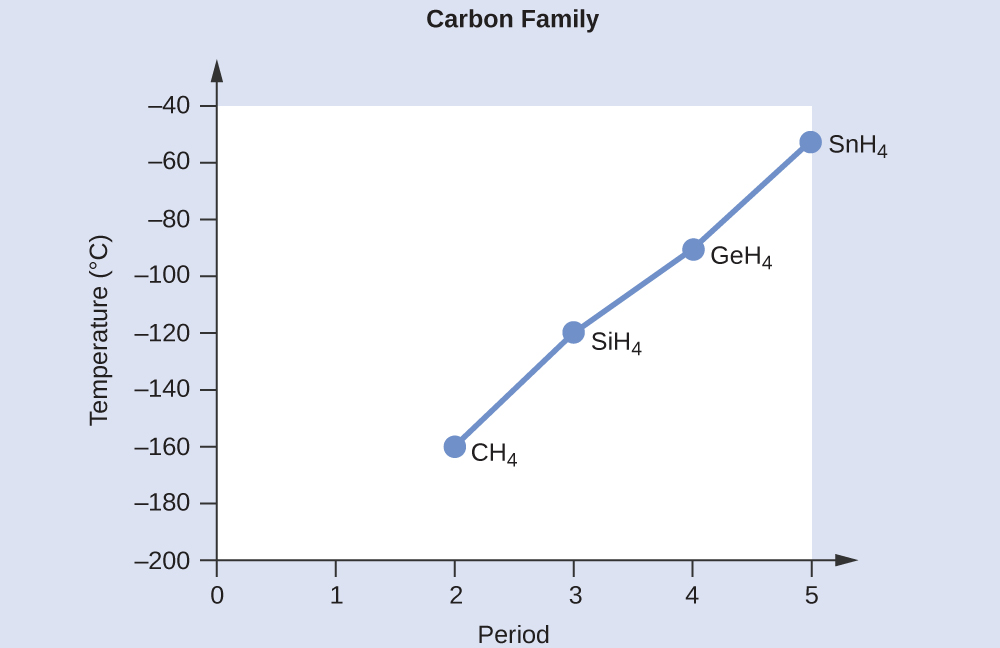
Applying the skills acquired in the chapter on chemical bonding and molecular geometry, all of these compounds are predicted to be nonpolar, so they may experience only dispersion forces: the smaller the molecule, the less polarizable and the weaker the dispersion forces; the larger the molecule, the larger the dispersion forces. The molar masses of CH4, SiH4, GeH4, and SnH4 are approximately 16 g/mol, 32 g/mol, 77 g/mol, and 123 g/mol, respectively. Therefore, CH4 is expected to have the lowest boiling point and SnH4 the highest boiling point. The ordering from lowest to highest boiling point is expected to be CH4 < SiH4 < GeH4 < SnH4.
化学結合と分子の形の章で学んだ方法を使うと、これらはすべて無極性で、分散力だけを受けると予測される。分子が小さいほど分極しにくく、分散力も弱い。分子が大きいほど分散力は大きい。CH4、SiH4、GeH4、SnH4のモル質量は、それぞれ約16 g/mol、32 g/mol、77 g/mol、123 g/molである。したがって、CH4の沸点が最も低く、SnH4の沸点が最も高いと予想される。沸点の低い順に並べると、CH4 < SiH4 < GeH4 < SnH4となると予測される。
A graph of the actual boiling points of these compounds versus the period of the group 14 element shows this prediction to be correct:
これらの化合物の実際の沸点を、14族元素の周期に対して描くと、この予測が正しいことがわかる。
Check Your Learning理解度の確認
Order the following hydrocarbons from lowest to highest boiling point: C2H6, C3H8, and C4H10.
次の炭化水素を、沸点の低い順に並べなさい。C2H6、C3H8、C4H10。
The shapes of molecules also affect the magnitudes of the dispersion forces between them. For example, boiling points for the isomers n-pentane, isopentane, and neopentane (shown in Figure 10.7) are 36 °C, 27 °C, and 9.5 °C, respectively. Even though these compounds are composed of molecules with the same chemical formula, C5H12, the difference in boiling points suggests that dispersion forces in the liquid phase are different, being greatest for n-pentane and least for neopentane. The elongated shape of n-pentane provides a greater surface area available for contact between molecules, resulting in correspondingly stronger dispersion forces. The more compact shape of isopentane offers a smaller surface area available for intermolecular contact and, therefore, weaker dispersion forces. Neopentane molecules are the most compact of the three, offering the least available surface area for intermolecular contact and, hence, the weakest dispersion forces. This behavior is analogous to the connections that may be formed between strips of VELCRO brand fasteners: the greater the area of the strip’s contact, the stronger the connection.
英語のヒント
分子の形も、分子間の分散力の大きさに影響する。例えば、異性体であるn-ペンタン、イソペンタン、ネオペンタン(図10.7)の沸点は、それぞれ36 °C、27 °C、9.5 °Cである。これらの化合物は同じ化学式C5H12の分子からなるにもかかわらず、沸点の違いから、液相での分散力は同じではなく、n-ペンタンが最大でネオペンタンが最小だと考えられる。n-ペンタンの細長い形は、分子間で接触できる表面積を大きくし、それに応じて分散力を強くする。よりコンパクトなイソペンタンでは分子間の接触面積が小さくなり、分散力も弱くなる。ネオペンタンの分子は三つの中で最もコンパクトであり、分子間の接触面積が最も小さいため、分散力も最も弱い。この振る舞いは、VELCROブランドの面ファスナー同士を貼り合わせる場合に似ている。接触する面積が大きいほど、結び付きが強くなる。
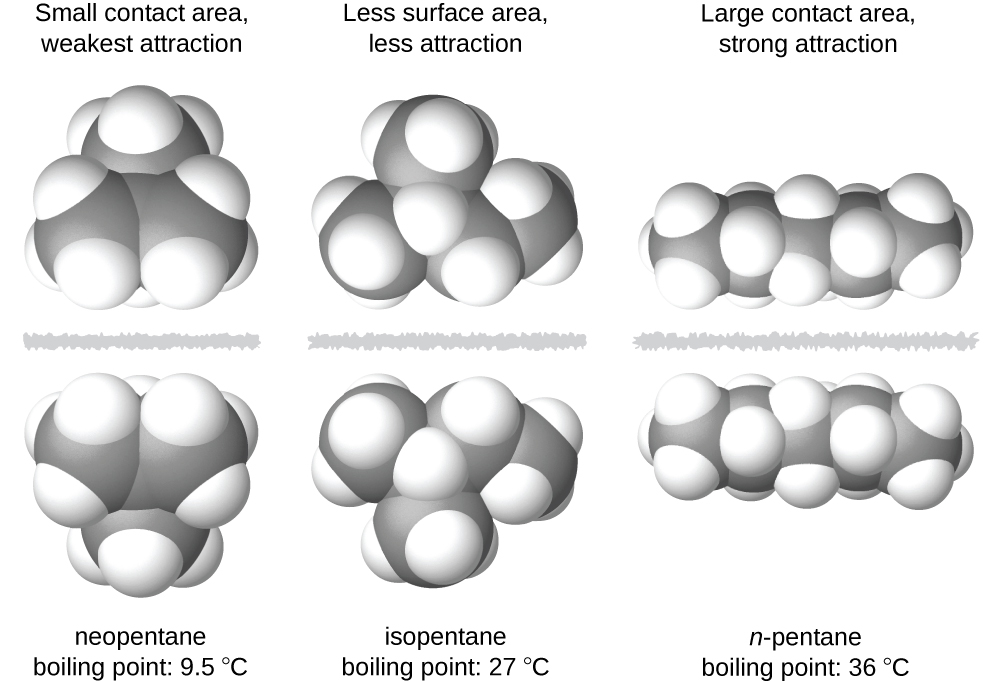


Figure 10.7図 10.7
The strength of the dispersion forces increases with the contact area between molecules, as demonstrated by the boiling points of these pentane isomers.
これらのペンタン異性体の沸点が示すように、分散力は分子間の接触面積が大きくなるほど強くなる。