第10章液体と固体
Key Concepts and Summary重要な概念とまとめ
The intermolecular forces between molecules in the liquid state vary depending upon their chemical identities and result in corresponding variations in various physical properties. Cohesive forces between like molecules are responsible for a liquid’s viscosity (resistance to flow) and surface tension (elasticity of a liquid surface). Adhesive forces between the molecules of a liquid and different molecules composing a surface in contact with the liquid are responsible for phenomena such as surface wetting and capillary rise.
液体状態の分子間に働く力は、化学物質の種類によって異なり、それに応じてさまざまな物理的性質に違いが生じる。同種分子間の凝集力は、液体の粘度(流れに対する抵抗)と表面張力(液体表面の弾性的な性質)を生み出す。液体分子と、それに接する表面を構成する異種の分子との付着力は、表面のぬれや毛細管上昇などの現象を生じさせる。
Key Equations重要な式
Chemistry End of Chapter Exercises章末演習
Exercises 22–29練習問題 22–29
Exercise 22問題 22
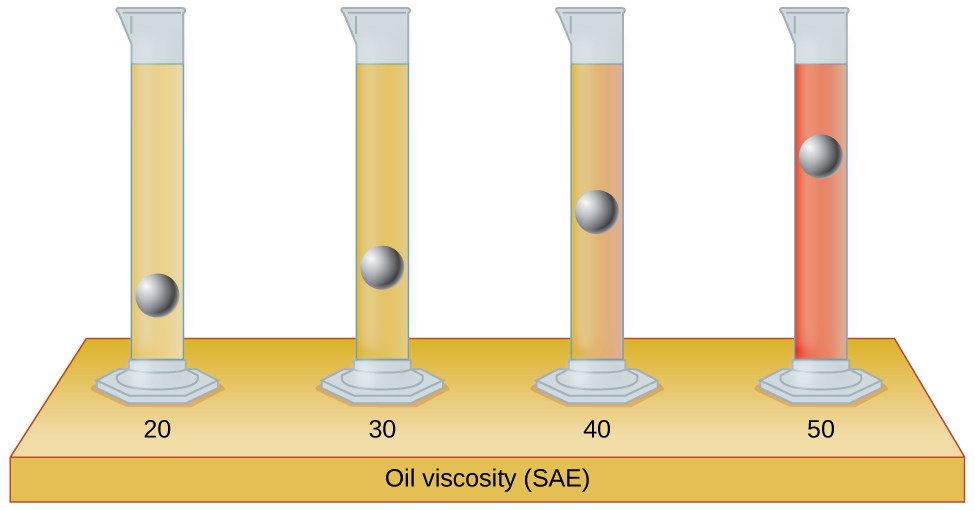
The test tubes shown here contain equal amounts of the specified motor oils. Identical metal spheres were dropped at the same time into each of the tubes, and a brief moment later, the spheres had fallen to the heights indicated in the illustration.
図の試験管には、それぞれ表示されたエンジンオイルが等量入っている。同じ金属球を同時に各管に落とすと、少し後に、球は図に示す高さまで落下した。
Rank the motor oils in order of increasing viscosity, and explain your reasoning:
これらのエンジンオイルを粘度の低い順に並べ、理由を説明しなさい。
Exercise 23問題 23
Although steel is denser than water, a steel needle or paper clip placed carefully lengthwise on the surface of still water can be made to float. Explain at a molecular level how this is possible.
英語のヒント
鋼は水より密度が大きいが、鋼の針やペーパークリップを静かな水面に長い方向を横にして注意深く置くと、浮かせることができる。これが可能な理由を分子レベルで説明しなさい。
Image omitted because its reuse rights could not be verified.権利の確認ができないため画像を割愛。
Figure 10.22図 10.22
(credit: Cory Zanker)
(クレジット:Cory Zanker)
Solution解き方
The water molecules have strong intermolecular forces of hydrogen bonding. The water molecules are thus attracted strongly to one another and exhibit a relatively large surface tension, forming a type of “skin” at its surface. This skin can support a bug or paper clip if gently placed on the water.
水分子には、水素結合による強い分子間力がある。そのため分子同士が強く引き合い、比較的大きな表面張力を示して、表面に一種の「膜」を形成する。この膜は、虫やペーパークリップを水面にそっと置くと、それを支えられる。
Exercise 24問題 24
The surface tension and viscosity values for diethyl ether, acetone, ethanol, and ethylene glycol are shown here.
ジエチルエーテル、アセトン、エタノール、エチレングリコールの表面張力と粘度を示す。
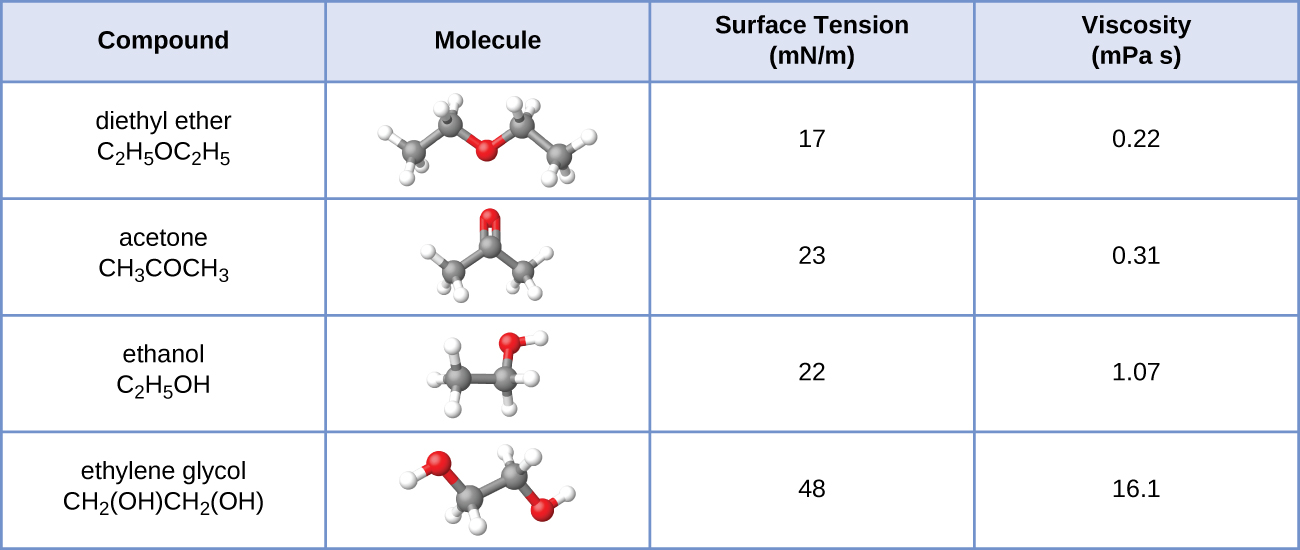


(a) Explain their differences in viscosity in terms of the size and shape of their molecules and their IMFs.
(a) 分子の大きさや形、分子間力を用いて、粘度の違いを説明しなさい。
(b) Explain their differences in surface tension in terms of the size and shape of their molecules and their IMFs:
(b) 分子の大きさや形、分子間力を用いて、表面張力の違いを説明しなさい。
Exercise 25問題 25
You may have heard someone use the figure of speech “slower than molasses in winter” to describe a process that occurs slowly. Explain why this is an apt idiom, using concepts of molecular size and shape, molecular interactions, and the effect of changing temperature.
英語のヒント
非常にゆっくり進むことを「冬の糖蜜より遅い」とたとえる表現を聞いたことがあるかもしれない。分子の大きさと形、分子間の相互作用、温度変化の影響という概念を用いて、これが適切なたとえである理由を説明しなさい。
Solution解き方
Temperature has an effect on intermolecular forces: The higher the temperature, the greater the kinetic energies of the molecules and the greater the extent to which their intermolecular forces are overcome, and so the more fluid (less viscous) the liquid. The lower the temperature, the less the intermolecular forces are overcome, and so the less viscous the liquid.
温度は分子間力に影響する。温度が高いほど分子の運動エネルギーは大きくなり、分子間力に打ち勝つ程度が大きくなって、液体は流れやすく(低粘度に)なる。温度が低いほど分子間力に打ち勝つ程度は小さくなり、液体の粘度は低くなる。
Exercise 26問題 26
It is often recommended that you let your car engine run idle to warm up before driving, especially on cold winter days. While the benefit of prolonged idling is dubious, it is certainly true that a warm engine is more fuel efficient than a cold one. Explain the reason for this.
英語のヒント
特に寒い冬の日には、運転前にエンジンをアイドリングして暖めることがよく勧められる。長時間のアイドリングの有益性は疑わしいが、暖まったエンジンの燃料効率が冷たいエンジンより高いことは確かである。その理由を説明しなさい。
Exercise 27問題 27
The surface tension and viscosity of water at several different temperatures are given in this table.
いくつかの温度における水の表面張力と粘度を、この表に示す。
Water 水 |
Surface Tension (mN/m) 表面張力(mN/m) |
Viscosity (mPa s) 粘度(mPa s) |
|---|---|---|
0 °C |
75.6 |
1.79 |
20 °C |
72.8 |
1.00 |
60 °C |
66.2 |
0.47 |
100 °C |
58.9 |
0.28 |
(a) As temperature increases, what happens to the surface tension of water? Explain why this occurs, in terms of molecular interactions and the effect of changing temperature.
(a) 温度が上がると、水の表面張力はどうなるか。分子間の相互作用と温度変化の影響に基づいて、その理由を説明しなさい。
(b) As temperature increases, what happens to the viscosity of water? Explain why this occurs, in terms of molecular interactions and the effect of changing temperature.
(b) 温度が上がると、水の粘度はどうなるか。分子間の相互作用と温度変化の影響に基づいて、その理由を説明しなさい。
Solution解き方
(a) As the water reaches higher temperatures, the increased kinetic energies of its molecules are more effective in overcoming hydrogen bonding, and so its surface tension decreases. Surface tension and intermolecular forces are directly related. (b) The same trend in viscosity is seen as in surface tension, and for the same reason.
(a) 水の温度が高くなると、分子の運動エネルギーが増え、水素結合によりよく打ち勝てるため、表面張力が下がる。表面張力と分子間力は直接関係している。(b) 粘度も表面張力と同じ理由で、同じ傾向を示す。
Exercise 28問題 28
At 25 °C, how high will water rise in a glass capillary tube with an inner diameter of 0.63 mm? Refer to Example 10.4 for the required information.
25 °Cで、水は内径0.63 mmのガラス毛細管をどの高さまで上がるか。必要な情報は例題10.4を参照しなさい。
Exercise 29問題 29
Water rises in a glass capillary tube to a height of 17 cm. What is the diameter of the capillary tube?
水がガラス毛細管内で17 cmの高さまで上がる。この毛細管の直径はいくらか。
Solution解き方
1.7 10−4 m
1.7 10−4 m
adhesive force
付着力
force of attraction between molecules of different chemical identities
異なる化学種の分子の間の引力。
capillary action
毛細管現象
flow of liquid within a porous material due to the attraction of the liquid molecules to the surface of the material and to other liquid molecules
液体分子が材料の表面やほかの液体分子に引き付けられることによって、多孔質材料内を液体が流れること。
cohesive force
凝集力
force of attraction between identical molecules
同一の分子同士の間の引力。
surface tension
表面張力
energy required to increase the area, or length, of a liquid surface by a given amount
液体表面の面積または長さを、ある量だけ増やすのに必要なエネルギー。
viscosity
粘度
measure of a liquid’s resistance to flow
液体の流れに対する抵抗の尺度。