第10章液体と固体
The Structures of Ionic Crystalsイオン結晶の構造
Ionic crystals consist of two or more different kinds of ions that usually have different sizes. The packing of these ions into a crystal structure is more complex than the packing of metal atoms that are the same size.
イオン結晶は、通常は大きさの異なる二種類以上のイオンからなる。これらのイオンを結晶構造に詰める配列は、同じ大きさの金属原子を詰める場合より複雑になる。
Most monatomic ions behave as charged spheres, and their attraction for ions of opposite charge is the same in every direction. Consequently, stable structures for ionic compounds result (1) when ions of one charge are surrounded by as many ions as possible of the opposite charge and (2) when the cations and anions are in contact with each other. Structures are determined by two principal factors: the relative sizes of the ions and the ratio of the numbers of positive and negative ions in the compound.
英語のヒント
大部分の単原子イオンは帯電した球として振る舞い、反対の電荷を持つイオンへの引力はどの方向でも同じである。このため、イオン化合物の安定な構造は、(1) ある電荷のイオンが、反対の電荷のイオンにできるだけ多く囲まれ、(2) 陽イオンと陰イオンが互いに接するときに生じる。構造を決める主な要因は二つ、イオンの相対的な大きさと、化合物中の正負のイオンの個数比である。
In simple ionic structures, we usually find the anions, which are normally larger than the cations, arranged in a closest-packed array. (As seen previously, additional electrons attracted to the same nucleus make anions larger and fewer electrons attracted to the same nucleus make cations smaller when compared to the atoms from which they are formed.) The smaller cations commonly occupy one of two types of holes (or interstices) remaining between the anions. The smaller of the holes is found between three anions in one plane and one anion in an adjacent plane. The four anions surrounding this hole are arranged at the corners of a tetrahedron, so the hole is called a tetrahedral hole. The larger type of hole is found at the center of six anions (three in one layer and three in an adjacent layer) located at the corners of an octahedron; this is called an octahedral hole. Figure 10.58 illustrates both of these types of holes.
英語のヒント
単純なイオン結晶構造では、通常、陽イオンより大きい陰イオンが最密充填配列を作っている。(前に見たように、同じ原子核に引きつけられる電子が増えると陰イオンは元の原子より大きくなり、電子が減ると陽イオンは元の原子より小さくなる。)小さな陽イオンは、陰イオン間に残る二種類の隙間のいずれかを占めることが多い。小さい方の隙間は、一つの面の3個の陰イオンと、隣の面の1個の陰イオンの間にある。この隙間を囲む四つの陰イオンは四面体の頂点に並ぶので、この隙間を四面体孔という。大きい方は、八面体の頂点にある6個の陰イオン(一つの層の3個と、隣の層の3個)の中心にあり、八面体孔という。図10.58に両方の隙間を示す。
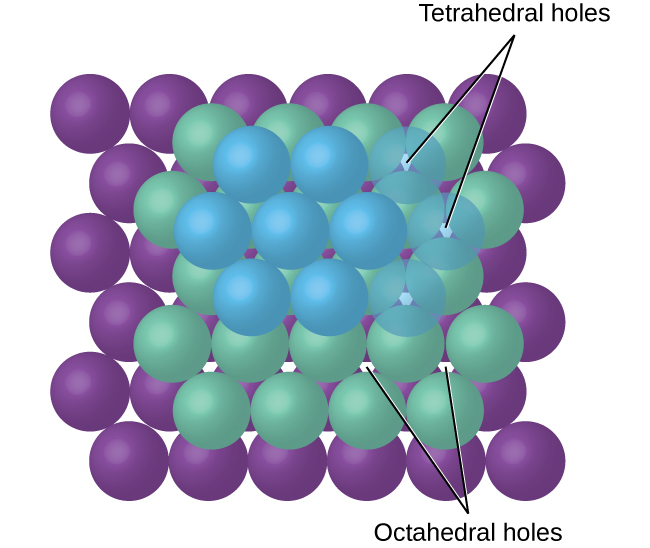
Figure 10.58図 10.58
Cations may occupy two types of holes between anions: octahedral holes or tetrahedral holes.
陽イオンが占める陰イオン間の隙間には、八面体孔と四面体孔の二種類がある。
Depending on the relative sizes of the cations and anions, the cations of an ionic compound may occupy tetrahedral or octahedral holes, as illustrated in Figure 10.59. Relatively small cations occupy tetrahedral holes, and larger cations occupy octahedral holes. If the cations are too large to fit into the octahedral holes, the anions may adopt a more open structure, such as a simple cubic array. The larger cations can then occupy the larger cubic holes made possible by the more open spacing.
英語のヒント
イオン化合物の陽イオンは、図10.59のように、陽イオンと陰イオンの相対的な大きさに応じて四面体孔または八面体孔を占める。比較的小さい陽イオンは四面体孔を、大きい陽イオンは八面体孔を占める。陽イオンが大きすぎて八面体孔に収まらない場合、陰イオンは単純立方配列のような、より隙間の多い構造をとることがある。その場合、大きな陽イオンは、間隔が広がったことでできる、より大きな立方体孔を占めることができる。
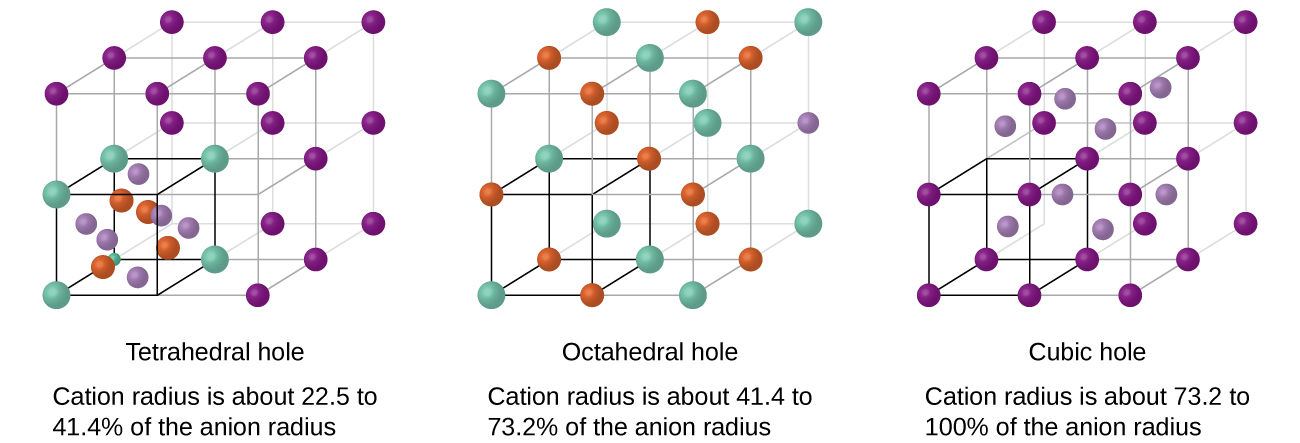


Figure 10.59図 10.59
A cation’s size and the shape of the hole occupied by the compound are directly related.
陽イオンの大きさと、化合物が占める隙間の形には直接的な関係がある。
There are two tetrahedral holes for each anion in either an HCP or CCP array of anions. A compound that crystallizes in a closest-packed array of anions with cations in the tetrahedral holes can have a maximum cation:anion ratio of 2:1; all of the tetrahedral holes are filled at this ratio. Examples include Li2O, Na2O, Li2S, and Na2S. Compounds with a ratio of less than 2:1 may also crystallize in a closest-packed array of anions with cations in the tetrahedral holes, if the ionic sizes fit. In these compounds, however, some of the tetrahedral holes remain vacant.
英語のヒント
陰イオンがHCP配列でもCCP配列でも、陰イオン1個につき四面体孔が二つある。陰イオンが最密充填配列を作り、陽イオンが四面体孔を占める化合物では、陽イオン:陰イオンの個数比は最大で2:1となる。この比では、四面体孔はすべて埋まる。例としてLi2O、Na2O、Li2S、Na2Sがある。個数比が2:1未満の化合物も、イオンの大きさが適していれば、陰イオンの最密充填配列の四面体孔に陽イオンが入った構造で結晶化する。ただし、その場合には四面体孔の一部が空いたままになる。
Example 10.16例題 10.16
Occupancy of Tetrahedral Holes四面体孔の占有
Zinc sulfide is an important industrial source of zinc and is also used as a white pigment in paint. Zinc sulfide crystallizes with zinc ions occupying one-half of the tetrahedral holes in a closest-packed array of sulfide ions. What is the formula of zinc sulfide?
英語のヒント
硫化亜鉛は工業的に重要な亜鉛の原料であり、塗料の白色顔料にも使われる。硫化亜鉛の結晶では、硫化物イオンが最密充填配列を作り、四面体孔の半分を亜鉛イオンが占める。硫化亜鉛の化学式は何か。
Solution解法
Because there are two tetrahedral holes per anion (sulfide ion) and one-half of these holes are occupied by zinc ions, there must be or 1, zinc ion per sulfide ion. Thus, the formula is ZnS.
陰イオン(硫化物イオン)1個につき四面体孔が二つあり、その半分を亜鉛イオンが占めるので、硫化物イオン1個あたりの亜鉛イオンは、すなわち1個である。したがって、化学式はZnSとなる。
Check Your Learning理解を確かめよう
Lithium selenide can be described as a closest-packed array of selenide ions with lithium ions in all of the tetrahedral holes. What it the formula of lithium selenide?
セレン化リチウムは、セレン化物イオンの最密充填配列のすべての四面体孔に、リチウムイオンが入った構造として表せる。セレン化リチウムの化学式は何か。
The ratio of octahedral holes to anions in either an HCP or CCP structure is 1:1. Thus, compounds with cations in octahedral holes in a closest-packed array of anions can have a maximum cation:anion ratio of 1:1. In NiO, MnS, NaCl, and KH, for example, all of the octahedral holes are filled. Ratios of less than 1:1 are observed when some of the octahedral holes remain empty.
HCP構造でもCCP構造でも、八面体孔と陰イオンの個数比は1:1である。したがって、陰イオンの最密充填配列の八面体孔に陽イオンが入った化合物では、陽イオン:陰イオンの比は最大1:1となる。例えばNiO、MnS、NaCl、KHでは、八面体孔がすべて埋まる。八面体孔の一部が空いたままの場合、比は1:1未満になる。
Example 10.17例題 10.17
Stoichiometry of Ionic Compoundsイオン化合物の化学量論
Sapphire is aluminum oxide. Aluminum oxide crystallizes with aluminum ions in two-thirds of the octahedral holes in a closest-packed array of oxide ions. What is the formula of aluminum oxide?
サファイアは酸化アルミニウムである。酸化アルミニウムの結晶では、酸化物イオンが最密充填配列を作り、八面体孔の3分の2にアルミニウムイオンが入る。酸化アルミニウムの化学式は何か。
Solution解法
Because there is one octahedral hole per anion (oxide ion) and only two-thirds of these holes are occupied, the ratio of aluminum to oxygen must be :1, which would give The simplest whole number ratio is 2:3, so the formula is Al2O3.
陰イオン(酸化物イオン)1個につき八面体孔が一つあり、その3分の2だけが占有されるので、アルミニウムと酸素の比は:1となり、が得られる。最も簡単な整数比は2:3なので、化学式はAl2O3である。
Check Your Learning理解を確かめよう
The white pigment titanium oxide crystallizes with titanium ions in one-half of the octahedral holes in a closest-packed array of oxide ions. What is the formula of titanium oxide?
白色顔料である酸化チタンは、酸化物イオンの最密充填配列の八面体孔の半分にチタンイオンが入った結晶を作る。酸化チタンの化学式は何か。
In a simple cubic array of anions, there is one cubic hole that can be occupied by a cation for each anion in the array. In CsCl, and in other compounds with the same structure, all of the cubic holes are occupied. Half of the cubic holes are occupied in SrH2, UO2, SrCl2, and CaF2.
陰イオンの単純立方配列では、陰イオン1個につき、陽イオンが入れる立方体孔が一つある。CsClや同じ構造の化合物では、立方体孔がすべて占有される。SrH2、UO2、SrCl2、CaF2では、立方体孔の半分が占有される。
Different types of ionic compounds often crystallize in the same structure when the relative sizes of their ions and their stoichiometries (the two principal features that determine structure) are similar.
異なるイオン化合物でも、構造を決める二つの主要な特徴、すなわちイオンの相対的な大きさと化学量論的な比が似ていれば、同じ構造で結晶化することが多い。